Apple plummets 1.8 trillion overnight

According to a report from Zhidx on June 26th, last night, the prices of multiple Apple products increased. The starting prices of products such as Mac, iPad, HomePod, and Vision Pro on the Chinese official website have all been raised. Among them, the starting price of Mac Studio increased by 3,500 yuan, the starting price of MacBook Pro increased by 2,500 yuan, and the starting price of Mac mini increased by 800 yuan, with a price increase of 33.3%. The entire iPad product line also saw price increases, with all price increases exceeding 20%. The starting price of the basic iPad rose from 2,999 yuan to 3,799 yuan.
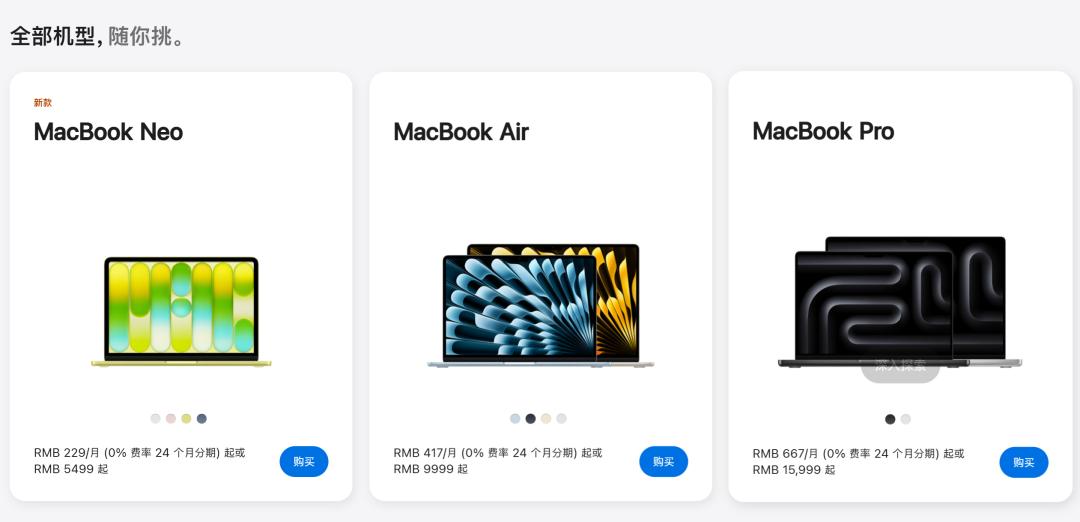
▲The latest prices of Mac series products (Source: Apple)
The direct reason for this round of price increases is that the expansion of AI data centers has driven up the demand for memory chips and storage, leading to a rapid increase in the cost of upstream components. Apple's price increases have taken effect globally. iPhone, Apple Watch, and AirPods are not affected for now. However, according to reports, Apple has hinted that it may adjust the prices of more products in the future.
Affected by the price increase news, as of the close of trading on June 25th, Eastern Time, Apple's stock price dropped by 6.12% in a single day, with a closing price of $275.15 (approximately RMB 1,871.02), marking the largest single - day decline since April 4th, 2025. After the close, its market value was approximately $4.04 trillion (approximately RMB 27.5 trillion), evaporating approximately $263.4 billion (approximately RMB 1.8 trillion) in one day.
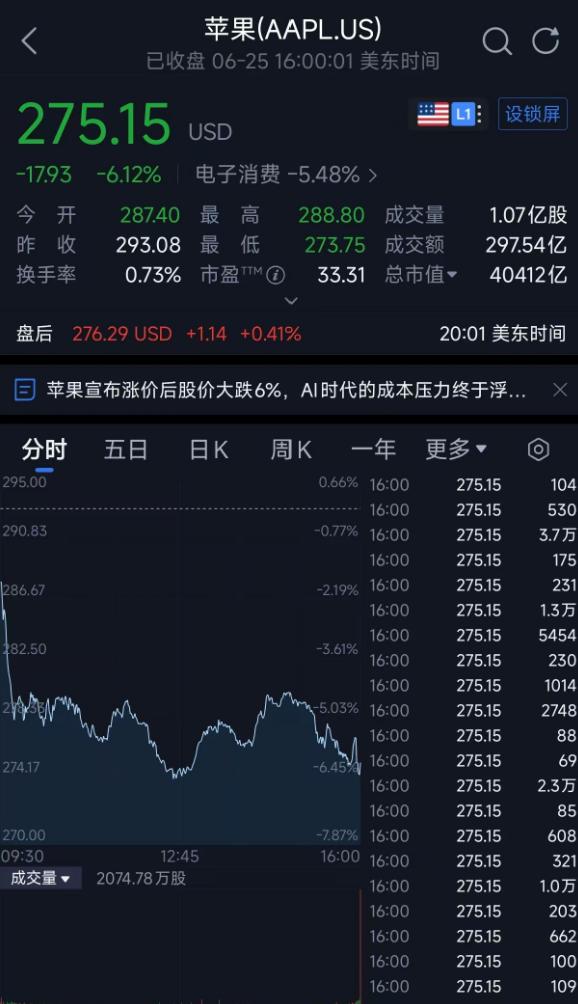
▲Apple's stock price dropped by 6.12% on June 25th, Eastern Time (Source: Tencent Stock Selector)
01. Multiple Apple products see price increases, Mac mini price up 33%
Apple's price increases this time cover multiple Mac products. The starting price of MacBook Neo has been raised from 4,599 yuan to 5,499 yuan, an increase of 900 yuan. The starting price of MacBook Air has been raised from 8,499 yuan to 9,999 yuan, an increase of 1,500 yuan. The starting price of MacBook Pro has been raised from 13,499 yuan to 15,999 yuan, an increase of 2,500 yuan.
The starting price of iMac has risen from 10,999 yuan to 12,499 yuan, an increase of 1,500 yuan. The starting price of Mac Studio has risen from 16,499 yuan to 19,999 yuan, an increase of 3,500 yuan. The starting price of Mac mini has risen from 4,499 yuan to 5,999 yuan, an increase of 1,500 yuan, with a price increase of 33.3%.
The entire iPad product line has also seen price increases, with all price increases exceeding 20%. The starting price of iPad Pro has risen from 8,999 yuan to 10,799 yuan, an increase of 1,800 yuan. The starting price of iPad Air has risen from 4,799 yuan to 5,999 yuan, an increase of 1,200 yuan. The starting price of iPad mini has risen from 3,999 yuan to 4,799 yuan, an increase of 800 yuan. The starting price of the basic iPad has risen from 2,999 yuan to 3,799 yuan, an increase of 800 yuan.
Apple's home devices have also seen price adjustments. The current price of HomePod mini is 999 yuan, an increase of 250 yuan compared to the previous 749 yuan. The current price of HomePod is 2,699 yuan, an increase of 400 yuan compared to the previous 2,299 yuan. In addition, the starting price of Apple's Vision Pro headset has been raised from 29,999 yuan to 31,999 yuan, an increase of 2,000 yuan.
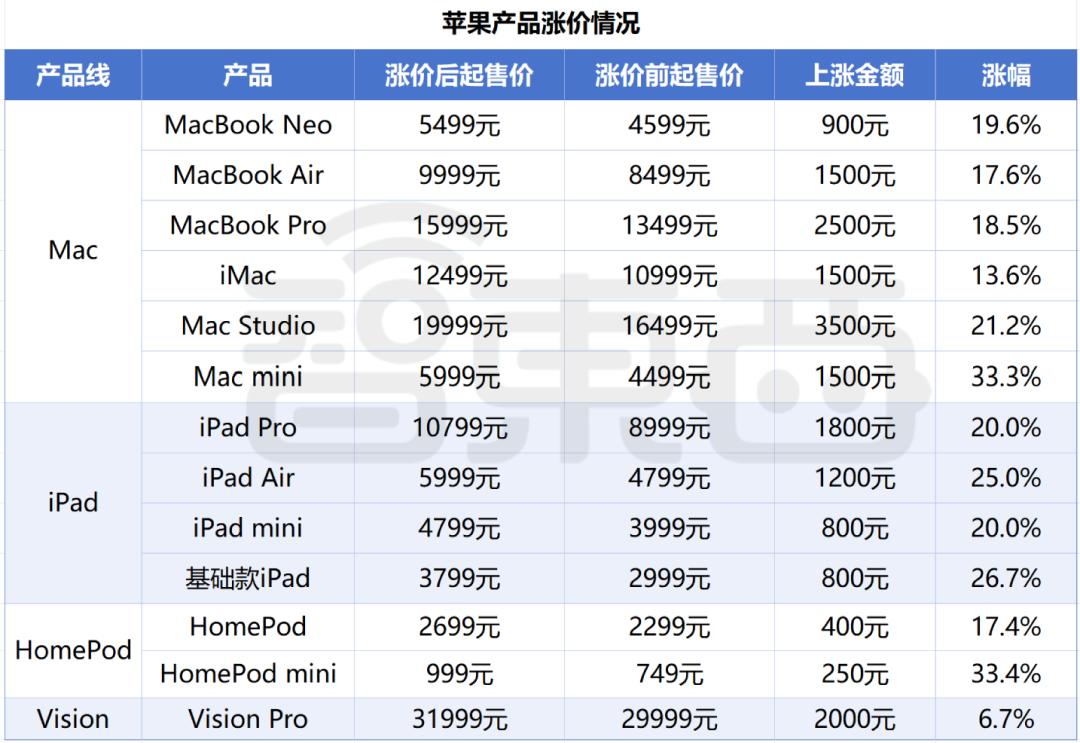
▲Price increases for multiple Apple products (Chart by Zhidx)
This kind of large - scale price increase is not common in Apple's history. Apple has raised the price of single products in the past, but rarely covered multiple product categories at the same time. In March this year, Apple raised the prices when updating the configurations of MacBook Air and MacBook Pro to partially offset the cost pressure. According to reports, Apple said that it knows this is not good news and is working hard to find solutions.
02. Memory cost pressure continues to intensify, iPhone may be the next target for price increases
At the earnings call for Apple's second fiscal quarter of 2026 at the end of April, Apple executives had already warned that the pressure on memory costs will continue to increase. Tim Cook said at the call that memory costs will rise significantly in the second quarter and will continue to affect Apple's business thereafter. The relevant shortages have affected the supply of some products, and many Macs have experienced supply limitations and shipping delays, and the limitations may last for several months.
This shortage has also affected Apple's new product launch schedule, including key products such as the new Mac Studio. Compared with Mac, iPhone is less affected by memory issues, but it also faces a tight supply of main device processors.
Apple is expected to release new iPhones in September, including a foldable model with a possible price of over $2,000 (approximately RMB 13,600), as well as iPhone 18 Pro and iPhone 18 Pro Max with more expensive camera components. These changes may drive up the prices.
The media believes that Apple may raise the price of iPhone in the future, mainly targeting Pro models with relatively low price sensitivity of demand. If the price of Pro models is increased by $100 (approximately RMB 680), Apple can offset about 78% of the new costs.
03. Conclusion: The cost pressure of AI infrastructure expansion begins to be transmitted to consumer electronics terminals
The core background of Apple's price increase this time is that the expansion of AI data centers has driven up the demand for memory and storage. In the past, such cost changes mainly remained in the supply chain and data center markets. However, Apple's large - scale price increase of consumer electronics products such as Mac and iPad means that the shortage of upstream components is more directly affecting the terminal pricing.
For Apple, the next challenge is not only how to stabilize the supply but also how to find a new balance among cost increases, product upgrades, and consumers' price acceptance. If the supply pressure of storage and processors continues into the autumn new product cycle, whether iPhone can maintain its original pricing will also become a key factor for the outside world to observe Apple's profit margin and demand resilience.
This article is from the WeChat official account “Zhidx” (ID: zhidxcom), written by Yang Jingli, and is published by 36Kr with authorization.