Dai Zonghong and His "Industrial World Model": One Person, Two Weeks, Completing the Customized "Grunt Work" That Would Normally Require a Team of 100
Text | Wang Xinyi
Editor | Zhou Xinyu
Half a year ago, when we first had a conversation with Dai Zonghong, the founder and CEO of Jidian Origin, this AI company that entered the B - end customized market against the trend had just advanced 7 or 8 projects. The most common voices he received from the outside world were doubts: "The story is not exciting enough" and "Customization is all hard work."
Half a year later, Jidian's response to the skeptical voices is tens of millions of yuan in hand orders.
Dai Zonghong revealed to "Intelligent Emergence" that the number of orders of Jidian Origin has doubled , and the contract value of orders has increased by an order of magnitude compared with half a year ago. The AI solutions have been implemented in more than 10 industries such as metallurgy, chemical industry, precision manufacturing, semiconductors, and textiles.
Along with the orders, Jidian Origin completed 3 rounds of financing within half a year, with a financing amount of hundreds of millions of yuan. "Intelligent Emergence" exclusively learned that Guoke Investment, Electric Control Industrial Investment, Shanghai Semiconductor Industrial Investment, Jiantou Investment, Xinheda, Chonglin Capital, and Hardcore Nut Capital have placed bets on the development of Jidian Origin.
Dai Zonghong is a "veteran" in the AI To B field. He was a co - founder of Lingyi Wanwu, one of the "Six AI Tigers", and previously served as the AI CTO of Huawei Cloud, having implemented hundreds of customized projects.
He once told "Intelligent Emergence" that the so - called "customization" is to artificially model the Know - How of enterprises precipitated in experts and business data into a set of workflows.
Sorting out complex data and knowledge is exactly where the traditional customization is "dirty" and "tiring". The leap in the reasoning ability of large models has allowed Dai Zonghong to see the opportunity to change the customization paradigm.
What Jidian Origin is doing now is to hand over the traditional enterprise customization services that rely heavily on manpower and long delivery time to an AI system.
The final achievable effect is: to turn the traditional customized cases that require hundreds of people on - site and take several months into projects that can be controlled by a single person and delivered in about 2 weeks. At the same time, the delivery results can exceed those of traditional large - factory teams.
Create an "Industrial World Model" for Business
After investigating more than a hundred enterprises, Dai Zonghong found that traditional manufacturing enterprises are not concerned about whether they need an office tool to improve the efficiency of white - collar workers, but more about the indicators that can be truly achieved in the production process, such as the yield rate, production capacity, inventory, and supply chain.
For example, in the non - ferrous metal industry, the biggest pain point for enterprises is how to effectively expand production capacity while ensuring stable and safe production. This is because the benefits brought by the increase in production capacity far exceed the savings from simply reducing costs.
The underlying demand is that enterprises need a "brain" that can iterate based on business data, which can refer to the business indicators put forward by enterprises and provide customized optimization solutions that enterprises can directly adopt in the real production process.
With the improvement of the reasoning ability of large language models, Dai Zonghong believes that the time has come to change the traditional customization process: Let AI directly replace the customized expert team and provide accurate solutions for front - line workers according to the business indicators given by enterprises.
In essence, the production and manufacturing links in traditional manufacturing can be simply separated into the questions of "what to use" and "how to do". No matter how complex the production process is, it can be disassembled into several controllable simple modules for large models to learn.
Traditional customized services rely on expert experience for modeling, which consumes a lot of manpower and time and is difficult to respond to the overall optimization and flexible needs of enterprises. In Dai Zonghong's view, the learning and reasoning abilities of large models can precisely solve the problems of difficult modeling and low efficiency.
Another advantage of using models to replace experts is that it can dig out every potential optimization point in the production link, rather than just conducting single - point optimization for a certain link.
Therefore, Jidian Origin has self - developed an industrial AI operating system called the "Full - factor Large Model" as the central brain to guide enterprise production operations. Its operation logic includes three steps:
Learning: Using the enterprise's original business data, conduct full - factor learning of the business model and establish a digital twin model that can reflect the real production process.
This model is the underlying architecture of the entire system. It can be continuously updated with the injection of new data later and can also accurately track information and filter out the noise of unreliable data and missing data. This is because the model can dig out the internal relationships between data and focus on the data that has a greater impact on key production indicators.
Optimization Search: With the continuous improvement of enterprise data and the model's own reinforcement learning ability, the system continuously conducts deductions to find the optimal solution in the production process.
Delivery: Directly face front - line workers and deliver an App that can interact with the AI system. The page and operation of this App are extremely simple. Workers only need to input the on - site environment to obtain the current optimal production plan. For example, in the metallurgical scenario, the system will tell workers how much material to stack, when to stack, and how to stack.
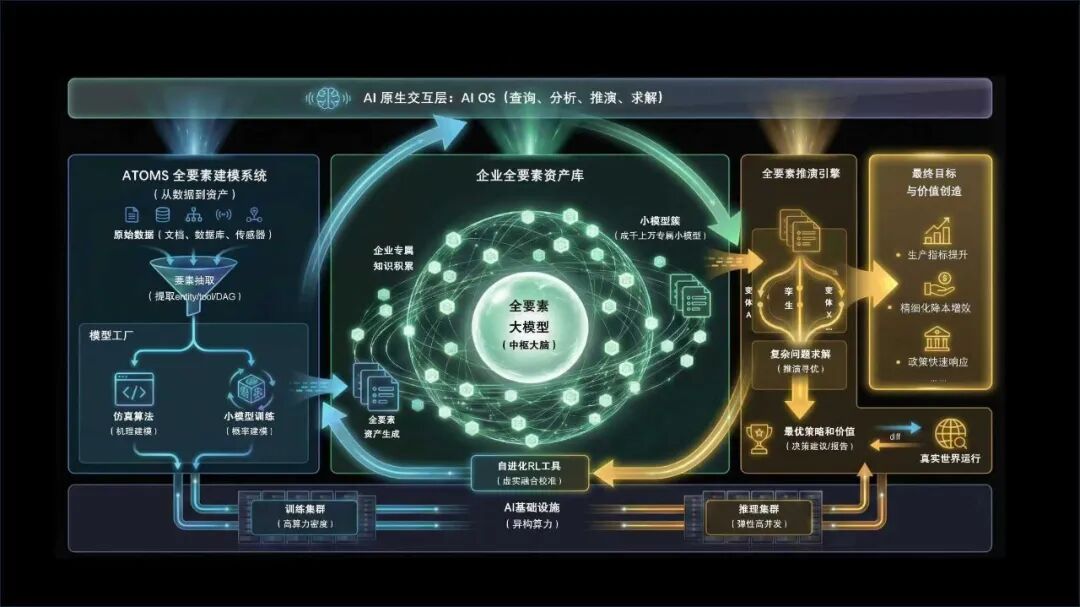
△Full - factor Large Model, Image Source: Enterprise Official
Dai Zonghong calls this set of systems an "Industrial World Model" for data and business.
Dai Zonghong believes that the business scenario is also a part of the world. In essence, people make business decisions based on business data to predict future business situations.
Therefore, they have built a world model in the industrial scenario, projecting the business scenario into the digital world, aiming to find out which factors are influencing each other and how they influence by learning the relevance between data, and then predict and guide the actual production optimization.
For example, on a real production line, this system can learn and analyze the enterprise's existing business data, sort out and reproduce the enterprise's production process, and generate a virtual twin "digital factory" model.
It can continuously conduct self - deductions, find a better actual operation plan according to the production indicators required by the production line, and front - line employees can directly carry out work with this set of plans.
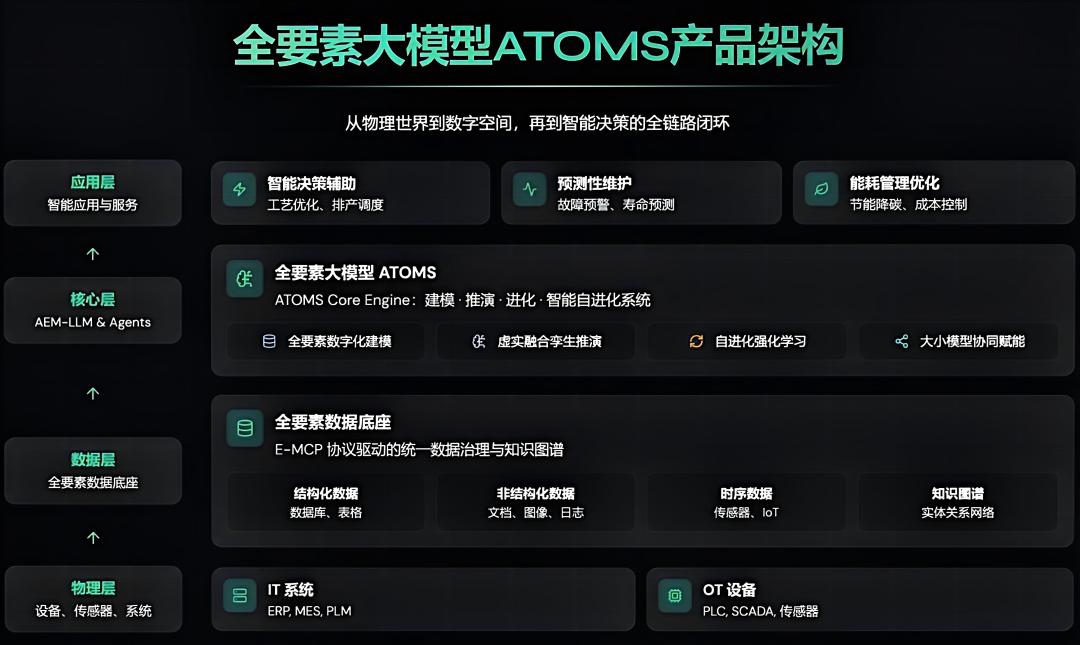
△Product Architecture of Jidian Origin, Image Source: Enterprise Official
Dai Zonghong summarizes their solution as "improving quality and efficiency" rather than "reducing staff and increasing efficiency". The advantage of this solution is that they do not create digital employees and do not use AI to replace the original manpower.
They found that when manufacturers propose to replace real people with AI projects, the actual acceptance of these traditional enterprises is relatively low. One reason is that the cost of manpower is much lower than that of AI projects, and the other is that they are more looking forward to short - term visible production capacity improvement rather than long - term manpower replacement.
Under the enterprise's existing production operation mode, Jidian Origin uses the solution design provided by the system to improve the "quality" indicators that enterprises really care about, such as output value and yield rate, and achieve the improvement of the efficiency of the entire production line.
Judging from the delivery results, in a certain process section, their system can help a certain key indicator increase by 2 - 3 times, and save costs of tens of millions of yuan annually.
Don't "Promise the Moon" to Customers, Directly Fulfill Optimization Indicators
For the first stop of implementation, Jidian Origin did not choose the more digitalized Internet industry, but first applied the AI system to so - called traditional industries such as metallurgy, chemical industry, precision manufacturing, semiconductors, and textiles.
In the public's view, the traditional industry is a difficult track. The story is not exciting enough, and the level of enterprises' management of their own data assets, that is, data governance, is not high enough.
Dai Zonghong gave an answer that goes against the stereotype. "In my opinion, industrial enterprises are actually easier to work with." His reason is very simple. The traditional industry is quite large and easy to form economies of scale.
Not choosing the Internet industry is because it is originally digital - native. The solutions in the Internet industry require more disruptive innovation, which puts higher requirements on customized manufacturers.
In the actual production process, industrial enterprises have a variety of original business data, such as Log (log files), Operation Log (operation logs), ERP (enterprise resource management data), and PRD (product requirement document data). These data are in different formats, full of noise, and even have incomplete parts, seemingly a hard nut to crack.
Dai Zonghong believes that this is not a problem. In fact, Jidian Origin doesn't need enterprises to conduct complex data governance by themselves.
"The data that has been governed is like chewed food, losing a lot of its original information." Dai Zonghong explained that the direct business data in the enterprise system retains more complete information in the production and manufacturing links, which is more helpful to them.
In the process of building the customer's "Industrial World Model", all the data used by Jidian Origin comes from the customer itself, without relying on Know - How experts. Therefore, this also makes this set of systems easy to migrate and implement across industries.
In the To B field with higher willingness to pay, Jidian Origin will inevitably face large enterprises and established industry solution providers. The team's customer acquisition strategy is: Write the business optimization indicators as a necessary condition for delivery directly in the contract.
Due to the uncontrollability of delivery results, most competitors dare not write the specific business indicators to be fulfilled directly into the contract. This leads to the fact that the business pain points of customers cannot be truly solved. In contrast, based on the "Full - factor Large Model", Jidian Origin can accurately provide business indicators that can be fulfilled and corresponding optimization solutions according to the customer's pain points.
At the same time, Jidian Origin has adopted a smart pricing model: Price according to the expected effect, rather than the actual delivery effect.
"If we price according to the actual delivery results , customers will try their best to lower the indicators before delivery." Dai Zonghong explained, "We hope to form a win - win relationship with customers, rather than confront each other for money." In order to make customers willing to pay for the expected effect, Jidian Origin will promise the "minimum delivery indicators" for improving business in the contract.
Although Jidian Origin has achieved good results in commercialization, Dai Zonghong frankly told us that the AI solutions of Jidian Origin are not generalized enough.
For example, currently, Jidian's customers are mainly leading enterprises with a high level of data governance. Therefore, the AI solutions have not been fully generalized to the production scenarios of small and medium - sized enterprises.
In order to improve the planning level and generalization ability of the system, Jidian Origin plans to start with 5 - 10 industries, implement well in a single industry, and finally generalize to more industries.
Dai Zonghong mentioned: "Next, we need to achieve end - to - end delivery across larger industries, at least develop two standardized products, and achieve actual delivery."

Welcome to communicate!
Scan the code to join the "Intelligent Emergence AI Communication Group"