I do housework for 8 hours every day to serve as fuel for robots
"In the future, robots will do all the work. We'll have to go out and find new jobs again." While waiting in line, my temporary partner, Li Chenchen, suddenly sighed as she watched the two people in the previous group.
The previous group was in front of a messy table, repeating a rather futuristic scene:
One person, wearing a helmet and gloves equipped with action cameras, dragged three long wires of different thicknesses behind. Moving slowly and bending slightly, they used one hand to pull a book to the edge of the table, picked it up, and put it on the storage rack. Then, they slowly stepped to the side and pushed a randomly placed pack of wet wipes next to the storage rack to straighten it.
At the other end of the long wires, their partner sat in front of a computer, staring at the sensor and camera images on the monitor. They moved the mouse, switched perspectives, and observed whether the movement trajectory of the mapped 3D model was consistent with that of the real person and whether the camera signal was stable...
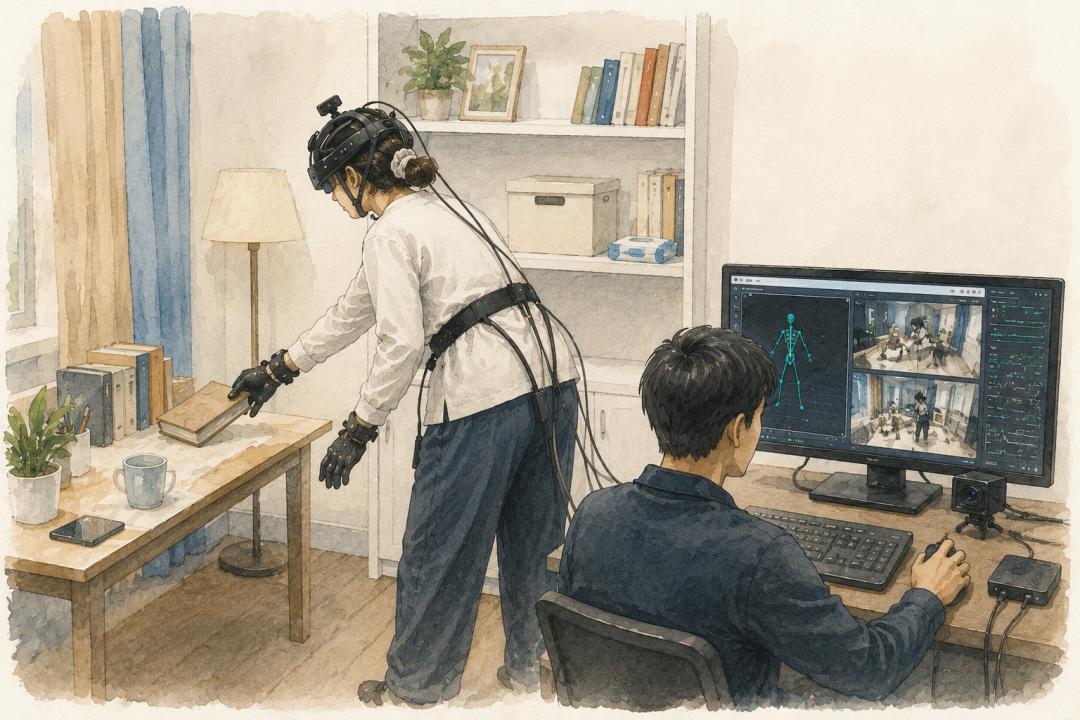
A group of data collectors are collecting data on desktop organization. Image source: AI-generated
They are teaching robots how to organize desktops, clean, make beds, or fold clothes. Every action a person takes - what to pick up first and then, what posture to use, where to grab the item, how much force to apply... will be recorded by cameras and sensors, converted into data, and used to train robot models after quality inspection and annotation.
Put simply, we are data collectors and also teachers for robots.
Just as human infants need adults to teach them how to walk and use chopsticks, robots also need a large amount of human action data to "feed" them. However, such data is very scarce on the Internet. For robots to learn to fold clothes, wipe tables, open doors, and organize books, someone has to do these actions repeatedly for them to watch.
Originally, the most beautiful vision for robots was to serve humans. But before they learn to serve, humans have to bend down and become their fuel.
In a homestay, I met laid-off programmers, former real estate agents with mortgages, and college students who came in groups... They put on helmets and gloves, repeated folding quilts, towels, and organizing desktops over and over again, disassembled their physical experiences into data, and sold them. They could earn about 6,000 yuan a month if they worked full-time.
This has briefly become their job, a job that no one knows how long it will last.
Li Chenchen is 36 years old this year. She has been working in IT operations for many years. After being laid off in 2024, she started a business but lost all her savings and even owed tens of thousands of yuan. Looking at the person slowly organizing the desktop in the previous group, she seemed to see a metaphor - when robots learn all these things, what can humans do?
A great sense of powerlessness swept through this space. People here may all hope that day doesn't come too soon.
Acting like a robot
One afternoon in June, I spent half an hour applying for nearly a dozen robot data collection positions on recruitment websites.
Soon, four companies contacted me. Three of them confirmed an online interview for the next day, and one of them was a robot company valued at tens of billions of yuan. But only this company recruited full-time employees and would pay the "five social insurances and one housing fund" through a third-party labor service company. The other two were "outsourcing" companies, and later I found that they both served the same data collection company.
In fact, the proportion of companies that pay the "five social insurances and one housing fund" is extremely low. Most of these robot data collection positions are circulated through part-time channels. Generally, it's 200 yuan a day for an eight-hour work shift. The night shift pays 50 yuan more per day than the day shift because of the inverted work schedule. The salary can be paid weekly or monthly. If you work for too short a time, a part of your salary may be deducted.
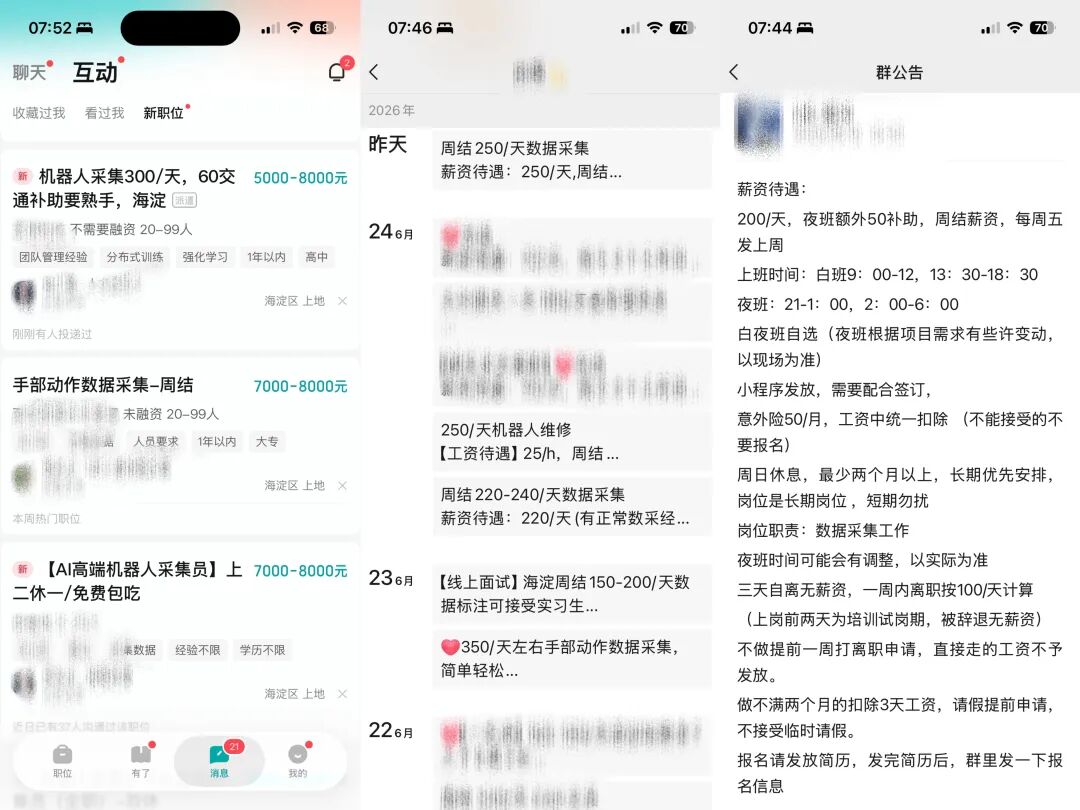
Recruitment information for robot data collection positions. Image source: Screenshot
Becoming a robot data collector is not difficult. Submitting a resume, being pulled into a recruitment group, having an online interview, and a trial on-site job - the whole process can be completed within 24 hours at the fastest. I finally participated in online interviews with two companies. I was only asked about my height and weight and passed both interviews. Then I went to the company that didn't require full-time work for a trial job.
This position hardly considers education and experience. The entry threshold ultimately boils down to physical fitness.
More than 30 people participated in the same video group interview with me.
A crowdsourced food delivery rider was very enthusiastic. His round and chubby face was tanned black, and he made a high-pitched self-introduction. He said he used to be a programmer. After being laid off, he started delivering food, but he still wanted to find a stable job. He wasn't sure what the position was called. After thinking for a long time, he said he was here to apply for a "claw machine" job. The interviewer calmly corrected him, "It's robot data collection."
A fresh graduate reported her height and weight. She was relatively petite. The interviewer seemed a bit hesitant and asked her to stretch her palm in front of the camera. After looking, the interviewer said, "Come and try first."
Throughout the interview, only one applicant was rejected on the spot. The reason was that they were too obese to wear the data collection equipment.
For this newly emerging industry, there is no unified answer yet as to what the most ideal data collection paradigm is. Currently, the mainstream solutions can be roughly divided into three categories: real human data, simulated data, and real robot remote operation data.
Real robot remote operation data is obtained by people remotely operating or controlling robots through exoskeleton devices to complete tasks in a real environment. The sensors on the robots record the whole process synchronously. This type of data is closest to the actual working scenarios of robots in the future and is considered to have the highest value, but its cost is also the highest - equivalent to bearing the costs of both the robot itself and manual operation. Currently, it is mainly completed by robot manufacturers through their self-built collection systems.
Simulated data is generated in a virtual environment. It doesn't require a real venue or real people. The cost mainly comes from computing power, and it can be trained in parallel on a large scale. However, due to the gap between the virtual world and the real world, it's difficult to fully reproduce details such as materials, friction, and lighting. Robots trained with this data may not adapt well in the real world.
Real human data has two situations. One only collects videos of real human behavior, which has the lowest cost but provides relatively limited information. The other adds motion capture, sensor trajectories, etc. on the basis of videos, which can record more details and has a moderate price. It is currently the most cost-effective solution.
We applied for the real human data collection position. A set of real human data collection equipment mainly consists of a cycling helmet equipped with an action camera, two data collection gloves with built-in sensors, a hand action camera, multiple locators, and supporting software. In total, it costs about 100,000 yuan. The recruiter told us that this set of equipment is currently applying for a patent.
Before starting the formal work, three days of training and a trial job are required.
On the first day, the project manager and the team leader "pinched" everyone's hands one by one to check their hand conditions. The data collection gloves are one-size-fits-all. Fingers that are too long, too short, too fat, or too soft won't work. More than forty trial job applicants sat in a row, putting their hands in front of them waiting to be checked. After the check, four or five people left the scene.
Li Chenchen was also on the verge of being eliminated. Her little finger was a bit short. After putting on the gloves, the sensors wrinkled at the knuckle position, and the software couldn't accurately restore the finger joint movements. She looked up at the team leader with wide eyes and pleaded to be given another chance. The team leader nodded.
But the fingers were just the first hurdle.
On the second day, the practical operation began, and the number of people was halved. Li Chenchen and I were grouped together. She debugged the software, and I wore the equipment. First, I put on the helmet and made sure it was firmly fixed. Then I put on a pair of disposable gloves to prevent sweating, followed by the data collection gloves with built-in sensors. Finally, I put on a pair of knitted gloves on the outside to isolate signal interference. Three long data cables extended from the gloves and the helmet and were fixed to my waist with an elastic band.
Next, I needed to hold my hands flat in front of my chest and stay still, waiting for the software to calibrate.
Li Chenchen sat in front of the computer, constantly adjusting the parameters of the virtual hand model on the screen. The team leader sat beside her to guide. Ten minutes passed, and the model hand still wasn't adjusted to the right position. The team leader got a bit impatient, took the mouse directly, clicked a few times, and said, "That's it. Change people. Next."
Li Chenchen got up to help me take off the equipment. It wasn't hot that day, and the air conditioner was on in the room, but there was already a thin layer of sweat on her forehead. "I can't learn it," she whispered.
On the third day of the trial job, Li Chenchen didn't show up. The team leader arranged a new partner for me, a fresh graduate majoring in nursing.
On this day, the work location was arranged in a homestay with two bedrooms, one living room, one kitchen, and one bathroom. My partner and I were in the master bedroom, and our task was to make the bed and fold the towels. Another group of people were collecting data on desktop organization in the living room. Some other colleagues were arranged to work in scenarios such as a board game hall and the kitchen - where to go and what to do specifically depend on the data requirements of the robot company.
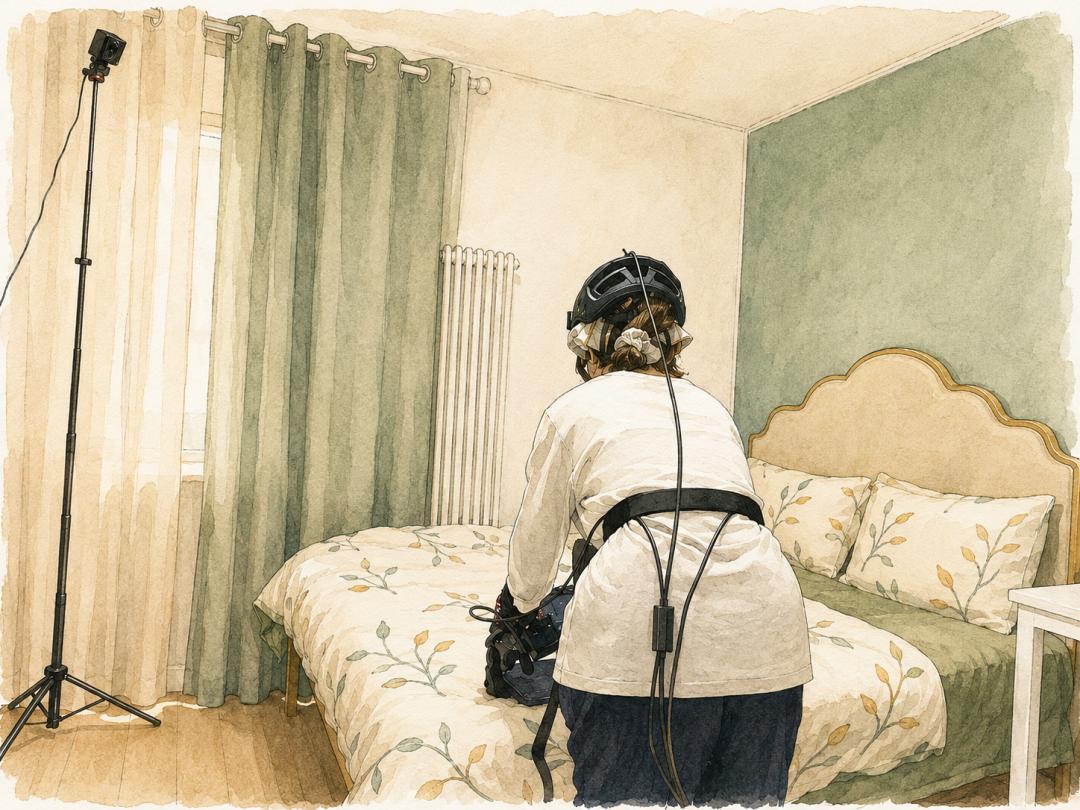
A data collector at work. Image source: AI-generated
We were required to act like robots - slowly and with small finger movements. This was a process of going against our instincts.
At first, I tried to complete the tasks as efficiently as I usually do when doing housework. Bending down, picking up the pillow, and putting it aside, the team leader said, "It's too fast. The video is all blurry. The sensors won't be able to keep up later." I consciously slowed down, and the team leader said again, "It's too stiff. Be more natural. Just move slowly, but act like a human."
So, I had to tense the muscles in my waist and hips, pick up the towel, unfold it, flatten it, fold it, and press it firmly. I also pulled the quilt flat, tucked in the corners, and smoothed out the wrinkles. Every action was as slow, complete, and continuous as possible.
"Don't swing the towel or shake the quilt," the team leader added. Since there are no cameras and sensors on the forearms, robots can't understand or keep up with such actions, so they are all prohibited.
We were also required to flexibly change the positions of the items and the actions of organizing them. Sometimes the towel was on top of the quilt, and sometimes it was sandwiched in the gap between the pillows. Sometimes we had to pick up one corner of the pillow with one hand, and sometimes we had to pick up the whole pillow with two hands. This was to enrich the types of data.
Before starting work, the team leader told us that the work location was in the homestay, so it was very convenient to go to the toilet. But in fact, it usually takes at least fifteen minutes to put on and take off the equipment and debug it. Going to the toilet once would waste nearly half an hour for two people. And missing even one minute of data collection may affect the final performance appraisal - there is no penalty for collecting too little data, but a 50-yuan bonus will be given only if the effective data collected per day reaches 5 hours, or 18,000 seconds.
Time here is calculated in seconds. There are 86,400 seconds in a day, and an 8-hour work shift is 28,800 seconds. As a novice, we need to collect about 9,000 seconds of effective data per day. But after wearing and debugging the equipment for more than 1,000 seconds, I already felt tired.
To prevent the head camera from shaking during my movements, I could only tighten the adjustment strap of the helmet as much as possible. This made the helmet feel like the golden hoop on Sun Wukong's head, tightly pressing on my head. The disposable gloves used to prevent sweating, after being wrapped layer by layer, created a "microclimate" of high temperature and humidity. After just one round of data collection, which was only more than 2,000 seconds, when I took off the gloves, both the gloves and my hands were wet and wrinkled.
In the evening, I couldn't remember how many times I had folded the quilt and towel. My shoulders and neck were sore because of the weight of the helmet, and my waist was a bit stiff from bending over for a long time. Before the robots learn to work like me, I've already become like them.
Who is buying and selling the fuel?
On the day of the trial job, the equipment that was applying for a patent almost kept having problems. Sometimes the locators kept disconnecting, and sometimes the sensors were deformed and couldn't be calibrated. Different hand shapes also caused deviations in the mapping effect.
An operation and maintenance staff member rushed back and forth between several buildings, trying different solutions to restart and debug the equipment. The sweat on his forehead never dried. Since the equipment was newly developed and there was no standard operating procedure, it could only be adjusted manually. He told me that he was still doing video editing half a month ago, and he learned the knowledge of repairing the equipment here on the spot.
"It's been two hours, and the data collection gloves still haven't connected," a team member in the next group said helplessly. He stood there with his hands up, cooperating with the debugging. When his shoulders got sore, he would move them a little and then continue to hold the position and wait. During the 8-hour workday that day, we spent nearly half of the time on equipment debugging.
Everyone hoped that the equipment would return to normal as soon as possible. There were only 24 sets of equipment here, and they were the most expensive "assets" in the whole space. To make the most efficient use of these equipment, the company arranged day and night shifts. Each set of equipment was used by 4 collectors in rotation. Every minute the equipment was idle meant one minute less of data output.
In the embodied intelligence industry, such data with visual and sensor information, which is operated by real people, is in high demand but short in supply. According to a report by The Paper, currently, the overall pricing range of embodied intelligence data is between 200 and 500 yuan per hour. Some real robot data collected through actual operations in real scenarios can cost up to 1,000 yuan per hour. Theoretically, a group of robot data collectors can sell their 8-hour effective data output per day for up to 1,600 to 8,000 yuan.
But the word "effective" is like a sieve for the data. During an 8-hour shift, if the video footage is lost, the movement route is designed unreasonably, the operations are repeated, or the camera captures a human face, it means the data is invalid