Theme Roundtable: We Will Always Praise Adventure - Earlier, Smaller, More Daring | 36Kr WAVES 2026 New Waves
In 2026, the waves in the venture capital circle are surging once again: AI has moved from a technological concept into the deep waters of the industry, and hard - tech entrepreneurship has transformed from a "niche track" into a "mainstream consensus". Young entrepreneurs are using code and their hands to redefine the future coordinates of Chinese innovation.
Every year, the WAVES Conference hosted by 36Kr · AnYong is the annual vane of the Chinese venture capital circle. This year's WAVES 2026, themed "This Summer", was held at Liangcang Xinzao Creative Park in Panyu, Guangzhou. Over two days, we gathered top - tier investors, industry leaders, and emerging entrepreneurs. Through 14 in - depth round - tables and dozens of independent speeches, we dissected the underlying logic of core tracks such as AI, hard tech, going global, and healthcare, and witnessed how the perseverance of "the few" converged into a wave that could change the industry.
The following is the content of the dialogue, compiled and edited by 36Kr:
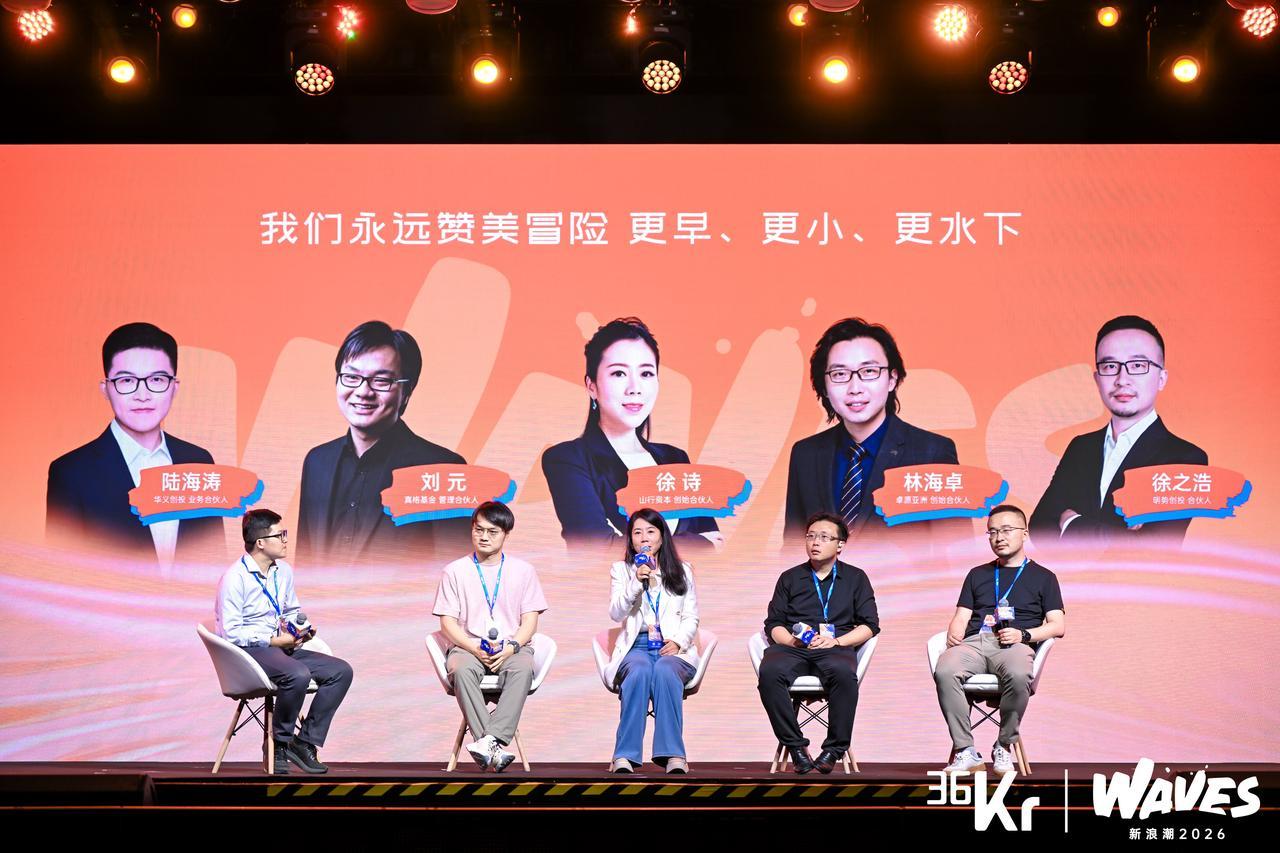
Lu Haitao | Business Partner of Huayi Venture Capital (Host)
Liu Yuan | Managing Partner of ZhenFund
Xu Shi | Founding Partner of Mountain Capital
Lin Haizhuo | Founding Partner of Zhuoyuan Asia
Xu Zhihao | Partner of MingShi Venture Capital
Lu Haitao: Hello, everyone! I'm very glad to be invited by 36Kr to host this round - table, and I'm also very happy to discuss a great topic with all the big names here, which is "We Always Praise Adventure: How to Invest in Earlier, Smaller, and More Under - the - Radar Projects". First, please ask each guest to briefly introduce the institution they belong to.
Liu Yuan: Hello, everyone. My name is Liu Yuan, and I'm from ZhenFund. ZhenFund is an angel investment institution headquartered in Beijing, founded at the end of 2011. The most prominent feature or differentiation, the core characteristic, and the most obvious difference compared with other institutions is that we have been consistently investing in early - stage angel - round projects for more than a decade. For the vast majority of invested companies, ZhenFund is the first institutional investor they receive.
Secondly, in terms of investment themes, ZhenFund doesn't have much top - level direction design, such as specific tracks. Our investment logic is more based on the judgment of the entrepreneurial team itself. Therefore, we cover a very wide range of industries, and it's possible to invest in almost every field. In the past decade, the projects we've invested in include Xiaohongshu in the mobile - internet era, KIMI, Manus, and Typeless in the AI era, and recently, Muxi, which went public in the chip field. ZhenFund was basically one of the earliest investors in these projects.
Xu Shi: I'm Xu Shi from Mountain Capital. Mountain Capital is an early - stage VC institution founded 11 years ago. Our positioning is the "Founders Fund" in China. My founding partner and I are deeply rooted in the industry, and our partner team has rich practical business experience in managing large teams.
In the mobile - internet era, we heavily invested in several companies that led product definition and paradigm changes, such as Li Auto and RELX. However, in today's epic - scale AI technology cycle, I believe this is the most important historical opportunity in the next three years. We have completed our layout in the cloud - side and edge - side chip fields, and we also highly value the great potential of Chinese entrepreneurs in building global brands and platforms (for example, we invested in the cross - border brand Halara). I'm really looking forward to having in - depth exchanges with all my peers today.
Lin Haizhuo: Hello, everyone. We are Zhuoyuan Asia, and I'm Lin Haizhuo, the founding partner of Zhuoyuan Asia. We were founded in 2016 at the FIT Laboratory near the east gate of Tsinghua University. Several of our founding partners are from the Department of Computer Science at Tsinghua University. From the very beginning, we have been relatively focused on investments in the field of artificial intelligence. Our investment characteristics range from the angel round to the Pre - IPO round. We are used to the full - cycle investment model. For example, in the case of Qingwei Intelligence, we are the only institution that has invested in it for 8 consecutive rounds. Jiliu Technology is also a very popular company recently and is now in the IPO process. We have invested in it for 9 consecutive rounds. We have also invested in Shengshu Technology for 8 consecutive rounds. In addition, companies like Zhongke Fifth Century, Zhongke Times, and Jiuzhang Yunji are mainly the result of our investment layout around the upstream and downstream of the artificial - intelligence and semiconductor industrial chains.
Xu Zhihao: Hello, everyone. I'm Xu Zhihao from MingShi Venture Capital. Our institution was founded in 2014. The characteristic of our institution is that we are relatively focused on the technology field. Since its establishment, we invested in Li Auto at the earliest stage and also invested in some companies around the intelligent - mobility and autonomous - driving industrial chains. In the AI era, we invested in MiniMax at the end of 2021 and the beginning of 2022. Later, we successively invested in many companies in the underlying AI data centers, AI applications, and embodied intelligence. Many of these companies are also developing very well.
Lu Haitao: Let's get straight to the point at the beginning. First, I want to look at a set of data. Less than 2% of the funds in the entire equity market are invested in our early - stage angel - round projects. To be precise, only 1.9% of the funds are invested in these projects. At the same time, when we analyze the underlying capital - contribution structure, about 89% of the funds come from state - owned LPs. I first want to discuss with all the guests how you view the fact that angel investments only account for 1.9% of the funds in all equities. Please let Mr. Xu share his views first.
Xu Zhihao: First of all, I think it's quite normal. In the early stage, people usually only have ideas, and they are still in the idea - verification stage. They don't necessarily need to spend a huge amount of money at the beginning. And to be honest, as Mr. Huang said within our institution, good founders can't be created by just throwing money at them. For example, if we suddenly add 1 trillion yuan to the Chinese angel - investment market, it may not be able to produce proportionally more excellent founders.
From the perspective of our own institution, we don't conduct large - scale, scatter - gun investments. Instead, we focus our limited resources on finding those truly promising founders, supporting them earlier, accompanying them in the long run, and continuously increasing our investment when they need it.
Lu Haitao: That means using our resources where they are most needed.
Xu Zhihao: Yes.
Lin Haizhuo: Actually, when we look at the venture - capital market data, we see a figure that may be mutually corroborative with what the host just mentioned. In the United States, the capital volume of the primary market and the secondary market is in a 4:6 ratio. Or we can say they are about the same. In China, the primary market is just a drop in the bucket compared with the secondary market, accounting for only about 8% - 10% of the total volume of the secondary market. In comparison, angel investments account for only about 1% of the entire primary market, which is still insufficient. In terms of early - stage investment, in the future, we still need to address the issue of how to define the rights and responsibilities when state - owned capital participates in the first two early rounds. Of course, since 2023 and 2024, the state has generally advocated investing early, investing in small projects, investing for the long term, and investing in hard tech. It has also loosened the restrictions on a lot of government funds and earmarked them for specific purposes. Due to the nature of the investment in the early - stage field, as our understanding of early - stage investment deepens and the restrictions are gradually relaxed, more and more funds will likely flow into the early - stage investment in the future.
Xu Shi: In fact, early - stage investments, including primary - market investments, only account for a very small single - digit percentage in the global asset management allocation. That's why I really like today's theme - "Always Praise Adventure". What we hope to invest in are those very few entrepreneurs who Dare to dream and can drive paradigm changes.
The current challenge lies in the misalignment of the technology cycle, the capital cycle, and the industry cycle. In the AI era, everyone can deeply feel the "space - time compression" - companies that used to take 3 to 5 years to grow now have their growth cycles compressed, quickly verifying PMF and widening the gap. The current reality for early - stage projects is that there is a lack of sufficient B - round and C - round investors in the market. If a project fails to seize the first window period in the first year and its valuation skyrockets later, investors will be forced to follow - up invest for three consecutive rounds, which puts great pressure on early - stage VCs.
In the past few years, the domestic US - dollar primary market has shrunk. Although the market has gradually recovered after the "DeepSeek Moment", the RMB market is still dominated by government - guided funds and other state - owned LPs. Due to the high requirement for the safety margin of this part of the funds (requiring "no losses, no deficits"), it poses a more stringent and critical challenge to VC investors: Not only do we need to invest early, but we also need to control risks and invest accurately. This is the reality that the industry must face at present.
Lu Haitao: Thank you, Mr. Xu.
Liu Yuan: We've always been doing angel investments. Early - stage investments are usually small amounts of money, so it's normal for them to account for 1% or 2%. As several guests mentioned earlier, for some of the best star projects, we invest for 8 or 9 consecutive rounds. By the 8th or 9th round, the capital volume is quite large.
ZhenFund had its own slogan many years ago, aiming to be the biggest small - fund in the universe. Actually, having a small capital volume is quite good because a small amount of money can achieve great things when investing, helping entrepreneurs lay the foundation. Once the company truly develops, it will naturally raise more funds later. So, 1% or 2% is not a big problem.
Lu Haitao: Our understanding is that the definitions of the seed round and the angel round are quite vague, especially in some popular tracks. Maybe in the seed round or the angel round, the eighth - round investment has already been locked in. The next question is for everyone to answer. This question is also quite interesting. When investing early and in small projects, especially in the technology field, there are often many technological routes. So, as early - stage investors, we often face the problem of how to choose among six or seven technological routes. I believe several guests here may have experienced situations where the route we invested in was bypassed. I'd like to invite the guests here to share if you've had such moments and how you dealt with the emotions in investment after investing in a project. Please let Mr. Liu from ZhenFund share first.
Liu Yuan: We've always taken the "team" as the most core investment criterion. Frankly speaking, we don't think we are particularly knowledgeable about technology, nor do we think we are the most forward - looking people. What we really hope to find are those founders who can quickly realize the changes, adjust their directions, and find new paths when the technological paradigm changes. From historical experience, many excellent entrepreneurs didn't start on the latest technological wave at the beginning. For example, we've invested in some entrepreneurs in the SaaS era and the mobile - internet era. As long as they still have strong combat capabilities, imagination, and adaptability, when new technological opportunities emerge, they may still be the first to embrace and apply the technology. The companies mentioned earlier are examples. For instance, the founder of Manus was engaged in a business in the SaaS - like era during his first entrepreneurship; the founder of Typeless initially developed ToB plug - in products. Another example is Momenta. When we invested in it ten years ago, it was also the first investment it received. At that time, there was no large - model concept like today, and there was no end - to - end technological route. The technological path at that time was completely different from today's. The best entrepreneurs are those who can react and act the fastest, capture changes acutely, and adjust themselves quickly. Technology will surely develop continuously, but the progress of technology is often driven by people. We hope to find those who can truly drive the changes.
Going back to the previous question, the entrepreneurs we invested in during the SaaS era and the mobile - internet era, as long as they can react fast enough, often still become the first to embrace and apply new technologies when they emerge. They will turn new technologies into their advantages, strengths, and levers, rather than becoming victims of the new paradigm. This is exactly the characteristic of such founders.
Lu Haitao: I'll summarize. The probability of the best founders being bypassed by technological routes is the lowest.
Liu Yuan: We believe that the most important indication of the so - called entrepreneurial spirit is the ability to find a way around obstacles. After setting a goal, even if the resources are insufficient, one should have the ability to solve problems. When facing changes and opportunities, one needs to have the keenest insight and the fastest execution ability. Therefore, the most important, core, and fundamental quality of an entrepreneur is the ability to "find a way around".
Lu Haitao: Please, Mr. Xu.
Xu Shi: For founders, rapid iteration to embrace paradigm changes is the only solution. But from the perspective of the fund, the prediction of technological routes must be done by track.
Taking the current World Model direction as an example, there are the VLA route, the WAM, and different latent world models. The technological routes are highly divergent, and data collection is the current core difficulty. Many valuations have reached the mid - to - late stage, and it's hard to say which single direction is the right one to bet on now.
However, for some tracks, end - game thinking is required. For example, in the past, in the field of autonomous driving, between the L2+ incremental approach and the direct leap to L4 driverless technology, we judged at that time that the pure L2 solution lacked barriers. Some companies that chose the L4 direction achieved exits in the secondary market, and some EV companies also chose to develop their own end - to - end autonomous driving. Another example is when we invested in Li Auto. It was during a round when its capital chain was extremely tight. The mainstream consensus at that time chose the pure - electric direction, and the extended - range hybrid route was not recognized by the market. However, during the three - year window of range anxiety, it actually met the needs of users, and giants like BYD also chose the hybrid route. This shows that technological choices need to be closely combined with the development stage of industrial technology to match the real needs of users.
In today's environment of technological explosion, VCs must stay vigilant: Which technological routes will be mercilessly swallowed up by underlying large models or super - giants in the future? Which can build real technological and user barriers? Although no one can guarantee that they will win in the end today, we will continue to screen those teams with strong vitality, fast iteration ability, and the highest possibility of surviving in the competition.
Lu Haitao: We still need to take risks when it's necessary.
Lin Haizhuo: I really agree with the views of the previous two guests. It may seem that venture capital investment has shown very positive changes in the past two years, but overall, for the vast majority of market - oriented institutions, including the work we do, there is a relatively key difference: whether the problem being solved is an academic research problem or a commercial problem. After all, there are many "funds" at the national level, such as the National Natural Science Foundation, and various academic - type funds, as well as academic research projects by the National Development and Reform Commission. To be frank, if it's purely exploratory and academic research, it may not be particularly suitable for venture - capital - type funds. Therefore, when it comes to technological routes and screening directions, we will consider the overall big proposition. For some projects that are still in the frontier exploration process, of course, this also has something to do with the nature of the LPs behind each company's fund. Some LPs have a higher acceptance level and may not be particularly focused on extremely forward - looking or exploratory directions.
In addition, within the broad