Earning 26,400 yuan net per second, more profitable than NVIDIA, do you believe in "the light"?
The memory chip industry has long been infamous for the "pork cycle."
When production capacity is tight, the prices of DRAM and NAND skyrocket, prompting manufacturers to expand production. Once the new production capacity is released, there is an oversupply, and prices start to plummet. After several cycles, memory manufacturers make profits for a few years and then suffer losses for a few years. It's difficult for anyone to break free from the cycle.
Now, the AI wave has arrived.
This fierce demand for computing power has not only elevated Jensen Huang to the altar but also rewritten the fate of memory manufacturers. Micron, an established memory manufacturer, has transformed into a money - printing machine with extremely high profit margins.
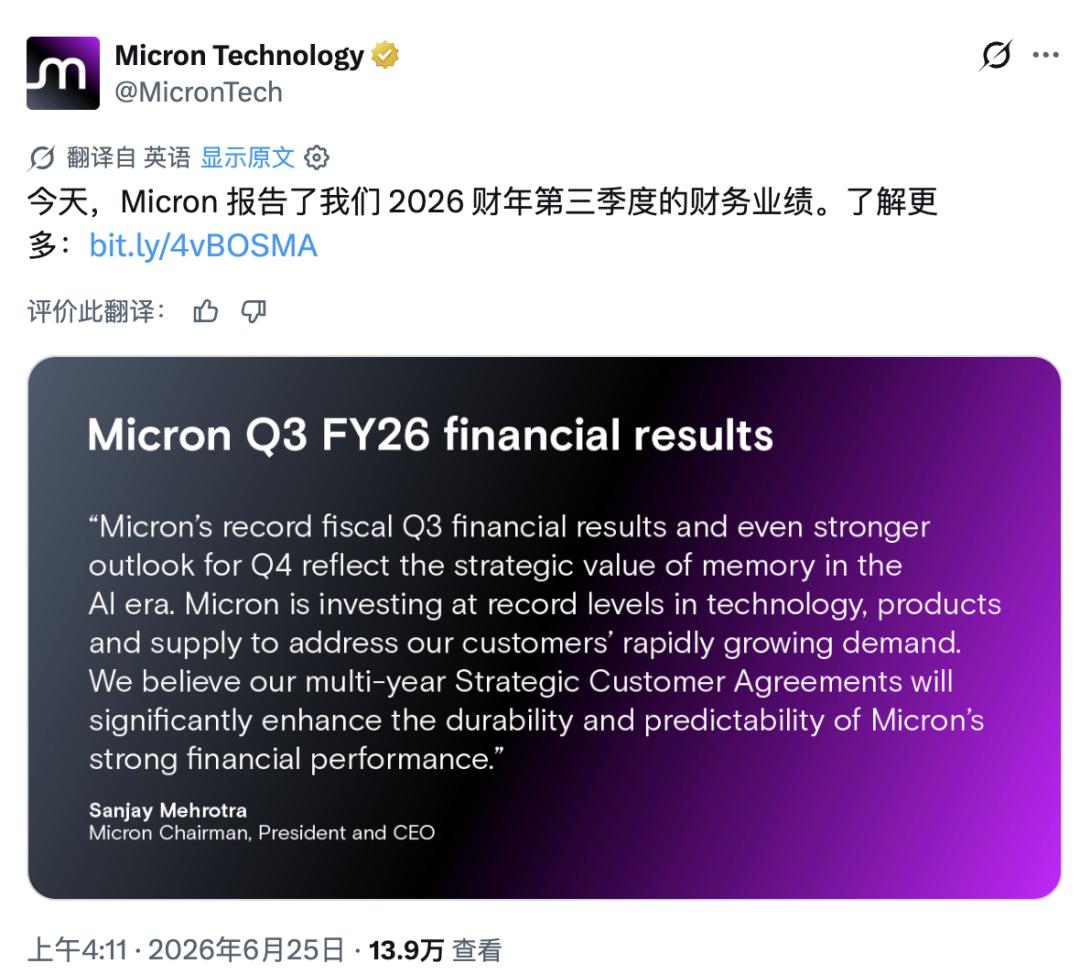
According to Micron's latest financial report released today, this 48 - year - old memory manufacturer achieved a net profit of $28.24 billion (equivalent to about 192 billion RMB) in a single quarter, compared with only $1.89 billion in the same period last year. After the release of the financial report, Micron's after - hours stock price soared nearly 16%, and its market value once reached about $13 trillion.
An industry that has been repeatedly affected by the cycle now seems to be on the side of the long - term trend for the first time.
How was the "King of Margin" Made?
Analyzing Micron's financial report, we'll see an astonishing figure: 84.9%, which is Micron's gross profit margin (Non - GAAP) this quarter.
What does this mean? Take several leading technology companies as examples: Meta, which focuses on social media, has a gross profit margin of 81.9%. NVIDIA, with a current market value close to $5 trillion, has a gross profit margin of 75%. Further down, Broadcom has a gross profit margin of 69.5%, Microsoft 67.6%, and Alphabet 62.4%.
A memory manufacturer has outperformed this group of companies.
What's even more striking is that even at the peak of NVIDIA's GPU popularity in early 2024 when GPUs were in short supply, its gross profit margin peak was only around 79%, 6 percentage points lower than Micron's current level.
Micron CFO Mark Murphy also clearly mentioned in the earnings call that this quarter's gross profit margin more than doubled compared to a year ago, setting a new record in the company's history. This figure was only 39% in the same period last year and 74.9% last quarter.
The revenue is also enviable.
In Micron's third fiscal quarter (ending on May 28), the revenue was $41.46 billion, and the net profit was $28.24 billion. (If the net profit figure doesn't mean much to you, you can think of it as a net profit of $26,400 per second.) Breaking down the revenue, DRAM contributed $31.3 billion, accounting for 76% of the total revenue, and NAND contributed $9.9 billion, accounting for 24%. Both are record highs.
Looking further into the details, all departments have also set new records:
The core data center business unit had a revenue of $11.521 billion with a gross profit margin of 87%. The cloud storage business unit had a revenue of $13.769 billion with a gross profit margin of 83%. The mobile and client business unit had a revenue of $11.524 billion with a gross profit margin of 87%. Even the automotive and embedded business unit achieved $4.6 billion in revenue with a gross profit margin of 79%.
The cash flow is also remarkable:
The operating cash flow was $25.4 billion, capital expenditure was $7.1 billion, and free cash flow was $18.3 billion - another quarterly record. At the end of the quarter, the company held $30.2 billion in cash and investments, with a net cash position of $24.4 billion.
This fiscal year, Micron was collectively upgraded by the three major rating agencies, with one of them upgrading it to BBB+. In Murphy's words, Micron's balance sheet has "never been so strong."
As for the next quarter, Micron predicts its revenue to be around $50 billion (±$1 billion), with the gross profit margin climbing to 86% and the adjusted EPS around $31, leading by a large margin.
More importantly, Micron has signed long - term "Strategic Customer Agreements" (SCA) with 16 major customers. The contract period is generally five years from 2026 to 2030, and three years for automotive customers. For the first time, there are prepaid deposits in the billions of dollars.
Among these 16 agreements, there are 4 super - large customers, 3 medium - sized customers, and the rest are small customers in the automotive industry. These agreements cover data centers, consumer electronics, and the automotive industry, accounting for about 20% of Micron's DRAM production capacity and one - third of its NAND production capacity.
Mehrotra said that once all the planned agreements are signed, it is expected that more than half of Micron's revenue will be covered by these long - term agreements.
The signed part (14 agreements) alone has locked in a minimum contract revenue (RPO) of about $100 billion, plus about $22 billion in deposits and financial commitments. Among them, about $18 billion is in real cash deposits, and the remaining about $4 billion is in letters of credit.
It should be noted that the memory manufacturing industry was previously known for its "boom - bust" cycles. Now, signing long - term agreements and receiving deposits is like turning a highly volatile cyclical business into a strategic infrastructure.
By the way, Micron also signed a supply agreement with AI lab Anthropic this week and participated in its Series H financing.
Manish Bhatia, the executive vice - president of Micron's global operations, said: NVIDIA had its AI moment with GPUs a few years ago, "and now, memory has never been such a valuable part of the computing stack as it is today."
Micron Thrives, Global Smartphone Manufacturers Struggle
HBM is high - bandwidth memory designed for AI GPUs and high - performance computing chips.
Ordinary DDR5 and LPDDR5X are more like general - purpose memory, serving mature markets such as servers, PCs, and smartphones. The core indicators are capacity, power consumption, cost, and stable supply. However, the logic of HBM is completely different. It aims to feed as much data as possible to the GPU in a unit of time.
The GPU is responsible for matrix operations, but model parameters, activation values, and intermediate results need to be transferred at high speed between the memory and the computing unit. Once the memory bandwidth is insufficient, even the most powerful GPU will have to wait for data, and the computing power utilization rate will be reduced.
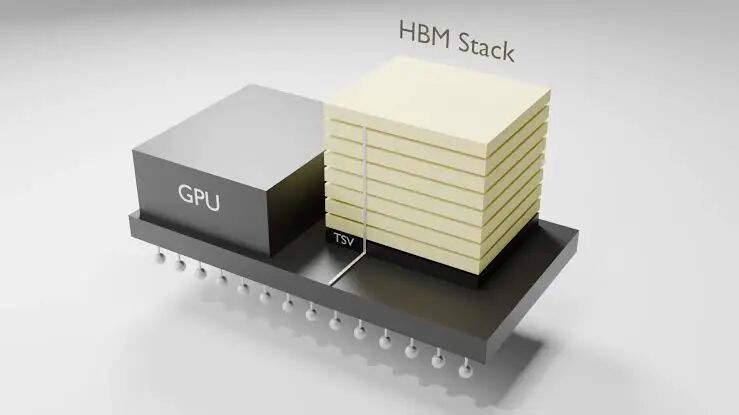
HBM is created by vertically stacking multiple layers of DRAM chips, connecting them with processes such as TSV silicon vias, and placing them on the same substrate as the GPU through advanced packaging. With a shorter distance and wider channels, the bandwidth is naturally much higher than that of traditional memory.
For AI chips, HBM has evolved from a supporting component to an integral part of the performance ceiling.
However, the drawbacks are obvious: HBM is expensive, difficult to manufacture, has a complex process, requires a very high yield rate, and consumes a large amount of wafer, packaging, and testing resources. To produce the same capacity of HBM, the resource consumption is much higher than that of ordinary DDR5 or LPDDR5X. Especially in the advanced packaging stage, it is one of the most constrained parts of the current AI chip supply chain.
Since AI giants are offering high prices and generous deposits, the advanced production lines of Samsung, SK Hynix, and Micron will naturally tilt towards HBM. As a result, the previously balanced or slightly oversupplied general - purpose memory market has suddenly faced a severe shortage, and prices have skyrocketed.
However, the scary thing about memory is that it is almost everywhere: in smartphones, PCs, servers, cars, game consoles, smartwatches, routers, security cameras...
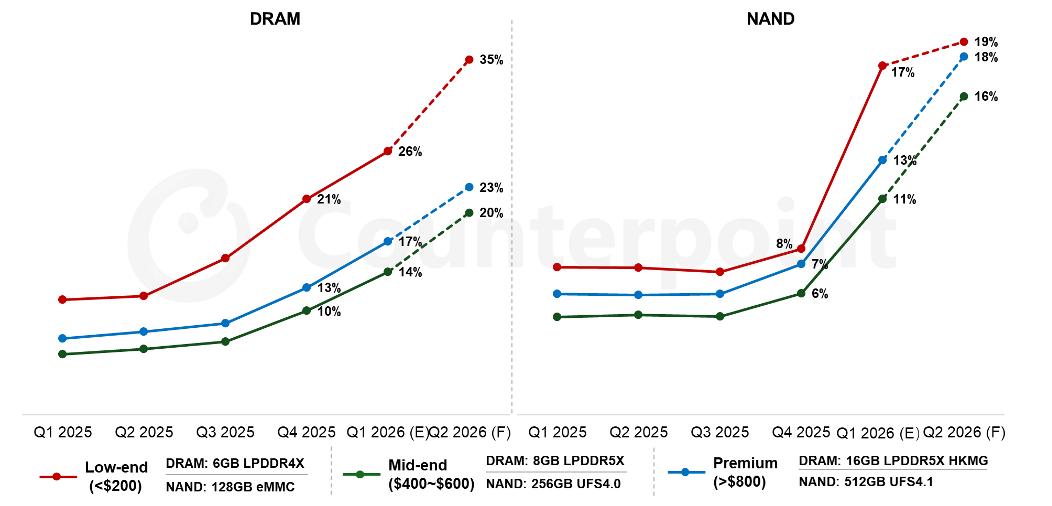
🔗 https://counterpointresearch.com/en/insights/Memory-Price-Surge-Triggers-Shifts-in-Smartphone-BOM-Structure | Image source: Counterpoint Research
Take smartphones, which have been hit the hardest. For a standard configuration of 8GB LPDDR5X + 256GB UFS 4.0, by the second quarter of 2026, memory and flash memory alone will account for nearly 40% of the total hardware cost of the phone (20% for DRAM + 16% for NAND).
The situation is even more extreme for flagship models: for a 16GB + 512GB phone, the cost of memory and flash memory alone will increase by $100 - $150 per unit.
MediaTek CEO Tsai Li - hsing helplessly said at ISSCC that memory has become the biggest performance bottleneck in system design. In some advanced XPU systems, its cost can account for about 50% of the total BOM.
The cost pressure has quickly affected sales.
Goldman Sachs has cut its forecast for global smartphone shipments in 2026 by 10%, to 1.14 billion units. IDC is even more pessimistic, directly warning of a 13% decline. According to Goldman Sachs' data, the mid - range market priced between $200 and $600 has been hit the hardest.
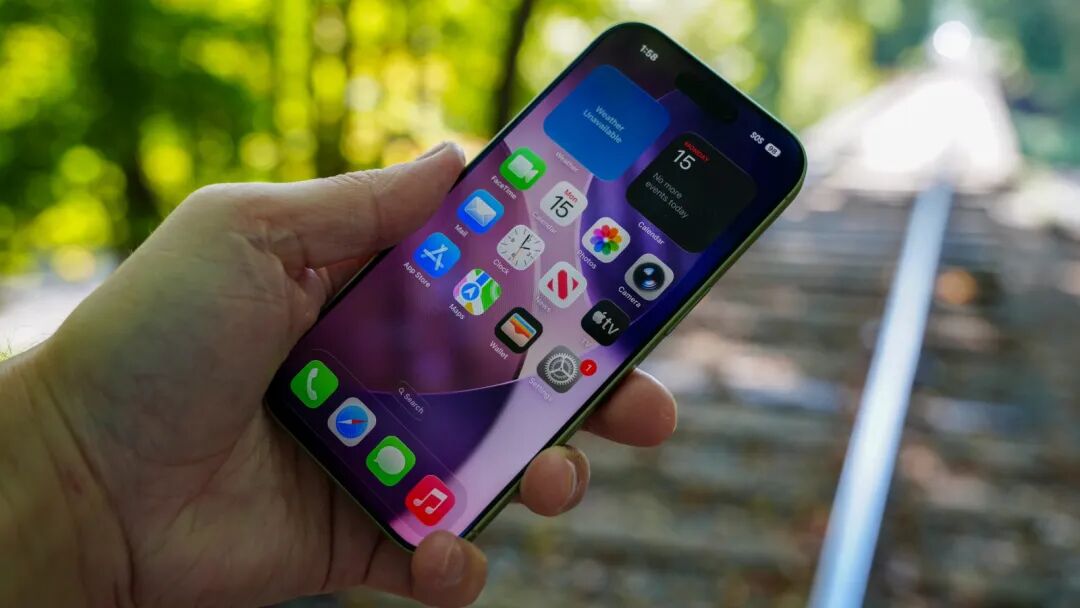
Domestic manufacturers have also started to "cut off their wrists to save themselves."
In March this year, OPPO, vivo, Xiaomi, and Honor conducted intensive internal coordination and carried out what analysts described as "the largest and most significant collective price increase in the past five years."
The "big - memory popularization storm," where 12GB was standard for mid - and low - end phones and "24GB + 1TB" was widely available in flagship models, has basically come to an end.
Manufacturers have also quietly phased out the highly publicized 16GB and 24GB large - capacity RAM versions and reverted to 12GB or even 8GB as the starting configuration.
The "killing line" of memory price increases in the smartphone market falls precisely in the price range of $200 - $350 (about 1500 - 2500 RMB). In this price range, even models known for their cost - effectiveness are facing significant profit considerations.
In sharp contrast, the quasi - flagship/high - end price range has sufficient brand premium and a relatively large BOM cost pool. Through improvements in comprehensive experiences such as imaging, texture, and system smoothness, it can to some extent cover up or absorb the increase in memory costs.
A Goldman Sachs report also confirms this trend. It is expected that by 2028, the sales of high - end smartphones priced over $600 will continue to grow at a compound annual growth rate of 5%, and their share of the total sales will increase significantly from 29% in 2025 to 34%.

However, even the leading manufacturers with the strongest pricing power are starting to feel the cost pressure under such structural changes. Recently, Tim Cook publicly complained in an interview with The Wall Street Journal: Unfortunately, price increases are inevitable. "We've been trying to protect our customers from price increases, but this situation can no longer be sustained." (Coincidentally, shortly after this article was published, Apple has just raised the prices of its Mac, iPad, and home devices due to the soaring costs of memory and storage chips.)
He also pointed out the absurdity - when consumers need memory the most, the supply inexplicably decreases, and original manufacturers are recklessly shifting the costs downstream.
This veteran who has worked at IBM, Compaq, and Apple for more than 40 years described the drastic fluctuations in commodity prices in the past six months as a "once - in - a - century flood" in his career.
Specifically for products, according to TechInsights' calculations, the procurement cost of the 12GB LPDDR5X memory in the iPhone 18 Pro will soar from $39 in the previous generation to $145, and the cost of the 256GB NAND will increase from $13 to $51.
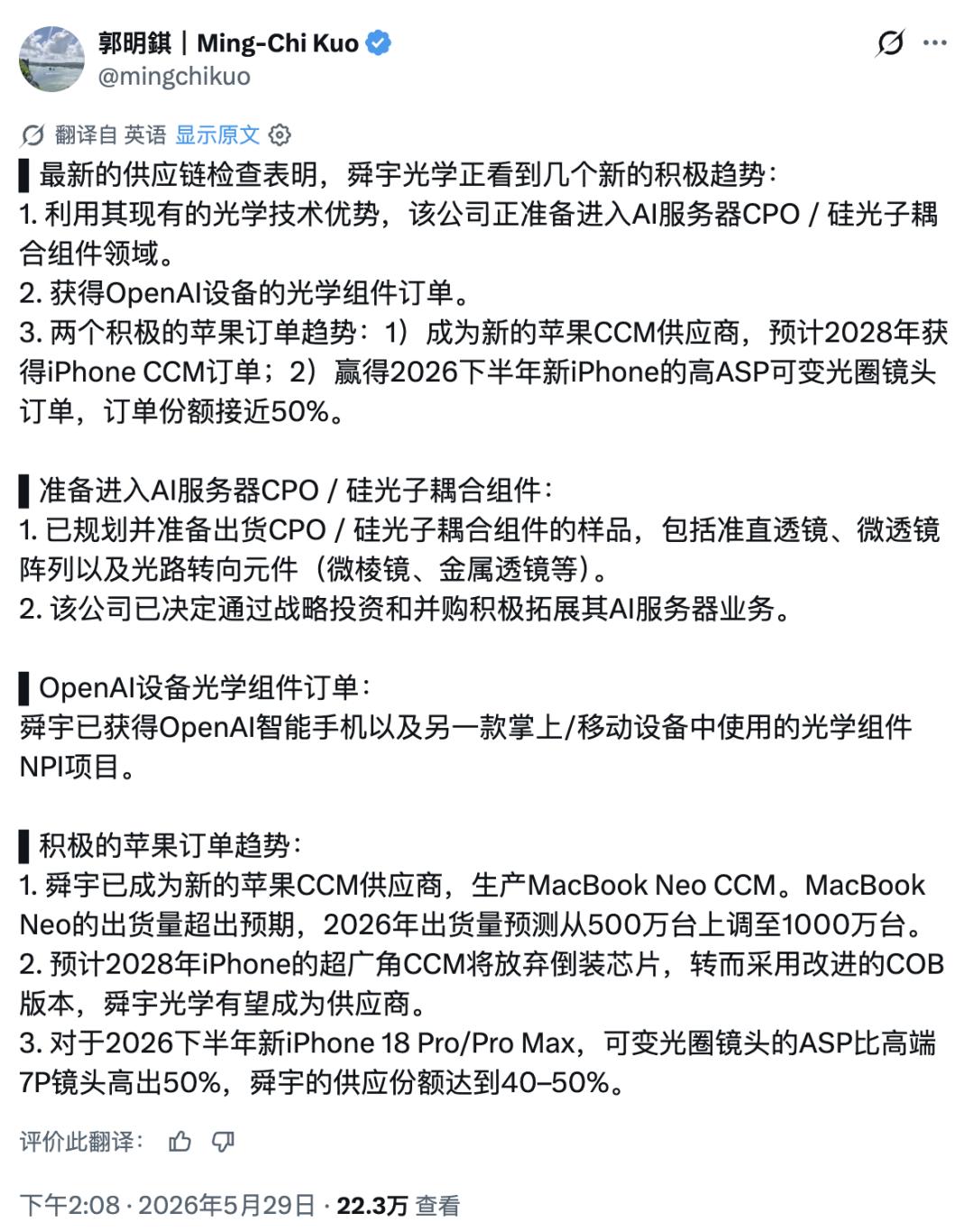
Coupled with the 50% additional camera cost predicted by Ming - Chi Kuo for the variable - aperture camera, the hardware cost of the entire iPhone 18 Pro is expected to increase by about 25% compared to the previous generation, reaching about $726.
However, The Wall Street Journal believes that considering consumers' tolerance limits, Apple will most likely