5,000 companion robots sold, can UBTECH finally breathe a sigh of relief?

Author: Qi Xiao, Editor: Zhao Yuan
In June, Ubtech stirred up the consumer - grade market for humanoid robots.
Its consumer - grade brand, UWorld, launched pre - sales simultaneously on JD.com and Tmall. This full - sized humanoid robot named U1 focuses on emotional companionship. There are two versions for male and female, each equipped with 88 high - degree - of - freedom motion joints. The pre - order volume approached 4,000 units in 10 days after its launch, and by June 21, the cumulative pre - order volume exceeded 5,000 units.
For comparison, in the whole year of 2025, Ubtech sold a total of 1,079 full - sized embodied intelligent humanoid robots. The pre - order volume of a C - end product in less than three weeks is nearly five times the annual sales volume of the B - end products last year.
Ubtech revealed that the expected mass - production scale of the U1 series this year is 10,000 units. In addition, Ubtech has also set a production capacity target of 10,000 industrial humanoid robots.
At the beginning of 2026, Zhou Jian, the founder of Ubtech, said, "Judging from the currently publicly disclosed orders and winning bid information, whether it's the single - order total amount or the cumulative total amount, we may be the world's number one."
Judging from these figures and statements, Ubtech is trying to break into both the industrial and consumer markets simultaneously and is running fast on the path from 1 to N. However, there are still some doubts surrounding Ubtech, such as falling behind and the invisible profit - making time.
I. The Situation under the "Stage Rotation" of the Spring Festival Gala
In the 2016 CCTV Spring Festival Gala, 540 Ubtech Alpha 1S robots appeared in formation and danced in unison to Sun Nan's singing, which instantly boosted Ubtech's popularity. Subsequently, in 2018, 2019, and 2021, Ubtech appeared on the Spring Festival Gala stage three more times.
The exposure effect of the Spring Festival Gala was quickly transmitted to the capital market. Ubtech won the favor of multiple well - known investors, including Tencent, and started round after round of financing.
At the end of 2023, Ubtech, with the halo of "the first humanoid robot stock", was listed on the Hong Kong Stock Exchange and enjoyed a moment of great glory.
In 2025, new players replaced the old ones. On the Spring Festival Gala stage, the robots wearing flowered cotton - padded jackets and waving handkerchiefs were replaced by Unitree Robotics. With its excellent performance in motion control, Unitree Robotics became the symbol and spokesperson of "humanoid robots". In the same year, Zhipu Robotics, relying on its cost - reduction ability through software - hardware decoupling and the ecological barrier built by the open - source large - scale model, achieved a shipment volume of 5,100 units and became the new top player in the industry.
Also in 2025, Ubtech adjusted its financial report disclosure caliber and for the first time listed "full - sized embodied intelligent humanoid robots" as an independent business category. Previously, in terms of revenue caliber, Ubtech had always divided its business according to scenarios.
In terms of public perception and industry discourse power, the former "first stock" was outshone by the new players.
In terms of the 2026 shipment guidance, Unitree Robotics aims for 10,000 to 20,000 units, and Zhipu Robotics' target is "up to tens of thousands of units". Ubtech's shipment guidance for the industrial - end Walker S series is 5,000 units, and the pre - sales of the U1 consumer - grade product have exceeded 5,000 units, showing significant growth.
Behind the order gap is the differentiation in product positioning and price.
The starting price of Unitree Robotics' G1 is less than 100,000 yuan. In 2025, the unit price of Unitree's humanoid robots was 167,000 yuan, while the average price of Ubtech's humanoid robots in the same period reached 760,000 yuan.
The most direct reason for the huge price difference is the different fields of expertise and technical routes of the products. The industrial scenario has a naturally higher requirement for stability than the consumer scenario, which is also reflected in the product cost. However, we cannot ignore Unitree's outstanding advantage in cost control, which is intuitively reflected in the financial data: as the product price continues to decline, the gross profit margin has risen to 60%.
In this track, volume and price are a pair of mutually reinforcing gears. A low price can boost sales volume, and a large volume can bring about economies of scale, further reducing the manufacturing cost per unit. This flywheel of "trading price for volume and using volume to reduce cost" is the most core business logic in the stage from 1 to N.
Cognitive awareness, orders, and market position will all affect the capital market's positioning of Ubtech.
The robot performances in the Spring Festival Galas in the past two years have raised the public's expectations for technology too high; and Unitree Robotics' first profitable report has also raised the market's expectations for commercial returns.
These two sets of expectations have put Ubtech, which is in the red and has relatively low visibility, in an awkward situation.
In fact, Ubtech's stock price has experienced a roller - coaster ride after its listing: after being included in the Hong Kong Stock Connect list in March 2024, the stock price soared by 88% in a single day, then reached a historical high of HK$328, and the total market value once exceeded HK$130 billion; but then it continued to decline, and by the beginning of 2025, it dropped to a minimum of HK$40.8, with a market value evaporation of tens of billions.
As Ubtech's humanoid robot shipment volume increased from 10 units (including different models and sizes) in 2024 to thousands of units in 2025, Ubtech's stock price rebounded. Currently, Ubtech's market value is about HK$49 billion (equivalent to about RMB 42.6 billion), almost the same level as Unitree's issuance market value.
However, multiple institutions estimate that Unitree's reasonable market value after listing is between RMB 60 billion and RMB 100 billion, and it is the mainstream expectation that the market value will rise from RMB 42 billion. From the perspective of static financial data, Ubtech's revenue in 2025 was 17.7% higher than that of Unitree. Apparently, the market is pricing according to two different logics.
There is, of course, the factor of the listing location: Unitree plans to be listed on the Science and Technology Innovation Board, while Ubtech is listed in Hong Kong. The A - share market naturally gives a higher liquidity premium to hard - tech companies. It cannot be ruled out that it is also because of the route chosen by Ubtech.
II. Doing the Hard Work and Betting on the Long - Term
Regarding the business scenario of robot performances, Zhou Jian's attitude is: "Initially, I didn't think it could form a stable and large - scale market. Later, we found that dancing still has great appeal in the vast sinking markets. However, I always believe that it is not a sustainable and large - scale development direction."
Zhou Jian believes that helping humans complete repetitive, simple, and boring work is the correct direction for the development of humanoid robots. However, from the perspective of technology and cost, the maturity of household - level applications obviously requires more time.
Ubtech's strategy is a three - step approach: the first step is to be implemented in the industrial scenario to assist production - line workers; the second step is to be implemented in the commercial scenario; the third step is to enter households for companionship and communication.
Judging from the companion robot launched in June, the "three - step approach" is not strictly linearly advanced in time. The early deployment of consumer - grade robots may be a pragmatic choice under the pressure of competition and commercialization.
Adhering to the "hard - work" route means that Ubtech must heavily invest in the "brain".
In the field of embodied intelligence, the cerebellum is responsible for motion control, the body is responsible for hardware execution, and the brain is responsible for decision - making and planning. Dancing can be completed by the cerebellum and preset programs, but in a complex factory environment for tasks such as handling and quality inspection, robots face non - standardized and unexpected situations. To handle these situations, understand instructions, and plan actions, it depends on the "brain".
Zhou Jian publicly stated: "No one in China has invested more in the embodied brain than we have."
For the brain's algorithm to truly work, the cerebellum and the body must keep up. When Ubtech started its business, the supply chain was not yet mature, so the team had to do it themselves, and "full - stack" gradually became its identity label.
Full - stack means that from the algorithm model of the brain, to the motion control strategy of the cerebellum, and then to the joint motors of the body, all links are self - made. Ubtech's technology list spans almost all levels: the Thinker embodied large - scale model, the BrainNet 2.0 group - brain network, the Thinker - VLA visual - language - action model, etc.
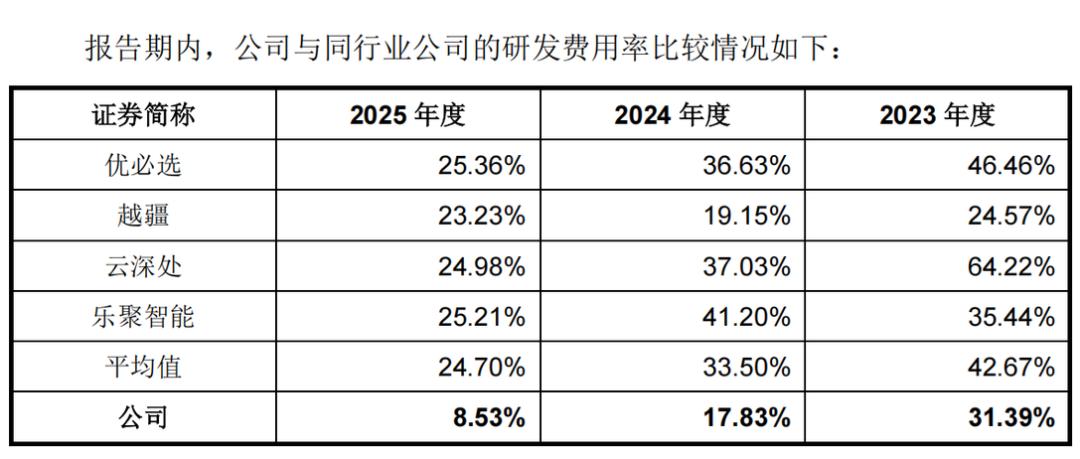
However, the other side of full - stack is burning money. For example, Ubtech's R & D expenses in 2025 reached 507 million yuan, and the R & D expense ratio is much higher than that of its peers, which also lays a foreshadowing for financial pressure.
(Source: Unitree Robotics' prospectus)
Strategies and routes will be reflected in the order structure and business logic.
Ubtech's orders are mainly divided into two categories: one is the "embodied intelligence data collection center" projects led by local governments or state - owned enterprises; the other is industrial procurement orders. Zhou Jian predicts that more large manufacturing enterprises will make bulk purchases in 2026.
Whether it is working in a factory or collecting data in a data center, high - quality multimodal data from the real physical world can be obtained. These data are fed back to the "brain" large - scale model to improve its generalization ability and then deployed to more scenarios, forming a flywheel of "data - model - application".
This is a long - term strategy of feeding the large - scale model with data from the real physical world, on the premise that there are enough terminals to capture data.
The primary purpose of the first - type customers to buy robots is to collect real - scenario data and build test infrastructure, rather than directly putting them into the production line to create ROI. It takes time from data infrastructure construction to actual application. This means that these orders often have the characteristics of project - based and long acceptance cycles, which is not conducive to Ubtech's payment collection speed and cash - flow performance, which will be detailed below.
For large - scale procurement to occur in the B - end manufacturing industry, the ROI must be carefully calculated. In other words, whether a humanoid robot can do the job, do it quickly, and do it cost - effectively is the key to determining its commercial value.
In the industrial scenario, the success rate of Ubtech's robots in single tasks such as intelligent handling and loading and unloading has reached 99%.
At the beginning of 2025, the work efficiency of Ubtech's humanoid robots in the factory was about 30% of that of a single worker. By the end of the year, it had increased to 45%, and it is expected to exceed 60% in 2026. That is, a robot working for 12 hours is roughly equivalent to a worker working for 8 hours.
Industry estimates suggest that if a robot is to replace a worker with an annual salary of 80,000 - 100,000 yuan, the procurement cost should be controlled within 150,000 yuan and the total cost of ownership should be controllable for large - scale replacement to be economical. Since the hidden costs such as maintenance, downtime, and parts replacement after the robot is put into use will significantly increase the total cost of ownership, the real economic threshold may be higher than the procurement price of 150,000 yuan.
Therefore, from the perspective of manufacturers, humanoid robots still need to continue to trade price for volume.
III. The Cost in the Account Book
The customer structure deeply affects the financial structure.
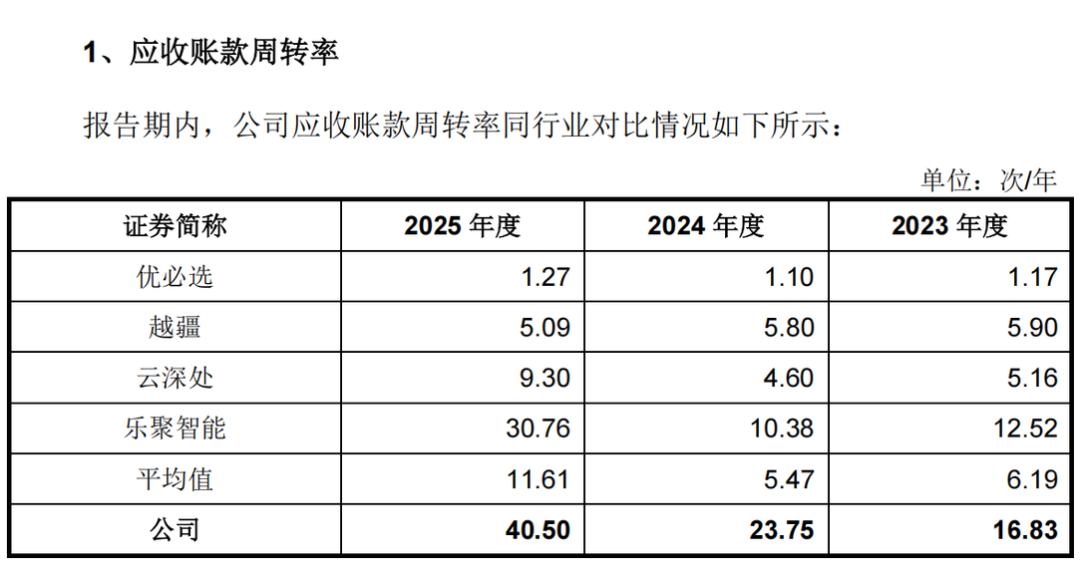
Since a significant portion of the orders come from government departments, Ubtech's payment collection situation is not optimistic. In 2025, Ubtech's revenue reached 2.001 billion yuan, and the scale of accounts receivable at the end of the year reached 1.3 billion yuan. The accounts receivable turnover speed is much slower than that of other companies in the same industry.
From the perspective of the aging structure, at the end of 2025, more than 40% of the accounts receivable had an aging period of more than one year, and the accounts receivable with an aging period of more than three years increased by more than three times year - on - year.
(Source: Unitree Robotics' prospectus)
Moreover, Ubtech has been in a state of perennial losses. From 2023 to 2025, its net losses attributable to the parent company were 1.234 billion yuan, 1.124 billion yuan, and 703 million yuan respectively.
Poor payment collection and profit pressure have jointly led to a continuous outflow of Ubtech's operating cash flow. From 2023 to 2025, the net outflows were 1 billion yuan, 880 million yuan, and 780 million yuan respectively.
Currently, the industry generally believes that the humanoid robot industry is about to face a round of elimination. Even without the elimination, during the mass - production process, the enterprises' demand for funds will only increase rapidly.
Ubtech, which is losing profits and cash, should be in a very passive position.
However, looking at the balance sheet, Ubtech is not short of money. As of the end of 2025, it had 4.888 billion yuan in monetary funds on its books. This money was not earned but given by the capital market. In 2025 alone, Ubtech raised about HK$6.3 billion through three rounds of private placements.
Frequent discounted private placements less than two years after listing have significantly diluted the rights and interests of the original shareholders. The market has begun to worry whether this company has become highly dependent on financing, and the suspicion of "raising money to survive" has emerged.
In other words, Ubtech's "not being short of money" is the result of its strong financing ability; but "being short of money" is the essence of this business model.
Let's go back to the root cause of the losses. Two points have been pointed out above: one is that the shipment volume is not large enough to spread the manufacturing cost; the other is that the R & D expenses are much higher than those of the peers.
Actually, a financial variable also needs to be considered in Ubtech's loss situation.
In 2025, Ubtech's construction - in - progress projects amounted to 1.7