Qiu Sheng | Superbird Browser rushes for Hong Kong stock IPO, a huge profit story of two grassroots counterattacks
This article is approximately 4,500 words long. It is recommended to take 7 minutes to read.
Author | Peng Xiaoqiu
Editor's Note: Amid the AI boom, more and more companies are going public. Every page turn of a prospectus holds all that a company wants to say and what it has left unsaid.
In view of this, Yingke has launched the "Autumn Sounds" column. "Autumn Sounds" is taken from Ouyang Xiu's "Ode to the Sounds of Autumn". By "listening to the sounds of autumn", we aim to observe the trends in the industry, evaluate the quality of companies, and record the truths written and hidden during a company's sprint towards an IPO. This is our second issue, focusing on Zixun.
On June 24th, Zixun Technology (Fujian) Co., Ltd. submitted a listing application to the Hong Kong Stock Exchange, with Guotai Junan serving as the exclusive sponsor. Different from the unprofitable 18C companies flocking to Hong Kong in the past two years, Zixun is applying for a main - board listing. In other words, this is a company that has truly made money.
Zixun's prospectus defines itself as "an e - commerce technology company dedicated to innovating the e - commerce operation model by combining industry expertise with AI technology". At the beginning, there are seven bolded figures: a compound annual growth rate of 51.7% in revenue from 2023 to 2025, a compound annual growth rate of 145.4% in operating profit, a compound annual growth rate of 111.1% in operating cash flow, and a growth rate of 238.2% in LinkFox subscribers... A narrative of an AI - driven company with strong performance and loyal customers unfolds.
However, after dissecting this 379 - page prospectus, it becomes clear that the story of this company is much more complex and interesting than the term "AI e - commerce". It is a rare SaaS target in the Hong Kong stock market with real profits and real cash flow. Yet, its net profit on the books is only 57.5 million yuan, and its net assets are negative. It waves the AI flag high, but 84% of its revenue comes from a browser launched in 2018. It has so much cash that it invested 592 million yuan in financial products in a year and made a sudden dividend of 240 million yuan before listing, but it still wants to raise funds in the Hong Kong stock market.
Yingke will analyze the quality of Zixun's "browser - selling" business.

Waving the AI Flag High, but 84% of the Revenue Comes from a Seven - Year - Old Browser
Let's first look at a surprising comparison.
In 2025, Zixun's operating profit reached 257 million yuan, with an operating profit margin of 37.4%. It increased from 42.695 million yuan to 257 million yuan in three years, with a compound annual growth rate of 145.4%. However, looking further, the annual net profit in 2025 was only 57.497 million yuan, with a net profit margin of 8.4% - it even had a loss of 87.363 million yuan in 2023. Why does a company with an operating profit of 257 million yuan only have 20% of its actual profit left in the year?
The answer lies in an unremarkable item on the profit statement: a change in the book value of redemption liabilities, which deducted 178 million yuan in 2025. This is the liability corresponding to the "redemption right" in the special rights of the Series A and Series B investors. It is a non - cash book fluctuation resulting from the re - evaluation at fair value. Ironically, the better the company's operation and the higher its valuation, the higher this liability grows - it swallowed up 125 million yuan, 88 million yuan, and 178 million yuan in profits in 2023, 2024, and 2025 respectively.
The prospectus also provides a restoration basis: after adding back non - cash items such as the change in redemption liabilities (178 million yuan) and share - based compensation (5.807 million yuan), the adjusted profit (non - IFRS) is 245 million yuan. This is exactly the opposite of many companies that use adjusted figures to cover up real losses. For Zixun, its real operating profit is suppressed by an accounting liability, making its book value seem poorer than it actually is.
It is more intuitive from the balance sheet. As of the end of 2025, Zixun's redemption liabilities reached 714 million yuan, dragging the company into technical insolvency with a negative net asset value of 358 million yuan. However, this "negative" situation is only on paper. According to the investment agreement, the redemption right was terminated when the company first submitted its application to the Stock Exchange. After the listing is completed, this 714 - million - yuan liability will be re - classified from a liability to equity. At that time, the problem of negative net assets will disappear all at once.
This is a standard move for gambling clauses in the Hong Kong stock market, but it is worth noting that: first, Zixun's thin book profit and negative net assets are accounting illusions. Its real profitability (257 million yuan in operating profit and 364 million yuan in operating cash flow) is much stronger than the bottom line of the financial statements. Second, this company highly depends on the success of its listing. The prospectus also states that if the listing application is withdrawn, rejected, or not completed by the end of 2028, the redemption right can be reinstated.
Zixun includes "AI" in its company definition, but its revenue structure tells the real story.
Out of the total revenue of 687 million yuan in 2025, e - commerce security operation products accounted for 96.5% (663 million yuan), and the flagship "Ziniao Browser" alone accounted for 84.1% (578 million yuan). The Zhanfu Browser, acquired at the beginning of 2024, accounted for 10.6% (72.757 million yuan). The much - talked - about AI product matrix LinkFox only had revenue of 17.448 million yuan, accounting for 2.5%.

(Source: Compiled by Yingke)
Looking at the longer time frame, it is clearer: the proportion of Ziniao's revenue decreased from 97.4% in 2023 to 87.4% in 2024 and 84.1% in 2025. The decrease in the proportion is not because Ziniao is not selling well, but because the acquired Zhanfu Browser has filled a gap. The real second - growth curve, LinkFox, had revenues of 445,000 yuan → 2.791 million yuan → 17.448 million yuan in three years, with a compound annual growth rate of 526.2%. It sounds amazing, but it started from an almost zero base.
The risk warning in the prospectus is also very straightforward: "We rely to a large extent on the sales of the Ziniao Browser", and it lists "the inability to maintain the subscription volume, pricing level, and renewal rate of Ziniao" as a major risk. In the end, this is still a company that makes money from a single browser. AI is just a new label, and it is far from being the source of profit. In 2025, the gross profit margin of e - commerce AI products was only 26.3%, while that of e - commerce security operation products was as high as 66.9%.
So, what exactly is the Ziniao Browser? The official description in the prospectus is "an infrastructure for cross - border e - commerce store operation". Its core functions include multi - account management across platforms, fine - grained permission control, account isolation, and login management, helping sellers "manage multiple stores and accounts safely, centrally, and systematically". The pricing is about 68 - 128 yuan per device per month, with a pure subscription system, prepaid fees, and non - refundable.
Industry background: This category is usually referred to as "anti - association browser/fingerprint browser" in the cross - border e - commerce circle. Sellers use it to operate multiple accounts simultaneously on platforms such as Amazon and TikTok without being judged as "associated" by the platform's risk control.
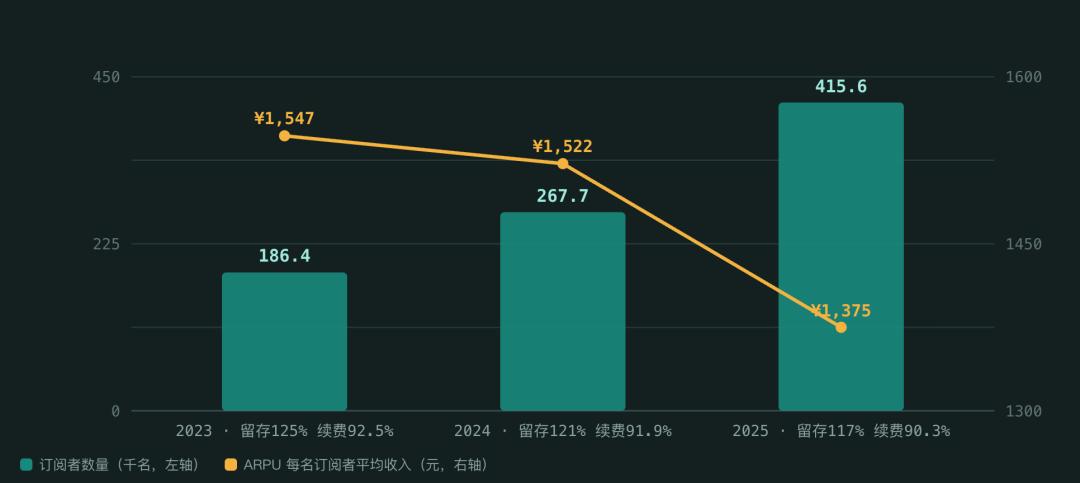
Ziniao has experienced rapid growth, but when analyzing its "unit economics", we can see a set of downward - trending curves.
Average revenue per user (ARPU): 1,547 yuan → 1,522 yuan → 1,375 yuan, a 11% decrease in three years;
Net revenue retention rate: 125% → 121% → 117%, still above 100%, but declining year by year;
Average monthly subscription renewal rate: 92.5% → 91.9% → 90.3%, indicating a slow loosening of customer stickiness.
(Source: Compiled by Yingke)
So, where does the growth come from? The answer is purely from the increase in new subscribers: the number of Ziniao subscribers soared from 186,000 to 416,000, the average monthly active users doubled from 121,000 to 264,000, and the cumulative number of serviced stores increased from 3.249 million to 7.009 million. The prospectus explains the decline in ARPU as rapid market penetration and the diversification of the user base. In other words, the newly attracted small and medium - sized sellers pay less and renew subscriptions slightly less frequently, but the large number of them has boosted the overall revenue.
This is not a trivial matter for a subscription - based SaaS company. When both the price and retention rate are decreasing, and growth is completely dependent on "volume", once the growth rate of new customers slows down, the pressure on the revenue engine will become apparent. Most of Ziniao's customers are small and medium - sized enterprises and individual sellers. The prospectus itself admits that such customers "have limited capital reserves, weak operational resilience, and a high failure rate" and are particularly sensitive to macro and platform policies.
As for the acquired Zhanfu Browser, its unit economics is even weaker. It is an entry - level tool for Southeast Asia, with a monthly fee of only 28 - 68 yuan per account. Its ARPU decreased from 570 yuan to 492 yuan.
The acquisition of Zhanfu is worth discussing separately.
In December 2023, Zixun signed an agreement with Shenzhen Maiyue Information Technology and its shareholders to acquire all the intellectual property, contracts, equipment, data, and other assets and businesses of the Zhanfu Browser for 10.06 million yuan in cash, and the acquisition was completed on January 1st, 2024. One year later, Zhanfu contributed revenues of 38.52 million yuan and 72.76 million yuan in 2024 and 2025 respectively. The assets acquired for 10.06 million yuan generated 72.757 million yuan in revenue in the second year, accounting for 10.6% of the total revenue.
If we exclude the contribution of Zhanfu, the growth rates of Ziniao itself in 2024 and 2025 would be significantly lower than the reported 57.4% and 46.2%. The prospectus clearly lists strategic acquisitions and investments as one of the five growth strategies, and a portion of the funds raised from the listing is reserved for strategic investments and acquisitions. This means that "buying growth" is likely to be the path that Zixun will continue to take after listing, and the risks of acquisition integration failure and goodwill impairment also come along.
In contrast, its much - emphasized AI R & D seems to be shrinking. The R & D expenses were 75.205 million yuan → 68.401 million yuan → 69.641 million yuan in three years. The absolute amount remained almost the same, but the proportion of R & D expenses to revenue decreased from 25.2% to 10.1%. A company that focuses on raising funds for "AI R & D capabilities" has seen a decline in its R & D intensity in the past three years. This is a gap that needs to be pointed out between the narrative and the investment.

Distributing a 240 - million - yuan Dividend First and Then Investing 600 Million in Financial Products. Where Does It Need the Money?
In terms of cash flow, it can be seen that Zixun is a cash - generating machine.
The secret lies in its business model: purely prepaid. Customers must pay in advance to use the service. As a result, Zixun's days sales outstanding of trade receivables were only 0.7 days, 0.4 days, and 0.4 days, almost zero. At the same time, contract liabilities (pre - received subscription fees) increased from 86 million yuan to 223 million yuan. This is a typical business with negative working capital, where customers pay in advance. The cash flows in continuously. In 2025, the net cash flow from operating activities was 364 million yuan, far exceeding the net profit on the books.
With so much cash that it couldn't be spent, Zixun invested in financial products. As of the end of 2025, the "financial assets at fair value through profit or loss" reached 592 million yuan, including 380 million yuan in structured deposits and 212 million yuan in wealth management products, with an annualized yield of 1.49% - 3.65%. The scale of this financial investment is close to its annual revenue. The large - scale cash outflows from investment activities, amounting to 150 million - 280 million yuan each year, are mainly used for buying these financial products rather than building factories or purchasing equipment.