Themed Roundtable: When Everyone Sees the Bubble, When Will Robots Step into Real Scenarios | 36Kr WAVES 2026 New Waves
In 2026, the venture capital circle is once again surging with waves: AI has moved from a technological concept into the deep waters of the industry, and hard - tech entrepreneurship has changed from a "niche track" to a "mainstream consensus". Young entrepreneurs are using code and their hands to redefine the future coordinates of Chinese innovation.
Every year, the WAVES Conference hosted by 36Kr · AnYong is the annual barometer of the Chinese venture capital circle. This year's WAVES 2026, themed "This Summer", was held at Liangcang Xinzao Creative Park in Panyu, Guangzhou. Over two days, we gathered top - tier investors, industry leaders, and emerging entrepreneurs. Through 14 in - depth round - table discussions and dozens of independent speeches, we dissected the underlying logic of core tracks such as AI, hard tech, going global, and healthcare, and witnessed how the perseverance of "the few" converged into a wave that changes the industry.
The following is the content of the dialogue, edited by 36Kr:
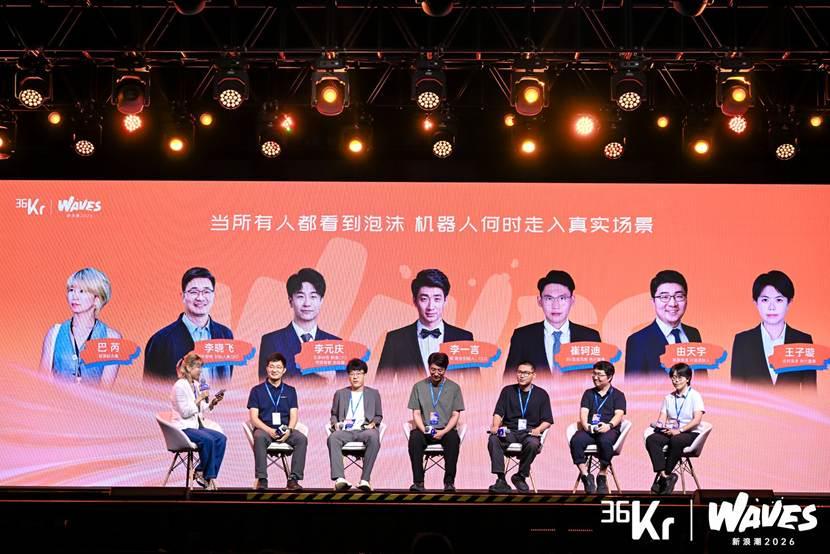
Ba Rui | Deputy Editor - in - Chief of AnYong (Host)
Li Xiaofei | Founder and CEO of Shenpu Intelligence
Li Yuanqing | Co - CTO of Lexiang Technology, General Manager of Qiongming Intelligence
Li Yiyan | Co - Founder and CEO of Qingtianzu
Cui Kedi | Executive Director of BV Baidu Ventures
You Tianyu | Industry Partner of Kailian Capital
Wang Zixuan | Executive Director of Yunshi Capital
Ba Rui: Hello, everyone! There are the most people at our table, and it's very lively. However, we are short on time and have a heavy task, so I'll make it quick.
Embodied intelligence has been the most money - attracting market in the primary market in the past one or two years and is also one of the most anticipated hard - tech tracks. The faster the money pours in, the greater the doubts about the bubble. Today, these six people happen to represent three perspectives on whether it can be implemented. First, there are two people who build robots, Li Xiaofei, the founder and CEO of Shenpu Intelligence, and Li Yuanqing, the co - CTO of Lexiang Technology and the general manager of Qiongming Intelligence. Then there is Li Yiyan, the CEO of Qingtianzu, who is at the forefront of commercialization. And there are three investors who are betting on it, Cui Kedi, the executive director of BV Baidu Ventures, You Tianyu, the industry partner of Kailian Capital, and Wang Zixuan, the executive director of Yunshi Capital. These three represent three completely different betting logics: financial, industrial, and special and vertical. Putting these people at the same table, we actually want to answer one question, that is, when everyone sees the bubble, when and where will such embodied intelligence truly enter reality? First, please tell us in one sentence what is the first truly money - making scenario of embodied intelligence that you have seen or are currently working on. Let's start with the entrepreneur Xiaofei.
Li Xiaofei: Okay, I think it's very simple. The industry is still in a relatively early stage, and this is a very large track. So in the early stage of such a large track, there are actually many opportunities on the R & D side. This is what I've seen. So I think on the R & D side, we've already seen some companies making some money.
Li Yuanqing: At present, Lexiang has seen some opportunities in the geek market and the Maker market. At the same time, we've also found some turnover in the content with rich connotations and IP attributes in the Pet area.
Li Yiyan: Since Qingtianzu is at the forefront of commercialization, every business that AI is currently engaged in is a money - making business. Our concept is to commercialize things below the upper - limit ability of the robot's generalization ability. So basically, all the businesses we are conducting at the moment are making money.
Cui Kedi: I've been really into watching UFC fights recently, so I'm quite fond of the fighting scenario that Zhongqing is working on, which is similar to commercial fighting. On the one hand, it's really a personal interest. On the other hand, I think such a high - confrontation and high - dynamic scenario really tests the comprehensive capabilities of the robot. It can verify the technology and is also highly watchable. I think it's a very imaginative direction.
You Tianyu: Since the industry is in the early stage, the money - making situations at this stage are all due to short - term mismatches in supply and demand. I think one is the leasing business. Maybe it's not like Qingtianzu. Currently, the most profitable thing is to be an agent locally. Maybe if you get 5 or 10 devices, you can rent them out for thousands of dollars a day, just like renting a stretched Rolls - Royce. The second is the data collection area. Of course, not all data collection businesses are profitable. It's partly about human - resource outsourcing. Since I'm just here to do the work for you and you're in a hurry to get the data, a human - resource outsourcing company doing data collection work for thousands of people can have a short - term supply - demand mismatch. Third, some people who are into stock trading have also made money.
Wang Zixuan: For Yunshi Capital, in some places that we can't easily see, like in shipyards, under the ocean, or in some heavy industrial factories in the suburbs, we've actually seen many robots using the concept of embodied intelligence already or about to make a lot of money. As for general humanoid robots, our feeling is that the companies that truly consider the customers' economic accounts may be the first ones to really make money themselves.
Ba Rui: I'm not sure if you all answered so concisely because I said we were short on time. We can still make it more specific and clear later.
My first question is for Mr. Cui Kedi. Embodied intelligence has been really hot this year. You entered the market at the end of 2022 when the term "embodied intelligence" was not a hot term and few people mentioned it. It's completely different in the past two years. Just to give an example, Shizhihang raised $242 million in its angel round, which is quite exaggerated. On the other hand, Goldman Sachs asked 9 supply - chain companies, and none of them dared to say that they had received large orders. Some investment institutions also directly admitted that there was a bit of a valuation bubble. So I'd like to ask you, you've been betting from a non - consensus view to today's consensus. The ability to deliver products has never caught up with the valuation. Is it because you saw the opportunity early and made the right bet, or did the market turn a good hand into a myth too early? To put it more directly, are you increasing your position or quietly reducing it at today's price?
Cui Kedi: Let me first introduce our institution. BV Baidu Ventures is a financial investment fund initiated by Baidu Group. Our main investment theme is centered around AI. There are two major narratives in AI: digital AI and physical AI. Since I'm more interested in physical - level things, I've been doing more research in the area of physical AI. Since the second half of 2022, we've been continuously deploying in the field of autonomous driving. Subsequently, with the new wave of AI brought by ChatGPT and the rapid improvement of the capabilities of large - language models, the global artificial - intelligence industry has entered a new stage of development. This change didn't happen overnight but was driven by the joint efforts of technological progress and industrial demand. From March to May 2023, we started to systematically pay attention to and invest in some robot projects that originated from the spill - over of autonomous - driving technology. However, my focus is not limited to the robots themselves but more on how intelligent capabilities penetrate into the real world. From this perspective, whether it's autonomous - driving cars, robots, or consumer electronics, they are essentially the specific manifestations of intelligent systems in different forms and scenarios. For us, the core is always the evolution and implementation of intelligent capabilities.
I remember in 2023, we had a project. The materials for the meeting said "from end - to - end autonomous driving to general artificial intelligence in the physical world". At that time, there was also a quite in - depth discussion within the company because people didn't have a unified understanding of the concept of "general artificial intelligence in the physical world". The term "embodied intelligence" may not have been as widely discussed as it is today, but we had already captured some key changes.
For example, now people are discussing more about VLA, world models, etc., while at that time, we were discussing more about end - to - end model capabilities. Besides the model itself, data is also very important, and data is highly related to specific scenarios. So later, our discussion continued to expand, from model capabilities, to data accumulation, and then to scenario closed - loops, gradually forming a more systematic understanding of this direction.
Since BV is an early - stage investor and the comprehensive investment cost is relatively low, today we are mainly doing two things. First, we are still continuously investing in new embodied - intelligence companies. Second, we are also continuously increasing our positions in the companies we've already invested in. From our perspective, this industry has just begun.
The other day, I saw that Mr. Xinyu from Meituan Longzhu also mentioned that in the embodied - intelligence industry, there is not too much money but rather not enough. I quite agree with this judgment. From the perspective of the long - term development of the industry, embodied intelligence is still in a very early stage, and in the future, it will require more capital, talent, scenarios, and infrastructure to jointly promote its development.
Ba Rui: Even though it's already so hot, there's still not enough money, right?
Cui Kedi: I think so. If we look at it in the context of the entire AI industry, the investment in embodied intelligence is still in a relatively early stage. After all, it's about artificial intelligence in the physical world, which is more difficult and complex. Taking large models as an example, in the past few years, the financing scale and valuation of leading large - model companies have reached very high levels. In contrast, today, the leading companies in the field of embodied intelligence still have a significant gap in terms of both financing scale and valuation level. So from this perspective, I think this industry doesn't have too much money but needs more long - term investment to reach maturity.
Ba Rui: I'm not sure if the two entrepreneurs also agree with this.
The two entrepreneurs on stage are both working on household robots, like Xiaofei and Yuanqing. The industry says that household robots are stuck in an impossible triangle. You need them to be cheap enough, able to do work, and safe without harming people. It's very difficult to achieve all three at the same time. If they are cheap, there may already be some. Some consumer - grade humanoid robots have already dropped below 10,000 yuan, but I think they are more for companionship. Once you require them to actually do some housework and be safe at the same time, the cost may immediately go up.
Please tell us a real - user scenario that is used every day, not a demo. Xiaofei, you actually have a "1 + 2+N" route, which is a set of embodied large - model bases, two real - data pipelines, and N gradually retrieved scenarios. How many of them have you really achieved?
Li Xiaofei: Let me also briefly introduce myself. Just now, Kedi said that the entire track is very hot, but actually, there's still relatively little money. I very much agree with this, so everyone should invest in the embodied - intelligence industry as soon as possible. Mr. Kedi has also invested in our company in the previous three rounds.
In the area of embodied intelligence, as you mentioned, we are also working on household applications. We believe that the entire embodied track is definitely a very long and large track. I've been involved in autonomous driving and the previous generation of robots and have been an entrepreneur for ten years. Looking at the development of the entire embodied intelligence, I prefer or am better at looking at the rhythm of the entire industry from a five - to ten - year cycle. Five to ten years later, I'm very confident that embodied intelligence will enter thousands of households and all industries. Of course, at this moment or in the past one or two years, I think it's very similar to the situation of autonomous driving in 2017 and 2018. Looking at it from this time point, we think there will probably be three ways to achieve the multi - scenario and multi - function application of embodied intelligence at the L3 or L4 level. Among them, we really believe in the large track or generalization ability from quasi - household to household. I won't go into details about the other two, as I've explained them to some extent before.
In this path, we hope to find the largest track or the most generalized scenario to highlight or extend the greatest energy of the entire embodied intelligence. In this process, we think it's very similar to the process of finding the autonomous - driving track in 2017 and 2018. Tesla locked in the simplified autonomous - driving function of passenger cars very early and first chose to launch functions such as high - speed navigation, parking, or in urban areas on structured roads like highways, and gradually increased scenarios or functions. We think that in the broadest household track, the future achievement path will also be a gradual one. So in terms of our path selection, we choose some structured scenarios, such as the commercial scenarios of hotels, including the health - care scenarios of some institutions, and then gradually move into households. This may be our biggest future goal, achievement path, and entry point.
In this process, we've explored a lot of functions in about a year. Last month, we also conducted some POCs in some hotels of our partners. There were good points and a lot of feedback. We found that there were still a lot of things to do in terms of actual operation, including delivery. You just mentioned a function. I can briefly tell you that in the hotels, we explored functions such as cleaning the restroom, doing laundry, that is, the process of sending clothes for washing, including self - service laundry, and the front - desk reception, check - in, and check - out. We received a lot of feedback from customers, including our end - user C - end customers. So we also hope to polish the functions in some structured and controllable scenarios and gradually have two, three, or complete functions gradually enter households, rather than choosing to directly enter households now and having a hard time finding an entry point for functions. These are the things we are currently thinking about and doing.
Ba Rui: Thank you, Xiaofei! Yuanqing, I know that Lexiang initially worked on some small household robots. While Xiaofei and his team are first entering from some large commercial scenarios, you once said that you treat the home as a factory. So has your production line started running? Which specific link has it reached? What's it like?
Li Yuanqing: I think the process of embodied intelligence for the ToC market entering households is very similar to the process of industrialization, digitalization, and intelligentization in factories. When we were working on the ToB side of factories before, especially when I was at Huawei, we found that there were two pre - conditions for intelligentization. The first pre - condition is informatization. It needs to integrate as much information as possible from the entire physical scenario. The second thing is automation. We hope that based on that information, both equipment, people, and processes can operate automatically. Only then can AI truly show its value, which is intelligentization.
The factory scenario is a case - by - case basis, solved by the factory. If we apply this to the home, can we first complete the informatization of the home? How? We let a small robot enter the home through a camera or the emotional and functional values of pets. Just like when a sweeping robot first enters the home and knows what things are there, such as the kitchen, bedroom, and living room. Can we then add more information, such as knowing that there is a refrigerator and a sink in the kitchen, and a bed, a wardrobe, and a bedside table in the bedroom? Through these things, we complete the informatization of the things in the home that don't often change their positions. The next step is based on traditional automation. We can see that the sweeping robot has already done a very good job in navigation at home. It moves around at home, and this is a rule - based bottom - layer. Another point is whether we can use object recognition and planning based on the foundation_pose to achieve automated grasping of some clearly visible objects and then use a mature IK to calculate it. In such a large context, we'll find that we don't need very high computing power, and the cost can also be kept very low.
Finally, I want to say that the home scenario is indeed unstructured, highly dynamic, and very sensitive. Can we use a more complex software architecture, rule - based, to provide low - cost and highly interpretable backup, and combine the currently well - developed APIs, as well as the good perception, reasoning, and skills models in a model - based way? When it comes to end - to - end, after completing the product implementation and data accumulation on the basis of the previous two layers, we can enter the home.
Of course, I'm more determined about one thing. People say that robots can't enter the home if they