Focusing on next-generation human-computer interaction and embodied data entry, Ningxiang Technology completes nearly 10 million yuan in angel round financing | 36Kr Exclusive
Text | Hu Xiangyun
Editor | Hai Ruojing
36Kr learned that "Nianxiang Technology", which focuses on the R & D and industrialization of non - invasive neural interface technology, has completed an angel round of financing of nearly ten million yuan. This round of financing was led by Yongjun Xingmang, with Pufa Venture Capital and Yicun Capital participating. The raised funds will be mainly used for product R & D, team expansion, and the construction of a local sEMG dataset.
Nianxiang Technology was founded at the end of 2025. Its first product, Omniband, is a wrist - worn surface electromyography (sEMG for short) neural interface device. It does not directly collect signals from the cerebral cortex. Instead, it analyzes the hand movement intention and continuous dynamic gestures through the neuromuscular electrical signals at the wrist, and then uses them for human - machine interaction in terminals such as mobile phones, computers, smart glasses, and smart homes.
In addition to the general interaction scenarios, Nianxiang Technology also regards high - precision hand movement data as another long - term value line. The team hopes to build a large - scale sEMG dataset for local hand operation scenarios around labels such as hand posture, muscle force, and object interaction, providing data support for embodied intelligence, physical AI, and world model training.
The founder, Dr. Wang Yi, engaged in research in the field of brain - computer interfaces at the University of Auckland in New Zealand during his doctoral studies. He is currently the vice - chairman of the National Brain - Computer Interface Industry Alliance and has been included in the Shanghai Magnolia Talent Program. He served as the chief scientist of Yingmai Medical and the R & D director of Zhiyuan Robotics. He has fully practiced the R & D of relevant technologies such as invasive/non - invasive/interventional brain - computer interfaces and sEMG neural interfaces, as well as embodied intelligence human - machine interaction.
In Wang Yi's view, the common goal of different technical routes is to "translate people's intentions". However, compared with medical - grade brain - computer interfaces or invasive solutions, he hopes to first develop a product that ordinary people can accept, are willing to wear, and can use frequently.
Therefore, when founding Nianxiang Technology, Wang Yi chose to start with the neural interface wristband. This direction had failed to be implemented on a large scale in the past few years due to poor generalization and difficulty in lightweight design. It was not until 2025 that Meta published a study in Nature, stating that the Scaling Law effect confirmed that cross - user calibration - free recognition could be achieved through data accumulation. Finally, the industrialization window for the "neural wristband" was opened.
The following is a (edited) dialogue between 36Kr and Wang Yi:
Q: Why did you choose the non - invasive neural interface technology path instead of the mainstream scalp electroencephalogram (EEG) or invasive route?
Wang Yi: In the market, brain - computer interfaces are often understood as "being able to read all thoughts after implanting a chip", but this does not conform to the current technological reality. The conduction of human consciousness and neural links are extremely complex, and it is still very difficult to fully analyze thinking. Therefore, after fully practicing invasive, non - invasive EEG, EMG and other routes, I believe that for brain - computer interfaces to truly benefit ordinary people, we must first find a technical path that is solid and can be accepted and worn by users.
Both the mainstream invasive and non - invasive brain - computer interface routes have certain shortcomings. The former requires surgical implantation of equipment to collect electroencephalogram signals, which causes great damage to the body and is naturally more suitable for special scenarios such as medical rehabilitation. The latter mainly faces problems such as unstable signals, insufficient recognition accuracy, and cumbersome wearing, making it difficult to support daily high - frequency interaction.
The logic of the sEMG neural interface is different. After the brain sends out a movement intention, the signal will be transmitted to the hand muscles via the spinal cord and peripheral nerves, and muscle contraction itself is a natural signal amplifier. We collect the amplified terminal command signals, which have high clarity and do not require complex decoding of the messy original brain signals. Therefore, collecting electromyogram signals at the wrist can not only ensure non - invasiveness and safety but also guarantee a high signal - to - noise ratio. I firmly believe that this will be the ultimate direction of future human - machine interaction.
The core problem that has made this route difficult to implement in the past is poor generalization. The gesture signals of different users vary greatly, and individual calibration is required. After Meta acquired CTRL - Labs in 2019, it has been looking for solutions. The research published last year confirmed that the Scaling Law similar to that of large models also applies in the sEMG field. When the training data covers more than 100 users, the generalization ability of the model will continue to improve. Coupled with the iteration of edge computing power, real - time gesture analysis across users without calibration finally has the conditions for implementation.
For Nianxiang Technology, previously, the model trained based on a small - scale laboratory data has basic generalization ability. However, compared with overseas leading teams, the lack of a local exclusive dataset is still the core shortcoming.
Therefore, building a local dataset is the team's current key task. We plan to create an sEMG public dataset in the field of hand operation that is comparable to ImageNet. We will focus on collecting multi - dimensional labels such as the hand postures, muscle forces, and object interactions of Chinese people, divide it into two application directions: interaction and embodied intelligence, and fill the data gap in local scenarios. Subsequently, we will also continue to expand the data by recruiting volunteers and opening a developer platform to drive continuous upgrades of the model's capabilities.
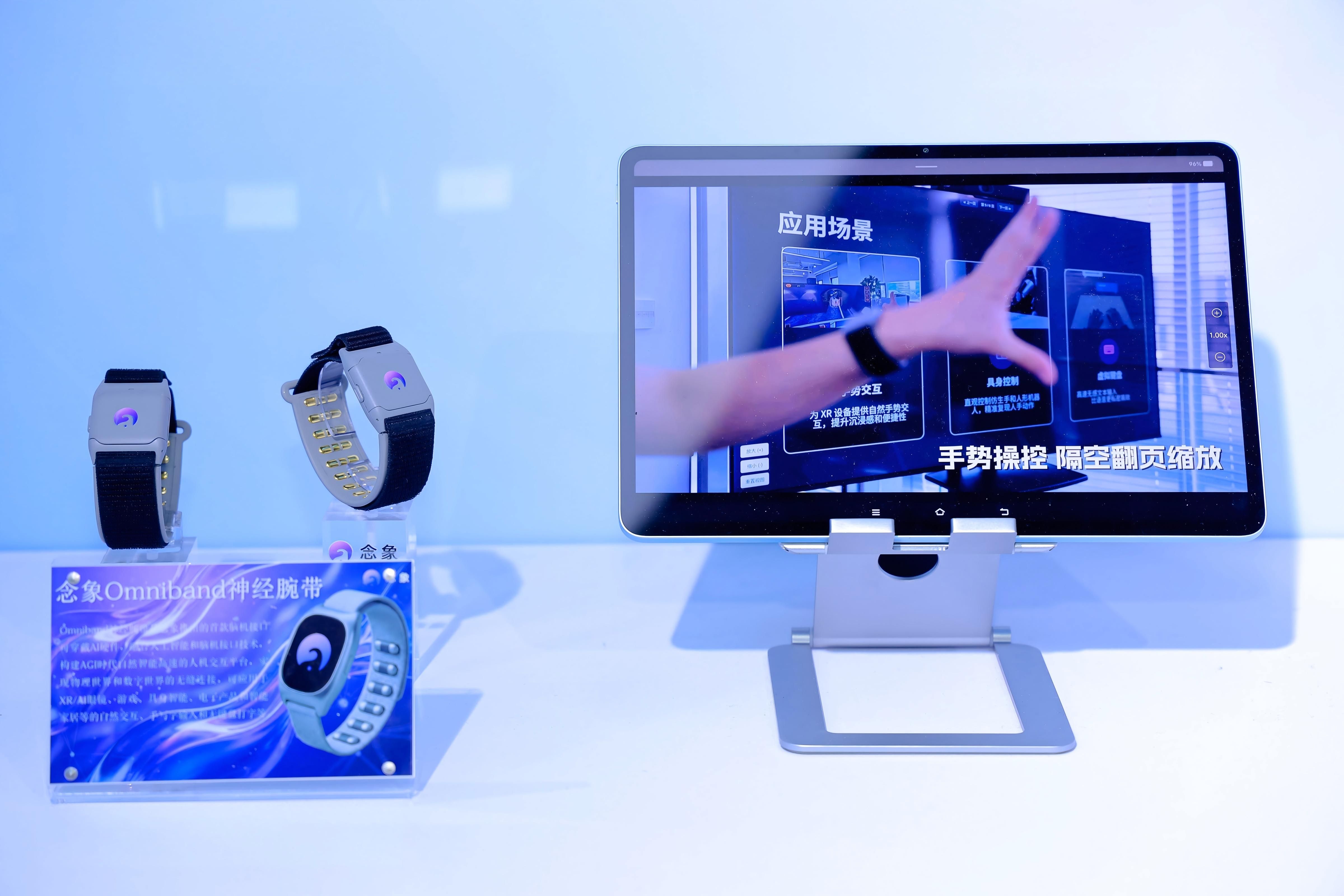
Image source: Nianxiang Technology
Q: When making a neural interface wristband, the signal interference at the wrist is usually relatively large. How does the team solve core problems such as motion artifacts and signal noise?
Wang Yi: Motion artifacts, signal drift, environmental noise, and individual signal differences are the core difficulties that sEMG devices have faced for a long time. We mainly solve the problems systematically from three dimensions: hardware, algorithms, and models.
In terms of hardware, we reduce common - mode noise through differential electrodes and structural design, and optimize wearing stability to reduce drift caused by position changes and limb movements. In terms of algorithms, the team has self - developed filtering and signal separation algorithms for sEMG to filter out interference such as motion artifacts and skin sweating. At the model level, we use a multi - modal data complement and cross - validation mechanism to allow the AI model to learn richer signal features and improve its robustness under different users and different action states.
Currently, Omniband can continuously estimate the dynamic angles of all 20 joints of the hand. Next, the team will continue to improve calibration - free, cross - user generalization, and long - term wearing stability.
Q: Nianxiang Technology's first product is a non - invasive neural interface wristband, Omniband. Please introduce its R & D progress; it mainly decodes gestures by collecting electromyogram signals. What are the differences between it and traditional sports bracelet sensor products?
Wang Yi: Omniband generally belongs to brain - computer interface products. It does not directly collect signals from the cerebral cortex. Instead, it relies on multi - channel, high - bandwidth electromyogram sensing and an AI decoding model to analyze the human hand movement intention. Currently, the product is in the engineering prototype stage.
Therefore, different from traditional sports bracelets that can only record basic sports data results such as steps, heart rate, and exercise duration, Omniband can directly capture the user's movement intention, analyze the angles of all hand joints and the muscle force, and recognize micro - hand movements and continuous dynamic gestures. Relying on the standard HID Bluetooth protocol, the product can remotely control devices such as mobile phones, computers, smart glasses, and smart homes, and can also realize air writing, creating an invisible keyboard and mouse, getting rid of the limitations of physical input devices.
At the same time, the high - precision hand movement data collected by the device can also provide core data support for embodied intelligence, physical AI, and world models. Subsequently, we will also iterate and add new sensors to continuously expand application scenarios.
Q: From the actual test results, what is the most mature application scenario for Omniband at present? Has the product achieved "out - of - the - box use", and how long does it take for new users to get started?
Wang Yi: At present, we have polished the general interaction scenarios most maturely, and the user experience in game and short - video control is the best. In the short term, the team will give priority to the implementation of gesture - interaction products, and the embodied intelligence data collection business will also be steadily promoted as planned. Currently, the product has not fully achieved "out - of - the - box use", but new users only need to complete a 30 - 60 - second quick calibration and cooperate with a few basic actions to get started, with a very low learning threshold. The team is promoting calibration - free and more stable cross - user recognition capabilities, with the goal of further reducing the use threshold to a level acceptable for consumer - grade products.
Q: Please briefly introduce the company's market and commercialization strategies.
Wang Yi: We generally adopt a "B - first, C - second" commercialization strategy. In the first stage, we focus on the B - end market, providing services such as interaction customization, embodied data collection, and SDK authorization to universities and large enterprises. This can not only verify the technical solutions but also continuously accumulate multi - scenario data.
As the product continues to iterate and mature, we will gradually launch products to the geek community, frontier technology enthusiasts, and a wider range of consumer - grade users. The company has fully launched preparations for the mass production of consumer - grade products. Next, we will continue to polish the hardware and software solutions and application experience, and accelerate the implementation in the C - end market.