Jensen Huang's latest statements about AI
Early Thursday morning Beijing time, NVIDIA, the world's most valuable listed company, held its annual general meeting of shareholders. Jensen Huang, a leading figure in the AI industry, said at the meeting that "the answer" to the question of AI return on investment has been found.
In the business update, Jensen Huang repeatedly emphasized that the AI data center is a 'factory for manufacturing tokens'. Tokens can be transformed into code, answers, designs, actions, and services. Therefore, each token is a unit of profit.
This also includes the most market - arousing statement of his entire speech: Useful AI has arrived, and it is profitable.
Jensen Huang also emphasized that NVIDIA's systems may not have the lowest purchase price, but they can generate tokens at the lowest cost, with the highest token throughput - and the highest revenue.
In other words, NVIDIA's customers are not buying a bunch of servers; they are building AI factories capable of generating revenue.
This logic also supports NVIDIA's astonishing financial performance. The company's annual revenue increased by 65% to $216 billion, operating income increased by 60% to $130 billion, operating cash flow reached $103 billion, and $41 billion was returned to shareholders. Among them, data center revenue increased by 68% to $194 billion.
As NVIDIA's growth engine for the next stage, the Vera Rubin architecture has now entered full - scale mass production.
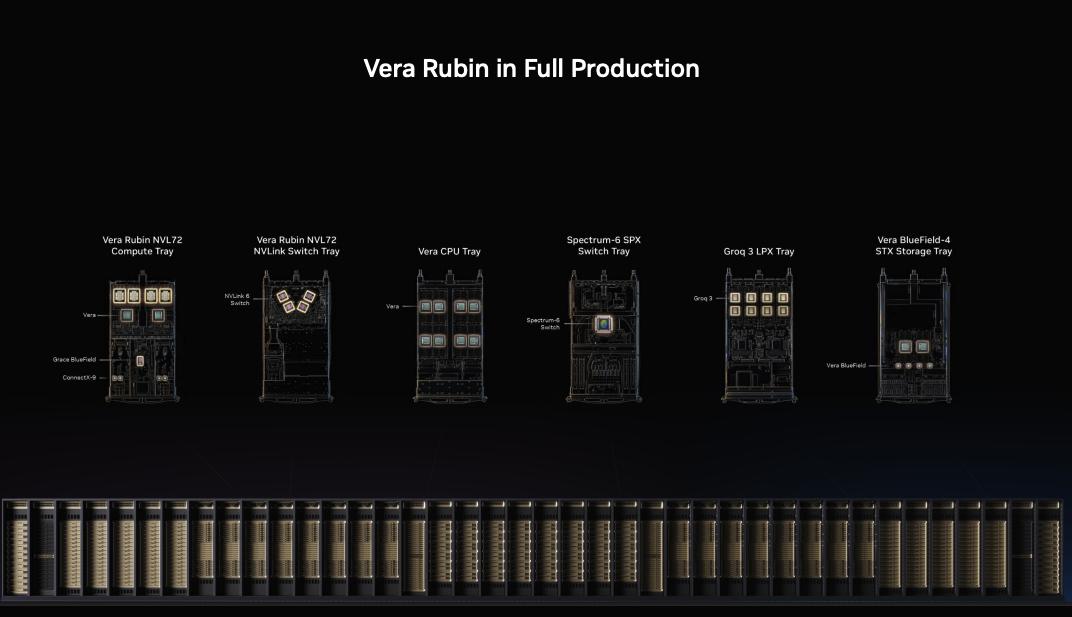
Jensen Huang said that Hopper is built for pre - training, Blackwell brings inference to rack scale, and Vera Rubin is designed for agents. Agents need to think continuously, access databases, call tools, and execute code. If the CPU can't keep up, the GPU will be idle; in an AI factory, idle GPUs mean lost revenue.
In addition to AI factories, Jensen Huang also referred to 'physical AI' as the next wave of growth. He believes that robots, cars, and factories will become agents in the real world, capable of perceiving, reasoning, planning, and acting autonomously. NVIDIA will train models in AI factories, conduct simulations with Omniverse, and then run the models on robots and devices through computing platforms such as Jetson.
Jensen Huang also expressed an optimistic attitude towards long - term growth rates and the impact of ASICs, emphasizing that this round of construction will be measured in decades, and NVIDIA's infrastructure can provide the best inference economics.
In terms of shareholder returns, Jensen Huang said that the plan is to return 50% or more of free cash flow to shareholders this year, next year, and in the future.
The voting at the annual general meeting of shareholders was generally uneventful. Shareholders approved the company's executive compensation plan through an advisory vote and approved the re - election of all 10 board members. Another proposal from external shareholders was passed, which requires amending the company's articles of association so that all shareholder voting matters can be passed by a simple majority vote.
The following is a transcript of Jensen Huang's 'Business Update' and the Q&A session at NVIDIA's general meeting of shareholders (AI - assisted translation, with some content abridged)
Jensen Huang's Business Update
This has been an extraordinary year for NVIDIA and the entire computing industry. Every 10 to 15 years, the computer industry undergoes a reset: from mainframes to PCs, from PCs to the Internet, from the Internet to the cloud, and from the cloud to the mobile cloud. This time, the reset is even greater.
In the past 60 years, humans have written software, and computers have executed instructions. This paradigm has changed. With AI, computers can understand, reason, plan, use tools, and perform useful work. Computers are no longer just tools. In the AI era, they are assistants that can use tools. As an extension, data centers are no longer just 'tool sheds'; they are AI factories composed of digital assistants and are the infrastructure for producing digital intelligence.
NVIDIA is building computing infrastructure for this new era.
Two years ago, generative AI caught the world's attention. ChatGPT can write, draw, summarize, and answer questions. Subsequently, inferential AI learned to think about problems. Now, agent AI has arrived. Agents can use tools, access memory, write code, call other agents, test results, and keep working until the task is completed.
Software programming is the first major breakthrough application scenario on the enterprise side. This is important: AI is now useful. When AI can perform useful work, tokens become valuable; when tokens can bring profits, the demand for computing power will accelerate.
Look at the evidence. GitHub developers merged 300 million pull requests in 2023 (Note: A pull request is a request made by a programmer to a project, saying 'Please merge my code'), 400 million in 2024, and 500 million in 2025, showing a clear and stable upward trend. However, in the first few months of 2026, this speed almost tripled. Obviously, this means that the world's approximately 30 million software developers - who receive about $3 trillion in annual salaries and whose work supports the world's $100 trillion in economic activities - are being amplified by AI. With the help of agents, the same workforce is now creating nearly $9 trillion in output, an increase of $6 trillion.
Programming is just one of the demand - driving factors. Useful AI has arrived. The question of AI's return on investment has been answered, and industries across the board are competing to adopt agent AI.
NVIDIA's revenue increased by 65% to $216 billion. Operating income increased by 60% to $130 billion. Diluted earnings per share increased by 67% to $4.90. We generated $103 billion in operating cash flow and returned $41 billion to shareholders.
Data center revenue reached $194 billion, a 68% increase. Blackwell significantly expanded the coverage of NVIDIA's infrastructure among different customer groups, including hyperscale cloud providers, cloud service providers, AI laboratories, industrial enterprises, and sovereign customers. Model developers and hyperscale cloud providers have cumulatively deployed hundreds of thousands of Blackwell GPUs. The construction of AI factories is still expanding rapidly in major industries. Companies such as Capital One, Hyundai Motor Group, Jane Street, and Eli Lilly are expanding NVIDIA's infrastructure to deploy AI.
International revenue more than tripled, exceeding $30 billion. Nearly 40 countries/regions, representing a total GDP of $50 trillion, are building AI factories powered by NVIDIA's infrastructure.
AI infrastructure is no longer experimental; it has entered the production stage. AI is not just a model; it is a new industry. You can think of it as a five - layer cake: energy, chips and systems, infrastructure, models, and applications.
Traditional data centers store and provide file services. AI factories manufacture tokens. Tokens will become code, answers, designs, actions, and services.
Useful AI is profitable. Each token is a unit of profit, which is why the demand for computing power is extremely high. Customers are not buying computers; they are building AI factories capable of generating revenue.
The architecture of the (AI) factory is very important. The question is how much revenue this factory can generate and what the cost is. Inference is the process of generating tokens, and NVIDIA's Blackwell has set the standard. In the SemiAnalysis InferenceX benchmark test, Blackwell was recognized as the 'King of Inference', capable of providing the lowest cost per token and achieving 30 times the token throughput of the second - place platform.
This is why architecture is so crucial. NVIDIA's systems may not have the lowest purchase price, but NVIDIA can generate tokens at the lowest cost, with the highest token throughput, and the highest revenue.
Vera Rubin is the next step. Hopper is built for pre - training. Blackwell brings inference to rack scale. Vera Rubin is designed for agents.
Agent AI has changed the computing model. Agents think, use tools, access databases, retrieve memory, execute code, and repeatedly call applications until the task is completed. The large - language model running on the GPU is responsible for thinking, and the CPU must keep up. If the CPU becomes a bottleneck, the GPU will be idle. In an AI factory, idle GPUs mean lost revenue.
This is why Vera is important. Vera is a CPU for agents, and Rubin is a GPU for thinking. The storage and security capabilities on NVLink, Spectrum - X, BlueField, and software together connect these systems.
In fact, NVIDIA is the only company with three network businesses. NVLink connects the GPUs in a rack into a giant computer. Spectrum - X is an Ethernet built for AI. It can scale horizontally inside and outside the AI factory, and its scale now exceeds the sum of all other Ethernet network peers. InfiniBand provides the lowest - latency network for the world's largest AI and scientific computing systems.
These technologies combine to enable the AI factory to be optimized as a whole from the GPU to the rack, from inside the data center to across data centers.
Vera Rubin is not a single chip but an AI factory platform, and the ecosystem has already started to act. Vera Rubin is in full - scale production. Every major model developer, public cloud, AI cloud, and hyperscale cloud provider is preparing to build on it.
Vera opens up a brand - new market. So far, every CPU has been built for humans. We live in a world measured in seconds. Agents live in a world measured in nanoseconds. Every moment that the CPU makes the agent wait is a moment when the most expensive thing in the building - the GPU - is idle.
Therefore, we built a brand - new, agent - oriented CPU from scratch. This is a new market. CPUs for humans are divided and rented by cores. Agents do not rent cores; they require ultra - fast responses. In the future, there will be billions of agents, and they need CPUs built for themselves.
We believe that Vera will be one of the most important product launches in the company's history, and orders have already started to come in.
CUDA is one of the most important investments we've ever made. For 20 years, we've been working on the same accelerated computing architecture. The installed base attracts developers, developers create breakthrough applications, applications create new markets, and new markets expand the installed base. This flywheel is accelerating.
CUDA - X is a library stack built on top of CUDA. These libraries are NVIDIA's crown jewels. They solve some of the most difficult problems in the scientific and industrial fields, including computational lithography, optimization, genomics, physics, data processing, robotics, AI, wireless networks, and more.
Now, these libraries are becoming tools for agents. This week, we announced BioNeMo, a set of digital biology and drug discovery tools for agents.
NVIDIA is vertically integrated and horizontally open. We build a complete technology stack so that we can optimize the system end - to - end. Then we open it up so that the entire industry can build on it.
Our business is broad and becoming more diversified. To make it easier for everyone to understand our business, we now describe NVIDIA using two market platforms: data centers and edge computing.
In the data center field, we serve two markets: hyperscale data centers and AI cloud, industrial, and enterprise markets. Our customer base is diverse and growing.
Edge computing includes PCs, workstations, games, AI base stations, robots, and cars. We can serve all these markets because we have a unified architecture, a software stack, and a rich ecosystem.
Physical AI is NVIDIA's next wave of growth. Physical AI is agent AI in the real world. Robots, cars, and factories will be able to perceive, reason, plan, and operate in dynamic environments.
NVIDIA pioneered this field and built a complete closed - loop. AI factories train models; Omniverse simulates them in the virtual world; NVIDIA Jetson computers run in robots; and Cosmos is the world's foundational model that drives all this.
Robots and robot systems are being built in various industries, from transportation, manufacturing, surgical robots to hotels and the service industry.
In the past few months, there has been a huge acceleration in AI. Finally, I'd like to emphasize a few points: Useful AI has arrived, and it is profitable. Therefore, computing power is revenue. Vera Rubin is in full - scale production. Vera is opening up a brand - new CPU market for agents. Every enterprise is becoming an agent company, and they all run on NVIDIA.
The AI era is moving forward at full speed, and NVIDIA is building the infrastructure to drive this era.
As we grow, we will continue to increase R & D investment, invest in our ecosystem, and return capital to shareholders. We recently announced a significant increase in dividends and an expansion of the stock repurchase plan. We plan to return 50% or more of free cash flow to shareholders this year, next year, and in the future.
Thank you.
Transcript of Some Q&A
Question: How sustainable is the current AI infrastructure construction? When will the main driving factors of your business mature, and when will the growth slow down?
Jensen Huang: As I mentioned in my speech, AI is not just a model. It represents a fundamental transformation in the field of computing. For 60 years, computing has mainly been about retrieving, storing, and sending information; now, computing is being reinvented by AI to generate intelligence.
Tokens are the basic units of intelligence. They are manufactured in a new type of data center - the AI factory - and generate revenue through commercialization. The more computing power, the more tokens, and the more revenue.
This round of construction will be measured in decades, similar to the construction of other key infrastructures such as the power grid, transportation systems, and the Internet. We believe that this will be the largest infrastructure construction in human history.
Agent AI is accelerating infrastructure investment because this is the first time AI has truly started to do practical work and create real economic value. As various organizations seek to mass - produce intelligence, the demand for AI factories will far exceed today's cloud computing and extend to enterprises, sovereign countries, and regional AI clouds.
NVIDIA, with its full - stack, end - to - end co - designed infrastructure and a large partner ecosystem to support these projects, can drive the construction of AI factories in a unique way.
The next major growth stage is physical AI, and this has just begun. Over time, AI will move from the digital world to robot taxis, humanoid robots, and industrial systems, enabling these machines to perceive, reason, and act autonomously in the physical world.
Driving physical AI requires a new round of infrastructure investment. In this field, NVIDIA provides AI infrastructure, the Omniverse simulation and digital twin platform, open models, the Jetson Thor embedded computing platform, and a software stack for large - scale development and deployment of physical AI.
We have a long growth runway ahead.
Question: NVIDIA GPUs currently support most of the world's artificial intelligence training infrastructure. As inference workloads exceed training, how confident is NVIDIA that the GPU architecture will still be the preferred platform for large - scale inference?
Jensen Huang: NVIDIA is indeed very good at training. With Blackwell, we have also established our leading position in the field of inference.
Inference is enabling AI to achieve commercialization. Since data centers are limited by power, their token throughput and revenue potential depend on the per - watt performance of the AI infrastructure.
In the SemiAnalysis Inference - X benchmark test, Blackwell was called the 'King of Inference', achieving the best per - watt performance, the lowest token cost, and 30 times the token throughput.
In the latest round of MLPerf inference benchmark tests, we achieved our seventh consecutive victory. For AI agents, the results of Artificial Analysis's New Agent Perf show that compared with Hopper, the Grace Blackwell 300 NVLink 72 system can run up to 20 times more agents per megawatt of power consumption.
This superior performance is the result of NVIDIA's extreme co - design at the chip, system, algorithm, and software levels. NVIDIA's AI infrastructure provides the best performance and therefore the best inference economics.
But our advantage is not only in leading performance. Our large installed base allows developers to reach the most AI users. NVIDIA's programmable GPU architecture runs more than 7,000 applications, bringing the greatest revenue opportunities for cloud customers, as well as potential in financing and off - take.
For enterprise and sovereign customers, NVIDIA provides unparalleled deployment flexibility, the most widely used leading open - source models for custom AI, and the industry's most in - depth IT ecosystem support.
Today, most of NVIDIA's computing footprint is used for inference. We are in a favorable position to further expand our share, as evidenced by our recent announcements with Anthropic and