Claude writes 80% of the code, yet Anthropic's engineers are feeling increasingly isolated
The people who created Claude Code have already tasted the loneliness it brings.
“Writing code is no longer a bottleneck.”
Fiona Fung, the engineering lead at Anthropic, said this on the Lennys Podcast a few days ago.
She is in charge of Anthropic's Claude Code and Cowork teams, and even Boris Cherny, the father of Claude Code, reports to her.
It is the two products led by her that have pushed Anthropic's code output to a historical high.
A piece of data recently released by Anthropic shows that the average quarterly code output per engineer at Anthropic is now eight times that from 2021 to 2025.
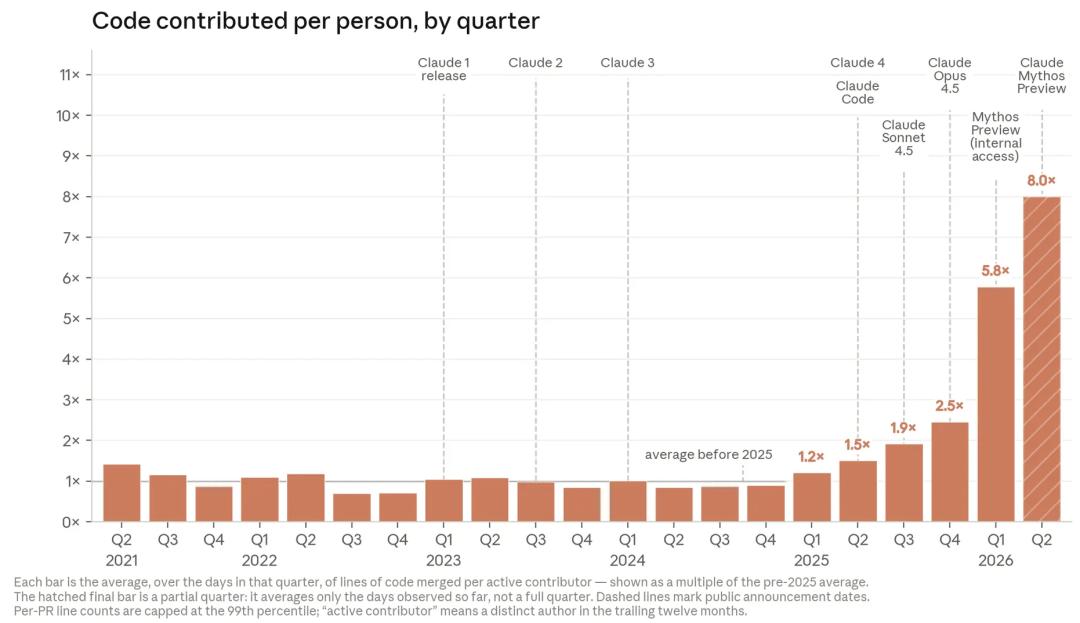
Changes in the average quarterly code output per engineer at Anthropic (using the average before 2025 as a baseline of 1x). It has been rising sharply quarter by quarter since 2025: 1.2x in Q1, 1.5x in Q2, reaching 5.8x in Q1 2026, and surging to 8.0x in Q2. The rightmost striped column represents a partial quarter that has not ended. Source: Anthropic's report “When AI Builds Itself”
It is the team led by Fiona that has driven this eight - fold increase in efficiency. This team is responsible for both the Claude Code and Cowork product lines and is known as “the most AI - enabled” engineering team in the world.
However, in the same conversation, Fiona also mentioned another thing beyond technological breakthroughs: team members are talking to each other less and less recently, and work has become a lonely experience.
A team that claims 80% of its code is written by Claude has been the first to feel the loneliness brought by using Claude.

Fiona Fung, the engineering lead of the Claude Code and Cowork teams at Anthropic
During the conversation, the host, Lenny, asked Fiona this question: What exactly is lost in this new world of software engineering?
She mentioned that team members are communicating less because of excessive use of AI, resulting in less social interaction and the accompanying sense of loneliness.
On one hand, there is a mad dash for eight - fold efficiency; on the other hand, there is the loneliness seeping quietly from the interpersonal vacuum.
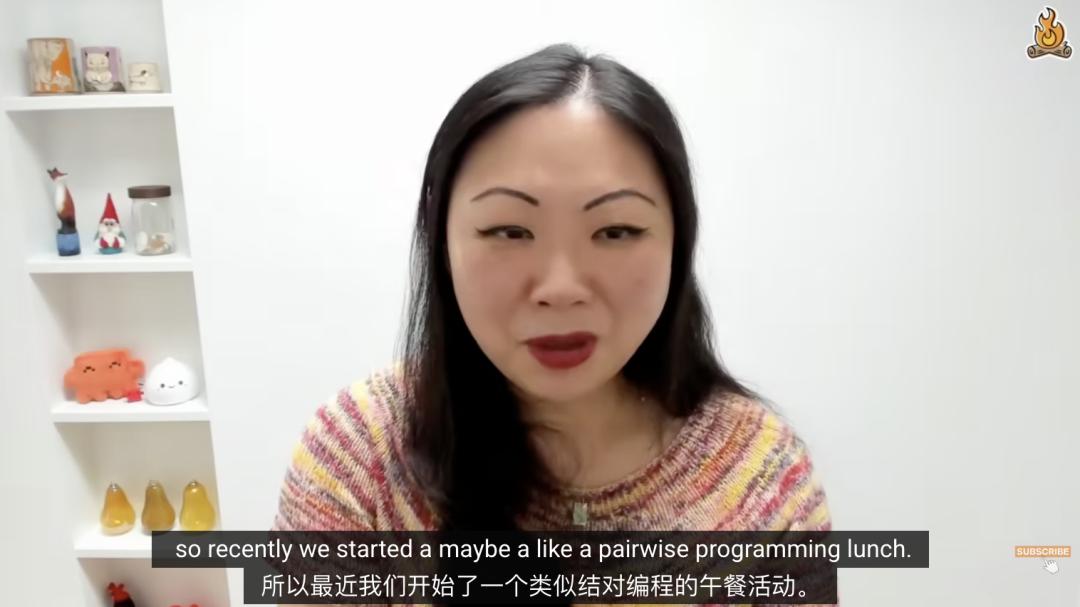
This is why this company that has taken AI programming to the extreme relies on in - person offline activities such as hackathons and pair - programming lunches to restore the lost connections between people.
When Collaboration Becomes “Parallel Play”
In the past, the mainstream way for engineers to write code was pair programming. Two people would share one machine, one typing and the other watching, chatting while writing. Knowledge was naturally passed on through such exchanges.
The host, Lenny, felt this deeply.
He said that he had been an engineer for ten years. In the past, a team of people would work together on a set of code, with some working on the backend, some on the frontend, and some on iOS, all working together to solve the same problem. Now, it's “ten Claudes running in parallel,” each doing its own thing.
He used a very apt term and said it was like “parallel play” among toddlers: several children sitting side by side, not disturbing each other, building their own blocks.
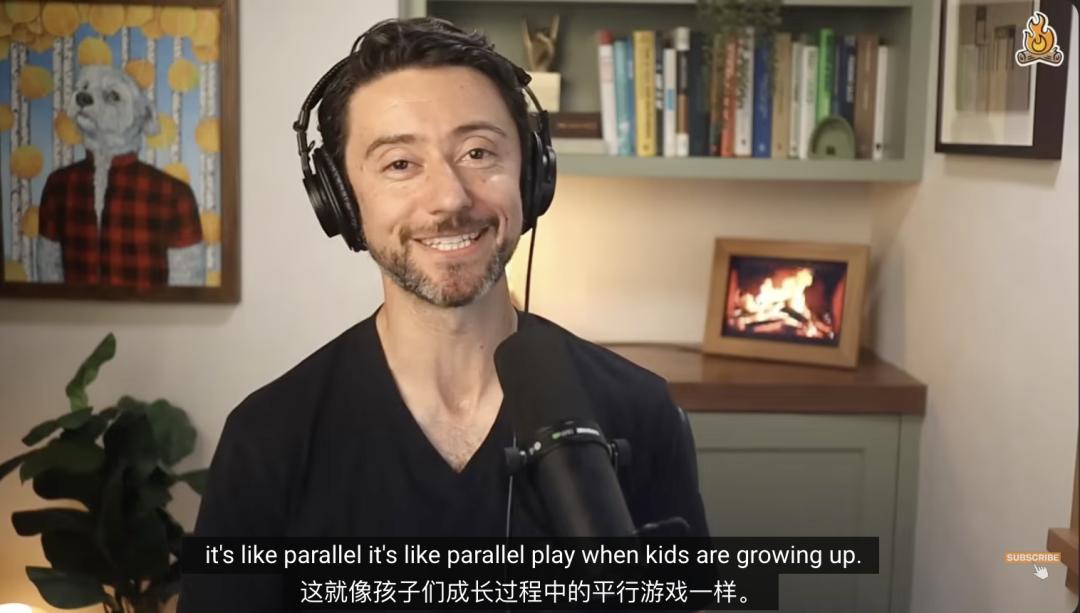
Fiona agreed with this statement and added, “When we do pair programming, we can actually learn so much from each other. Every time I see how others use it, I can learn something myself.”
In the past, it was “human + human,” but now it's “human + AI.”
A study comparing “human + AI” and “human + human” pairs found that the frequency of knowledge transfer between humans and AI is actually similar to that between humans. However, the interaction is more one - way, and developers scrutinize AI suggestions less than those from colleagues.
In other words, collaboration still exists, but the “sociality” of human - to - human communication is gone.
To restore the lost connections, Fiona's team has come up with some simple methods: pair - programming lunches, hackathons, and grouping “focus periods” together.
In short, it's about creating reasons for engineers to sit together again.
Cost
Far More Than Loneliness
Beyond loneliness, Fiona also pointed out another “by - product”: context switching.
When a person has a bunch of agents running simultaneously, their attention is fragmented:
If you have 20 agents running, there will be endless checking and reviewing, and you also have to remember what you were doing just now.
The host asked if there was a solution, and she admitted that there was none yet.
There is also a more hidden loss - flow.
Lenny recalled his days as an engineer: When facing a tricky bug, he would put on his headphones, play a song, immerse himself in it, and finally, when he saw it compile successfully, he would feel so excited that he wanted to shout.
Fiona said that this kind of experience is indeed fading: “I've heard other engineers say that some of the difficulties I used to enjoy the most are gone now.”
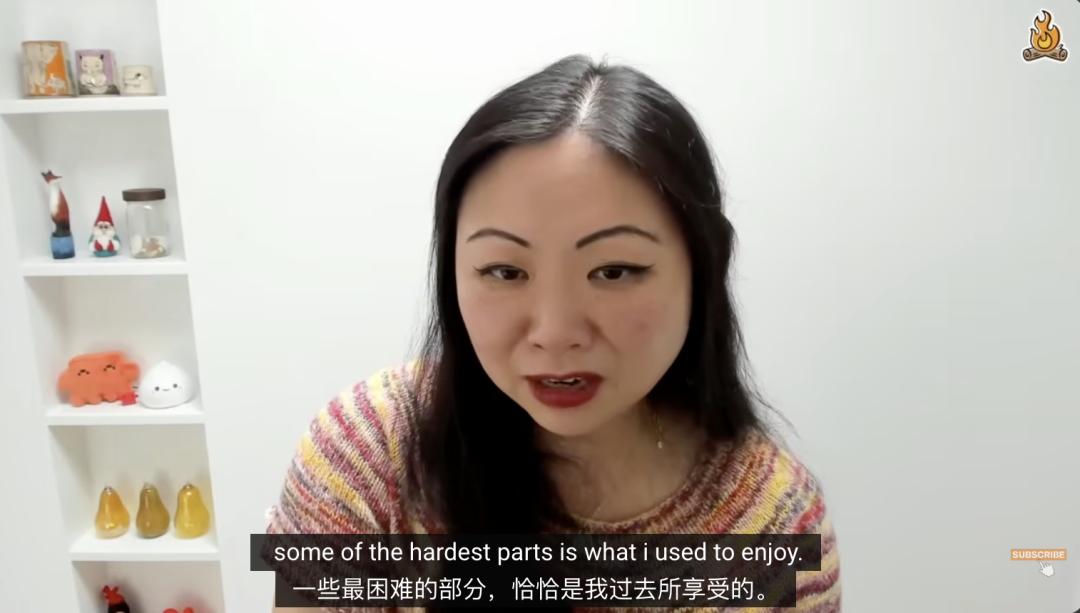
What is most addictive is exactly the “most difficult part,” and it happens to be what AI is best at. When it is automated, the fun is taken away as well.
A deeper problem than loneliness is the weakening of the meaning of work.
In the report “When AI Builds Itself” about AI recursive self - improvement, an employee described their state like this:
When things go smoothly, they feel that everything they do is unimportant because everything has been automated and may be done faster and better than they can. But once the system crashes and they can't find the cause, they suddenly realize that they don't know what they've been busy with all this time.
This is not just an outburst of individual emotions.
Lenny also mentioned a friend who works in data science. Now, most of his time is spent reviewing not - so - good analyses run by others using AI, “and half of the time they are wrong,” which has completely changed the nature of his work.
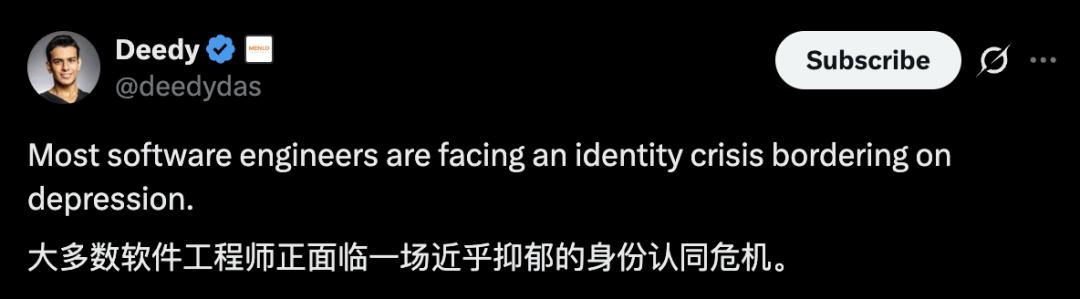
Deedy Das, a partner at Menlo Ventures, even mentioned that most software engineers are facing an “identity crisis bordering on depression.” He divides people into two categories:
One category is the “slackers” who are heavily dependent on AI and have less and less sense of participation. They seem to have the easiest time, as code comes to them with just a request. But once they are without AI, it is becoming increasingly unclear what they can actually do.
The other category is the senior engineers he calls “craftsmen,” who have to understand, review, and patch the large amount of code generated by AI. These craftsmen are very tired now. They not only bear the full burden of review but also find that the craft they love is dying.
The Bottleneck Won't Disappear
It Just Moves to Another Place
In Fiona's view, writing code is no longer a bottleneck, but this bottleneck won't disappear out of thin air; it will just shift elsewhere.
For example, verification.
“We didn't even have Claude code reviews last year, and human reviewers were a very big bottleneck at that time.” When code generation becomes fast enough, humans can't keep up with the review, and it becomes a new choke point.
What's more troublesome is that the number of people submitting code has also increased. “Now, it's not just engineers. Our designers, PMs, and everyone on the Claude Code team is submitting code.”
With different job roles writing code and such a high throughput, how to do verification has become a question that Fiona keeps asking.
In traditional software companies, writing code is a professional task with a threshold, and designers and product managers are kept out. In Fiona's team, this threshold has been removed by Claude. Anyone with an idea can have the model turn it into runnable code.
It sounds like a complete liberation, but it also means that the professional boundaries of engineers are becoming blurred.
What Do Hackathons and Pair - Programming Lunches Bring?
In April this year, Claude fixed more than 800 API errors in a month. It would take a human four years to do this job.
But Fiona is also aware of the cost behind this.
She said that Boris used to write code by hand in the early days, and his understanding of the architecture was accumulated through writing line by line. However, new employees nowadays may not have this process.
“Maybe one day this won't matter,” she said, “but at our current pace, I still think you have to take the time to understand the layer you rely on.”
This is her awareness: the more powerful the tools, the more we need to be wary of people being emptied unconsciously.
What worries Fiona more is “the next generation.” The path of engineer growth that she and Lenny took no longer exists.
She posed a question without an answer: If a software engineer never has to look at code again, what motivation does he have to really understand how the infrastructure runs and how memory is allocated at the most basic level?
So, looking back at her hackathons and pair - programming lunches, what they aim to make up for is not just the atmosphere but also knowledge transfer, team culture, and the sense of confirmation that engineers have that “I'm doing something meaningful.”
These are things that Claude cannot write for.
Behind the Loneliness
The Role of Programmers Has Changed
The sense of loneliness is just on the surface. Behind it, the job of engineers is being redefined.
The most extreme example is Boris.
He hasn't written a single line of code by hand for more than eight months. Instead, he commands an army of AI agents to do the work for him: sometimes hundreds, sometimes thousands, or even tens of thousands.
Similarly, Fiona's own work style has also changed.
She has set up a routine that automatically reviews feedback and assigns tasks to agents for her at a fixed time every day. When she wakes up in the morning, there is already a batch of code merge requests waiting for her to review. As the abstraction layer keeps rising, she is getting farther and farther away from the specific code.
It's not just them. Anthropic once conducted an analysis under privacy protection of about 400,000 Claude Code sessions, and the conclusion was clear: in a typical session, humans make about 70% of the planning decisions but only about 20% of the execution decisions.
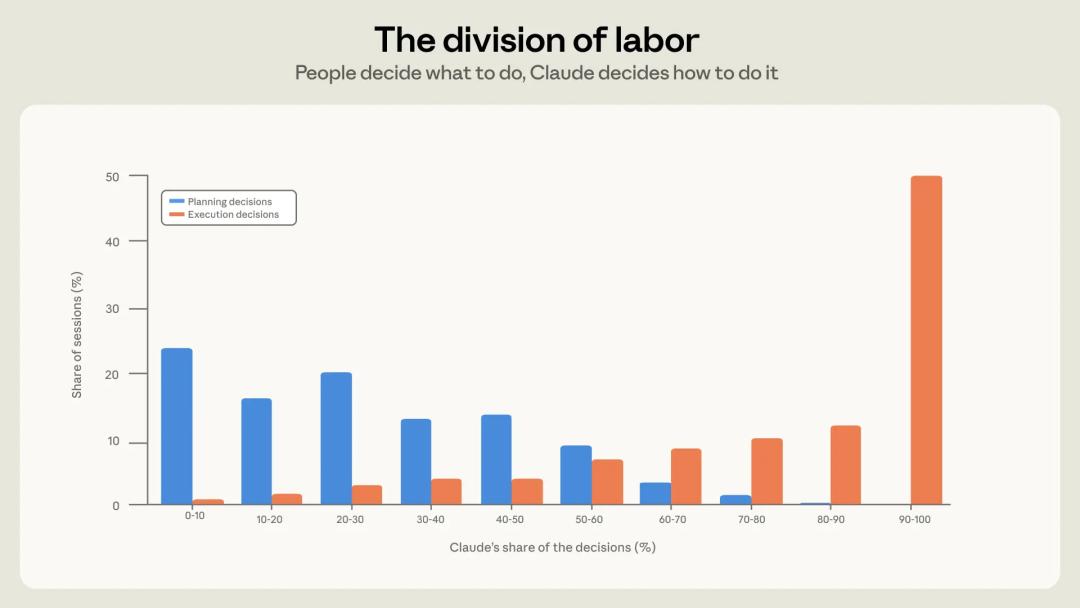
Decision - making division of labor between humans and Claude. Blue represents planning decisions (what to do), and orange represents execution decisions (how to do it). The concentration of blue on the left means that planning is mostly decided by humans; the concentration of orange in the 90–100% range on the far right means that execution is almost completely handed over to Claude.
Humans decide what to do, and Claude decides how to do it. This division of labor has been established.
What really determines success or failure is not programming background but domain expertise: the more you understand the problem you need to solve, the more and more accurately the model will do the work for you.
In other words, “people who write code” are becoming “people who command code.”
What's left of the “role” now?
Lenny relayed a statement on the show, which Fiona highly agreed with: What you spend the most time on is your current role.
References:
https://fortune.com/2026/06/23/anthropic-engineering-head-claude-code-lonely-experience-big-tech-morale/
https://www.anthropic.com/institute/recursive-self-improvement https://x.com/deedydas/status/2068238634600554699
This article is from the WeChat official account “New Intelligence Yuan”. Author: ASI Revelation, Editor: Yuanyu. Republished by 36Kr with permission.