Themed Roundtable: New Algorithms for Life, AI Reconstructs the Full Chain of the Healthcare Industry | 36Kr WAVES 2026 New Wave
"In 2026, the waves in the venture capital circle are surging again: AI has moved from a technological concept into the deep waters of the industry, and hard - tech entrepreneurship has changed from a 'niche track' to a'mainstream consensus'. Young entrepreneurs are redefining the future coordinates of Chinese innovation with codes and their hands.
Every year, the WAVES Conference hosted by 36Kr · AnYong is the annual barometer of the Chinese venture capital circle. This year's WAVES 2026, themed 'This Summer', was held at Liangcang Xinzao Creative Park in Panyu, Guangzhou. Over two days, we gathered top - tier investors, industry leaders, and emerging entrepreneurs. Through 14 in - depth round - table discussions and dozens of independent speeches, we dissected the underlying logic of core tracks such as AI, hard tech, going global, and healthcare, and witnessed how the perseverance of those 'few' converged into waves that change the industry."
On the afternoon of June 17th, a round - table dialogue with the theme of 'New Algorithms of Life - AI + Healthcare Round - Table' was held at the WAVES2026 New Wave Conference.
The following is the content of the dialogue, sorted and edited by 36Kr:
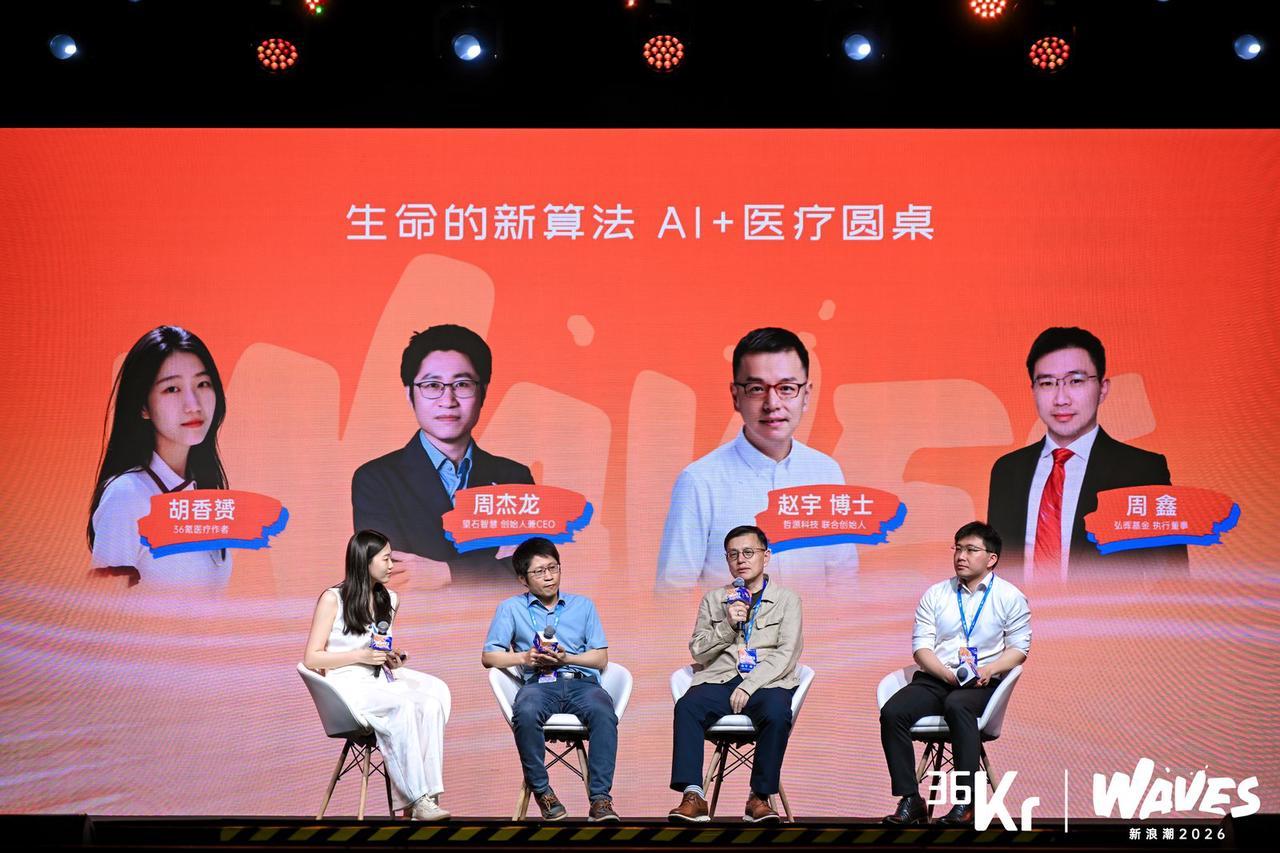
Hu Xiangyun | Medical Author at 36Kr (Host)
Zhou Jielong | Founder and CEO of Wangshi Intelligence
Dr. Zhao Yu | Co - founder of Zheyuan Technology
Zhou Xin | Executive Director of Honghui Fund
Hu Xiangyun: Good afternoon, everyone! Welcome to the 36Kr WAVES round - table forum on 'AI Healthcare - New Algorithms of Life'. 'New Algorithms of Life' is actually a rather grand and philosophical topic. The reason we named this round - table with this title is that we are now at such a turning point. AI for Science has become an important support for the new round of global scientific and technological revolution. In the relatively traditional healthcare field, which was previously considered difficult to be transformed by algorithms, AI has also become indispensable. There is no need to mention much about target discovery and molecular design at the R & D level. At the industrial level, the IPO process of some AI - driven pharmaceutical companies is accelerating; in the wave of BD going global, the presence of AI companies is becoming more and more prominent.
So, today we are very honored to invite three guests from the industry and the investment community to share their observations with us. Please introduce yourselves briefly one by one, such as what your company is doing with AI; or what issues your investment institution pays more attention to when investing in AI - driven pharmaceutical/AI healthcare projects?
Zhou Jielong: Hello, host. Thank you very much for the invitation from 36Kr. I'm Zhou Jielong, the founder and CEO of Wangshi Intelligence. Wangshi Intelligence is a technology company that uses artificial intelligence to drive new drug R & D. We are building an AI - driven pharmaceutical system based on a microscopic world model with multi - agent collaboration. Currently, we have two basic platforms. One is an AI platform based on a microscopic world model, which we call the 3D small - molecule generation model; the other is a full - chain intelligent agent system that connects the early stages of pharmaceutical R & D with multi - agents. Both of these systems rely on the rich data assets we have accumulated over the years and our completely self - developed models.
Currently, we have cooperated with hundreds of domestic and foreign pharmaceutical and scientific research institutions, and have promoted multiple pipelines into clinical trials. In May this year, we reached a tripartite strategic cooperation with Guangzhou Pharmaceutical and Huawei to jointly implement AI - driven pharmaceutical R & D solutions.
Zhao Yu: Hello, everyone. Thank you very much for the opportunity to enter the world of young people. We are Zheyuan Technology, a team focusing on life sciences. The biological model can be simply understood as: we have built a brand - new technological system for understanding life. Different from the common research ideas of evidence - based medicine and structural biology in the industry, we follow the computational medicine technology route. We rely on omics data to build an artificial intelligence system, analyze life and genetic diseases, and explore the underlying logic of disease onset, the mechanism of human diseases, and the intervention effects of target perturbations on diseases. Our core technology, the 'digital twin technology of life functions', has been recognized as the 'National Disruptive Technology' by the Ministry of Science and Technology for the first time.
Over the years, we have achieved many practical results. For example, we have completed a prospective virtual clinical trial, which has now been iterated to the fifth version; in addition, we have publicly disclosed the phase - I clinical data of PR00012, a class - I innovative drug for pancreatic cancer, and completed the virtual verification of more than a hundred targets.
We believe that, deduced from the first - principles, the underlying logic of AI - driven pharmaceutical R & D should be to understand the disease first, then discover effective targets, and finally guide molecular generation. This is also the core working direction of our team.
Zhou Xin: Honghui Fund is a venture capital institution focusing on the healthcare + technology field. It has been established for 12 years. Currently, it manages assets of nearly 30 billion yuan and has invested in about 200 enterprises in total. The healthcare track is our key investment area, among which 60 are invested enterprises related to innovative drugs. At present, AI - driven pharmaceutical R & D is our core layout direction. From early - stage target discovery, molecular design, molecular optimization, and molecular screening to later - stage AI - enabled clinical trials, we are continuously exploring and laying out the entire industrial chain. I'm very honored to communicate with all industry practitioners today.
Hu Xiangyun: The fields focused on by the three guests today are still quite different. The next question is for the two entrepreneurs first. We are very curious. In the real - world implementation scenarios of enterprises, compared with the traditional R & D model, what original processes or R & D ideas has AI changed or subverted? Mr. Zhou, Wangshi Intelligence has been deeply involved in the intelligent agent for early - stage small - molecule R & D and has built a complete closed - loop from targets, molecules to wet experiments. Please share first.
Zhou Jielong: Wangshi Intelligence has always focused on the early stages of drug R & D. So, I'll share my actual implementation experience in the early - stage R & D process.
The early - stage drug R & D process usually follows the so - called 'DMTA cycle', that is, the four major links of design, synthesis, testing, and analysis. In fact, no matter how the technology iterates, this process framework is always retained. However, the traditional model is completely driven by humans. In the complete traditional R & D process, industry experts rely on their own experience to complete molecular design, then preliminarily evaluate molecular activity, druggability, and synthesizability based on experience, and finally hand it over to the synthesis team for synthesis and biological testing. The whole process relies on manual connection of each link.
This traditional model has three core pain points: First, molecular design completely relies on experience and intuition. In the current highly competitive industry, it is very easy to have patent conflicts and insufficient patent innovation; Second, the link chain is long. In the fully manual transfer mode, each link is also prone to break, being extremely fragmented; Third, the problem of data islands is serious. The industry has accumulated a large amount of R & D data, but due to manual transfer and inconsistent standards, the data formats and standards of each link are inconsistent, and the data assets accumulated by enterprises cannot be transformed into core competitiveness.
To address the above pain points, we have built a full - stack intelligent R & D system based on intelligent agents: First, to address the pain points of molecular design, we have developed a multi - modal AI 3D small - molecule generation platform with a large - model base that combines language models and geometric models to assist experts in molecular design and avoid innovation defects caused by experience; in addition, we have implemented a multi - agent system that relies on intelligent agents to autonomously connect the entire R & D process, realizing automated data management and autonomous process execution. Third, all the data from the entire R & D process can be stored in the digital compass system of the intelligent agent. In the past, for most pharmaceutical companies, the project cycle was long, and R & D data was scattered and stored in various files such as PPT, Excel, and PDF. The data could not be unified and stored, and there was even a risk that core R & D results would be preemptively patented by competitors. Based on this digital compass, pharmaceutical companies can unify and store all their digital assets.
In summary, we have transformed and upgraded the original industry model, changing from'storing R & D ideas in the human brain and relying on manual communication to connect processes' to deeply integrating AI into the R & D design logic, relying on intelligent agents to autonomously drive the complete R & D process, and realizing the paradigm of continuous data storage and reverse iteration of models.
Hu Xiangyun: In short, AI can activate the large amount of real R & D data accumulated by the industry over the long term. Next, please let Dr. Zhao share.
Zhao Yu: There are two core keywords in this question: the impact of AI on the industry and the subversion of the R & D paradigm. I'll share based on the first - principles.
In the biomedical industry, developing a new drug is of great value. However, in the traditional model, a large number of drugs conduct repeated clinical trials on the same target, continuously consuming clinical resources. This is also the core significance of the implementation of AI for Science at present.
Many people think the concept of AI for Science is empty, but it's actually not. The core advantage of humans is the use of tools. Life is essentially a complex data set across scales and non - linear. It's very difficult for the human brain to fully analyze this complex system. The upper limit of the IQ of ordinary people is limited, and even the IQ of top - tier scientists has a ceiling. The era of relying solely on the human brain to analyze the high - dimensional life system has passed.
The essence of AI for Science is to rely on machine learning and neural networks to build a high - dimensional analysis model far beyond the upper limit of human cognition, make up for human cognitive shortcomings, and discover new laws, insights, and discoveries in life sciences. It can be compared to embodied robots. Robots are an extension of human physical functions, while AI models are an extension of human cognition and the brain.
Returning to life science research, human understanding of life is equivalent to human understanding of the universe, and there are a large number of unknown areas in both. We can't continue to rely on the subjective guesses and repeated experiments of industry experts for research. Medicine itself is an experimental science, but the complexity of the life system far exceeds human current cognition. We can't rely on simple linear experiments to deduce all disease mechanisms.
Molecular R & D is the carrier for drugs to intervene in diseases. But before developing molecules, we must first understand the underlying logic of the disease to accurately locate the target. If the target is inside the cell, it is suitable for small - molecule drugs; if the target is on the cell membrane surface, it is suitable for large - molecule drugs; if there is no clear target, cell therapy can be considered. Simply optimizing molecules can only improve the efficiency of molecular screening and cannot change the underlying logic of traditional R & D.
Currently, the general paradigm for global drug R & D is 'writing the answer first and then finding the question', that is, developing molecules with patent protection based on known targets. After the molecular R & D is completed, we then look for suitable diseases in reverse. This model has two paths. The first is imitation. In the past 30 years, China has been a major country in generic drugs, mainly replicating overseas mature drug targets and molecules and conducting repeated clinical trials; the second is independent exploration. When there are no reference targets, we put the developed molecules into clinical trials one by one for trial - and - error. Drug R & D, clinical trials, and ethical approvals all require extremely high costs, and the trial - and - error cost is unbearable.
We have built a new R & D paradigm based on the first - principles. First, we fully analyze the disease, lock in the suitable target, then select the appropriate drug form, and plan the clinically applicable population and disease subtypes simultaneously. Take our pancreatic cancer pipeline as an example. After fully disassembling all pancreatic cancer subtypes and locking in the exclusive target, our phase - 1B clinical data can be compared with the mature phase - 2A clinical research in the industry. At the early stage of drug R & D, we have clearly determined that in addition to pancreatic cancer, this drug can also be used for the treatment of colorectal cancer and stone disorders. When the first subject is enrolled in the clinical trial, we can predict the applicable scope of the drug. This is the new R & D logic of 'determining the question first and then writing the answer'.
The human body has 25,000 coding - region genes, and each person carries 300 - 500 gene deletions, amplifications, and mutations. Individual genetic differences are the core inducements for the differential onset of diseases. We need to analyze the global impact of individual gene mutations on the body's life functions through models. This is also the core research direction of Zheyuan Technology.
Hu Xiangyun: It's equivalent to the industry used to focus on developing First in class (FIC) molecules. Now, the industry's thinking is changing, turning to First in disease (FID), starting R & D from the root cause of the disease.
The two enterprise founders have shared a new industrial perspective. Next, I'll hand the question to Mr. Zhou. By 2026, the market sentiment of AI healthcare and AI - driven pharmaceutical R & D is significantly different from the previous two years. Some investors even say that only teams that can master AI well can raise funds. From the perspective of capital, how do you judge the current stage of the AI healthcare or AI - driven pharmaceutical R & D track? What one or two core characteristics do the targets that investment institutions are willing to hold in the long term usually have?
Zhou Xin: This is actually a core proposition that we have been speculating and discussing internally for a long time. I'll answer the question about the development stage of the track first: The implementation process of AI in the pharmaceutical industry is consistent with that in other industries. Currently, it has reached a critical turning point in the industry's development.
Our fund has been systematically tracking AI and related tracks since 2016. Ten years ago, there were very few mature projects in AI - driven pharmaceutical R & D. At that time, the mainstream in the market still focused on AI - based medical image diagnosis, such as lung nodule recognition. We investigated more than 40 related enterprises at that time, but finally did not make an investment. The core reason was not the lack of AI technical ability, but the immaturity of supporting regulations and industrial implementation conditions. It was not until last year that we truly felt that AI technology had the ability to be implemented maturely. Even in the traditional R & D paradigm of 'first molecule, then indication', AI could release real industrial value. Since then, we have decided to increase our investment layout in the AI - driven pharmaceutical R & D track.
Now, let's talk about the screening criteria for long - term partner enterprises: Enterprises that can survive the cycle must have the core ability to build high - barrier moats. The moats in the AI track are divided into three dimensions: computing power, algorithms, and data, among which data is the core barrier.
Enterprises must have: First, exclusive and sufficient self - owned data; Second, the ability to iterate self - developed algorithms, being able to independently optimize models and repair the inherent defects of open - source algorithms; Third, sufficient computing power support. Computing power essentially corresponds to financial strength. Enterprises need to have the ability to continuously raise funds and complete multiple rounds of financing such as Series A, B, and C to support R & D investment of tens of millions or even hundreds of millions of dollars. These are also the core consideration dimensions for us to screen projects.
Hu Xiangyun: That is to say, AI technology has reached a stage where you think it's worth investing, and it can be implemented in real R & D scenarios.
Actually, after achieving this goal, another core issue that everyone has been concerned about for a long time is how to achieve sustainable commercialization in AI - driven pharmaceutical R & D. Reviewing the development history of the biomedical industry, multinational pharmaceutical companies (MNCs) have always played a key role in the implementation and iteration of new technologies. In the past two years, one of the mainstream exploration paths in the industry was BD going global, relying on product and technology platform licensing to stabilize cash flow; but from the end of last year to the first half of this year, this cooperation model has gradually been upgraded and shifted to the co - construction of pharmaceutical infrastructure. For example, the cooperation between Eli Lilly and NVIDIA, and the cooperation between Merck and Google Cloud, with the transaction amounts reaching the level of one billion US dollars. This year, Wangshi Intelligence has also reached a similar tripartite cooperation with Huawei and Guangzhou Pharmaceutical. I'd like you to analyze the changes in the industry's BD cooperation model and the considerations of Wangshi Intelligence for this cooperation.
Zhou Jielong: We have indeed noticed some fundamental changes in this industry. From the end of last year to the first half of this year, there have been a series of high - profile collaborations among overseas leading pharmaceutical companies. For