This forgotten cultural history was written with his very life.
"If you want to understand the spirit of an institution, you have to read its publications."
——These words were spoken by a banker a hundred years ago. How many people still remember them today?
The person who said these words is Zhang Gongquan, the father of modern Chinese finance.
He was not only good at running banks but also at running newspapers and magazines. He personally built the newspaper and magazine system of the Bank of China. He used "The Bank of China Monthly" to "foster the team spirit" and "The Bank of China Life" as the "family communication organ" for employees. He firmly believed that if you want to know where the soul of an institution lies, you have to read its in - house publications.
These words still strike a chord today.
But here comes the problem: For a hundred years, almost no one has systematically sorted out the newspapers and magazines run by Zhang Gongquan and other business elites of his era. They have been lying dormant in the corners of archives, libraries, and second - hand bookstores, covered with dust and ignored.
Until a person appeared.
His name is Ma Xuebin, a "pioneer".
In the late 1970s, Ma Xuebin was a young editor - in - chief of an enterprise newspaper. In his spare time, he began to ponder a niche topic that no one else was interested in: the history of Chinese enterprise newspapers and magazines.
He visited many old entrepreneurs and journalists before the liberation of China and salvaged a large amount of historical materials on the verge of disappearing from their hands. In 1982, his article "An Overview of Chinese Enterprise Newspapers" was published in the first issue of "China Journalism Yearbook". Mr. Fang Hanqi commented that it "filled a gap in the research of modern journalism history."
In the same year, he wrote the entry "Chinese Enterprise Newspapers and Magazines" for "Encyclopedia of China: Journalism and Publishing Volume", and for the first time clearly put forward the concept and definition of "enterprise newspapers".
He was in his early thirties at that time.
Later, he left the research position and engaged in business management in an enterprise. He worked his way up to the position of enterprise management department head, leading his team to win the national "First - Class Enterprise", the national "May 1st" Labor Medal, and the national enterprise management excellence award (Golden Horse Award).
Do you think he gave up his research? No.
He was just waiting. After retirement, he picked up the research that had been interrupted for more than thirty years.
The enterprise newspapers and magazines in the eyes of a business manager
are different from what others see
Ma Xuebin's uniqueness lies in that he is not only a scholar but also has really managed an enterprise.
Ordinary scholars study enterprise newspapers and magazines from the perspectives of historical materials, textual research, and publication history. But Ma Xuebin delves deeper. Having been engaged in business management, he can understand why entrepreneurs in the Republic of China era ran newspapers, how newspapers and magazines managed enterprises, rallied spirits, and conveyed ideas.
Therefore, what he wrote is not a cold - blooded history of newspapers and magazines, but a vivid history of enterprise management and cultural construction.
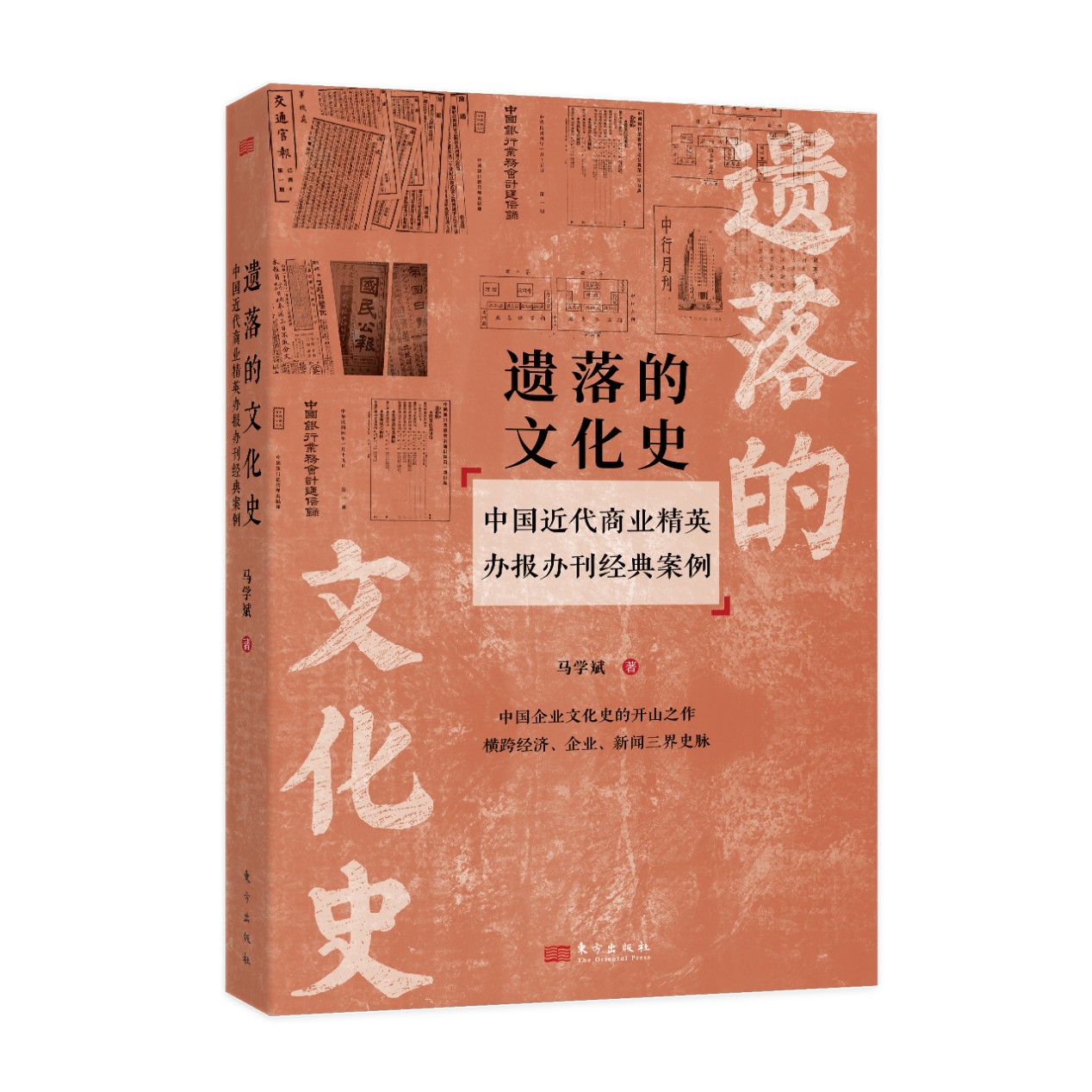
This book, "The Lost Cultural History", was written by him after more than a decade of painstaking work, exploring industry by industry and case by case after his retirement. From railways to banks, from insurance to cotton spinning, from exchanges to national - goods sales offices, he selected more than twenty kinds of newspapers and magazines from more than a dozen enterprises and wrote stories that combined "people + newspapers and magazines + enterprises".
For example, Zhang Gongquan. He was not only a banker but also a journalist by background. He ran "The Bank Weekly", which became the first Chinese financial professional publication. He transformed the "Phone Directory" of the Bank of China and established a special investigation department to run newspapers. He said that the purpose of running a publication was "not to record current events but to publish as much as possible about the thoughts and actions of all employees in the bank, about everything."
For example, Chen Guangfu. He ran the monthly magazine "Haiguang", with the words "Serving the Society" prominently printed on the cover. He invited the cultural celebrity Song Chunfang to be the editor - in - chief of the magazine, turning an in - house enterprise publication into "a valuable team history".
For example, the Rong family. They ran the "Renzhong Monthly". On one hand, it promoted scientific management, and on the other hand, it shouted the slogan "Don't forget to save the nation while working". The chief editor, Wang Fuli, was a technical expert but could write excellent articles. He even used phrases like "The textile mills are waging an undeclared war" to encourage employees to resist Japanese aggression.
These stories have hardly been discussed in the academic circle and are completely unknown to the general public.
This book is Mr. Ma's swan song.
When the manuscript was submitted to the publishing house, Mr. Ma was already in the late stage of cancer.
The editor once said:
"In the process of communicating with Mr. Ma about the manuscript, I fully felt his sense of responsibility as an author and his attitude of pursuing perfection... Especially when I suddenly learned that Mr. Ma was in the late stage of cancer and still insisted on verifying the problems I feedback to him again and again during chemotherapy, did I understand the real meaning behind his reply 'Due to blurred vision and lack of energy, the reply may be a bit slow' - how many times more effort and energy he had to put in than ordinary people!"
On December 27, 2025, before New Year's Day, Mr. Ma passed away.
He didn't get to see the book published.
Why is this book worth reading?
It's not a big academic tome. You don't need any professional knowledge to get into it. Each chapter is about a person, a newspaper or magazine, and a piece of history, as natural and smooth as reading a biography.
But it also has academic credibility - it makes extensive use of original newspaper and magazine materials, archives, and first - hand information, many of which are published for the first time.
More importantly, it has direct reference value for today's entrepreneurs. What the business elites in the Republic of China era did with newspapers and magazines - unifying thoughts, rallying people, conveying ideas, and building brands - isn't that exactly what we call "corporate culture" today?
Zhang Gongquan said a hundred years ago: "Principles are like the sea, and the team spirit is like the ripples of the sea tide." What really determines the success or failure of an enterprise has never been tangible things but that invisible "spirit".
Don't let this piece of history be forgotten again.
The title "The Lost Cultural History" is a pun.
It not only refers to the enterprise newspapers and magazines forgotten in the corners of history but also to Ma Xuebin himself - the cultural memory salvaged by a pioneer with half a lifetime of hard work was almost easily missed by us.
He's gone, but this book remains.
Open it, and you'll see how the smartest entrepreneurs in China a hundred years ago used culture to run their businesses. You'll find that "corporate culture" is not something imported from abroad; our own roots were planted long ago.
Don't let this piece of history be lost again.
"The Lost Cultural History: Classic Cases of Newspaper and Magazine Running by Modern Chinese Business Elites"
Written by Ma Xuebin | Published by Dongfang Publishing House
ISBN: 978 - 7 - 5207 - 4635 - 9