"Space computing power is meaningless," Masayoshi Son pours cold water on Elon Musk.
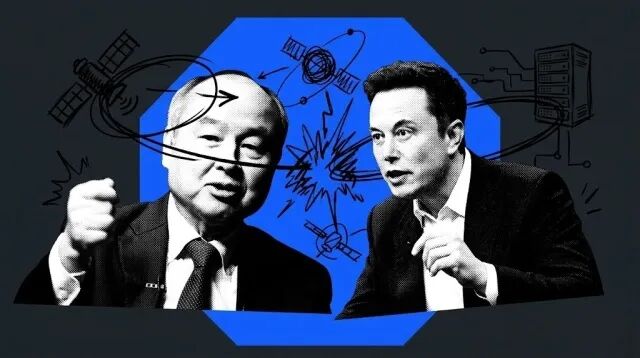
SoftBank Group CEO Masayoshi Son vs. SpaceX founder Elon Musk. The image has been processed by AI.
While the imagination of global tech giants is extending towards space, Masayoshi Son, the chairman and CEO of SoftBank Group, has chosen to firmly fix his gaze on the ground.
At SoftBank's 46th Annual General Meeting on June 24, Masayoshi Son first countered the theory of an AI bubble: "Saying it's a bubble is an insult to AI. This is just the beginning, and the potential of AI will be unleashed."
Immediately afterwards, he poured cold water on Elon Musk's concept of an "orbital data center."
It can be said that this is not only a difference in views between two business leaders but also a battle between two AI development routes: Will the decisive battle take place in the sky or on the ground?
"Space data centers are meaningless."
In response to a shareholder's question about whether SoftBank also has a grand plan similar to SpaceX's, Masayoshi Son directly countered: "What's the point? What benefits are there in building an AI data center in space?"
In his view, the concept promoted by Musk only sees the advantage of low electricity costs but ignores a bigger picture.
Economics is an inescapable topic.
Electricity accounts for only about 7% of the operating costs of an AI data center. What really burns money is the hardware, specifically the chips that drive and train AI models, which account for about 93% of the total cost. The money saved from cheap space electricity is insignificant compared to the sky - high cost of chips.
Industry analysis shows that the cost of building a 1 - gigawatt orbital data center is about $170 billion, three times that of an equivalent ground - based facility. More than 60% of the budget will be consumed by rocket fuel and launch logistics. The savings in electricity bills will soon be offset by costs such as launch costs, space maintenance expenses, and communication delays.
Masayoshi Son cares more about time.
He said, "In the AI competition, the next few years are far more important than what happens ten years later." This statement points out the core of SoftBank's strategy: speed takes precedence. The technical and economic challenges of space data centers may take years to solve. But the AI race waits for no one.
"The winner will be decided in the next few years. We hope to be the pioneer in any AI - related business."
Lead SoftBank for another decade
Masayoshi Son's sense of urgency stems from his long - term commitment to bet on this ground - based battle.
This 68 - year - old tech investor has quietly revised his retirement plan and vowed to lead SoftBank for another 10 to 15 years.
He said, "I don't have time to retire."
Matched with this personal commitment is an astonishing financial goal.
Masayoshi Son said at the general meeting that he hopes to increase SoftBank's net asset value to 1000 trillion yen (about $6.189 trillion) in the next decade. He admitted the ambition of this goal but insisted that SoftBank has repeatedly proven its ability to create value.
Masayoshi Son also compared SoftBank to a "swan that lays golden AI eggs" and said that the company's value has doubled since it formulated a strategy around "AI super - intelligence" - a theoretical AI form that surpasses human capabilities.
Masayoshi Son believes that the world is moving towards "physical ASI (Artificial Super - Intelligence)," and the bottleneck is no longer model design but the chips, electricity, and data center capacity required to run advanced systems on a large scale.
The "space war" of computing power
Masayoshi Son's assertion is firmly based on his business empire.
In recent years, SoftBank has built a complete ground - based AI empire. Its subsidiaries Arm, Ampere, and Graphcore are responsible for chip design. Through projects like "Stargate," SoftBank has invested hundreds of billions of dollars globally to build data centers. Its investment of about $65 billion in OpenAI covers the model level.
SoftBank also plans to complete the acquisition of the robotics business of Swiss industrial giant ABB in 2026, with the goal of becoming the "undisputed leader in the robotics world."
In terms of the energy lifeline, Masayoshi Son's layout goes even further.
He revealed at the general meeting that SoftBank's telecommunications division is seeking to acquire shares in Tokyo Electric Power Company (TEPCO), Japan's largest power company. At the same time, the telecommunications division also plans to transform a factory in Osaka into one of Japan's largest large - scale battery production lines.
If these partnerships are achieved, SoftBank will control the power supply from the source, providing stable energy support for its data centers and computing power empire.
This is a ground - based "full - stack" layout from chips to electricity, from computing to models, and then to physical entities. When Masayoshi Son says that the AI competition will be decided on the ground, he is also stating a fact: There are no rockets in his business empire.
In contrast, Elon Musk has SpaceX in his hands, the only company currently capable of sending large payloads into orbit at a low cost. The tonnage of Starlink satellites has exceeded the total of all other satellites in the world. All of Musk's assets can be sent into space on his own rockets.
For him, the energy ceiling on Earth is a visible limit, and space is his unique way out.
Both men are steering the future towards the fields where they already have an advantage. This is an invisible confrontation between the "ground full - stack" and the "space gateway."
Masayoshi Son is neither the only opponent nor the only supporter of space data centers.
Jeff Bezos' Blue Origin has also announced an orbital data center plan.
Google CEO Sundar Pichai described it as a "moonshot project." In his view, once you figure out how much computing power AI will need in the future, you'll realize that space data centers are not a pipe dream.
It "will start to make sense; it's just a matter of time."
On the other hand, OpenAI CEO Sam Altman bluntly said that the concept is "absurd." "We're not there yet. Orbital data centers won't have a significant impact before 2030."
Masayoshi Son's prudence finds technical support among the ground - based camp.
Technical analysis shows that in the space vacuum environment, heat cannot be dissipated through convection as it can on the ground. Cooling high - density chips is a physical challenge in itself.
Masayoshi Son admits that the AI competition is intensifying but believes that major players such as OpenAI, Anthropic, and Google still have huge growth potential. "AI is still in its early stages and has the potential to grow ten or a hundred times."
To seize this potential, SoftBank is fully consolidating its ground - based advantages.
Its telecommunications division is preparing to enter the "new cloud" and data center energy - storage battery markets in the United States. Masayoshi Son has high hopes for Arm. He predicts that as AI computing shifts towards a more CPU - centric design, Arm's value could increase tenfold.
SoftBank's robotics layout is also accelerating. Masayoshi Son revealed, "We've started mass - producing robots in a factory and will officially launch them soon. I believe everyone will be surprised."
In his view, the first to strike wins.
Those expensive chips will ultimately have to land on Earth to realize their true value.
This article is from the WeChat official account "Tencent Technology," written by Su Yang and published by 36Kr with permission.