in-store group buying ignites a new round of fierce competition among major tech giants
The battle for food delivery has come to a temporary end, and the flames of war have now spread to in-store group buying.
Alibaba, ByteDance, and JD.com are intensifying their siege on Meituan's core territory, but a group of merchants no longer want to play the game.
#01
The Abducted Caterers
Sister Jing is a small and medium-sized merchant running a yellow beef hot pot restaurant in Hangzhou, and the store has a group of loyal customers. Even so, more than two-thirds of the turnover comes from online group buying packages and vouchers.
She has a deep understanding of the involution in group buying. Originally, the packages only included some slow-selling items, but now she has to put the best-selling dishes in the store on the group buying as well. The discounts keep getting deeper and deeper, and a 25% discount is the current bottom line.
Huocaihe Barbecue is a barbecue brand in Beijing, and the turnover from group buying once accounted for 80%. Boss Brother Nan feels that he is getting farther and farther away from the catering business. He spends all his daily energy on updating packages, maintaining data, and spending money on promotion. As the regular customers who really support repeat purchases within a three-kilometer radius gradually disappear, he is so anxious that he suffers from severe insomnia.
Brother Nan tried to cancel the group buying, but the most intense opposition came from the head chef: Due to long-term reliance on the packages, the inventory quantity and thawing rhythm have already formed a habit. A sudden change would make it difficult to even carry out daily work.
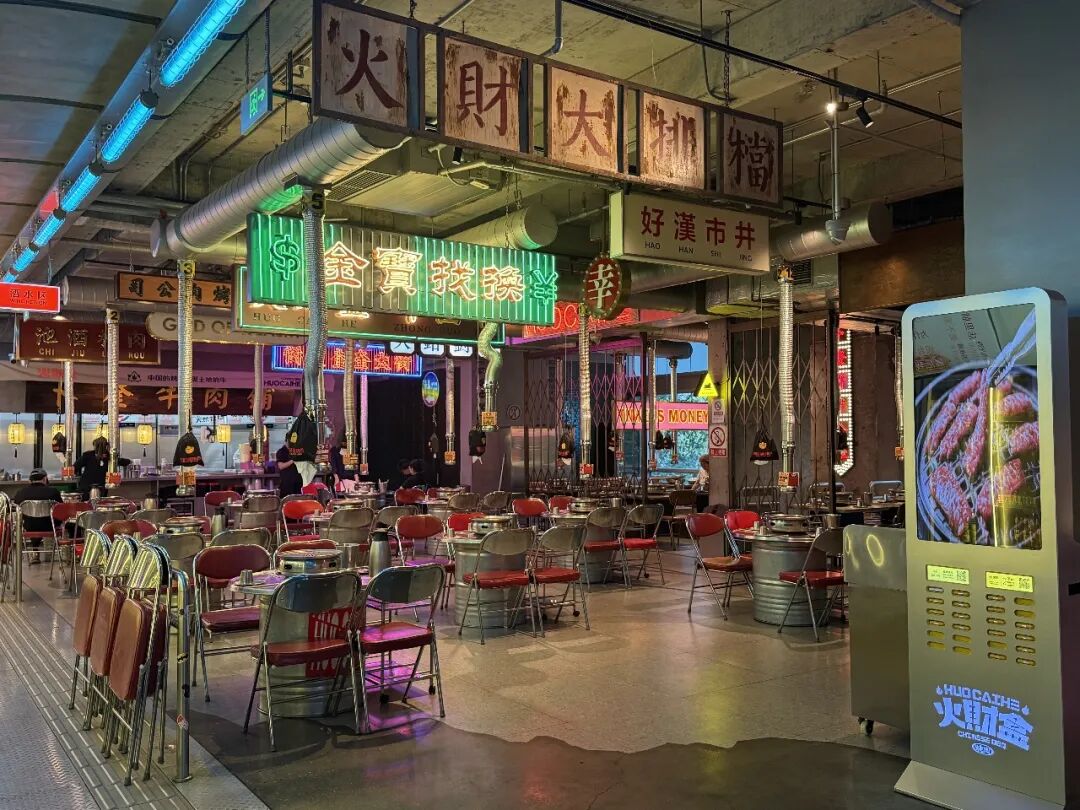
Photo | Huocaihe Barbecue
Dongzi, an expert in all-round catering marketing, said that in the highly competitive sectors with high customer unit prices such as hot pot and barbecue, it is actually normal for the group buying to account for 60 - 80% at present. For a newly emerging self-service hot pot brand in recent years, 100% of its turnover comes from online group buying packages, with 60% from Douyin and 40% from Meituan.
The "2026 White Paper on Chinese Cuisine" released by Nestle Professional Catering points out that consumers have become more rational and more concerned about the cost-performance ratio, and catering consumption has also become more daily-oriented. Currently, more than half of the restaurants have launched in-store group buying packages, hoping to use the platform traffic to attract customers, increase sales with small profits, survive in the highly competitive market, and achieve long-term operation.
The cost of group buying is not just the platform commission and discounts, but also a large amount of invisible consumption. Merchants have to adjust their business operations according to the platform's rules. Verification, order cancellation, and reconciliation take up the already limited manpower and energy. Waiters have to frequently remind customers to "check in, collect, and like". Group buying not only squeezes profits but also damages the most fragile trust between merchants and customers.
Song Ji, the founder of "Long Ago" mutton skewers, said in an exclusive interview that (group buying) cannot bring real customer value. It conforms to human nature, but we cannot take advantage of human nature. "The starting point is the end. When you are calculating on customers, you are all wrong." He believes that normal discounts damage the brand, discounts after price increases damage customers who pay the original price, and calculating discounts damage new customers.
"Long Ago" mutton skewers is a "benchmark for not doing group buying". It has cut all online discounts, promotions, and group buying. On its Dianping Banner page, it clearly states: "No group buying, no discounts, the in-store price is the real price. No collection, no check-in, and no asking for reviews." Data shows that the average daily customer flow of a single "Long Ago" store increased by 5% year-on-year in 2024 and further increased by 24% in 2025.
Brother Nan, who takes "Long Ago" as an example, after a long period of communication and SOP reconstruction, has now cancelled all online group buying and discounts and returned to the in-store real price. 90% of the products have a price cut of 10% - 20%. In the first month after canceling group buying, the online traffic dropped sharply, and the customer flow was greatly affected. However, many old customers saw the "former Huocaihe" and gradually came back. The customer flow gradually recovered the next month, and the profit also turned from loss to profit, returning to the natural growth track of "old customers bringing new customers".
Escaping from group buying is a privilege for a few with brand premium, not a common way out. Most merchants don't have Brother Nan's luck and courage. They can only stay in this game, and the rules of the game are constantly being rewritten by the war between platforms.
#02
The Platform Competition Is Intensifying
Now, various giants are accelerating their expansion in the in-store group buying battlefield. Taobao Flash Sale has launched group buying pilot projects in Shanghai, Jiaxing, and Shenzhen. Gaode has launched a street-scanning list. JD Instant Delivery has launched food group buying. Douyin has launched an independent app, Doushengxing.
In-store group buying is an enviable good business. Different from the heavy-asset food delivery business, it is essentially just information matching. Before the emergence of Douyin, Meituan's operating profit margin in in-store group buying had been over 40% for a long time.
One of the main reasons why Meituan was able to fight the food delivery war with Alibaba and JD.com is that a large part of its ammunition came from in-store business. In-store group buying is also a highly sticky and stable traffic entrance. Strengthening in-store business can complete the full-scenario closed loop of local life.
However, for Taobao Flash Sale and JD Instant Delivery, in-store group buying is a necessary strategic piece, but it may not be a top priority. Gaode's street-scanning list has made a big splash, but it is only available in 11 cities. The number of BD staff is limited, and they rely heavily on outsourcing.
The most aggressive move currently comes from Douyin Life Services. When the food delivery war was at its most intense in 2025, Douyin Life Services quietly increased in-store subsidies to seize the market.
On February 10th this year, Douyin launched an independent group buying life app, Doushengxing, with the slogan "Save more on food, drink, and entertainment". It only has two interfaces, the home page and the order page. According to QuestMobile data, three months after its launch, the daily active users of Doushengxing have approached 16 million.
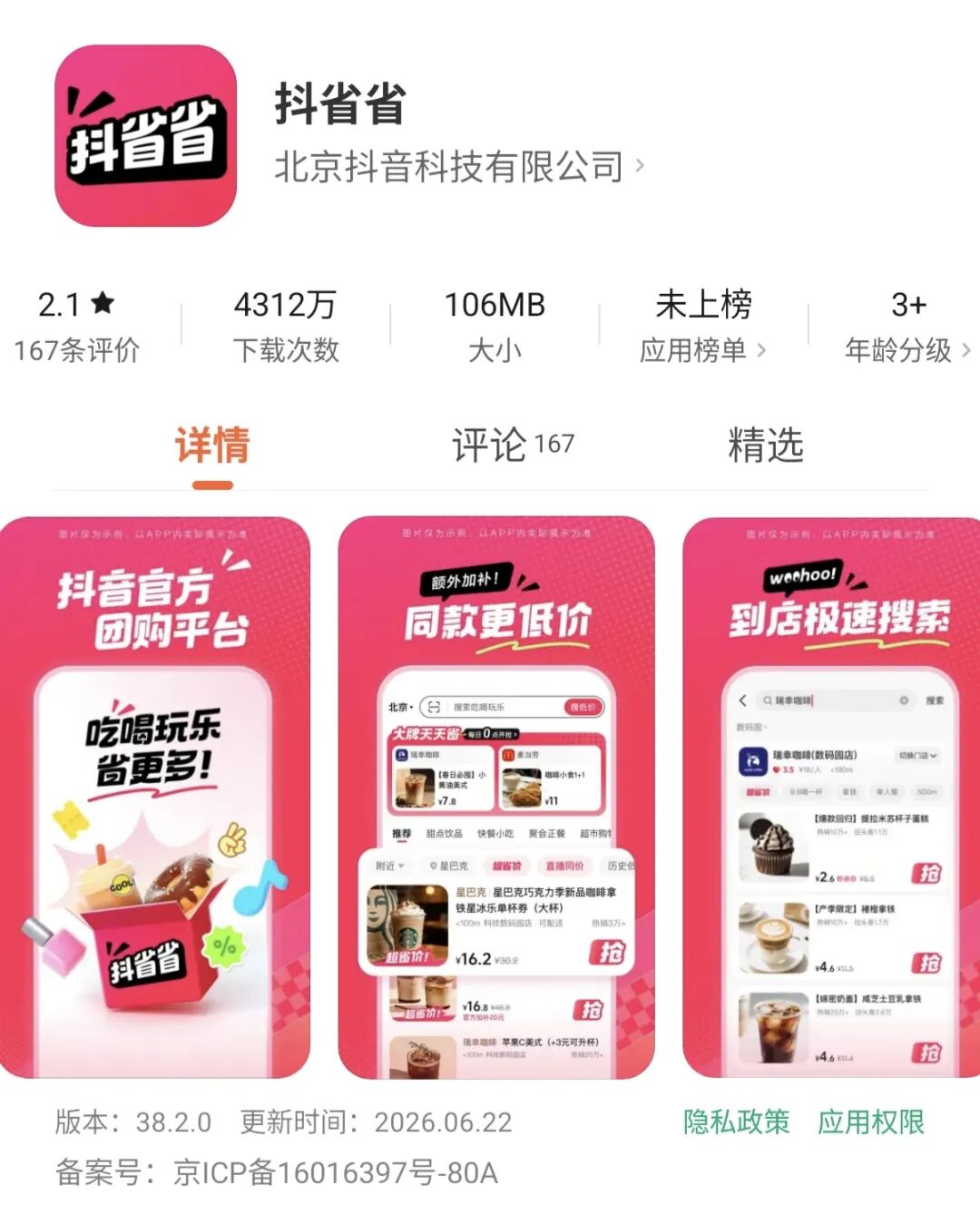
Photo | Doushengxing
Liuyedao, an independent researcher in local life, said that the core purpose of Doushengxing is to improve the verification rate and create a stable channel for repeat purchases for users with a low-price mindset. Currently, the verification rate of Doushengxing is 70%, which is significantly higher than the 50% - 60% verification rate of the main Douyin app.
However, Doushengxing is still in its early stage. All the packages on the Douyin shelf will be automatically synchronized to Doushengxing. On the merchant side, currently, chain merchants are the main target. Some small and medium-sized merchants don't even know the existence of Doushengxing. The current focus of the platform is on the price comparison of standard products of national chain catering.
Dongzi, an expert in all-round catering marketing, said that Doushengxing has to expand from interest-based consumption to purpose-based consumption. On the one hand, it can use a minimalist tool to undertake transactions. On the other hand, it provides an entry ticket for small and medium-sized merchants who are not good at creating content.
Small and medium-sized merchants are currently the target of competition for Douyin Life Services. In April this year, Douyin Life Services made a major adjustment to its organizational structure. The offline BD team is responsible for the expansion of small and micro merchants with an annual turnover of less than 50,000. It is reported that the BD's salary has also been adjusted from the previous commission system to a performance-based system.
Liuyedao believes that in local life services, BD actually plays a very important role. It is the only irreplaceable offline hub between online traffic, offline merchants, and user consumption, directly determining the platform's supply, GMV, regional competitiveness, merchant ecosystem, and user experience. The platform must rely on BD to repeatedly educate and guide merchants to gradually make merchants "controllable".
Merchant resources can be expanded through batch recruitment, subsidy wars can be launched at any time, and even platform gameplay and operation strategies can be easily imitated and iteratively optimized. Only the BD team that is rooted in the city, familiar with the business district, can handle merchants, implement contracts, and maintain long-term relationships cannot be replicated in a short time.
In addition, in the first half of this year, facing a relatively weak consumer market, both Meituan and Douyin Life Services actively increased subsidies for C-end users to stimulate activity and seek further GMV growth.
Liuyedao gave an example. For some categories, the platform subsidy is capped at 20 yuan, and merchants need to provide a 1:1 subsidy of 20 yuan. For a package with a discounted price of 150 yuan, customers can actually get it for 110 yuan.
According to 36Kr, achieving profitability is an important goal for Douyin Life Services in 2026.
Many experts believe that there is still a lot of room for change in the pattern of in-store group buying. It may become a "tripartite confrontation" among Meituan, Douyin Life Services, and Alibaba.
Merchants have been involved in the war between platforms. They are both chess pieces and prey. Many merchants have expressed concerns about the price war in in-store group buying, worried that a large amount of subsidies like in the food delivery war will appear again.
#03
How Can Merchants Coexist with Platforms?
Chen Qi, the editor-in-chief of a catering vertical media, said that those who can really quit group buying are ultimately a very small number of special cases: "Long Ago" itself has a certain market position, with a brand, good reputation, and stable regular customers; some fast-food brands with rigid demand already have enough natural traffic and don't need additional guidance from the platform.
There are some bloggers on Xiaohongshu who claim not to do group buying, but those who really stick to it are often in low-tier cities with less competition or in relatively independent business forms such as boutique cafes. "Consumption habits have been formed, and it's difficult for merchants to reverse them." Chen Qi said that talking about quitting is a luxury.
Dongzi said that merchants and platforms have long coexisted and thrived, and it's impossible to make a clean break. "Previously, caterers learned how to make popular dishes, but now all they talk about is making popular group buying packages."
Zhang Zhangzhang, a former catering operation lecturer at Alibaba Local Life, now runs his own small catering store. Regarding the problem of catering being abducted by group buying, he believes that as a merchant, if you can't beat it, join it and find a way that the platform likes and you are comfortable with.
Group buying is part of marketing and operation. Don't turn all the lead-in products, signature dishes, and hot-selling products into group buying items, otherwise, you will lose the bargaining chip to balance group buying; community stores with high-frequency and rigid demand should establish a membership system as soon as possible, and long-decision categories such as flower shops and cake shops should operate their private domains well.
"The most important thing is to figure out your core differences and target customer groups, do a good job in screening and expectation management in group buying design, and don't be led astray by the market to engage in price competition and mess up product offerings. In the end, you won't be able to serve anyone well and won't make any money."
Dai Dana, an expert in online catering marketing, said: "The core of being abducted by group buying is not figuring out what you really want."
He divides the group buying positioning of merchants into two categories. The first category is living on group buying. They regard group buying as a sales channel and rely on full-price packages to increase sales volume. It is normal for the group buying of such stores to account for 50% - 60%. What such merchants need to do is precise calculation: How much is the advertising cost? What is the gross profit margin? Is each in-store order a loss or a profit?
The second category is purely for drainage. Group buying is not for making money but for attracting customers to the store. The cost-performance ratio of such packages must be compared with that of competitors, and even "online exclusive packages" should be created: Customers enter the store because of a low-priced dish, and the real profit is hidden in the subsequent additional orders. "Some money is earned secretly."
In his opinion, group buying will become more and more involuted, and it will be extremely involuted. In the end, it may even be impossible to continue. But in the next stage, the competition will no longer be about price but about value creation. It will be reflected in the dish names, pictures, and short videos. Further up, it will be about competing for IP and people.
His core suggestion to merchants is all-round operation. Focus on the three platforms of Meituan, Douyin, and Video Account, and the rest of the focus is still on food delivery. The pattern of in-store group buying is unclear. "Stay put and watch the show first." Merchants have limited energy and a low input-output ratio. Wait for a leading platform to emerge and then fully invest in that platform.
For many merchants, the real variable may not be the platform but the policy.
The "Regulations on the Reporting of Tax-related Information of Internet Platform Enterprises" implemented in 2025 require platforms to report the real transaction data of merchants to the tax bureau every quarter, including local life service platforms. Some low-price group buying packages and persistent brush orders are gradually disappearing. The "Rules on the Pricing Behavior of Internet Platforms" jointly issued by three departments clearly prohibit selling at a price lower than the cost and prohibit platforms from forcing or indirectly forcing merchants to reduce prices.
These two documents may not end the involution, but they at least draw a line: The "subsidy to the point of price collapse" approach in the food delivery war is difficult to replicate in in-store group buying. A healthy business does not need a large amount of subsidies but reasonable profits and sustainable trust. If it is at the expense of emptying merchants, this matching business will sooner or later lose the objects to match.
This article is from the WeChat public account "Zhengu Research Institute", author: Liang Xiang, editor: Zhang Duo. It is published by 36Kr with authorization.