Behind the large-scale procurement of 50,000 GUP chips: Domestic giant Iluvatar CoreX emerges
On June 24th, Doubao Professional Edition was officially launched. A few days before that, ByteDance just announced a plan to purchase no less than 50,000 AI inference chips from Chinese GPU company Iluvatar CoreX for Doubao's terminal inference needs.
Currently, the news of this large - scale procurement is still spreading. If it is finally realized, it will be a major breakthrough in Iluvatar CoreX's business operation. Its stock price has soared under this influence, seemingly confirming the relevant news.
In the Chinese capital market, although Iluvatar CoreX is not as well - known as later - listed Moore Threads and MoonlightX, it was established earlier and is also the first Chinese company to mass - produce training + inference GPUs and the first to achieve 7nm mass production.
After founder Li Yunpeng left, Iluvatar CoreX went through two more CEOs, and the company formed a management team combining a "capital - oriented chairman" and "executives with technical backgrounds from AMD and NVIDIA". After its listing on the Hong Kong Stock Exchange, Iluvatar CoreX, along with Moore, MoonlightX, and Biren, became the "Four Giants of Domestic GPUs" in the secondary market.
Against the backdrop of an explosion in downstream demand and the blockade of high - end chip imports, Iluvatar CoreX didn't stubbornly choose to compete head - on with NVIDIA in high - performance training chips. Instead, it cleverly chose to develop in three directions: "training + inference + edge".
Facts have proven that this is a quite successful strategy. Winning this large order from ByteDance is a huge success in its business history.
In the new round of global AI competition, Iluvatar CoreX has opened up a large gap for domestic substitution in the already fierce market.
01
Super Large Order
The ice of domestic GPUs was first broken on the inference side.
According to Reuters, the core reason for ByteDance's large - scale procurement is to cope with the huge computing power call pressure generated by Doubao AI - there are simply too many users of this application.
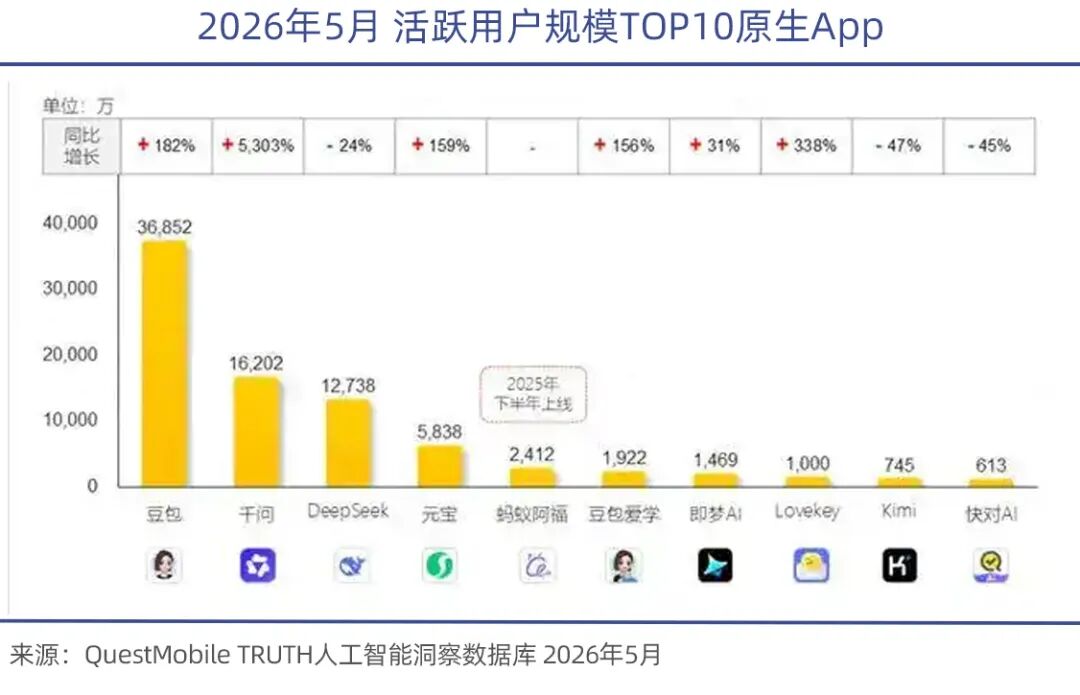
Doubao is the leading AI - native application in the current market, with a monthly active user count of up to 368 million in May, a year - on - year increase of 182%. As of March this year, Doubao's daily Token call volume exceeded 120 trillion. With continuous geometric growth and high - frequency calls, Doubao urgently needs to replenish resources on the inference side.
If the transaction is finally successfully completed, Iluvatar CoreX will become ByteDance's third - largest domestic GPU supplier after Huawei Ascend and Cambricon. There were also reports during the same period that ByteDance is also considering using Baidu Kunlun chips, and Alibaba is also in contact with Iluvatar CoreX and is likely to become its next customer.
Compared with the extremely difficult training, the task of inference chips is much easier. Its working environment is the deployment stage after model training, mainly responsible for executing the model's inference tasks. It has high requirements for real - time performance and needs to have fast response and low power consumption while ensuring accuracy.
Training has an end, but when large AI models are applied, as long as the product is online, inference will never stop. It can be predicted that the future inference demand will rise exponentially.
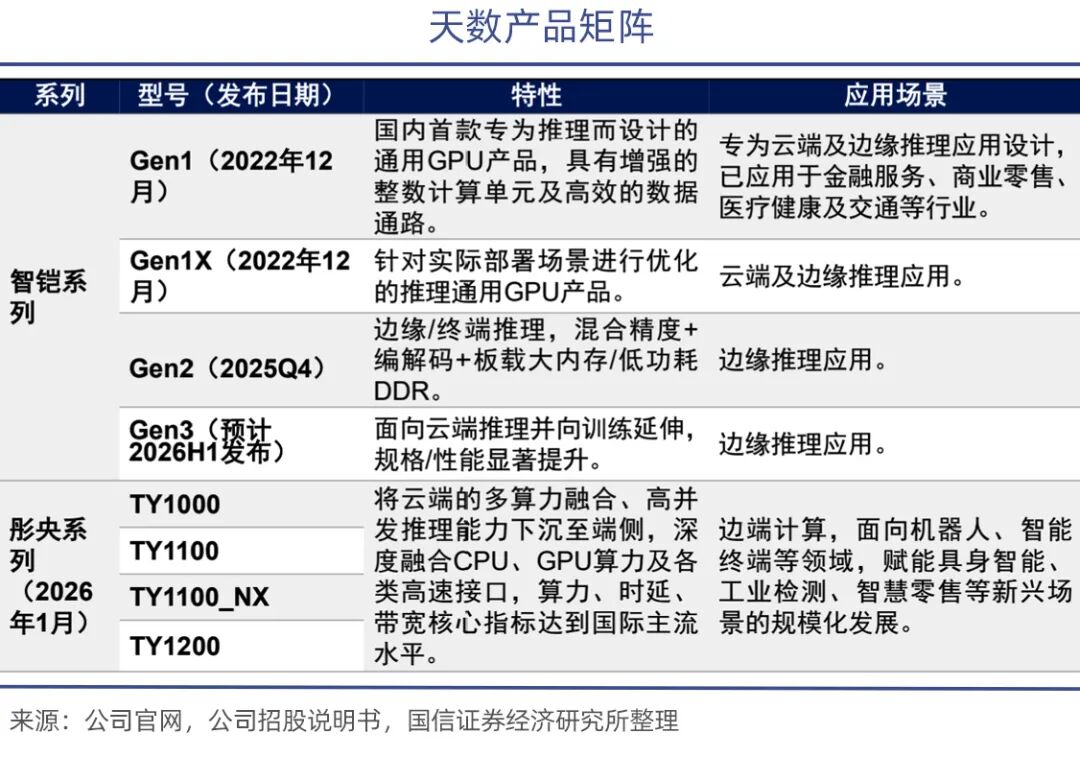
Since entering the GPU market, Iluvatar CoreX has adhered to the "training + inference" dual - track development and owns the Iluvatar InferX series of inference chips. In 2025, the revenue of this series reached 339 million yuan, a year - on - year increase of 238%, twice the growth rate of training chips.
Among them, the Iluvatar InferX Gen1/Gen1X (released in 2022) continued to gain popularity. The Gen2 was released in the fourth quarter of 2025 and has started small - batch delivery. The Gen3 will be mass - produced in the second half of this year.
According to IDC statistics, in 2025, Huawei Ascend's shipment volume reached 812,000 units, ranking first in the domestic GPU market, followed by Alibaba T-Head, Cambricon, etc. Iluvatar CoreX's shipment volume was 45,000 units.
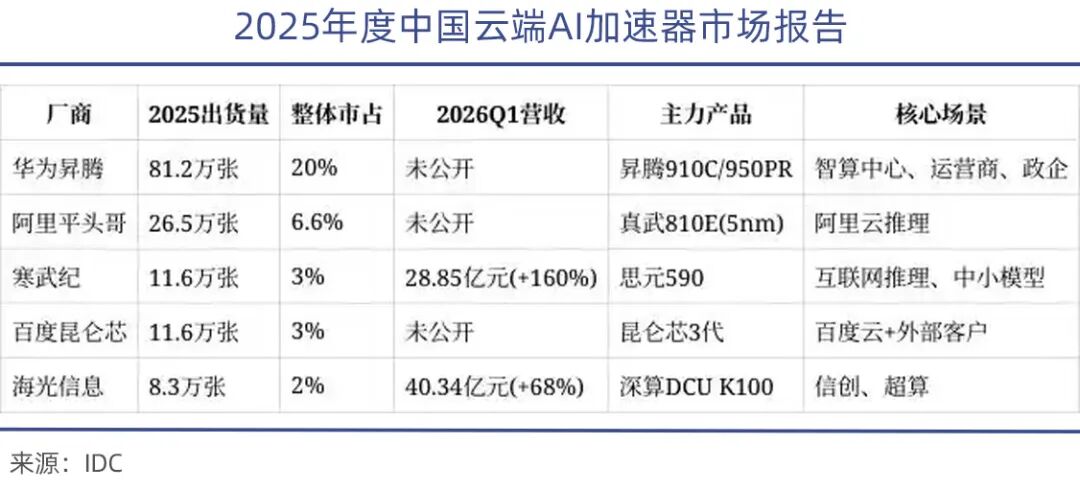
That is to say, the volume of ByteDance's procurement this time has exceeded all of Iluvatar CoreX's GPU shipments last year. If this order is achieved, it is not only a leap in scale but also proves that it has obtained the "certification of large enterprises".
According to Guosen Securities' calculations, the unit price of Iluvatar CoreX's inference chips in 2025 was 11,700 yuan. If calculated based on this, after the above - mentioned order is fulfilled, the company will receive nearly 600 million yuan from ByteDance, equivalent to 60% of last year's total annual revenue.
As of March 2026, China's daily Token consumption has exceeded 140 trillion, a more than 1,000 - fold increase compared to the beginning of 2024. After the large - scale implementation of AGI, the inference demand is growing at a faster rate than training. Morgan Stanley released a report at the end of last year, pointing out that the Chinese AI chip industry is undergoing significant structural adjustments, and the demand for inference computing is gradually replacing the simple stacking of computing power as the core driving force.
Every call and every conversation must be supported by the underlying inference computing power.
With both the explosion of market demand and the promotion of industrial implementation, Iluvatar CoreX has welcomed another critical moment after its IPO.
02
Multi - wheel Drive
In 2015, the Chinese AI chip industry was still in its infancy.
At that time, NVIDIA had just officially entered the field of artificial intelligence. Li Yunpeng, who was the R & D director of the database department at Oracle at that time, noticed the potential of China's technology industry and resolutely left his job to return to China to start a business.
He founded Iluvatar CoreX in Minhang, Shanghai in December 2015, five years earlier than Moore Threads and four years earlier than Biren Technology.
At that time, the future of AGI was still uncertain. Li Yunpeng focused on edge - side AI inference chips and launched the first AI chip, "Iluvatar CoreX I", in 2019, targeting visual intelligent algorithm scenarios.
However, less than a year after the chip was launched, investors believed that the company should focus on the general GPU direction, while Li Yunpeng insisted on his own opinion and finally left. After that, Diao Shijing, the former co - president of Tsinghua Unigroup and the chairman of Unigroup Guowei, took over.
In 2021, Iluvatar CoreX launched its first mass - produced general GPU, "Tian Gai Gen 1", filling the gap in high - performance domestic AI training chips. In July 2022, after Diao Shijing went missing, Gai Lujiang became the new leader, serving as the chairman and CEO. The company released the "Iluvatar InferX Gen 1 inference accelerator card" at the end of that year, completing the full layout of the dual product lines of training and inference, thus taking the lead in constructing a "training + inference" dual - line layout in China.
It is worth mentioning that the largest institutional shareholder of Iluvatar CoreX is Centurium Capital, which held about 22.92% of the shares before the IPO. Another well - known investment case of Centurium Capital in the industry is Luckin Coffee.
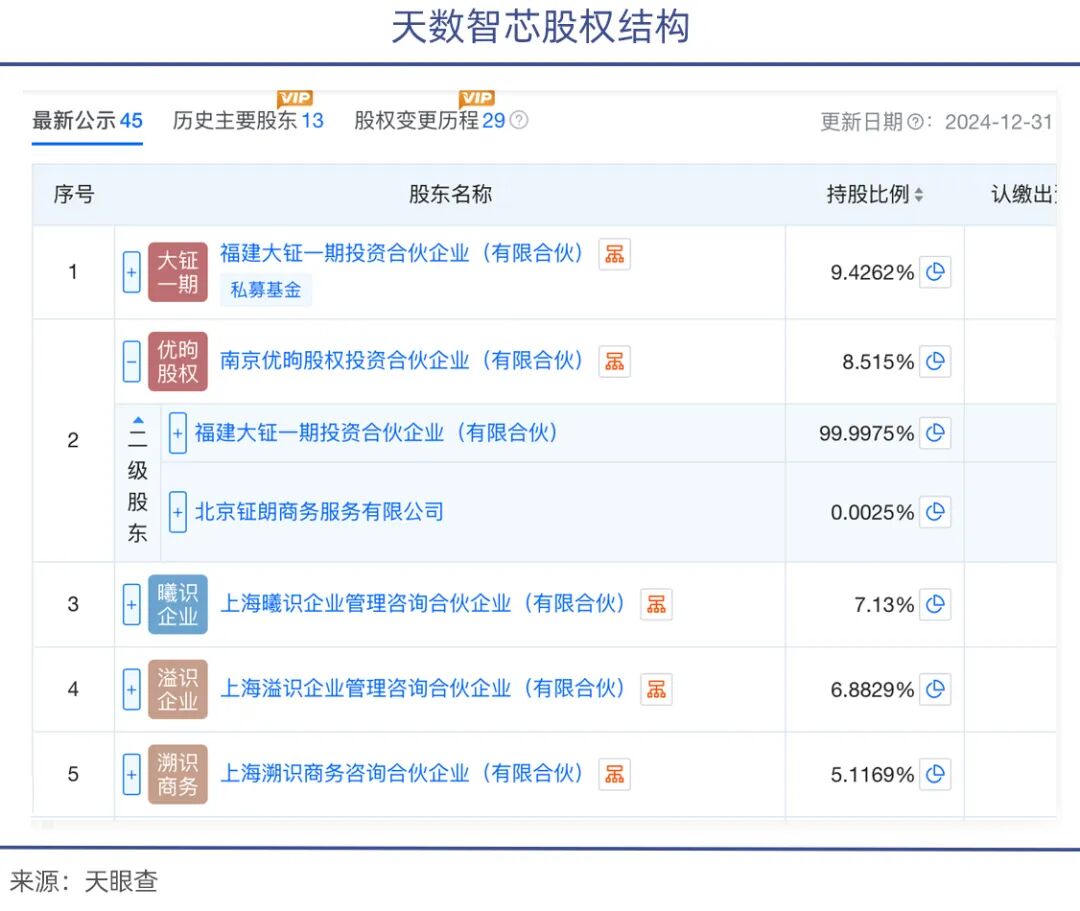
Gai Lujiang is also the core investor of Shanghai Xishi, another major shareholder of Iluvatar CoreX. Different from the previous two leaders, Gai Lujiang has no chip technology background, and his career trajectory is mainly in finance and investment.
In terms of technology R & D, CTO Lü Jianping has worked in world - class chip companies such as Samsung, NVIDIA, MediaTek, and Intel, and has accumulated rich experience in the field of general GPUs. Vice - presidents Sun Yile and Shi Jiasheng are both from AMD, responsible for chip R & D, mass production, and software R & D respectively. Vice - president Song Yu has worked at IBM.
Similar to its investment in Luckin, as early as 2017, Centurium Capital completed the early - stage layout of Iluvatar CoreX through affiliated enterprises. Since then, it has accompanied the company all the way, led the financing of the company's key rounds, and even carried out the joint - stock system reform and board of directors reorganization.
In an interview in 2022, Lü Jianping emphasized that "Iluvatar CoreX has always approached graphics from the perspective of general computing, rather than struggling to catch up from the traditional graphics pipeline. We will be the leader in this area."
Thanks to the strategic adjustments of several leaders and a powerful technical team, the company finally bet on the difficult domestic general GPU market and achieved the "three firsts": the first domestic mass - produced training GPU, the first mass - produced inference GPU, and the first to achieve 7nm process mass production.
After several days of sharp rises, Iluvatar CoreX's total market value has continued to break through, and it has been defined by the market as a key force to break through the international AI and chip war and even the blockade. Centurium Capital has not only become the biggest winner but also entered the domestic GPU and AGI markets.
After listing, Iluvatar CoreX also launched the "Tongyang Series" products for edge computing power and implemented them in scenarios such as Luckin Coffee with the help of Centurium Capital's connection. Thus, it has become one of the few domestic chip companies with full - scenario general computing power.
03
Ecosystem Challenges
"The core problem of domestic AI chips is the poor ecosystem. If the ecosystem is good, even if the performance is only 60%, there will still be users." Zheng Weimin, an academician of the Chinese Academy of Engineering, once pointed out the core pain point of domestic GPUs.
The essence of GPU competition is not only about performance but also a battle of the underlying software ecosystem.
NVIDIA's rise to the throne of AI chips is due to the CUDA software ecosystem that has penetrated deep into the hearts of developers. This is exactly the weakness of domestic GPUs.
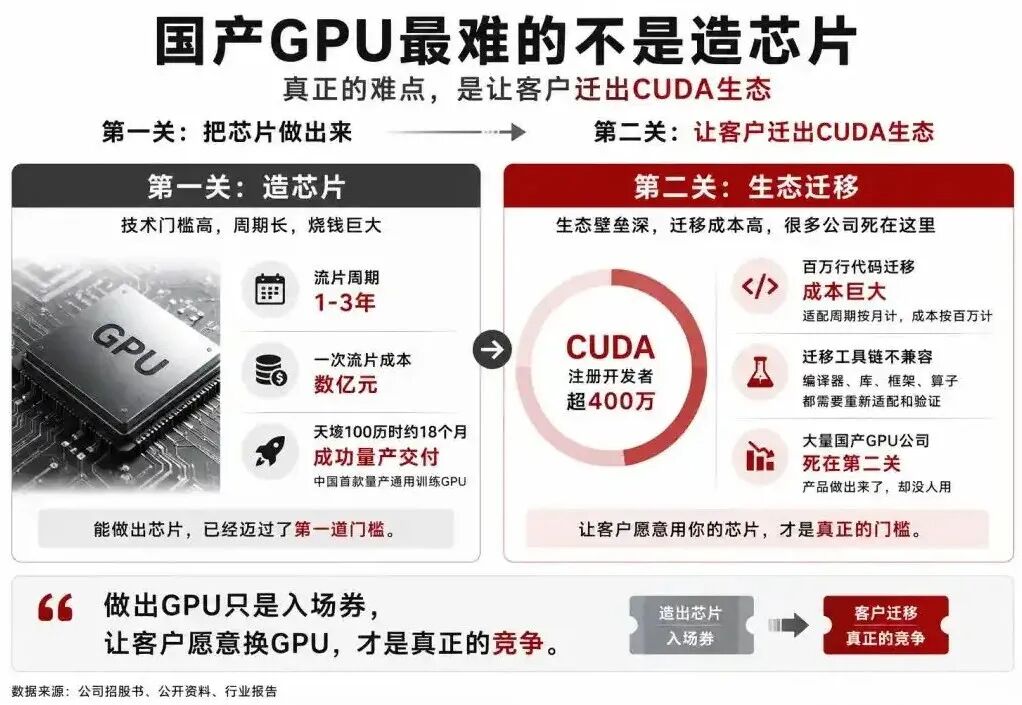
After more than a decade of in - depth development, NVIDIA's CUDA ecosystem has more than 4 million developers. Based on CUDA, a huge and prosperous "rainforest" has grown, including compilers, debuggers, math libraries, communication libraries, and deep - learning frameworks.
Just as WPS was compatible with Microsoft Office back then, Iluvatar CoreX's strategy is to build a full - stack self - developed software system from the underlying driver and compiler to the upper - layer AI framework, but it is deeply compatible with the CUDA ecosystem to solve the problems of "difficult to use" and "high migration cost" of domestic chips.
Some industry insiders said that when using Iluvatar CoreX's products, theoretically, more than 80% of the code can be smoothly migrated. Compared with Ascend and Cambricon, the adaptation period and cost have been significantly reduced.
In comparison, this is a relatively practical approach. Instead of starting from scratch and competing head - on with NVIDIA's CUDA, it chooses the path of minimizing migration costs, allowing developers to "get on board" with the least resistance.
However, just like the feud between Office and WPS back then, Iluvatar CoreX's current choice of the "compatible with CUDA" path rather than the "replace CUDA" path still shows a lack of long - term moat.
Due to the US export ban on high - end chips from NVIDIA and AMD, domestic GPUs have welcomed an opportunity for substitution.
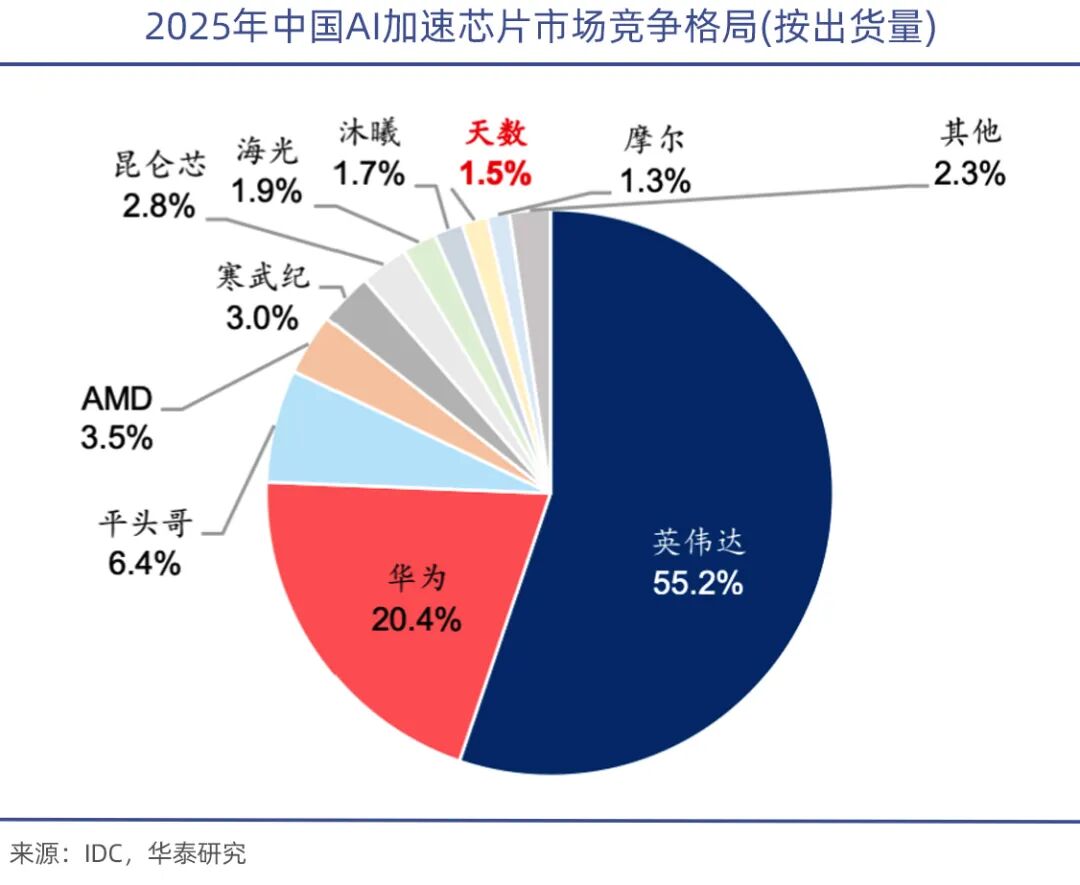

In the future, the wide application of domestic chips is undoubtedly certain.
Iluvatar CoreX has also released a "three - year (2025 - 2027) four - generation architecture" plan, clarifying the path of catching up generation by generation.
In 2025, the Tian Shu architecture was implemented. This year, it plans to launch the Tian Xuan and Tian Ji generations of architectures. The Tian Xuan architecture is comparable to NVIDIA's Blackwell; the Tian Ji architecture aims to comprehensively surpass Blackwell and is committed to achieving full - scenario AI and accelerated computing coverage.
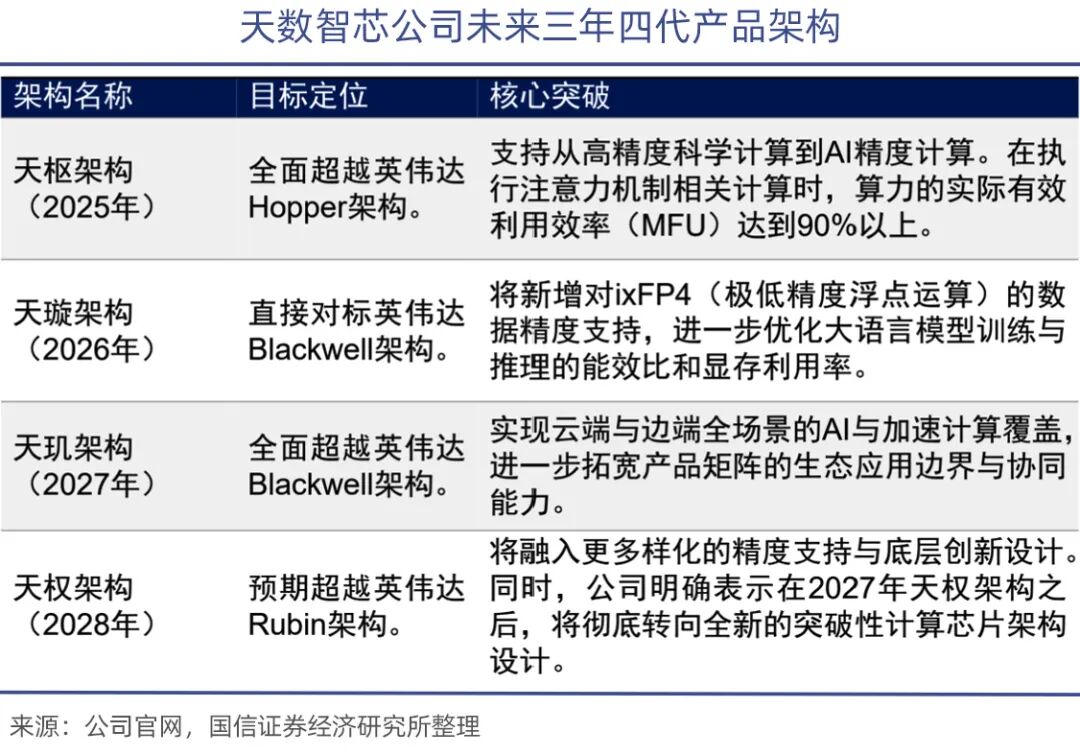
In 2027, the Tian Quan architecture will be launched, aiming to surpass NVIDIA's Rubin architecture, and plans to promote the R & D of a breakthrough computing chip architecture. If successfully achieved, it will be a new stage for Iluvatar CoreX and even the Chinese GPU industry to move from technology following to independent leadership.
Last year