Building a solid artificial intelligence security barrier: Empowering the healthy development of large models through innovative practices
Recently, the "lobster - raising" craze triggered by the open - source AI agent OpenClaw has rapidly spread on social platforms. While demonstrating the potential of artificial intelligence, it has also sparked extensive attention in the industry regarding the security issues of large models. As the capabilities of large models continue to strengthen, the problem of their security boundaries in complex interactions has gradually emerged. Against this backdrop, a series of innovative achievements represented by the Shenzhi Dialogue Risk Control Model (hereinafter referred to as the "Dialogue Risk Control Model") are responding to these challenges in a way that is closer to practical applications.
Security Challenges in the Wave of Large Models
With the rapid popularization and application of large - model technology, more and more enterprises and institutions are actively involved in the private deployment of large models in order to gain an early advantage in the intelligent wave and enhance their core competitiveness. However, behind the technological leap, the security risk issues caused by large - model technology have become increasingly prominent.
Facing the new - type security challenges brought by large models and related applications, relevant risk issues have drawn extensive attention in the industry. Multiple public information shows that some open - source AI agents have relatively high security risks under default or improper configurations, and are prone to cyberattacks, which may lead to the leakage of sensitive information. Meanwhile, in the private deployment scenario, some servers are exposed to the public network environment for a long time, and the models themselves may also have potential risks of being attacked. The overall security situation still needs further improvement. From the perspective of practical applications, the security issues of large models are no longer limited to the vulnerabilities at the traditional system level, but have further extended to the security of large models themselves and the application level of large models, including prompt injection, malicious induction, covert expression, and extraction of sensitive information, which pose new requirements for the existing security mechanisms.
A Security Practice for Practical Applications
Xu Jianjun, the founder of Caizhi Technology and an outstanding member of the China Computer Federation (CCF), led his team to propose the "Dialogue Risk Control Model" to solve the "hallucination" problem of large models in serious scenarios. He said, "Hallucination is a surface phenomenon. The root cause is that both knowledge engineering and large models have their own boundaries."
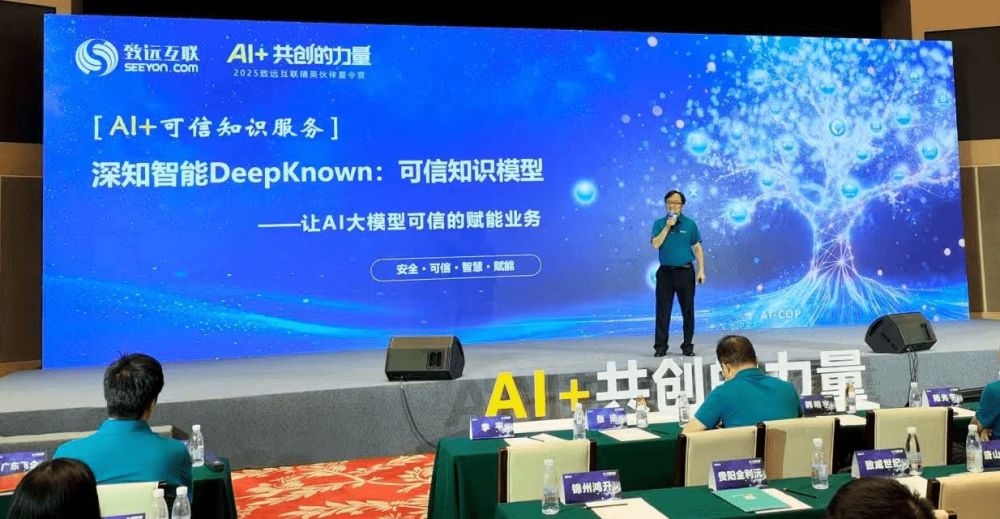
Xu Jianjun introduces the trusted knowledge model
It is reported that the "Dialogue Risk Control Model" adopts a component - based insertion mode and can cooperate deeply with the original base large model. It is equivalent to adding a professional security "firewall" in front of large - model applications such as the base large model and application agents. All user requests first pass through the dialogue risk control model. Based on the understanding of natural - language context, this model can quickly identify potential risks, recognize covert expression forms such as variant spellings and homophonic aliases, and provide a security substitution answer service for risk issues.
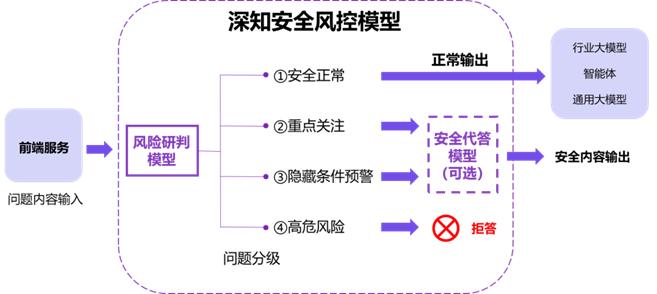
Schematic diagram of the working process of the dialogue risk control model
The dialogue risk control model is mainly composed of a risk assessment model and a security substitution answer model. Among them, the risk assessment model is responsible for identifying and classifying the risks of the input, realizing the active discovery and real - time warning of risks. The security substitution answer model is responsible for responding to the issues in the key - concern category and the hidden - condition warning category identified. It responds according to the three - stage principle of "fact clarification - policy citation - positive guidance", taking into account both risk prevention and service experience. For some questions with security risks, the model does not simply refuse to answer, but flexibly triggers the security substitution answer mode or the interception mechanism based on the risk assessment result. When the security substitution answer mode is activated, the model will provide responses based on the dynamically updated knowledge base constructed by authoritative documents, and the response content can be traced back to official authoritative documents.
Build a Joint AI Security Defense Line and Promote the Stable and Long - term Development of Artificial Intelligence
Building security protection capabilities for the era of artificial intelligence is one of the important issues that need continuous attention in the current application process of large models.
From the perspective of industry development, what the dialogue risk control model reflects is an externalized and low - coupling security protection idea. Through technical decoupling and API service methods, the R & D team can focus more on improving model performance and polishing core business, reducing the development pressure caused by the mutual restraint between the security module and business logic. This approach helps to reduce the comprehensive cost of large - model R & D and application, and also provides a new practical reference for the security implementation of large models in specific fields.