The Doubao Premium Edition, priced at 500 yuan per month, is officially launched. Is it really expensive? We discovered the truth after actual testing.
On June 24, Phoenix Tech learned that Doubao has officially launched three paid subscription services - the Standard version costs 68 yuan per month, the Enhanced version costs 200 yuan per month, and the Premium version costs 500 yuan per month.
Phoenix Tech has learned that Doubao has now fully integrated the Doubao 2.1 series of large models, resulting in an overall improvement in model performance. Meanwhile, the daily use of free users remains unaffected.
The long - awaited decision on paid services has finally been made.
In the past month, discussions about Doubao's charging policy have hardly stopped. In early May, the paid service statement on the App Store page was quietly updated, triggering discussions outside about the limited availability of free AI services. Subsequently, the Doubao Professional version quietly started a gray - scale test until its official launch. What the outside world has always been concerned about is why a national - level AI application like Doubao is starting to charge at this time and what problems it aims to solve?
01
Is 500 yuan a month really expensive?
Most of the public's disputes focus on the price itself.
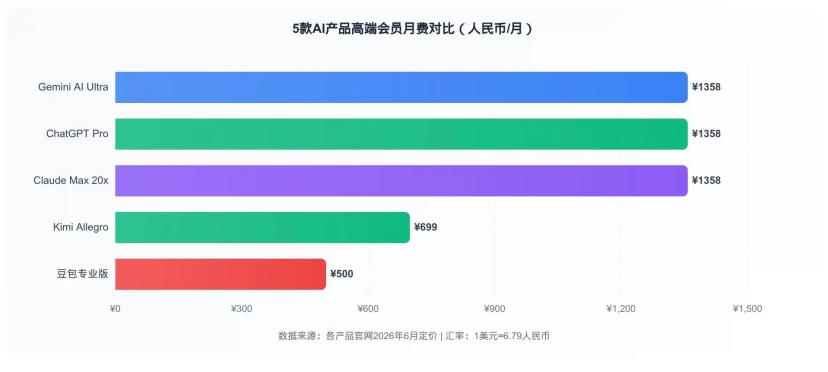
In the global market, Doubao's three - tier pricing provides a good basis for comparison.
ChatGPT has multiple tiers: the Go version costs 8 US dollars per month (about 54 yuan), the Plus version costs 20 US dollars per month (about 135 yuan), the Pro version costs 100 US dollars per month (about 677 yuan), and OpenAI also has a Pro tier at 200 US dollars per month. Claude also has two tiers: Pro (20 US dollars per month) and Max (100 US dollars per month and 200 US dollars per month). Gemini Advanced is priced at 19.99 US dollars per month.
Charting | Doubao Professional Version
The Standard version of Doubao, priced at 68 yuan, is also lower than ChatGPT Plus, which costs 20 US dollars (about 135 yuan) per month.
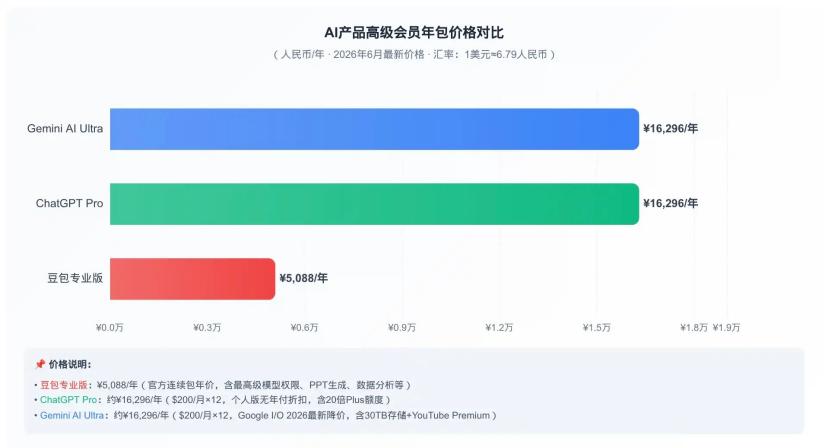
The annual fee for ChatGPT Pro is about 16,295 yuan, while the annual subscription for Doubao Professional version is 5,088 yuan, which is less than one - third of the former.
Charting | Doubao Professional Version
In China, currently, Kimi has set up four tiers: the Entry - level version costs 49 yuan per month, the Efficiency version costs 99 yuan per month, the Professional version costs 199 yuan per month, and the Premium version costs 699 yuan per month. Alibaba Tongyi Qianwen and Tencent Yuanbao still offer free basic C - end functions, mainly charging developers and enterprises through data calls.
It can be said that the current pricing of the Doubao Standard version is still at a medium level, but whether it is expensive or not is not the only evaluation criterion.
Sam Altman himself has said that OpenAI loses money on the 200 - dollar - per - month Pro subscription. In other words, even OpenAI has not been able to make money from high - end subscriptions. Whether Doubao's 500 - yuan Professional version can make money depends on whether users find it worth the price.
Tan Dai, the president of Volcengine, said at this conference that only when the model's capabilities cross the "qualitative change point" can it truly meet the needs of enterprises and individuals in production scenarios. Globally, the first video - generation model to cross the qualitative change point is Seedance 2.0, and in the fields of Coding and Agent, it is Claude Opus 4.6.
Currently, according to official disclosures, Doubao 2.1 Pro has achieved a significant leap in capabilities in three core directions: Coding, Agent, and VLM (Visual Language Model). Its performance in multiple evaluations is better than that of Claude Opus 4.6, officially crossing the production - level qualitative change point.
We also conducted a hands - on test of the Doubao Professional version. In complex scenarios, it indeed runs smoothly. Especially after enabling the office task mode on the PC version, by authorizing the local computer, users can start the agent - driven office task mode.
It should be noted that for the local computer operation support, users need to explicitly authorize Doubao. Only then can Doubao assist in using applications, browsers, and files on the computer to complete operations such as organizing local materials, classifying files, processing documents, filling out forms, moving information, and cross - application collaboration. It's like a controllable assistant, supporting Skills calls.
During our test, we let the Doubao Professional version run scheduled tasks, such as generating a daily hot news report or a research report, and it can directly output in PDF format.
In addition, the Doubao Professional version has integrated some capabilities of Feishu and incorporated Feishu's office suite, including commonly used online document, spreadsheet, and PPT functions. It can independently create online documents, spreadsheets, and PPT works that meet professional delivery requirements. It is also understood that the Doubao Professional version will be further integrated with Feishu in the future.
Overall, the Doubao Professional version and the free version target completely different user groups or solve problems in completely different scenarios. The Professional version is more suitable for complex work scenarios with high productivity requirements, which means that even after the launch of the Doubao Professional version, the actual use of the free version remains unaffected.
02
The computing power bill is hotter than expected
According to QuestMobile data, as of the first quarter of 2026, Doubao had approximately 345 million monthly active users. This active user data ranks first in the industry by a large margin.
However, the user scale is both a blessing and a burden.
345 million people ask questions, generate images, and have video conversations every day. Behind each round of interaction is a real - money computing power consumption. According to the South China Morning Post, ByteDance has raised its AI capital expenditure plan for 2026 to over 200 billion yuan (about 30 billion US dollars), an increase of at least 25% compared to the initial plan of 160 billion yuan discussed at the end of last year. ByteDance has even discussed an annual AI capital expenditure of up to 70 billion US dollars.
According to a report by "LatePost", Doubao, ByteDance's main product, consumes tens of millions of yuan in computing power per day. Although it has over 200 million daily active users, its daily revenue is less than one million yuan.
According to Volcengine, as of June this year, the daily Token call volume of the Doubao large model has exceeded 180 trillion, more than a ten - fold increase in the past year. When the model was first launched in May 2024, this number was only over 100 billion. In less than two years, it has increased by 1,500 times. A research report by Guolian Minsheng Securities in May estimated that, based on the cheapest Doubao model, the cost of providing one - day free AI services for Doubao is between 132 million and 240 million yuan.

ByteDance has made a lot of optimizations in technology. The inference efficiency of Doubao 2.0 has increased by 43%. The first - packet latency in long - context scenarios is more than 25% lower than the industry mainstream. The inference cost for 10,000 Tokens is 38% of the compliance link of overseas leading models. Even so, it is very difficult to fill the gap if 200 million daily active users continue to use it for free.
This is not a problem unique to ByteDance. Alibaba's capital expenditure in fiscal year 2025 was approximately 93.4 billion yuan. In the past four quarters, it has invested approximately 120 billion yuan in AI + cloud infrastructure. Alibaba's management said that the overall expenditure in fiscal year 2026 is expected to be between 145 billion and 150 billion yuan, with more than 75% invested in AI. Tencent invested 18 billion yuan in the development of new AI products last year, and this year's investment amount will at least double.
In this AI arms race, all leading tech giants have spent a lot of money, which forces them to find a viable way to survive.
As the era of high - cost Tokens approaches, some trends have emerged. Since this year, MiniMax, Zhipu, Kimi, and Alibaba Cloud have successively adjusted their Coding Plan pricing systems for developers, with a highly consistent direction: tightening free usage and switching to Token - based billing. On June 2, MiniMax publicly apologized for the sudden change in its billing method - this is already the second such apology letter this year. The API of Zhipu's GLM series has gone through three rounds of price increases, with a cumulative increase of over 60%. Institutional monitoring data confirms this trend: in the past year, the weekly Token consumption has increased from 2.1T to 24.5T, and since 2026, the weekly Token consumption has increased by 280%.
All manufacturers are trying to end the endless Token consumption. Inside the big tech companies, the Token usage volume is no longer the main indicator for competition, and many manufacturers have taken back the free Token quotas for their employees.
The Doubao Professional version at this stage is just an attempt.
According to a report by 36Kr, in 2026, ByteDance does not use the paid penetration rate as the core assessment indicator for now. Its primary task is to verify the functional value of the Professional version.
In other words, ByteDance does not expect to make a fortune from the 500 - yuan monthly fee. It wants to separate those "high - energy consumers" from the free user pool and provide them with separate services and pricing.
The free basic functions are still retained - the quotas for daily Q&A, writing, image generation, voice and video conversations, etc. remain unchanged. The paid privileges are only for high - computing - power scenarios such as software development, data analysis, professional design, and financial analysis. In a market where almost all domestic large models claim to be free, the first player to set a price is destined to face the most disputes. However, with a daily Token consumption of 180 trillion in front of us, who dares to claim "permanent free"? The computing power bill doesn't lie. The era of high - value Tokens has arrived, and Doubao has just opened a new window for everyone.
This article is from the WeChat official account "Phoenix Tech", author: Dong Yuqing. Republished by 36Kr with permission.