No more free handouts: New policies to boost auto consumption shift gears
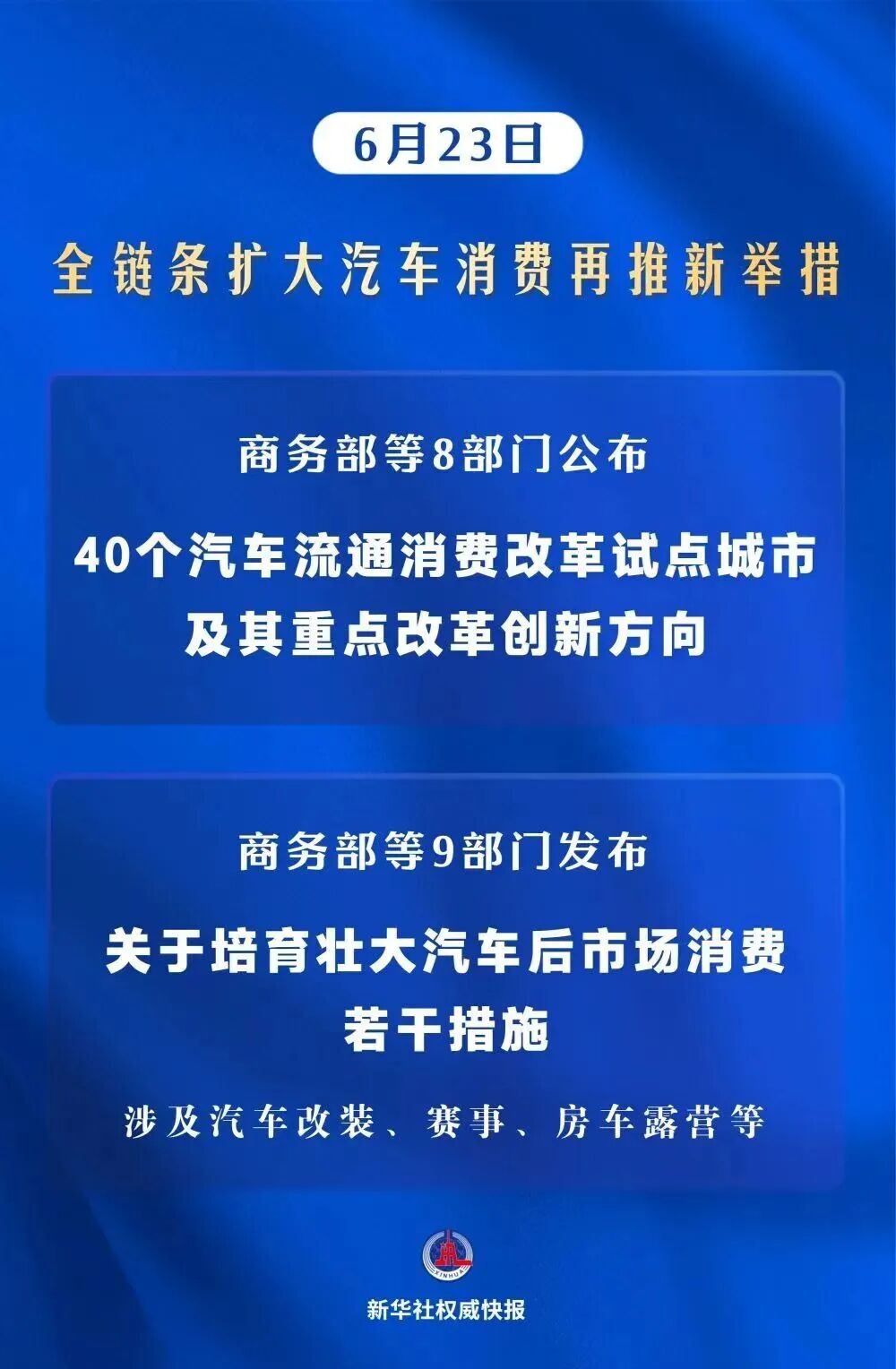
At 3 p.m. on June 23, Sheng Qiuping, the vice - minister of the Ministry of Commerce, jointly with relevant officials from the Ministry of Industry and Information Technology, the Ministry of Culture and Tourism, Hangzhou City, and Chengdu City, held a special press conference on "Expanding automobile consumption across the entire value chain". Before this press conference, two significant notices quickly went viral, sending out strong signals of reform.
Firstly, the "Notice of Nine Departments including the Ministry of Commerce on Several Measures to Cultivate and Expand the Consumption of the Automobile After - market" introduced 17 measures in six areas, namely automobile modification, RV camping, traditional classic cars, maintenance and insurance, automobile racing, and automobile leasing. These measures aim to remove various unreasonable restrictions in the after - market and make up for the long - standing institutional shortcomings.
Secondly, the "Notice of the General Offices of Eight Departments including the Ministry of Commerce on Announcing the List of Pilot Cities for Automobile Circulation and Consumption Reform" identified 40 pilot cities and regions. Each region will develop its own characteristic tracks based on its resources. For example, Guangzhou, Shenzhen, and Hangzhou will focus on optimizing car purchase restrictions and the vehicle - using environment; Qingdao and Lanzhou will focus on the development of RV camping; Baoding and Chengdu will strive to create automobile racing IPs...
The press conference held by the State Council Information Office was a complete interpretation of the background and core ideas of the two documents, and it signaled a key shift in "expanding automobile consumption across the entire value chain" - China's automobile consumption policies are shifting from short - term incentives for new car sales to in - depth cultivation of the existing car stock throughout the entire life cycle.
Facing the domestic automobile ownership of 370 million vehicles and the weak automobile demand, the policy - makers have launched a comprehensive set of measures covering the entire value chain of "buying, using, modifying, maintaining, and replacing" cars. As Sheng Qiuping summarized at the press conference, the entire reform follows three core logics: unified deployment along with pilot projects; revitalizing the existing stock while optimizing the new increment; standardizing management while also promoting market vitality.
Let's start with unified deployment and pilot projects. The state has introduced national unified policies to make up for the shortcomings in the after - market in terms of institutions, standards, and product supply in areas such as modification, racing, and camping. At the same time, 40 cities have been selected to carry out reform pilot projects. Each city will independently explore and innovate around local prominent bottlenecks in new car transactions, used car circulation, and scrap recycling.
Secondly, revitalize the existing stock and optimize the new increment. In terms of the existing stock, resources of automobile enterprises, racing tracks, and cultural and creative parks will be revitalized to create integrated consumption scenarios. For example, in Shanghai, Tianjin and other places, international automobile racing track resources are being utilized to actively organize well - known domestic and international automobile races. In terms of the new increment, local governments will optimize car purchase restrictions to release purchase demand, and develop bonded modification, classic car sales and other businesses relying on bonded policies.
Finally, parallel implementation of standardized supervision and market liberalization. The policy promotes the transformation of automobile management from purchase control to usage control, and moderately relaxes restrictions on used car circulation, RV camping, and pickup truck access. The state has introduced classification management rules for automobile modification to ensure safety, and at the same time, it has delegated reform powers, allowing pilot cities to simplify the land use approval process for RV campsites to fully release market vitality.
It should be noted that this "expanding automobile consumption across the entire value chain" is not simply about providing subsidies for car purchases, but a well - thought - out long - term strategy.
01
A Well - Thought - Out Strategy
17 Measures to Activate the After - market
To understand this package of policies, we need to first review the limitations of past single - subsidy policies. In the past, when it came to stimulating automobile consumption, the first impression for most people was always local governments providing car purchase subsidies and automobile enterprises reducing prices to boost sales. Early consumption - promotion policies basically focused on the single link of new car sales, but the long - term implementation results were always mixed.
The benefits were very obvious: subsidies directly lowered the threshold for car purchases. Consumers who were on the fence placed orders intensively, which short - term increased the retail sales of automobiles. Automobile enterprises quickly reduced their inventories, and the short - term revenue of the manufacturing industry was stabilized. The early new energy subsidies and the "Automobiles to the Countryside" campaign even built a complete new energy industry chain from scratch.
However, relying solely on subsidies to boost new car sales has gradually exposed deep - seated shortcomings. Multiple sets of industry data from the China Passenger Car Association and the China Automobile Dealers Association have confirmed the structural flaws of this model:
Firstly, short - term subsidies overdraft long - and medium - term purchasing power. After the tax incentives and local car purchase subsidies were phased out, the market declined sharply. In the first quarter of 2026 when the purchase tax incentives were tightened, the sales of low - cost new energy vehicles below 80,000 yuan plummeted by 47.8% year - on - year.
Secondly, subsidies have forced endless price competition, and automobile enterprises have been under continuous pressure on profitability. Continuously reducing prices to increase sales has directly compressed industry profits. From January to April 2026, the overall profit margin of the domestic automobile industry was only 3.4%, at a near - decade low.
Thirdly, single - minded support for new cars has "fragmented" the entire circulation chain, and the used car industry has fallen into a quagmire of losses. In recent years, the average discount rate for new cars at the terminal has exceeded 14%, which has directly lowered the residual value of used cars. The three - year value retention rate of mainstream family fuel - powered cars has dropped to 46.07%, a decline of more than 25 percentage points compared with five years ago. More than 70% of used car dealers have suffered long - term losses, facing pressure both in purchasing and selling cars, and their business operations have been extremely difficult.
Nowadays, the competition in the domestic automobile market has intensified, and the industry urgently needs to correct the situation. Against this background, a comprehensive set of policies covering six areas and including 17 supporting measures has been quickly implemented under the guidance of macro - regulation.
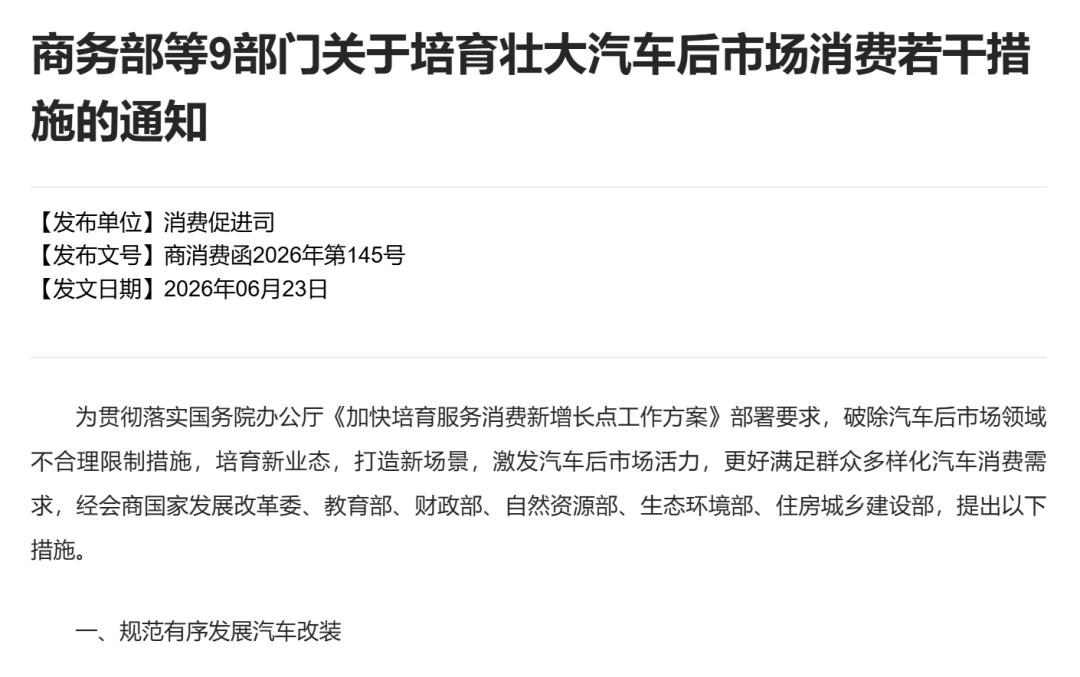
The core keyword of the entire set of 17 measures is to cultivate and expand the automobile after - market.
Sheng Qiuping said that the after - market derived from vehicle use is a trillion - level blue ocean. The global after - market scale has exceeded one trillion US dollars, and the Asia - Pacific region is expected to become the world's largest market this year. Currently, more than 50% of passenger cars in China are over 7 years old, and the industry has already entered a window period of high - speed growth in the after - market.
Simply put, the automobile after - market is the second growth curve of automobile consumption in the stock era. The 17 measures this time are to clear obstacles and point out the direction for this new growth track. Let's take a look at the six areas of the automobile after - market respectively:
The scale of the automobile modification market has exceeded 100 billion yuan, but there have long been problems such as inconsistent local standards, the prevalence of inferior parts, a shortage of professional technicians, and difficulties in claim settlement for modified vehicles. The policy will systematically rectify industry chaos through multiple means such as classification management, unifying national industry standards, and standardizing the supply of modified parts.
The popularity of RV camping has been continuously increasing, but problems such as RV traffic restrictions, a shortage of dedicated urban parking spaces, cumbersome land use approval for campsites, poor basic supply facilities, and vehicle model homogenization have restricted its development. The policy will simplify the approval process for campsites, add dedicated berths for RVs, improve water, electricity, and maintenance supplies along the way, and support industrial clusters to develop intelligent and age - friendly RV products to fully revitalize the travel and leisure consumption market.
There is a large group of classic car collectors in China, but there has long been a lack of a unified identification standard. Vehicle access and transactions have been restricted everywhere, and there have been frequent irregularities in private circulation. The new regulations will establish a unified vehicle identification mechanism based on national standards, pilot the opening of circulation, exhibitions, and limited - time access on the road, and simultaneously develop vehicle restoration, parts reproduction, vehicle auctions, and automobile cultural and tourism activities to open up the entire consumption chain of classic cars.
The new energy vehicle maintenance industry has long suffered from problems such as the monopoly of technology and parts by automobile enterprises, insufficient capabilities of third - party maintenance shops, high maintenance costs, and poor suitability of supporting vehicle insurance. The policy clearly requires automobile enterprises to open up maintenance technology and parts resources, promote the chain - style maintenance and repair - instead - of - replacement models, and innovate new vehicle - battery separation vehicle insurance to balance the rights and interests of automobile enterprises, maintenance providers, and vehicle owners and reduce the daily vehicle maintenance costs.
The development of the domestic automobile racing industry is unbalanced. There is a shortage of high - end professional races, an insufficient supply of mass - experience activities, and a huge gap in the operation of domestic new energy racing IPs and driver and technician talents. The policy will build a multi - level racing system, cultivate independent new energy racing brands, simplify the race - hosting approval process, integrate cultural and tourism resources to create racing tourism routes, and simultaneously improve the talent cultivation system in colleges and universities.
The automobile leasing industry has long had problems such as low - price marketing tricks, deposit disputes, a single choice of vehicle models, and a fragmented upstream - downstream industrial chain. The policy encourages leasing enterprises to transform into brand - oriented, chain - style, and large - scale operations, promote services such as returning vehicles in different locations and purchasing cars through leasing, provide exclusive leasing insurance, connect the industrial chains of automobile enterprise procurement and used car exports, and provide interest - subsidy support to meet the diverse vehicle - using needs for commuting and tourism.
In summary, the 17 measures take into account both standardized supervision and market liberalization. On the one hand, they rectify long - standing industry chaos and make up for supporting shortcomings. On the other hand, they expand consumption scenarios and tap into new industrial increments, comprehensively clearing development obstacles for consumers, automobile enterprises, and automobile business entities and creating all feasible conditions.
02
40 Pilot Cities
Revitalize the Automobile Consumption Market According to Local Conditions
As the largest bulk consumer product in China, the automobile industry is linked to dozens of industries such as manufacturing, parts, used cars, and cultural and tourism, and it is the core pillar for stabilizing the domestic demand. In the past, the single - subsidy model for new cars has seen a continuous decline in its effectiveness. However, a comprehensive value - chain layout can simultaneously activate the increment of new cars, the stock of used cars, and the increment of after - market services, extend the automobile consumption cycle, and form a long - term and stable drive for domestic demand.
However, well - designed policy measures still need a test field for implementation to directly address the real bottlenecks in the industry. Therefore, the state has selected 40 pilot cities to layout reform tasks differently according to local resources, rather than adopting a one - size - fits - all approach.
Reforms to lift purchase restrictions and optimize the urban vehicle - using environment will be implemented first in core cities with purchase restrictions such as Hangzhou, Guangzhou, and Shenzhen. In these cities, the vehicle ownership has reached saturation, and the residents' car - buying demand has long been restricted by quotas. Piloting the relaxation of car - buying quotas and improving parking facilities can directly test the actual effectiveness of policies in releasing consumption potential.
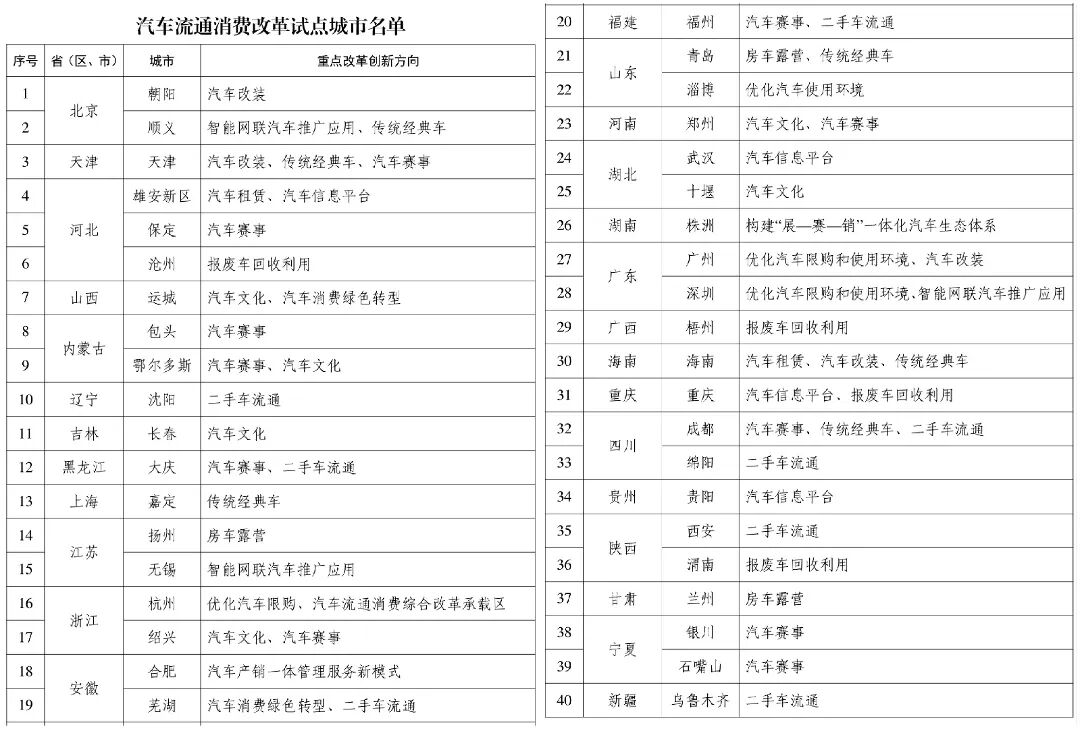
Pilot projects related to circular economy, such as used car circulation and scrap recycling, will be concentrated in regional transportation hubs and cities with a strong automobile manufacturing industry. Shenyang, Xi'an, and Urumqi are located on important cross - provincial transportation routes, and cross - regional used car transactions are frequent. These cities are suitable for removing barriers to used car relocation and cross - provincial vehicle registration. Wuhu, Chengdu, and Mianyang have a strong foundation in the automobile industry, and the residents have a strong demand for vehicle replacement. These cities are convenient for implementing innovative models such as trading in old cars for new ones and used car exports.
Cities with both industrial and cultural and tourism advantages will be selected to explore characteristic automobile consumption tracks such as modification and classic cars. Tianjin has professional racing tracks, automobile import and export ports, and a complete parts supply chain, which can integrate the industries of modification, racing, and classic cars. Hainan, relying on the bonded policies of the free trade port, will pilot cross - border modification and bonded sales of classic cars to create a new model of characteristic automobile foreign trade.
Automobile racing and RV camping will be differently laid out according to the local resources of cities. Baoding, Ordos, and Yinchuan have natural off - road terrains and will focus on developing mass - experience automobile sports. Shaoxing, Zhengzhou, and Zhuzhou have a large population and a well - developed business and tourism integration foundation, and will create an integrated consumption route of "racing + exhibition + tourism". Yangzhou, Qingdao, and Lanzhou have high - quality natural scenery, coastal areas, and northwest self - driving loop resources, and will carry out special reforms to address the pain points such as difficult approval for RV campsites and lack of supporting facilities.
Overall, each pilot city will revitalize the circulation of the existing vehicle stock relying on its local manufacturing industry and tap into new consumption scenarios with the help of cultural and tourism and free trade policies. The 40 cities will address the bottlenecks in the entire value chain of automobile production, trading, using, and recycling in a hierarchical and classified manner, summarize local innovative practices, and form a long - term automobile consumption reform plan that is suitable for the national market and balances development and safety.
This layout is not about the automobile industry working alone, but about the integration and coordination of the entire industrial chain and cross - industry cultural and tourism and commerce. It is not a short - term measure to stimulate the market, but a deep - seated layout for the long - term development of the industry, aiming to address every problem and bottleneck in the automobile industrial chain.
For ordinary consumers, this round of reform may not be as straightforward as a one - time large - scale subsidy, but it has actually reduced the full - cycle costs of buying, maintaining, using, and replacing cars, transforming automobile consumption from a "one - time transaction" into a whole - life - cycle experience of a better life.
It is worth emphasizing that this policy is not simply a replacement for past car purchase subsidies. On the basis of retaining incentives such as trading in old cars for new ones, the "Automobiles to the Countryside" campaign, and purchase tax incentives, it has completed a historical switch in the logic of automobile consumption governance: from the past extensive stimulation of "short - term sales boost and relying on price cuts for increment" to long - term in - depth cultivation of "making up for shortcomings, building systems, cultivating ecosystems, and shaping cultures".
This is exactly the state's well - thought - out strategy for the automobile industry. Instead of just focusing on the data fluctuations of new car production and sales, it breaks through the situation through the six after - market areas of modification, racing, camping, classic cars, leasing, and maintenance, opens up the entire value chain of automobile manufacturing, circulation, use, cultural and tourism, and recycling, and makes up for the biggest shortcoming of the domestic automobile industry - the automobile service system and the automobile cultural ecosystem.
In the future, the Chinese automobile industry will not only have the hard power of "strong manufacturing and high sales", but also the soft power of a standardized, internationalized automobile consumption ecosystem and a local automobile culture, continuously releasing trillions of domestic demand potential and providing long - term support for the stability of the consumption market, industrial transformation and upgrading, and the construction of an automobile - powerful country.