The AI data center boom has driven a sharp surge in power semiconductors.
In the past two days, power semiconductors have witnessed a significant surge. According to the latest institutional research reports, AI data centers are emerging as the core driving force for the new round of growth in the power semiconductor industry. Data shows that the global power semiconductor market size is expected to increase from $28.9 billion in 2025 to $43.3 billion in 2030. Among them, the scale related to AI data centers will reach $10.6 billion, accounting for nearly a quarter. The compound annual growth rates of silicon carbide (SiC) and gallium nitride (GaN) in data centers will be as high as 29.5% and 46.3% respectively.
In addition, South Korean media reported that the South Korean government is expected to invest 500 billion won (approximately $329 million) in research and development funds under the framework of the "Ultra-Innovation Economy Project" to promote the mass production of next-generation power semiconductors.
At the PCIM 2026 held in Europe this year, as the automotive industry is in the process of recovery, power semiconductor giants have collectively bet on the AI data center field. Due to AI data centers, since the beginning of 2026, the power semiconductor industry has also witnessed a wave of intensive price increases.
It can be said that power semiconductor manufacturers cannot afford to miss the big cake of AI data centers if they want to make money.
Transformation of Power Supply in AI Data Centers
Due to the long delivery cycle on the power grid side, simply expanding the power grid is not enough. Data centers must "save themselves" by adopting a more efficient power distribution architecture to make the most of every kilowatt - hour of electricity.
So, how can we make the most of it?
First, it is the 800V HVDC architecture led by NVIDIA recently.
Compared with the traditional 415 or 480V alternating current (VAC) three - phase system, the 800V direct current architecture shows significant advantages. From the physical transmission level, the same copper cable can transmit more than 150% of the power under 800V direct current. The 200 - kilogram copper busbar required for powering a single rack in the past can be significantly reduced, saving customers millions of dollars in costs.
In the actual application of data centers, the 800V direct current architecture improves the scalability of the system, enabling data centers to easily meet the growing computing power requirements. Its higher energy efficiency reduces the loss during power transmission, which is in line with the current trend of green energy conservation. At the same time, it reduces the material usage, optimizes the cost structure, and brings higher performance capacity to data centers. In fact, the electric vehicle and solar energy industries have already adopted 800V direct current infrastructure due to similar benefits. Now, the data center field is also experiencing this wave of transformation.
With the arrival of the 800V architecture, all the logics have changed.
On the input side of the data center: In the traditional architecture, the focus is on AC power distribution, UPS, and PDU. Under the 800V architecture, it becomes high - voltage direct current busbars, SST, and direct current power distribution. The affected devices include SiC modules, isolation drivers, and protection devices.
On the rack side: Traditionally, the focus was on the 48V/54V busbars. Now, the focus is on the 400V/800V high - voltage direct current busbars. The devices include high - voltage switches, hot - swappable devices, and protection ICs.
For board - level conversion: Traditionally, the focus was on multi - level low - voltage conversion. Now, the focus is on high - magnification DC - DC conversion from 800V to 50V/12V/6V. The devices include GaN, magnetic devices, and control ICs.
For near - load power supply: Traditionally, the focus was on VRM/Power Stage. Now, the focus is on higher current density and more stringent thermal management. The devices include DrMOS, Power Stage, packaging, and heat dissipation materials.
With the emergence of 800V HVDC, manufacturers have also begun to emphasize the concept of "from Grid to Core/Gate". This is because the current power supply path is changing:
Traditional path: Grid AC → Transformer → UPS → PDU → PSU → 48V → VRM → GPU
New path: Grid / MVAC → SST → 800VDC Bus → Rack DC - DC → 50V/48V → VRM → GPU
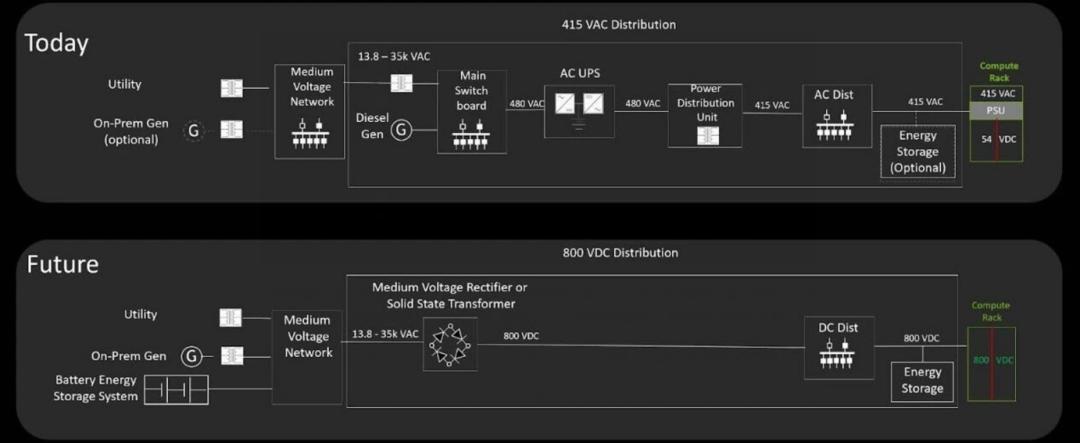
Second, when the rack power exceeds 1MW, solid - state transformers (SST) and solid - state circuit breakers (SSCB) become two hot commodities.
Bank of America predicts that the semiconductor opportunities for SST will be about $500 million by 2030, and about $400 million for SSCB. Coupled with energy storage (ESS/UPS) and liquid cooling infrastructure, the analog chip content per megawatt will increase from the current $12,400 to $38,900.
Third, NVIDIA's MGX (Modular GPU Architecture) is becoming another focus for power semiconductor manufacturers.
NVIDIA's MGX modular building - block architecture enables original equipment manufacturers (OEMs) and system builders to more quickly configure, deploy, and expand AI infrastructure, while reducing development complexity and accelerating time to market.
The MGX components are the NVIDIA GB200 NVL72 and GB300 NVL72 system infrastructure, which are responsible for managing power density and thermal load. By integrating the advanced liquid - cooled MGX architecture into the Blackwell computing node, NVIDIA meets the energy consumption requirements of the GB200 NVL72 at 120kW per cabinet. The GB300 NVL72, equipped with 72 Blackwell Ultra GPUs, requires more precise thermal management to achieve a 50 - fold increase in AI inference output.
Fourth, SiC and GaN are no longer exclusive to electric vehicles and will also shine in AI data centers. SiC is suitable for front - end high - voltage conversion (PFC, AC - DC, 800V protection), and GaN is suitable for high - frequency DC - DC conversion close to the computing board.
Bank of America predicts that the CAGR of SiC in the AI analog market will be as high as 63%, and GaN will reach 69%. From less than 4% in total in 2025 to more than 12% in total by 2030. In the future, the growth rate of third - generation semiconductors in AI data centers will be even more rapid than that in electric vehicles. However, SiC and GaN will still not shake the position of Si MOSFET.
Fifth, vertical power distribution (VPD) will be one of the most critical technologies for modern processors. At this year's CES, NVIDIA confirmed that Rubin will use the VPD solution.
VPD supplies power vertically upward through the PCB layer to directly power the processor above, effectively shortening the power transmission distance from the VRM to the SoC.
VPD will have three stages: The first stage is discrete/lateral power distribution. The power stage, inductor, and capacitor are directly arranged next to the processor (GPU). However, when the GPU current exceeds 850 - 1000A, the loss will exceed 100W, and the total resistance of the PDN will be about 90 - 140μΩ. The second stage is backside vertical power distribution (BVM), which adopts a vertical layout. The power supply module uses a vertically penetrating layout and vertically connects to the processor from the back of the substrate/mainboard, shortening the transmission path. The third stage is substrate - integrated voltage regulator power supply (SIVR), which integrates the voltage regulator directly on the substrate, further streamlining the vertical transmission path and is the optimal solution for loss control.
Sixth, VRM (voltage regulation module), IBC (intermediate bus converter), and PSU (server power supply module) will continue to evolve.
Power Giants Increase Investment in These Technologies
We can get a glimpse of how power semiconductor manufacturers view AI data centers recently from the PCIM 2026 held recently.
First, manufacturers' focus has shifted from parameters such as RDS(on), Eon/Eoff, Qg, Coss, and short - circuit capability of single devices to system - level efficiency, power density, and reliability.
The solutions of Infineon, onsemi, Navitas, ST, TI, and Power Integrations extend from 800VDC/HVDC power distribution, BBU, IBC, medium - voltage to low - voltage conversion, GaN high - density power supplies, SiC high - voltage front stages to the vicinity of the processor core power supply. Infineon mentioned that the power supply architecture for AI data centers is moving from traditional racks to power sidecars, HVDC sidecars, and DC microgrids, and emphasized that SST can be used to distribute HVDC to IT racks.
Second, the commercialization of SiC JFET is making a comeback in AI data centers, and this line is being bet on by both Infineon and onsemi.
Why is JFET attracting renewed attention? As the power supply architecture of AI data centers evolves from the 48V bus to ±400V and 800V high - voltage direct current (HVDC), the millisecond - level response speed of traditional electromechanical circuit breakers is no longer sufficient to meet the requirements of fault protection, and semiconductor protection solutions have become an inevitable choice.
Compared with MOSFET, JFET has more advantages in this scenario. MOSFET is limited by the body diode, and usually requires an additional anti - series structure to achieve bidirectional blocking. However, after combining with the Cascode driver, a single JFET device can achieve bidirectional blocking, which not only simplifies the circuit but also reduces system losses. Therefore, in applications such as high - voltage direct current power distribution and solid - state circuit breakers in AI data centers, JFET is regaining industry attention.
The 750V version of Infineon's CoolSiC JFET has a low on - resistance of 1.5mΩ, and the 1200V version is only 2.3mΩ. It uses the Q - DPAK top - cooling package and combines with the.XT sintered interconnection technology. In addition, Infineon has developed a complete set of solid - state circuit breaker (SSCB) solutions around the CoolSiC JFET, which can achieve microsecond - level fault isolation, bidirectional blocking, and modular current expansion capabilities. On the other hand, onsemi has taken a different approach by directly making the 800V SiC JFET into a modular product, mainly targeting the Hot - Swap and E - Fuse applications in AI data centers. Onsemi also demonstrated a complete 33kW "Grid - to - Chip" power tree solution, covering the entire link from the medium - voltage input on the power grid side, isolation transformation, to the point - of - load (PoL) power supply on the server board. It is one of the few system - level demonstration cases at this PCIM.
Third, GaN is clearly gaining popularity in the power supplies of AI data centers. It should be noted that GaN is not intended to replace SiC, but rather is accelerating its expansion in high - frequency and high - density power supplies, low - voltage and high - current conversion in AI data centers, auxiliary power supplies, bidirectional switches, and some high - voltage and low - power scenarios.
Navitas demonstrated various AI data center power supply solutions covering 10kW 800V - 50V, 20kW 800V - 6V, etc. ST demonstrated its PowerGaN products for power conversion, motor drive, and on - board charging, and identified the 800VDC AI server power supply as a key application direction. At the same time, it launched a 700V GaN HEMT device for AI servers. EPC brought its seventh - generation GaN devices and ePower Stage.
It is worth noting that GaN is expanding to higher voltage levels and is no longer limited to the high - frequency power supply market below 650V. Fraunhofer IAF demonstrated the research results of 1200V - level GaN, and Power Integrations launched 1250V and 1700V PowiGaN devices for applications such as the auxiliary power supply of 800VDC AI data centers.
Fourth, materials, packaging, and system technologies are becoming the focus of competition in the next stage.
In the field of SiC wafers, Wolfspeed announced that its 200mm SiC wafers and epitaxial wafers have entered the commercialization stage and also disclosed the R & D progress of 300mm single - crystal SiC wafers.
In the field of power modules, the importance of ceramic substrates continues to increase. CeramTec demonstrated various advanced ceramic materials such as AlN, Si₃N₄, and ZTA.
In terms of packaging technology, silver sintering, copper sintering, and low - void soldering have become the key directions. Heraeus, Indium, and MacDermid Alpha all demonstrated relevant solutions.
At the system level, solid - state transformers (SST) and solid - state circuit breakers (SSCB) are starting to move from concept verification to actual prototypes. Infineon, Navitas, and Wolfspeed demonstrated relevant solutions.
In addition, AI - assisted design, digital twin, and PHIL real - time testing are gradually being integrated into the R & D process of power electronics. High - speed current sensing and electronic fuse protection are also receiving wide attention.
Domestic Manufacturers Focus on Single - Point Technologies
Compared with the complete layout of Si, SiC, and GaN abroad or the complete solutions like "Grid to Core", domestic manufacturers mainly focus on single - point technologies.
For example, Juwat has been making efforts in the field of power chips for AI servers and can provide comprehensive analog chip solutions for the computing field. Among them, the "intelligent power stage (DrMOS) + multi - phase controller" is Juwat's biggest highlight. In terms of the intelligent power stage, it launched the JWH7079 intelligent power stage with a large current output of 90A, which integrates MOSFET and driver, supports a wide input of 3 - 16V, a large current output of 90A, and has an operating frequency of up to 3MHz. It integrates 5μA/A current detection, 8mV/℃ temperature monitoring, and multiple protection functions, and uses a 4×6mm TLGA package, which is suitable for high - performance computing power supply scenarios such as servers and GPUs.
In May this year, SGMICRO launched the 90A high - performance Smart Power Stage (DrMOS) - SGM25890 with a built - in current detection circuit.
In December last year, MPS launched a new generation of intelligent power stage (SPS) products, the MK684X series (MK6840 & MK6841). This series uses a compact 4mm x 6mm package and is a further iteration of the MK6850 with a 5mm x 6mm package launched in December 2024.
In December last year, Chipown also released 12 chips at once, including the PN786X series of DrMOS/Smart Power Stage products, targeting high - density multi - phase applications such as XPU high - current VRM.
Last year, BPS announced the launch of its second - generation DrMOS. Relying on the mature foundation of its first - generation self - developed BCD process (BPS - G1), BPS successfully developed and mass - produced the second - generation BCD process (BPS - G2), and its key performance indicators have achieved a leap and reached the international first - class level.
Analogix has also deployed in the field of DrMOS. The SQ29670 of Analogix is a single - chip SPS/DrMOS. The chip integrates decoupling capacitors, MOSFETs, drivers, and control units inside and uses the industry - standard package.
In terms of SiC/GaN, power semiconductor manufacturers are currently accelerating their entry into the AI infrastructure track.
In 2025, the revenue of Innoscience's AI and data center business reached 63.19 million yuan, a year - on - year increase of 50.2%. It has entered the supply chain of the 800V HVDC high - voltage direct current solutions of many domestic and foreign leading customers, including NVIDIA.
The proportion of AI