Roundtable: One Step Ahead of Consensus, The Real Landscape of AI Venture Capital | 2026 WAVES
AI is not just a passing trend; it's becoming the horizon. And the horizon means that you can't see its end, but it's always there.
Currently, the AI wave is surging, and industry consensus has not yet been formed. However, real opportunities often emerge before consensus. Now, let's enter the round - table forum on the real chess game of AI venture capital, which takes one step ahead of consensus!
The following is the content of the round - table dialogue, edited and organized by 36Kr:
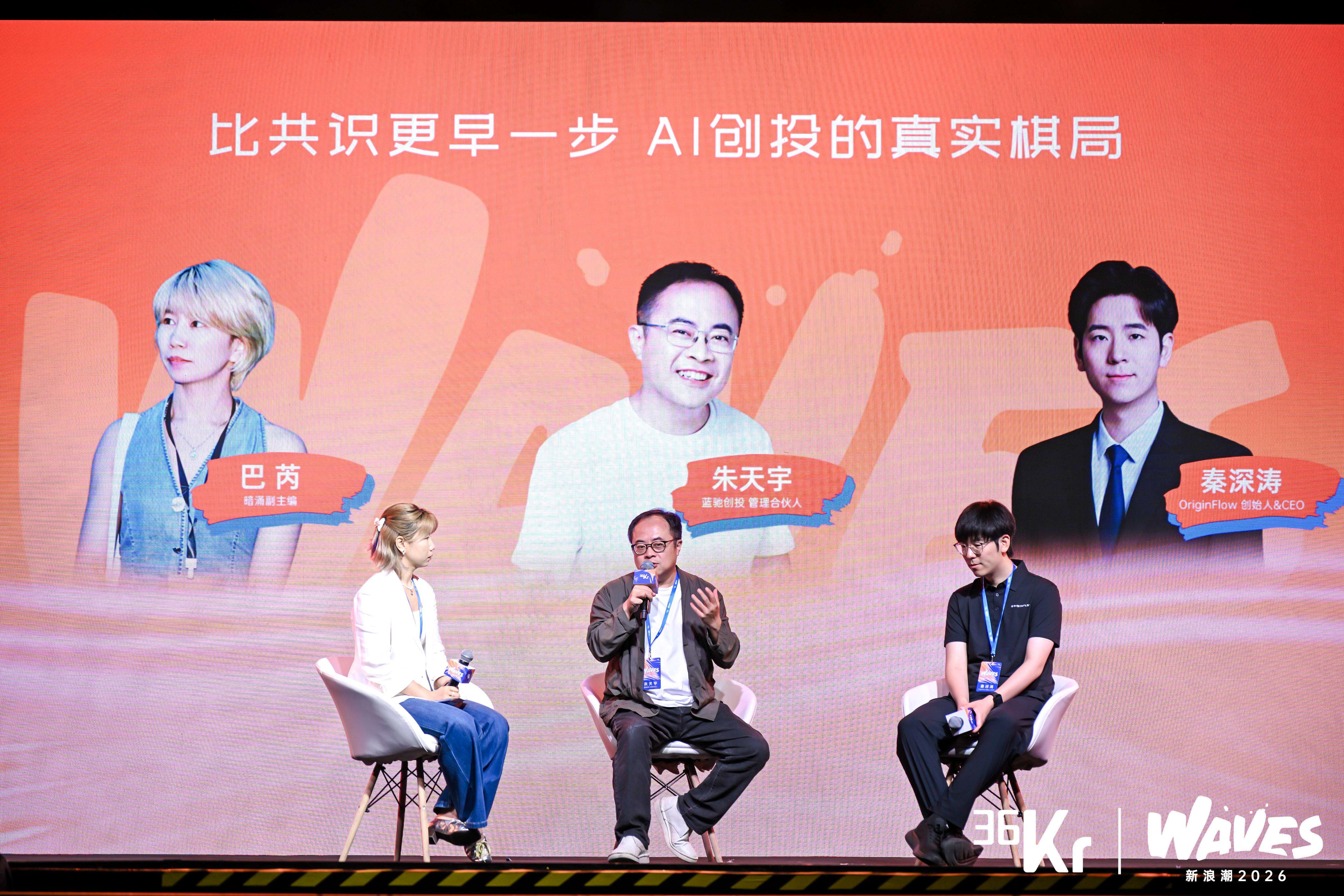
Ba Rui | Deputy Editor - in - Chief of AnYong (Host)
Zhu Tianyu | Managing Partner of BlueRun Ventures
Qin Shentao | Founder & CEO of OriginFlow
Ba Rui: Hello, everyone! The theme of our discussion today is "one step ahead of consensus". In the previous session, we talked about some non - consensus content. In this session, we'll discuss things that are one step ahead of consensus.
Here on site, we have two guests. One is Zhu Tianyu, the managing partner of BlueRun Ventures, who has made early investments. The other is Qin Shentao, the founder of OriginFlow, who started his business early. These two are brave enough to take action one step ahead of consensus, which is based on very firm judgments. We'd like to talk about this today.
Let me introduce. Mr. Zhu joined BlueRun Ventures in 2009. Under his leadership, BlueRun has invested in well - known companies like Li Auto, Dark Side of the Moon, Zhipu Robotics, and Genspark. Moreover, Mr. Zhu said very early that early - stage investors should be the first investors of entrepreneurs and be willing to invest real money at the most uncertain times. He also judged in 2017 that AI is not a fleeting trend but a long - term label. The other guest, Qin Shentao, is a very young Tsinghua doctoral graduate born in 2001. He founded OriginFlow last year, a company that provides physical world interaction infrastructure for embodied intelligent robots using non - invasive motor nerve interfaces. It sounds a bit complicated. Later, Shentao can explain in detail what the company does. I heard that within five months of its official operation, the company completed investments from the angel round to the Pre - A1 round, with a cumulative investment of over 500 million RMB, a very large amount. BlueRun was also the co - lead investor in its angel round and has continuously increased its investment for three rounds. It is said that BlueRun gave an investment letter of intent in the afternoon after communicating in the morning. I confirmed this just now. He said that the afternoon decision was due to some procedural matters. In fact, it only took him 30 minutes to really make up his mind to invest. So, I'd like to ask Mr. Zhu, why were you so quick to decide to invest in this young man?
Zhu Tianyu: First of all, the title "one step ahead of consensus" is actually a very high requirement. It's an over - compliment, and it's hard to easily accept such a perspective. But indeed, when chatting with Shentao, I decided to invest in this project in less than thirty minutes. In my past investment experience, only a few projects gave me a similar feeling, like Genspark, where we also communicated for about half an hour, and Li Auto, KIMI, etc., which also gave me a similar feeling.
Back to your question, why could I make the investment decision so quickly? There are mainly three core reasons: First, early - stage investment is not simply based on the information and characteristics presented by the project itself. Instead, it requires earlier and more structured views on the current global challenges and problems to be solved. About three or four years ago, around the emergence of ChatGPT, we had an idea about the investment content in the next few major cycles, which we called the "superposition of three waves". The "three waves" can be understood as three curves on a coordinate system constantly overlapping, corresponding to three driving factors. The first driving factor is AGI, which is well - known in the industry. The second is robotics, covering all relevant embodied and physically - driven fields. The third is 3D interaction. I think the combination of AGI, robotics, and 3D interaction defines the opportunities for our early - stage investment institution to continuously place bets on these three driving factors in the next ten or even thirty years. I think the business that Shentao is researching exactly fits these three major driving factors. There is an obvious difference between electromechanical control and embodied intelligence. Embodied intelligence mainly observes the movement of the human hand and judges how to control through inverse language. Shentao's team analyzes the descending data from the brain through the electromechanical system to understand the underlying control logic of human movement. From the perspectives of robotics, interaction, and AI intelligence, it perfectly matches the key points we are looking for, so this direction is very attractive.
Second, as the founder, I don't even consider age as a reference dimension for evaluating Shentao. In the short thirty - minute communication, I completely ignored his age. What I saw was an entrepreneur full of passion for his direction of struggle and eager to solve problems. Looking back on his more than twenty - year life experience, all his past accumulations have been paving the way for his current career. At this moment, with the integration of multi - field accumulations, he is fully committed to the technical breakthrough work he loves the most and is sparing no effort to promote the solution of problems. Such a pure and focused entrepreneur is very rare. In addition, his elaboration on the industry business and his judgment of people and things show a mental maturity far beyond his age.
The third point, which I think is crucial, is that this direction fully leverages China's comparative advantages. This is the same as the underlying driving logic for our fund to fully layout multiple companies in the field of embodied intelligence. Because China not only has an advantage in the density of AI talents but also has obvious comprehensive capabilities and industrial chain accumulations in the manufacturing field. So from the perspectives of embodiment, data, and intelligence, using a combination of hardware and software to obtain data, inverse - analyze data, and understand the world, I think this is an extremely promising direction. There is not only a solid data foundation but also a very promising commercial space that can be built on it.
As mentioned before, we have successfully invested in projects like KIMI, Genspark, and Zhipu. We may be the only or one of the very few early - stage institutions in China that have invested in basic large - scale models, embodied intelligence, and applications at the same time and were able to seize the opportunity at an early stage. So these are all the thinking frameworks that struck me in 30 minutes and the reasons behind my decision to invest.
Ba Rui: Did you show your intention to invest right after the 30 - minute chat on site?
Zhu Tianyu: At that time, I quietly said to my colleague on WeChat: "We must get this person."
Ba Rui: Shentao, did you notice Mr. Zhu's little action? After the chat, did you expect to get the TS so quickly that day? What was your reaction?
Qin Shentao: During the communication, there was eye contact, and I could really feel the sense of conviction. To be honest, we are lucky. Currently, AI is at an unprecedented industrial node, so there aren't many substantial difficulties in the financing process. But when choosing who to cooperate with, you can clearly feel the different motivations of the other party. BlueRun gave me a very different feeling. I remember that before the formal communication, they had been thinking deeply about this direction for many years and had been looking for the real solution. So when our solution collided with their long - term pursuit, you would feel that no matter what fluctuations occur in the industry in the future, these are the people worth walking side by side with.
Ba Rui: Shentao, would you like to introduce what your company does? The definition we gave before was a bit long.
Qin Shentao: When we talk about AGI today, its previous development mainly revolved around two major modalities. The first is the text modality: OpenAI and Anthropic were able to achieve breakthroughs in large - language model capabilities. Behind this, there is a core foundation, which we can call the uploading of human knowledge. This was gradually completed by the Internet over the past thirty - odd years since the 1990s: In the process of using Internet products, a large amount of logical human knowledge data was precipitated and solidified in the form of Tokens.
The second major modality practice is the video modality, with autonomous driving being a typical example. During the driving process, people accumulated a large amount of video data of autonomous driving vertical scenarios through the data collection devices on the vehicle at a relatively low cost, which supported the understanding and modeling of the visual modality by Robotaxi. Behind this knowledge uploading is the continuous operation of at least 300,000 user vehicles on real roads at a relatively high frequency, continuously contributing data.
But today, we are facing a third modality - enabling intelligent agents to have embodied interactions with the real physical world. The core ability of real embodied intelligence occurs after physical contact, which is fundamentally different from autonomous driving: Autonomous driving is a typical contact - free scenario. Once physical contact is involved, we will find that how to accurately define and model the "action" modality has not been deeply explored by the industry, and there is no mature facility to complete the corresponding uploading.
Here is a simple data reference: There are 8 billion people in the world, and each person is awake for more than 12 hours a day. If the physical interaction data of all humans can be collected, nearly 100 billion hours of real physical interaction data can be generated every day. However, the real interaction data used in the training of current generative AI models may only be hundreds of thousands of hours, with a huge quantitative gap between the two.
If we firmly believe that Physical AGI is the last industrial revolution in human civilization, we must go through a solid underlying infrastructure process: Expand the data collection funnel and upload the physical interaction data in human production and life in an efficient way. And this collection scheme must be non - invasive - not interfering with people's natural activities, not affecting normal production processes, and having extremely high requirements for collection rhythm, accuracy, and long - term collection consistency. It must be a truly in - the - wild solution, not an in - the - lab solution.
Ba Rui: Back to the topic of investment, I'd like to ask Mr. Zhu.
In the current primary market, making quick investment decisions is not something new. Especially for some popular projects and star entrepreneurs, it's not uncommon to issue a TS on the spot or make a decision on the spot like you did. But you once said that the real opportunity doesn't lie in the speed of following the trend but in the ability to see the structural changes earlier than others. In the past two years, embodied intelligence has been very popular, and OriginFlow is at the forefront of the wave. It raised 500 million in five months. How do you judge that your decision to invest in Shentao was based on seeing the structural changes rather than being driven by the craze?
Zhu Tianyu: I mentioned some of this before, the "superposition of three waves" framework. Let me explain it a bit more. This framework makes us constantly ask ourselves: What new opportunities will these driving factors create? For example, we have been looking at the embodied direction for a long time, and the data problem has always been a common difficulty. As Shentao just said, everyone is looking for a better way to collect data.
We have been paying attention to AI for a long time. You also mentioned the "debate about whether AI is a trend or a label". The wave in 2014 and 2015 was mainly discriminative AI based on computer vision, which is fundamentally different from this round of generative AI. At that time, saying "it's not a trend but a label" was to distinguish the degree of its impact on value - but the impact of this round no longer needs to be debated.
On the other hand, when it comes to AI itself, if you want to know the depth of its value creation and how we should understand and train the physical world in the embodied direction, the requirements for data are actually very high. So we have been looking for such a solution. I once made an important statement: In any technological cycle, the best state is to "make money while collecting data". Whether it's the big - data era, the previous AI era, or this round of the AI era, the logic is the same. Shentao's solution very nicely addresses this issue - "making money while collecting data". Because it naturally downloads the human brain's consciousness stream during the human process. Although there are many other ways, this is a very interesting perspective.
From another perspective, as we were discussing just now, from a bionic perspective. Since humans are very perfect machines, the entire brain can handle so many complex problems with a power consumption of only 10 to 20 watts, and the whole human body only consumes more than 100 watts. Being able to complete such complex work with such extremely low energy consumption, there are actually many bionic perspectives that we can use to think about how to realize the value of artificial intelligence.
So the structural thinking comes from both the big framework we mentioned and the habit of thinking with problems. In my opinion, founders can be roughly divided into two categories. One category comes with labels, such as wanting to be the Chinese version of someone, wanting to be the number one in a certain track, or wanting to build a company with a market value of 100 billion. The other category of founders often says that they have discovered a problem and feel that the needs of a certain group of users have not been met. They create from the perspective of solving problems rather than chasing a label. I think the different starting points of these two types of founders will lead to a series of different behaviors and choices. I actually have a more optimistic view of the latter.
Back to your question, in addition to the structural level of the matter, in terms of people, we have our own judgments about the founder's starting point and future potential. Regarding potential, I often say that a founder's self - iteration speed is actually the biggest factor determining the upper limit of the founder's potential. There is a common saying about judging a founder's level: "Knowing mistakes, being willing to correct, and correcting quickly." These three words basically correspond to three levels. Knowing mistakes, that is, knowing where one has made mistakes, is a hurdle that many top students get stuck at. The second is being willing to correct, which means getting out of one's comfort zone. Even if you know you are wrong, it's not easy to get out of the comfort zone. The third is correcting quickly, which requires a strong achievement motivation and a high degree of self - discipline. These three stages can roughly identify founders with a potential to build billion - dollar, ten - billion - dollar, and hundred - billion - dollar companies. Of course, this is a bit of a joke, but it does represent the ceiling of a founder's self - iteration, which is also a structure. So after forming judgments on both the matter and the person, in the early stage, it often only takes a moment of eye contact to know that this is the person we are looking for, and they also hope that we are the investment institution to accompany them. So the deeper structural cognition and connection at the bottom determine the faster formation of a relationship.
Ba Rui: During your communication with Shentao, what behaviors of his made you see his potential, such as knowing mistakes and being able to correct quickly, the potential of a founder of a company with a very large market value as you mentioned?
Zhu Tianyu: It would be embarrassing if I can't answer this question well. How can I solve this problem in 30 minutes? Actually, an important point is that in those 30 minutes, I could at least feel two things.
First, when he described the problem he wanted to solve, his state was not about "being the first in something". He started from the problem itself, just as I said before. This is the problem the industry is facing, and there is no better perspective. Some other open - source projects provide some parts, but how to assemble them. His description was very smooth and structured, and his thinking was very thorough.
Second, at that time, more of the communication was about Shentao's past experiences and various life choices. Because these choices actually reflect to a large extent what kind of person he is. Although I haven't seen his future growth yet, his choices and the impacts and directions they bring to his life are very important foundations.
Since we have invested in three consecutive rounds, the first round was fast, and the following three rounds were also fast, and with a large - scale and over - investment. Why? Because after the investment, we found that Shentao has extremely strong abilities in recruiting and transforming talents. Some people we introduced to Shentao joined the company immediately. And I know that a heavyweight person has recently joined, which are all important signs.
Ba Rui: Shentao, you are right in the middle of this wave of enthusiasm. From the other side of the financing table, what does the "quickness" of investors look like? Is there a moment when you even think it's too fast? And how do you distinguish who really understands and who rushes in for fear of missing out? You mentioned a little bit in your first answer. You can elaborate more.
Qin Shentao: It's true. During the boom period, a large amount of hot money will pour into the track. There is a core structural driver behind this: The AG