How can AI "understand" the global climate system? Tsinghua University proposes a unified climate modal prediction model UniCM
[Introduction] A team from Tsinghua University has proposed the UniCM model. By learning the interactions among multiple climate modes through a unified framework, it helps AI better understand the complex relationships in the global climate system. This breakthrough not only improves the accuracy and timeliness of climate prediction but also turns AI into a tool for exploring climate mechanisms, which is of great value in fields such as disaster prevention and agriculture.
When it comes to climate prediction, people are most familiar with El Niño (ENSO).
However, the global climate is not determined by a single climate phenomenon. In addition to ENSO, multiple climate modes such as the Indian Ocean Dipole (IOD), Tropical North Atlantic Mode (TNA), and North Pacific Meridional Mode (NPMM) co - exist and form a dynamically coupled global system through trans - ocean basin teleconnections and air - sea interactions.
For a long time, most prediction methods have mainly focused on a single climate mode or only studied the relationships between a few modes, making it difficult to describe the complex non - linear interaction processes in the global climate system. UniCM models multiple key climate modes within the same unified framework, regarding the global ocean - atmosphere system as an interacting whole.
Recently, the research team led by Professor Li Yong from the Department of Electronic Engineering at Tsinghua University published a research paper titled "Learning the coupled dynamics of global climate modes" in Nature Machine Intelligence, proposing the Unified Climate Model (UniCM) for global climate modes.
Paper link: https://www.nature.com/articles/s42256-026-01245-5
The research team found that the predictability of the climate system not only comes from individual climate phenomena themselves but also from the long - term coupling relationships among multiple climate modes. By learning these coupled dynamics, UniCM unleashes the "Emergent Predictability" that is difficult to utilize with traditional methods.
This research breaks through the traditional thinking of "single - mode, separate prediction" in climate prediction. For the first time, from the perspective of the global coupled system, it comprehensively learns the complex dynamic relationships among multiple ocean - atmosphere climate modes, providing a new research paradigm for long - term climate prediction, early warning of extreme climate events, and AI - driven climate science discovery.
Research Background
In recent years, artificial intelligence has achieved rapid development in the field of weather forecasting. Various AI models can already achieve high - precision weather prediction on a scale of days to weeks.
However, climate prediction focuses on longer - term issues: How will the global climate system evolve in the next few months, years, or even longer? Which regions may experience extreme events such as droughts, floods, and heatwaves? These issues involve complex cross - scale interactions among multiple ocean and atmosphere systems.
Existing methods often treat climate modes as independent objects, while the real - world climate system is a highly coupled complex network. How to enable AI not only to "make predictions" but also to help scientists understand the long - term coupling relationships among these modes has become an important challenge in the field of AI for Science.
The "Dual - Perspective" Unified Climate Model
To solve this problem, the research team designed the dual - branch architecture of UniCM.
The model consists of two core modules:
1. Globalformer: Learning the evolution of local physical fields
Globalformer is responsible for processing key physical variables such as sea surface temperature (SST), wind stress, thermocline depth, and upper - ocean temperature, and learning the spatio - temporal evolution laws of the climate system from fine - grained climate fields.
2. Modeformer: Learning the relationships among climate modes
Modeformer focuses on seven important climate modes, including ENSO, IOD, TNA, NPMM, SPMM, IOB, and SIOD, and learns their non - linear interactions and co - evolution processes.
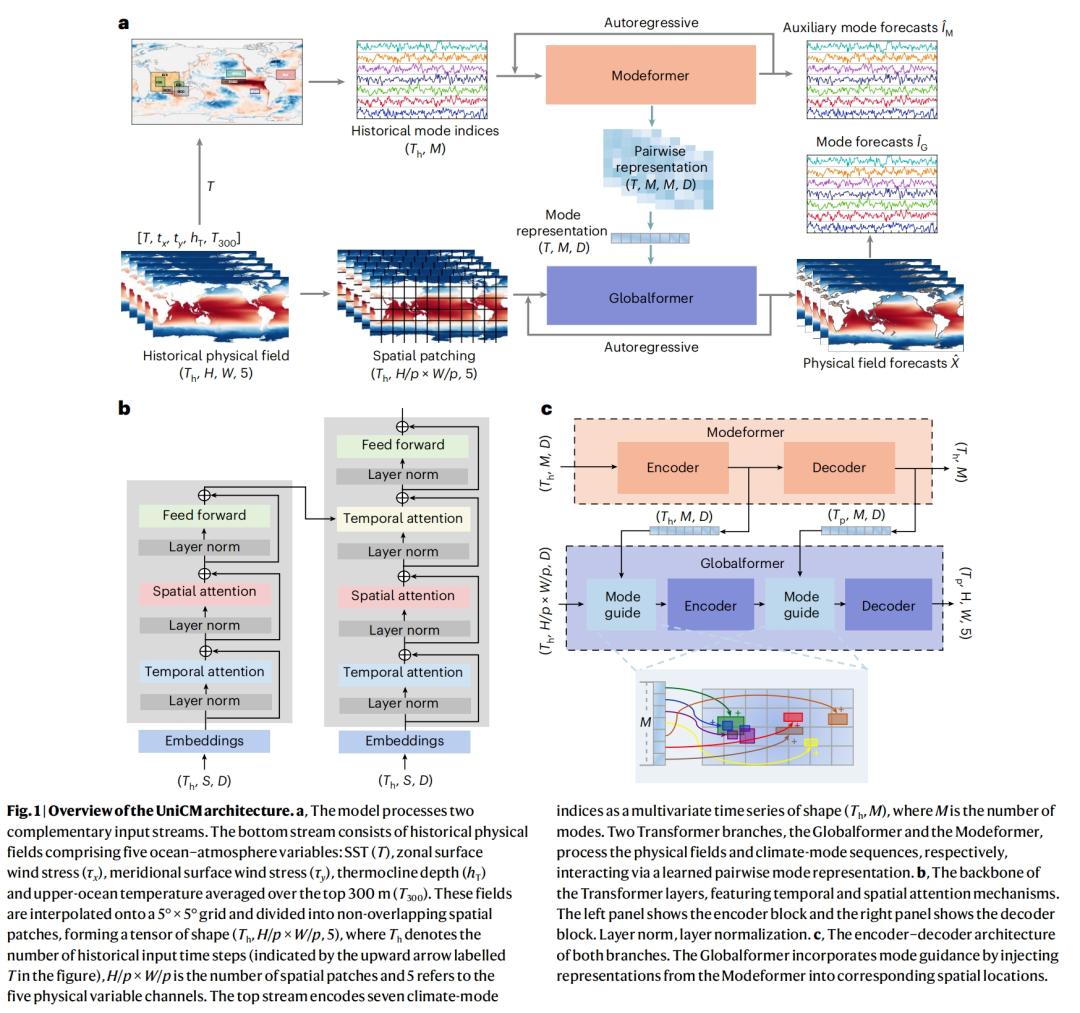
More importantly, UniCM establishes a two - way coupling mechanism: on the one hand, local physical fields generate large - scale climate modes; on the other hand, the formed climate modes in turn affect the future evolution of local physical fields. The research team calls this mechanism "mode - to - patch guidance", that is, using large - scale climate states to guide local predictions, achieving a closed - loop modeling from the local to the whole and then from the whole back to the local.
Research Results
The ENSO prediction ability reaches the international leading level
ENSO is considered one of the most important climate modes globally and is also the most challenging task in the field of long - term climate prediction.
The research results show that in the verification of observational data from 1980 to 2023, UniCM continuously outperforms various representative baseline models within a 24 - month prediction window. The model can extend the effective prediction lead time of ENSO to 19 months, while previous advanced models usually only reached about 15 to 16 months.
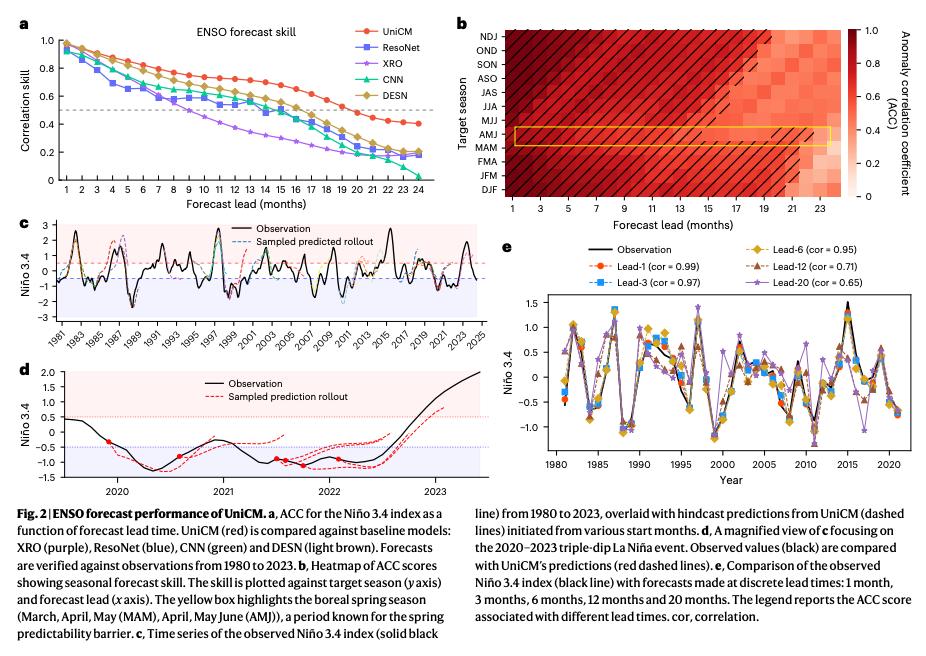
At the same time, UniCM also shows obvious advantages in the "spring predictability barrier" problem that has long troubled the field of climate prediction. The model can still maintain high prediction skills when crossing the Northern Hemisphere spring, extending the effective prediction ability to about 14 months.
In addition, UniCM successfully reproduces the 1997 - 1998 super El Niño event and the consecutive three - year "triple La Niña" event from 2020 to 2023, accurately capturing the occurrence, development, and attenuation processes of these historical extreme events.
Realize the unified prediction of multiple global climate modes for the first time
UniCM is not only good at predicting ENSO but also can simultaneously predict seven important climate modes within the same framework, including ENSO, IOD, IOB, SIOD, SPMM, NPMM, and TNA.
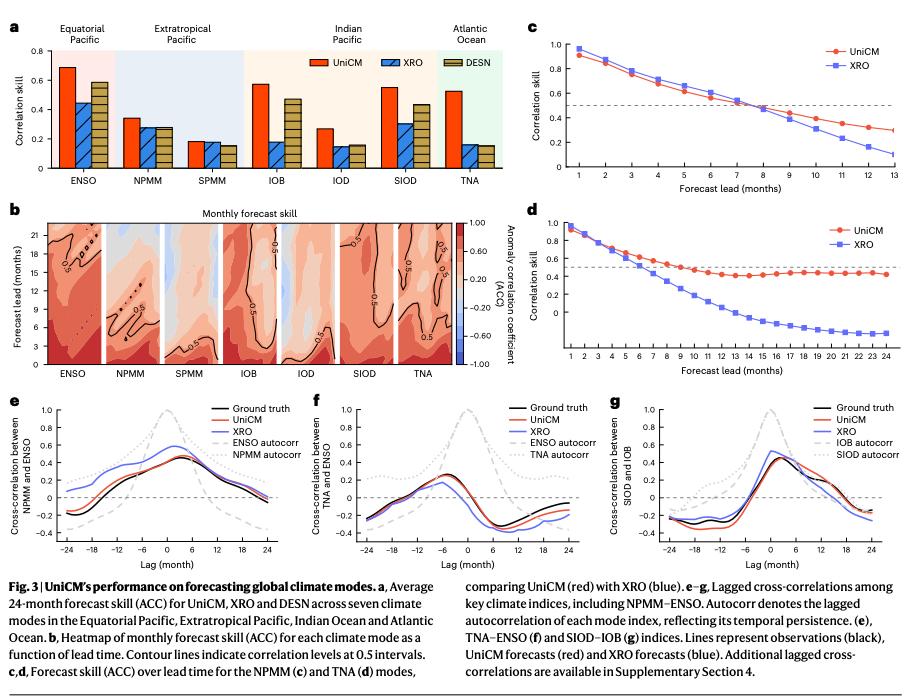
The results show that the prediction ability of the model for multiple climate modes is better than existing representative methods. Among them, for some non - ENSO modes that are more difficult to predict, the average prediction skill is improved by more than 22%; the effective prediction lead time of IOD reaches about 7 months.
More importantly, UniCM can accurately reconstruct the real lag - correlation relationships among different climate modes. For example, it successfully reproduces the physical relationship that NPMM leads ENSO by about 4 months and the coupling structure among multiple trans - ocean basin climate modes.
This indicates that what the model learns is not simply statistical correlation but the real physical coupling mechanism existing in the global climate system.
Turn AI from a "predictor" into a "scientific discovery tool"
In addition to prediction ability, UniCM also has strong interpretability.
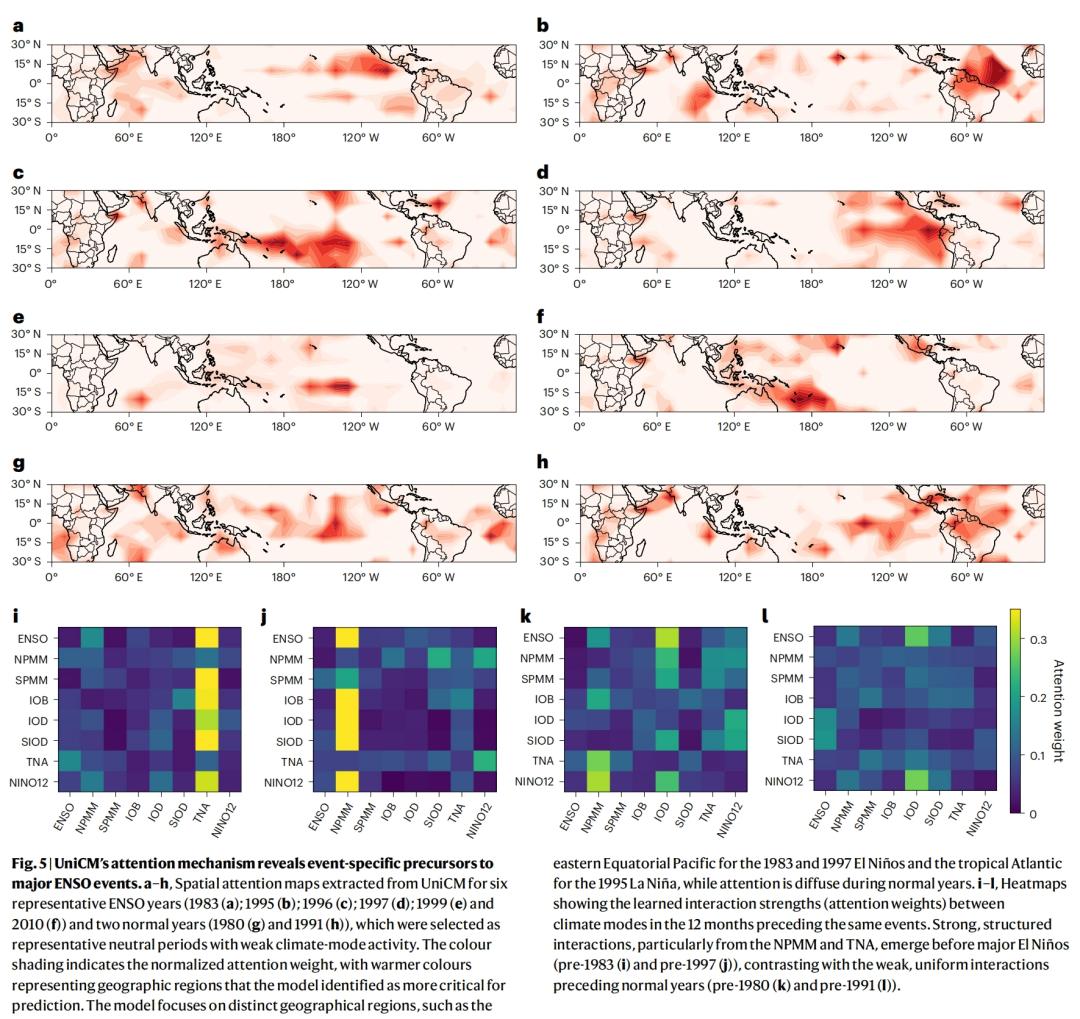
The research team found through analyzing the internal attention mechanism of the model that before major ENSO events occur, the model will automatically focus on key regions and key mode relationships with physical significance.
For example, before the 1997 super El Niño event, the model identified the important leading role of NPMM; in some complex climate events, it was found that TNA may play a key hub role. The relevant findings are highly consistent with the existing climate physics research results.
This means that UniCM can not only predict future climate states but also help scientists discover potential mechanisms and propose new scientific hypotheses, thus becoming an important auxiliary tool for climate science research.
Future Applications and Development Prospects
Against the background of global climate change, the importance of long - term climate prediction is becoming increasingly prominent. More accurate and longer - term climate prediction will directly serve fields such as agricultural production, water resource management, energy scheduling, fishery development, and disaster prevention and mitigation.
The research team believes that what UniCM represents is not only a new climate prediction model but also a unified modeling idea for complex systems. In the future, this framework is expected to be extended to the study of intraseasonal oscillations, interdecadal climate change, and the evolution of climate modes under the background of global warming, and further applied to other complex systems with the two - way coupling characteristics of "local process - overall structure".
From "predicting the weather" to "understanding the climate" and then to "discovering the laws", UniCM demonstrates new possibilities for artificial intelligence in earth system science: perhaps the truly important prediction information is not hidden in a single climate indicator but exists in the coupling relationships of the continuous evolution of the entire climate system.
Reference: https://www.nature.com/articles/s42256-026-01245-5
This article is from the WeChat official account "New Intelligence Yuan". Author: New Intelligence Yuan; Editor: LRST. Republished by 36Kr with authorization.