AI payment is not a pseudo-demand, but there is also no need to rush to claim that it will subvert everything
What's more difficult than payment is authorization, and what's scarcer than technology is trust.
AI payment is not a product of big tech companies' whims, nor is it a meaningless competition for entry points, let alone a "pseudo - demand" that users don't need. It is an infrastructure upgrade driven by both technology and user habits, and an inevitable evolution of the payment industry from "transaction processing" to "intelligent services."
Of course, it is still imperfect today. There will be security issues, limitations in application scenarios, and games and competitions among big tech companies.
However, if we are overly critical due to its imperfection, we may miss an era when payment truly becomes "seamless."
Advancing the "Last Mile" of AI - Enabled Transactions
Recently, WeChat, Alipay, JD.com, and UnionPay have intensively launched AI payment products. Many people's first reaction is: Are big tech companies starting another round of competition in the payment field? But if we take a closer look at these products, we'll find that they are not even in the same race.
Alipay is addressing how AI can truly complete tasks. WeChat is solving the problem of how AI can spend money on behalf of users safely. JD.com is considering who should be responsible if AI spends money incorrectly. UnionPay is dealing with how AI can enter the existing payment network and gain trust.
Overseas, Visa, Mastercard, and Stripe are competing for the underlying protocols and infrastructure of future intelligent agent commerce.
Although they all seem to be doing AI payment, in fact, they are filling different gaps in the transaction chain of the Agent era.
The most radical one is Alipay. According to LatePost, Alipay internally launched the "Treasure Plan" in the second half of 2023 to explore intelligent transformation. In September 2024, it launched an independent app called "Zhi Xiaobao." However, due to the fragmented entry points, its influence has always been limited. In March 2025, the team made a crucial adjustment, abandoning the independent app route and returning to the main Alipay app.
The key judgment behind this shift is that AI should not become a new entry point outside the payment system but rather an integral part of the payment system itself.
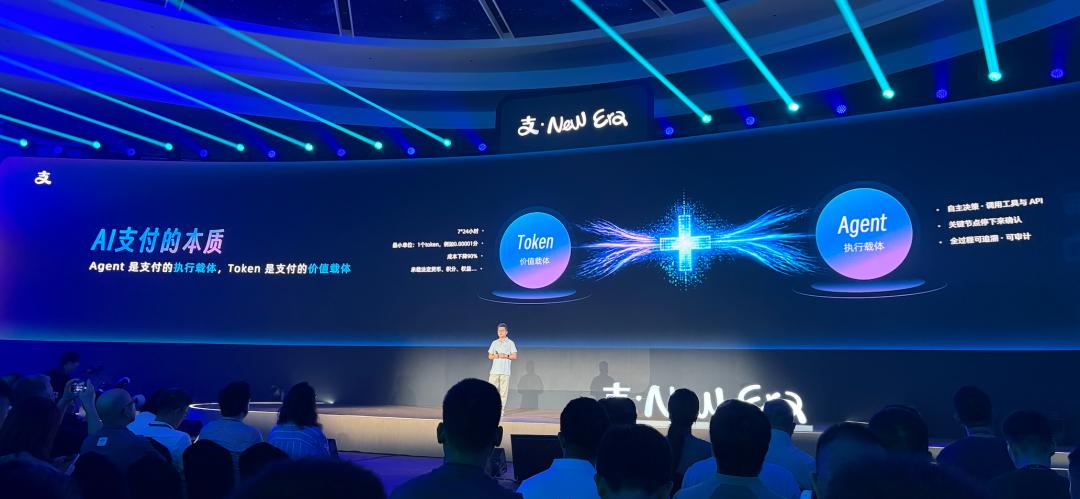
Abao, launched in June this year, is a brand - new AI interface, which is connected to Alipay's service network that has been accumulated over the years.
On the one hand, Alipay is promoting the opening of the MCP interface, enabling merchant services to be directly called by AI. On the other hand, through screen - reading operations, it is compatible with mini - programs and service ecosystems that have not yet been fully transformed.
Abao is trying to enable AI to complete a full - fledged closed - loop process from understanding user needs, calling services, to payment settlement.
Compared with Alipay's reconstruction of the underlying infrastructure, WeChat is more concerned about how to allow intelligent agents to have limited consumption capabilities while ensuring security.
In early June, WeChat opened its AI platform, and Meituan, JD.com, Didi, Ctrip, etc. became the first batch of access partners. Subsequently, WeChat Pay was connected to Tencent's self - developed desktop intelligent agent, WorkBuddy.
Users can submit requests to AI on the PC side, such as searching for nearby group - buying packages. The intelligent agent will complete the recommendation, screening, and ordering process, and the payment process will be confirmed and completed on the mobile side.
The whole process may seem simple, but it hides WeChat's most important design principle: Let AI spend money, but not recklessly.
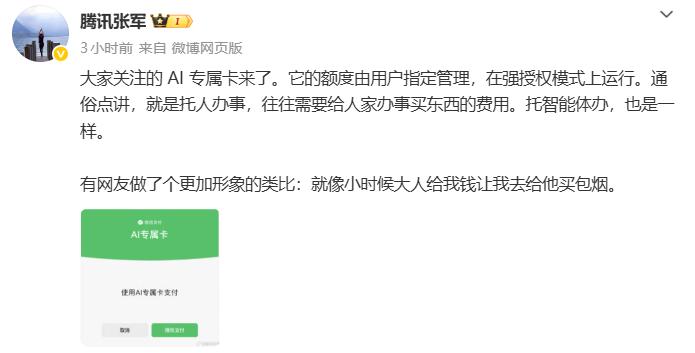
Currently, the AI - exclusive card uses an independent authorization mechanism. Users need to bind their accounts and authorize the payment ability for the first use, and both the consumption scope and amount are strictly restricted.
It first completes a full verification of "recommendation, decision - making, payment, and verification" in a closed - loop scenario, aiming to solve the problem of how AI can pay safely.
JD.com has a more long - term vision. It is considering how to divide the responsibility if AI starts to consume on behalf of users and there are issues such as incorrect purchases, over - consumption, or even fraud. Based on this, it proposed A2P2 (Agent to Payment Protocol), a six - level autonomous payment system from L0 to L5, as well as a task - delegation certificate and an ARI identity authentication mechanism. JD.com is trying to establish a standard framework that can describe AI's consumption permissions, responsibility attribution, and risk boundaries.
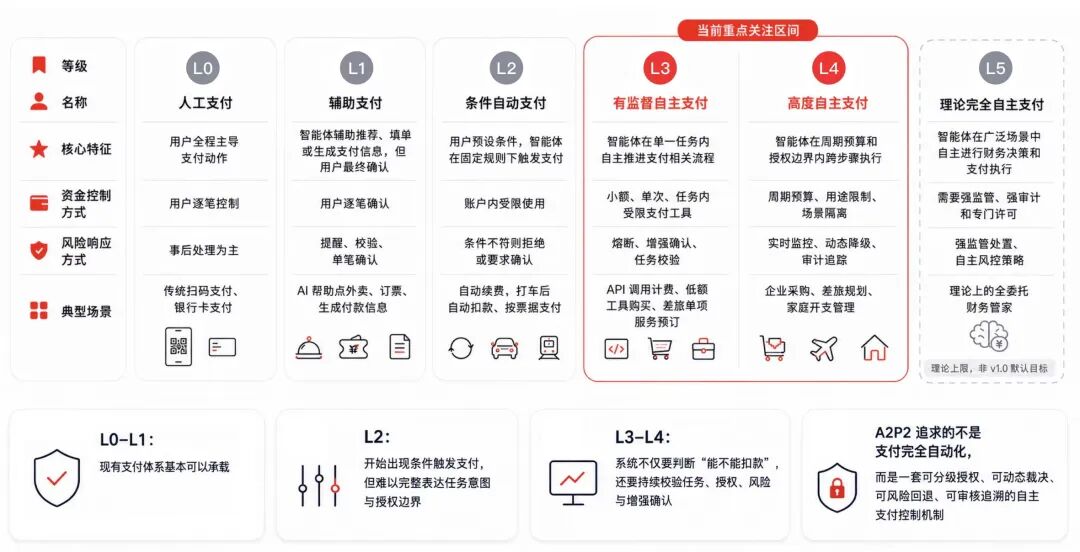
Compared with Alipay and WeChat, which are directly targeted at users, JD.com is more like building a road.
UnionPay and UnionPay Merchant Services are upgrading the traditional acquiring system into a transaction network that AI can directly call. In April this year, China UnionPay released the intelligent agent payment open protocol framework APOP and completed multiple real - transaction verifications. From airline and hotel bookings to in - car assistant coffee purchases, APOP is solving the problem of how intelligent agents can gain the trust of the payment network.
Questions such as who the user is, who the intelligent agent is, who initiated the payment, and whether the payment conforms to the user's intention... all require a new trust mechanism to answer.
UnionPay Merchant Services further extends this ability to real - world business scenarios such as campus meal ordering and utility bill payments. If UnionPay is formulating rules, then UnionPay Merchant Services is verifying these rules.
Looking overseas, we can find that similar things are happening simultaneously. Mastercard launched Agent Pay, Visa released the Trusted Agent Protocol, Stripe started building payment capabilities for AI agents, and Google is collaborating with industry partners to promote the Agent Payments Protocol.
Almost all global payment giants are striving to build new transaction infrastructure for the AI era. They have all realized that when AI starts to perform tasks on behalf of users, payment is no longer just the last step in completing a transaction but a crucial link for intelligent agents to gain action capabilities.
In this regard, the term "AI payment" itself is inaccurate. Alipay is reconstructing the service network, WeChat is verifying the consumption closed - loop, JD.com is formulating the responsibility framework, UnionPay is establishing trust rules, and Visa and Mastercard are competing for global protocol standards.
They start at the same time but reach the same goal through different paths: After AI does things for people, can it spend money for people safely and trustworthily?
Why Now?
AI large - language models have been popular for three years, and mobile payment has been widespread for over a decade. Why has it suddenly become a hot topic that all giants are vying for?
The answer lies in the transformation of AI's role.
In the past, large - language models only provided "question - and - answer" services. No matter how powerful they were, they remained at the information level, without dealing with money or performing tasks. However, in the Agent era, AI starts to help you book tickets, order meals, hail a taxi, and reserve a hotel. AI has changed from "talking" to "doing," and the next step of doing is spending money.
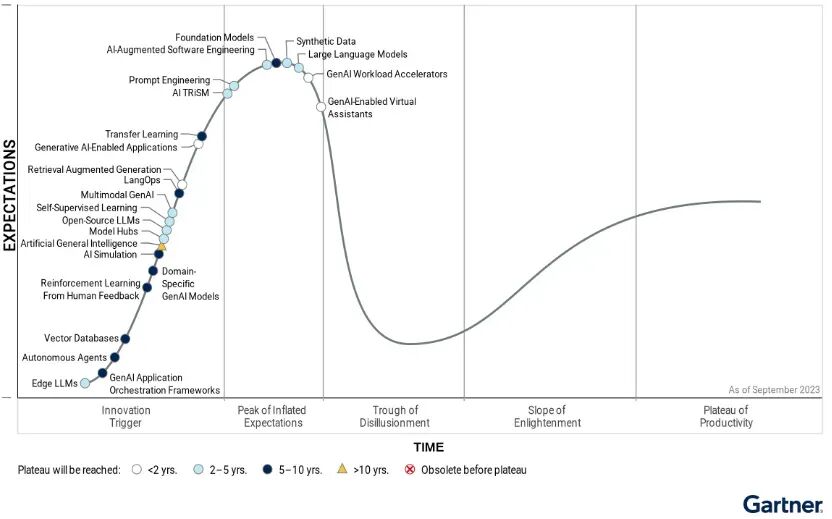
The technological inflection point is emerging first. Gartner predicts that by 2026, more than 80% of enterprises will use generative AI (GenAI) application programming interfaces (APIs) or models, or deploy generative - AI - enabled applications in relevant production environments. This proportion was less than 5% in 2023.
IDC data shows that the number of globally active AI agents is expected to grow rapidly from about 28.6 million in 2025 to 2.216 billion in 2030, nearly an 80 - fold increase in five years.
These numbers may seem huge, but in the specific context of payment, it can be summarized as one sentence: AI can not only help you search for information but also help you make decisions.
From QR - code payment in 2011, face - recognition payment in 2018, palm - recognition payment in 2023, to NFC tap - and - pay in 2024, and glance - based payment in 2025, the evolution of payment methods has always been seeking a more seamless interaction form.
However, the essential difference between AI payment and previous iterations is that QR codes, face recognition, and NFC are all about optimizing how people complete payment actions, while AI payment is redefining who makes the payment decision.
The former is an improvement in interaction efficiency, while the latter is a shift in the decision - making subject.
Mastercard clearly listed AI - driven agent - based commerce as the top of the six global payment trends in its 2026 trend report, stating that this is not a side function but a fundamental shift where AI agents, rather than humans, initiate and complete transactions.
Moreover, there is not much room for growth in the mobile payment market itself, and both users and the market have reached a ceiling.
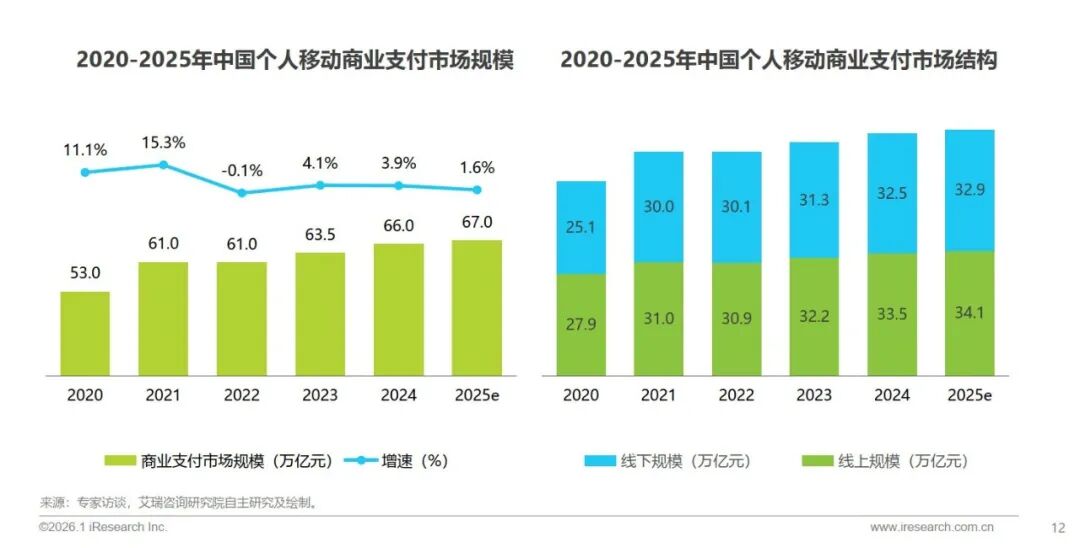
Data from iResearch shows that the scale of China's personal mobile payment market was 20.52 trillion yuan in 2024, but it is expected to decline by 3.7% year - on - year to 19.75 trillion yuan in 2025, and the growth rate of transaction volume is only 1.1%. High - frequency scenarios such as offline small - scale and daily - life services have been fully penetrated. In other words, QR - code payment has reached its peak, and new ways need to be explored.
The maturity of user habits is another driving force. During the Spring Festival in 2026, major giants invested more than 4.5 billion yuan in red envelopes and subsidies to attract new users and educate them to use AI assistants. This 4.5 - billion - yuan investment is not for payment but for user intention. Users are already accustomed to booking tickets, ordering meals, searching for travel guides, and grabbing red envelopes by simply chatting with AI.
When users are already used to telling AI their needs, it's much easier to let it pay for them than it was one or two years ago.
The last driving factor comes from regulations. Many people think that big tech companies are trying to get ahead of regulatory requirements. On the contrary, the intensive launch of AI payment products this time indicates that the industry has realized that rule - building must precede large - scale implementation.
JD.com's A2P2 hierarchical system, Alipay's Token Pay, WeChat's AI - exclusive card, and UnionPay's APOP protocol are answering questions such as how much money AI can spend, in what scenarios it can spend, and who is responsible if something goes wrong.
These products seem to be opening up payment capabilities, but in fact, they are constantly adding constraints. Limit restrictions, whitelist mechanisms, pre - authorization, identity authentication, risk classification... all participants are trying to put up layers of guardrails for AI.
Payment has never been a purely technical issue; trust is the core.
Let's go back to the original question. Why now? Because for the first time, AI has the ability to take action and is starting to move from answering questions to completing tasks. At the same time, users are also getting used to expressing their needs in natural language on a large scale and entrusting more and more things to AI.
Meanwhile, the mobile payment industry has entered a mature stage, and the payment industry needs new growth space. The rule framework around intelligent agent payment is also starting to move from conceptual discussions to real - world verification.
When technology, demand, the market, and regulations all reach a critical point, the emergence of AI payment is no longer a choice but an inevitability.
Don't Be Too Critical of AI Payment
In the past decade or so, the payment industry has been focused on making it more convenient for people to complete payments. From online banking to QR - code payment, from face - recognition payment to tap - and - pay, each innovation has optimized the payment action itself.
AI payment, however, is trying to solve the problem of how money should be spent after AI starts to perform tasks on behalf of people.
If speed is the only concern, NFC tap - and - pay is already sufficient. Alipay's tap - and - pay service covered more than 400 cities across the country in 2025, connected to over ten million merchants, and had more than 100 million users. The real value of AI payment lies in the transformation of payment from a tool to a service.
In the past, the act of paying was the goal; now, it is just the result.
Imagine a scenario where you tell WeChat AI to book a high - speed train ticket to Shanghai tomorrow, leaving in the morning and not too expensive. AI will call Ctrip, compare prices, select seats, and complete the payment. You don't need to open the Ctrip app, repeatedly confirm the amount, or even manually enter the password, of course, within your preset limits and rules. The core value of this experience is that you don't need to worry, and the service comes to you instead of you looking for the service.
In the context of Alipay, this logic goes a step further. You tell Abao to check this month's financial investment returns. AI not only completes the query but also gives suggestions based on your historical data and risk preferences, saying, "Your monthly fixed - investment performance outperformed the average of similar products last month, but the proportion of bonds is relatively high. Do you want to make an adjustment?"
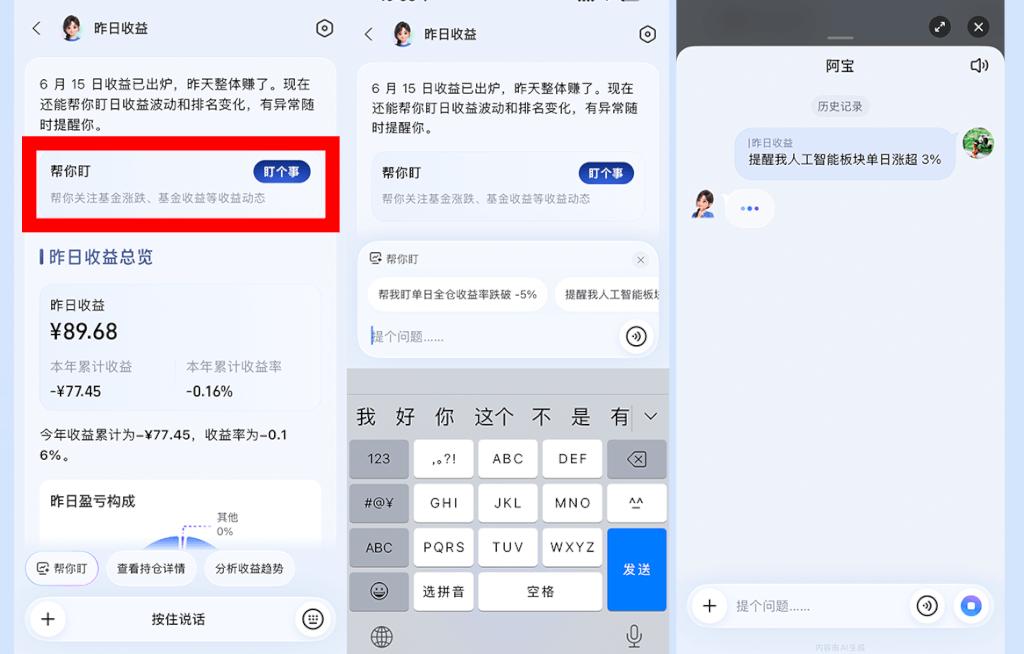
This "payment plus insight" experience cannot be provided by simple QR - code scanning.
Now, the commercial significance of this transformation has been verified in the B2B field. Gartner predicts that by 2028, 90% of B2B purchases will be completed through AI - agent intermediaries, involving more than $15 trillion in spending. McKinsey's estimate is even more aggressive. By 2030, the intelligent - agent - based commerce coordination revenue in the US B2C retail market alone could reach $1 trillion, and the global intelligent - agent - based commerce market could be as large as $3 - 5 trillion.
When agents