Do you understand the first stock of Physics AI?
Let me tell you an interesting thing:
You know Yann LeCun, right? The Turing Award winner. In March this year, he closed a $1.03 billion seed round for his new company, AMI Labs. This is the largest seed round in European history.
Then, in the first half of this year, technology companies around the world seemed to have made an agreement and all flocked to one term: "Physical AI."
01
Jensen Huang mentioned this term 17 times in a speech at CES in January this year. Seventeen times! He announced that "the ChatGPT moment for Physical AI has arrived."
Okay, since Jensen Huang has spoken, everyone followed suit. At the GTC conference in March, NVIDIA directly launched the Cosmos 3 open - source world model and also revealed that the revenue from the Physical AI business exceeded $9 billion in the past year.
Fei - Fei Li wasn't slow either. World Labs received $1 billion in financing in February, and its valuation is approaching $5 billion. OpenAI went even further. It directly scrapped Sora and redirected the entire team to work on world models. Sora was hyped up so much before, but they just gave it up.
Coatue Management made a prediction: The Physical AI market is at least $6 trillion, which is higher than the digital AI market.
In just the first quarter of this year, the global financing for Physical AI exceeded $6.4 billion.
It's really bustling. But if you think carefully about a question that is rarely answered directly: What do these incoming players actually have?
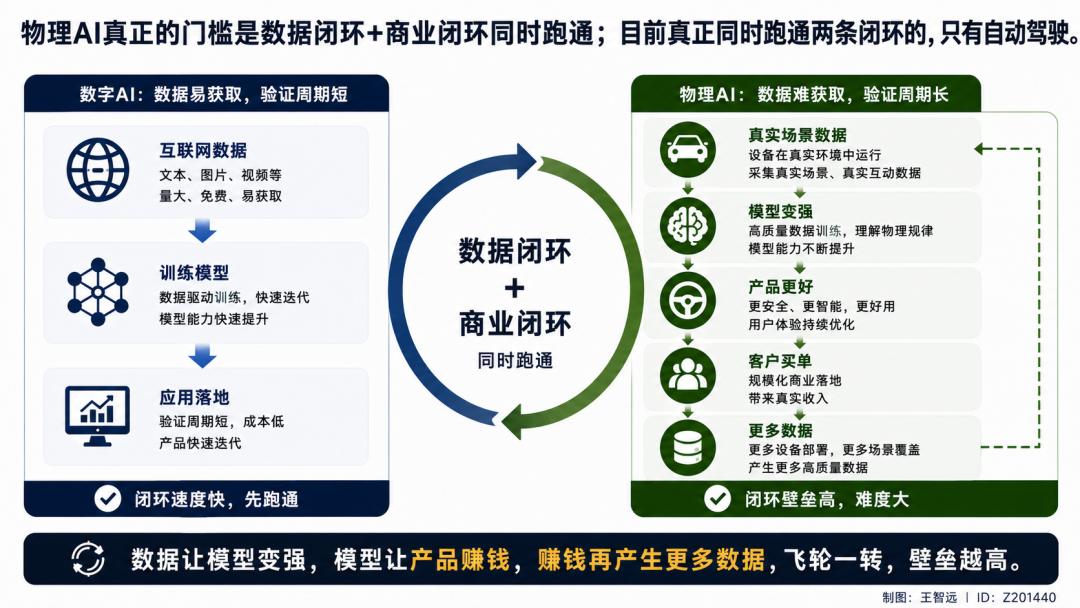
Why did digital AI succeed first? To put it simply, there is one reason: the data is readily available. There is an abundant supply of text, images, and videos on the Internet. The acquisition cost is almost zero, and the verification cycle is short.
OpenAI worked on both robotics and language models in its early days. Later, it cut the robotics business temporarily and focused on GPT because it's too difficult to obtain data from the physical world.
However, the physical world is actually the major part. Half of the global GDP comes from the real economy. Manufacturing, logistics, transportation, and healthcare are all dozens or even hundreds of times larger than the digital world. Since digital AI has succeeded, who doesn't want to replicate the experience?
The problem is: the data required for Physical AI can't be obtained from the Internet.
It has to "grow" from the real world. Devices need to operate in real environments, collect data in real scenarios, and accumulate data through real interactions. None of these steps can be skipped.
There is a cruel logic here: you need to have large - scale commercial implementation first to obtain large - scale data. With data, you can train a model that truly understands physical laws.
So, I'll give you a yardstick to distinguish between real and fake Physical AI.
Don't look at how many algorithm papers have been published, and don't care how dazzling the demos of world models are. Just look at two things: Has the data closed - loop been established? Has the business closed - loop been established? And these two must operate simultaneously and support each other.
Data makes the model stronger. A stronger model makes the product more useful. A useful product makes customers pay. Customer payments bring in more data. Once this flywheel starts spinning, the gap between the leading players and the latecomers will be exponential.
So far, among all the directions claiming to be Physical AI, only one has truly established both closed - loops: autonomous driving.
And in this field, there is a company that has just received the "approval" from the capital market.
02
On June 23rd, Momenta passed the Hong Kong Stock Exchange's hearing and is in the IPO sprint stage. It has been labeled as the "first Physical AI stock."
Just take the label as a reference. The real question is: Why did the capital market give its approval at this time? What does it actually have? The answer lies in its 900,000 mass - produced vehicles.
But don't rush. "Having cars" and "knowing how to use cars" are two completely different things.
At the Beijing Auto Show in April this year, a reporter asked a good question to Momenta's CEO, Xudong Cao. The exact words were probably: You always talk about data - driven, but there is also a saying in the market that it's not that difficult to obtain a large amount of data. The difficult part is using it well. What's your opinion?
Xudong Cao gave a response, and I suggest you read it word for word.
He said that data is like ore. And it's iron ore with a very low ore content. If you want to use it, you first need to turn the low - grade ore into high - grade ore, smelt the high - grade ore into steel, make an engine from the steel, and install the engine in a car. Only then does it have value.
Having a large amount of raw data only accounts for 10% of the value source. The remaining 90% comes from the system. This set of numbers, 10% and 90%, is the key to understanding Momenta.
When the outside world talks about Momenta, they always mention two numbers: 900,000 mass - produced vehicles and 12 billion kilometers of real - vehicle mileage. It sounds astonishing.
Think about it. If "having data" is equal to "having the ability," then every company that installs a few more cameras could do Physical AI. Right? Obviously, it's not that simple.
What Momenta is really doing is ore refining.
Let's first talk about how to turn low - grade ore into high - grade ore. With 900,000 vehicles on the road every day, there is a huge amount of raw data. However, most of it is repetitive and ordinary, with little training value. The truly valuable data comes from those extremely rare scenarios.
Xudong Cao gave an example: Three puppies lined up and crossed the highway.
Think about it. Such a scenario is extremely rare. How can you pick it out from a vast amount of data? It's as difficult as finding a needle in a haystack. Momenta has screened out 100 million segments of high - quality data from 12 billion kilometers. This screening process itself is a barrier that others can't replicate.
Now, let's talk about how to turn high - grade ore into an engine.
There is a product, the R7 world model that Momenta mass - produced and launched in April this year. How was it refined? Three steps.
Step 1: Pre - training.
Feed a large amount of real - world driving data to the model so that it can first learn basic physical laws. For example, what speed will cause a side - slip when turning, at what distance to start braking, and what it means when the vehicle in front suddenly changes lanes. After this step, the model has "physical common sense."
Step 2: Simulation.
Having physical common sense doesn't mean being able to drive. You need to build a virtual driving training ground for it and let it run through thousands of extreme scenarios. The key here is that Momenta's simulation environment is generated using real data, so the gap between the virtual and real worlds is naturally smaller.
Step 3: Reinforcement learning.
In the simulation environment, let the model figure things out on its own, make mistakes, and engage in games. If it crashes, it gets a deduction. If it drives well, it gets a bonus. Through such rewards and punishments, it learns to make optimal decisions in complex scenarios. The goal is not to imitate human drivers but to surpass them.
At this point, you may ask: Other companies are also talking about end - to - end and reinforcement learning. Why does Momenta achieve different results?
Xudong Cao answered this question directly at the auto show. He said: The real difference doesn't lie in single - point algorithms but in the system and organization. A good architecture involves trade - offs. A good system includes a complete set of processes for data iteration, training, and verification. Above the system are the organization and culture.
Then, he quoted an old Chinese saying: Oranges grown in the south of the Huai River are sweet, while those grown in the north are bitter.
Everyone may be talking about the same algorithm direction, but the results can be one or even two generations apart. The difference behind is not the algorithm but the system.
The difference in the system is reflected in the numbers.
From 2023 to 2025, Momenta's revenue increased from $743 million to $2.413 billion. It tripled in three years, with an average annual compound growth rate of over 80%.
What's even more worth looking at is the revenue structure: The revenue from technology development has been steadily increasing. Among them, the licensing revenue, which is the payment from car companies using your solutions per vehicle, soared directly from $23 million to $968 million, a 42 - fold increase in three years.
What's the advantage of licensing revenue? The marginal cost is extremely low. The more cars are sold, the more this revenue will be, and there is no need to make new investments every time.
Now, let's look at the investment side. The total R & D investment in 2025 was $1.869 billion, accounting for 77.5% of the revenue. In other words, for every $100 in revenue, $78 was reinvested in technology. There were 1,157 R & D personnel, accounting for 82% of the total company staff, and more than two - thirds of them have a master's degree or above. The cumulative R & D investment in three years was $4.66 billion.
What did this investment bring back?
In the third - party urban NOA supplier market, Momenta's sales market share is 65%, ranking first in the industry. Listen carefully. It's not just in the first echelon. It's more than the sum of the second - to - last - ranked companies.
Going back to Xudong Cao's analogy: Turning low - grade ore into high - grade ore, smelting high - grade ore into steel, making an engine from steel, and installing the engine in a car. Momenta has completed the entire ore - refining chain.
03
However, completing the entire process and reaching the finish line are two different things.
The ore - refining chain proves Momenta's current ability, but what the capital market is really betting on is the ceiling of this ability. How far can it grow?
Regarding this question, Xudong Cao made another judgment, which I think is even more worth pondering than the "ore - refining" analogy.
He said: Physical AI requires a ticket.
What does it mean? He did some calculations. To achieve large - scale L4 autonomous driving, the cumulative investment needs to be at least $10 billion. Note that this is still based on the R & D efficiency of a startup.
For large companies, the investment starts at tens of billions. What about general robots? It's in the range of tens of billions to hundreds of billions of dollars.
Look at how bustling the financing market for embodied intelligence is in China now. But in the long run, it's unrealistic to rely solely on investors' funds to develop general Physical AI. You must have a cash - flow business that can generate its own revenue. This is the ticket.
So, looking back at Momenta's IPO this time, its significance becomes clear. It's getting the ticket.
As of the end of 2025, Momenta's cash reserve exceeded $10 billion. Twenty - four global car companies are paying for its services, and the flywheel of licensing revenue has started spinning. All these together mean one thing: it can generate its own revenue.
With the ability to generate revenue, it is qualified to fight a bigger battle. What kind of battle?
This brings us to a very crucial judgment of Momenta. You may think it's overly ambitious: One large - scale model can be used for all vertical applications of Physical AI, and it can do better.
Now, their world model is already running on three fronts: intelligent driving for passenger cars, Robotaxi, and Robovan. In 2027, they will add a fourth front: Robotruck. In the future, the underlying capabilities of this world model may also extend to the field of embodied intelligence.
One model for four types of vehicles.
Xudong Cao gave an analogy. He said it's like the e - commerce industry ten years ago. Some did vertical e - commerce, and some did platform e - commerce. In the end, only the platform e - commerce companies survived. Can you still name any vertical e - commerce companies now?
Why? It's the platform effect. The data and experience from each vertical scenario are integrated into the same large - scale model, and each front benefits. On the contrary, the more fronts are added, the lower the marginal cost becomes.
How large is the market corresponding to this platform logic?
I checked. CIC (CIC Consulting) made a prediction: By 2030, the global market for Robotaxi will be about $81.8 billion, for Robovan about $85 billion, and for Robotruck about $33 billion.
Just the Robo segment alone adds up to nearly $200 billion. Coupled with the $305.9 billion market for mass - produced assisted driving, the total of the two markets exceeds $500 billion.
No matter how large the market is, not everyone can participate. Xudong Cao's judgment is that the scale effect and first - mover advantage in autonomous driving are even more significant than in the chip industry.
Think about the chip industry. In the PC era, there were only two major players globally, and in the mobile phone era, there were also only two. Autonomous driving is software, with zero marginal cost, so the scale effect is stronger. There is not only a scale effect in cost but also in experience improvement.
His final judgment, in his exact words, is: Only two or three companies will survive in China, and three or four globally. Sounds harsh, right? But when you look at his evidence, you'll know he's not scaring people.
Take Mercedes - Benz as an example.
In 2017, Ola Källenius, the current chairman of Mercedes - Benz, invested in Momenta. When do you think the first jointly mass - produced vehicle was launched? At the end of 2025. It took a full eight years.
Eight years. It went through POC verification, small - batch development, and full - scale mass production, without skipping any step.
Interestingly, once the process was established, the speed completely changed. In 2024, Momenta directly won the intelligent driving business for all Mercedes - Benz electric and fuel - powered vehicles.
Eight years of hard work, and all the business was won in one year.
This is the moat of the first - mover advantage. It's not that latecomers lack technology; they just can't make up for the lost time.
Momenta's customer list is the result of this logic. Nine out of the top 10 global car companies are its customers, including the German BBA, Volkswagen, the Japanese Toyota, Honda, and Nissan, the American General Motors and Ford, as well as BYD, Hyundai, and Chery.
These 24 car companies are not just testing the waters; they are in full - scale mass production.
The shareholder list is also worth a look. In terms of industrial capital, there are seven car companies: SAIC, General Motors, Mercedes - Benz, Toyota, BYD, Hyundai, and Chery.
There are also mobility platforms like Uber and Grab, and technology giants such as Tencent, Alibaba Cloud, Ant Group, and JD.com. Financial investors include Temasek, IDG, and the Oman Investment Authority.