With the increasing capacity of smartphone batteries, are power banks being pushed to the brink of obsolescence?
"Portable chargers won't become a 100-billion-yuan category. In fact, there's a high probability that they'll die out in a few years."
A decade ago, Yang Meng, the founder of the smart hardware brand Anker Innovations, pronounced a "death sentence" on this market segment.
Recently, in an interview with the media, Yang Meng emphasized that "portable chargers haven't reached the point of extinction," but still firmly believes that "this category will definitely disappear."
Just yesterday, the Honor X80 Pro Max was officially launched. Its single-cell super-large battery with a capacity of 11,000 mAh set a new industry record.
As mobile phone batteries are getting larger and larger, is the portable charger cornered?
Getting Larger and Larger
11,000 mAh!
This is the capacity of the built-in battery of the Honor X80 Pro Max, which was just released.
Equipped with the industry's largest battery, the Honor X80 Pro Max has an astonishing standby time of 42 days, a continuous call time of 73.7 hours, and a battery life of up to 6 years.
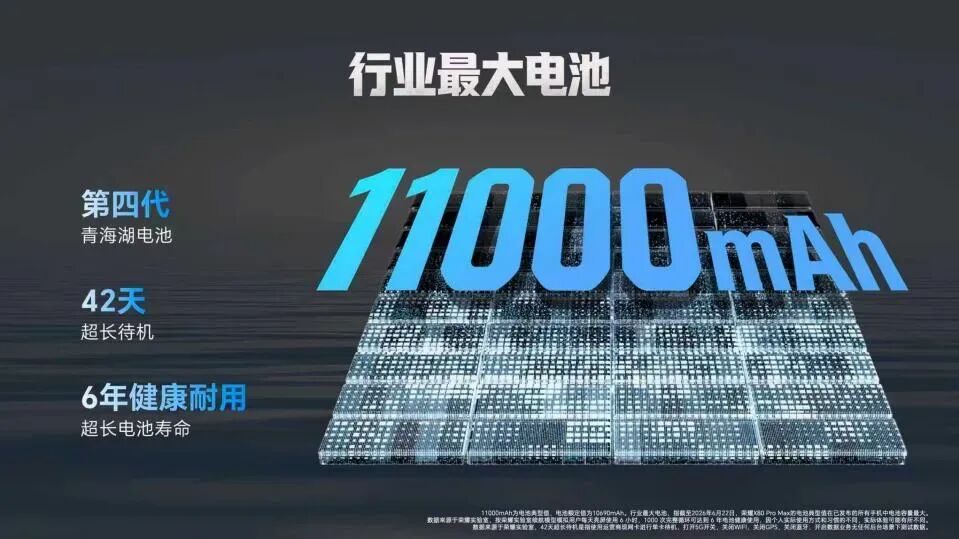
The Honor X80 Pro Max is equipped with the industry's largest 11,000 mAh battery
To address the anxiety about battery life, the competition in mobile phone batteries has been going on for more than three decades.
Back in the feature phone era, there was no such thing as charging anxiety.
The Nokia 1100, which was launched in 2003, had a global sales volume of 250 million units.
This "legendary phone" had a built-in battery of only 850 mAh.
Although it seems small, the Nokia 1100 only had a 1.4-inch black-and-white screen, so its power consumption was not high.
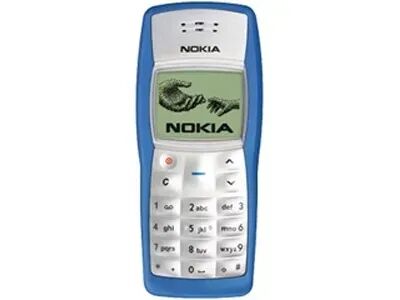
Nokia 1100
At that time, mobile phones could only make calls and send text messages, and the usage frequency was low. One battery could last for two or three days.
Later, as mobile phone screens got larger and functions became more diverse, people used their phones more frequently, and the battery gradually became insufficient.
Fortunately, mobile phone batteries at that time were replaceable, and universal chargers were available to solve the problem of battery life anxiety.
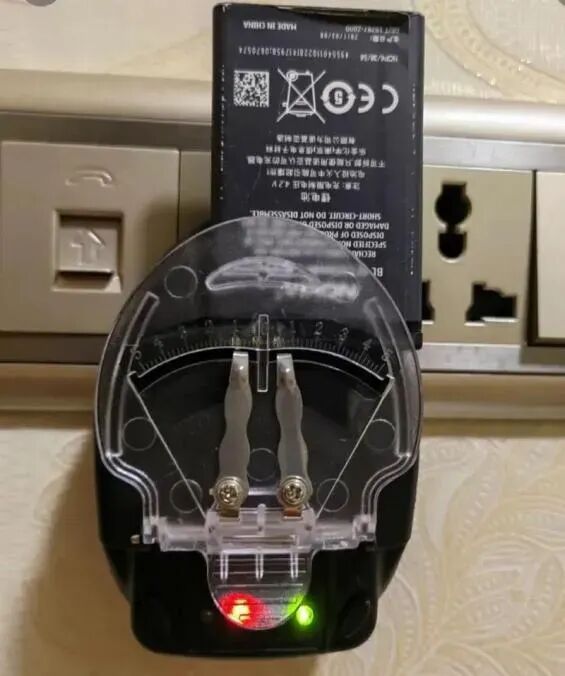
Universal charger for mobile phone batteries
It was until Apple's iPhone, with its "non-removable built-in battery," became the mainstream industry standard and triggered a wave of imitation across the industry, that the trend of all-in-one body design began.
The original iPhone in 2007 had a battery capacity of only 1,400 mAh, while the iPhone 17 Pro Max has soared to 5,088 mAh, nearly tripling in seventeen years.
However, the power consumption of the screen, the power consumption of the chip, and the background refresh of applications have completely offset the increase in battery capacity.
As mobile phones become more intelligent, the battery life becomes increasingly insufficient. Charging multiple times a day and looking for sockets when going out have become daily anxieties.
Portable chargers seized this pain point and began to grow explosively around 2010. Almost everyone has one.
In the past decade, people thought that mobile phone batteries had reached a bottleneck because the theoretical specific capacity of traditional graphite anodes is only 372 mAh/g, and the physical limit has kept the battery capacity firmly between 4,000 and 5,000 mAh.
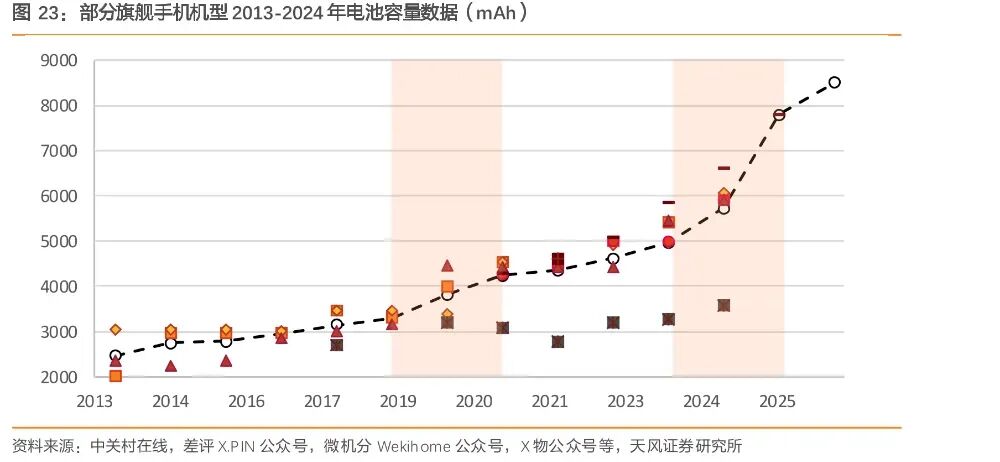
From 2013 to 2024, the battery capacity of mainstream flagship mobile phones increased from 2,000 mAh to less than 6,000 mAh. Source: Sanpijiang Industry Report
However, in recent years, domestic manufacturers have been focusing on this market segment, and the competition in batteries has become white-hot.
Brands such as Xiaomi, Huawei, and Honor took the lead in promoting the upgrade of battery capacity in flagship phones.
Data shows that in 2025, the market share of smartphones with an average battery capacity of 6,000 mAh or more among major Chinese OEMs jumped from 9% a year ago to 35%.
In terms of specific products, in 2025, mobile phones with a battery capacity of 7,000 mAh are quite common, and some are starting to break through 8,000 mAh.
What really broke the bottleneck was the implementation of silicon-carbon anode technology.
The theoretical specific capacity of silicon is as high as 4,200 mAh/g, more than ten times that of graphite. The capacity can be increased by 30% - 50% under the same volume. Manufacturers embedded nano-scale silicon particles into the carbon skeleton, solving the fatal defect of severe expansion during charging and discharging.
Finally, large capacity and a thin and light body can be achieved at the same time.
In 2026, the battery capacity of smartphones officially entered the "10,000 mAh era."
The battery capacity of models such as the vivo Y600 Pro and Honor Power 2 has exceeded 10,000 mAh, and users can use the phone normally for more than two days after a full charge.
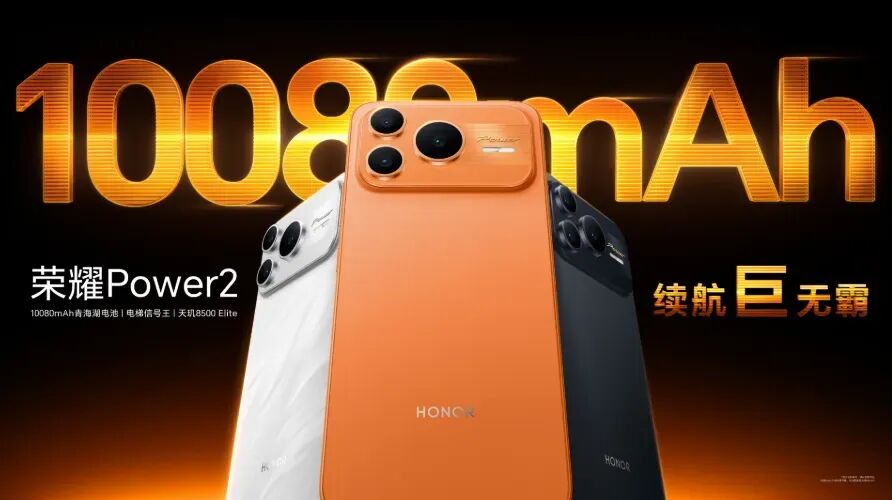
The battery capacity of the Honor Power 2 exceeds 10,000 mAh
In the newly released X80 Pro Max, Honor, based on the previous generation's silicon-carbon anode technology in the X series, adopted advanced cell materials and an ultimate formula design to achieve a more breakthrough energy density, allowing the battery to store more power in a limited space.
At the same time, through system-level architecture innovation, the Honor X80 Pro Max improves the overall space utilization rate from multiple aspects such as stacking design, motherboard layout, and antenna structure, releasing key space for a larger battery.
It was unimaginable two years ago to fit an 11,000 mAh battery into a body that is 8.08 mm thick and weighs 203 g.
A large battery, combined with system energy efficiency adjustment, makes the battery life performance even better.
Experimental data shows that the Honor X80 Pro Max can play short videos for 33.5 hours, make calls for 73.7 hours, play games for 23.9 hours, and navigate for 21.3 hours, setting four industry records for battery life and meeting users' long-term needs from entertainment to daily use.
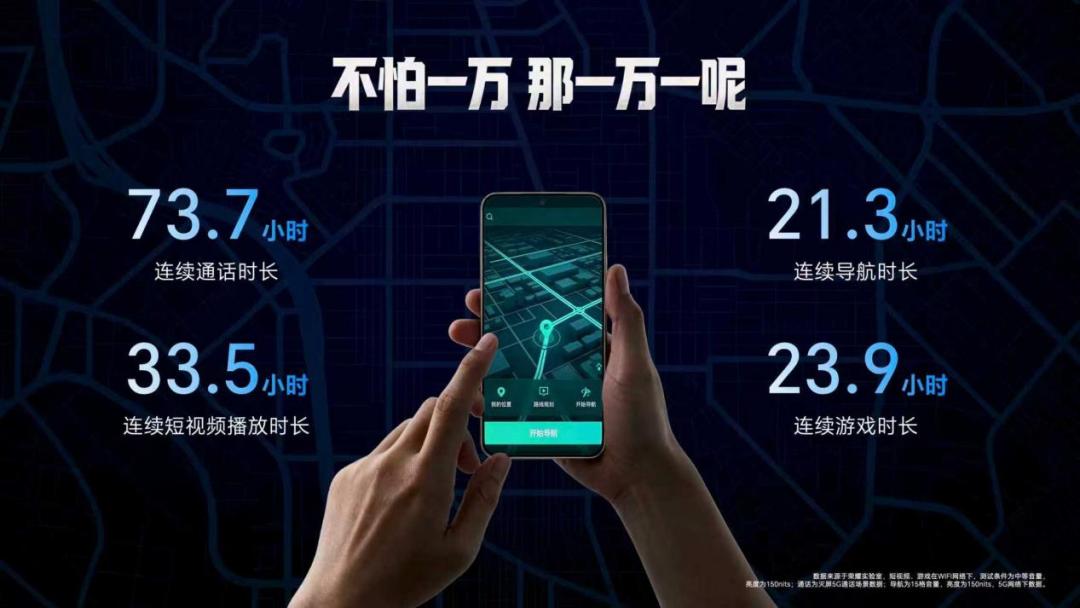
The Honor X80 Pro Max sets four industry records for battery life
In an authoritative challenge, the Honor X80 Pro Max refreshed the Guinness World Record for battery life, with a continuous usage time of an astonishing 26 hours, 8 minutes, and 34 seconds.
The battery capacity has increased from 900 mAh to 11,000 mAh in just over thirty years.
Is 11,000 mAh the end?
Certainly not.
Honor has planned multiple large-capacity battery solutions ranging from 10,000 mAh to 12,000 mAh and has completed the technical research and development, with the ability for mass production.
It is reported that Huawei also plans to introduce high-density batteries of 7,000 mAh, 8,000 mAh, and 10,000 mAh into its future product lines.
The "10,000 mAh era" of mobile phone batteries has just begun.
Under Pressure
In the past, when going out, people always carried a portable charger in their bags because it would be a hassle to go home if the phone ran out of power.
Now, mobile phones in the 3,000-yuan price range are directly equipped with batteries of 8,000 - 10,000 mAh. In actual tests, they can last for 2 - 3 days with moderate use and can still last for more than one day with heavy use.
The "King of Battery Life," the Honor WIN RT, uses a 10,000 mAh Qinghai Lake silicon-carbon battery and can be charged once every two days, with a price of only 2,999 yuan.
This means that in most scenarios such as daily commuting, work meetings, and dinners with friends, portable chargers are no longer needed.
As the battery capacity increases, the charging speed has also become faster.
Now, each brand has its own unique fast-charging solutions, including PD, QC, VOOC, and SCP.
Taking the Honor X80 Pro Max as an example, in addition to being equipped with an 11,000 mAh fourth-generation Qinghai Lake battery, it also supports 90W wired fast charging and 27W wired reverse charging.
Not only does it have a long battery life and fast charging speed, but it can also provide emergency power for other devices.
The improvement in charging efficiency is, to some extent, more fatal than the increase in battery capacity, directly breaking the psychological barrier of carrying a portable charger with you.
Another factor that is easily overlooked is that public charging facilities are becoming more and more visible.
There are sockets under the seats on high-speed trains, USB ports at the corners of restaurant tables, wireless charging pads in the rest areas of shopping malls, and even charging interfaces are starting to be installed on buses.
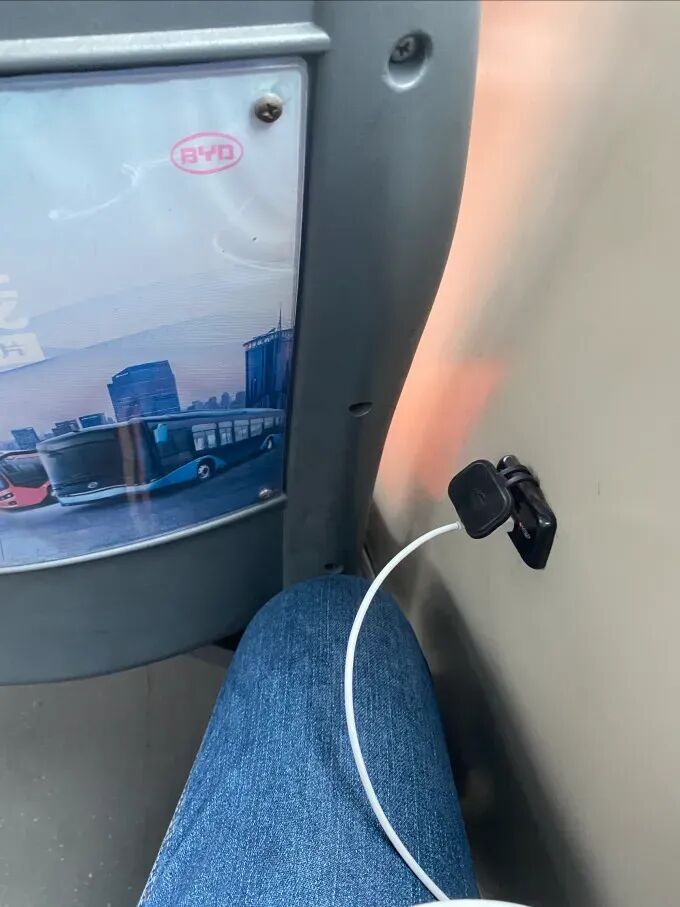
Buses are starting to be equipped with charging interfaces
Even if you don't bring a portable charger, there are shared portable chargers as a backup.
In shopping malls, restaurants, and convenience stores, you can use them by scanning the code and return them at any time.
Although they are becoming more and more expensive, the "emergency" need is fully met.
Data shows that the high-frequency usage scenarios of portable chargers will be significantly compressed, and the demand is expected to decrease by 40%.
However, compression does not mean elimination.
In high-intensity scenarios such as long-distance business trips, outdoor work, and live streaming, even the largest mobile phone batteries will face extreme tests.
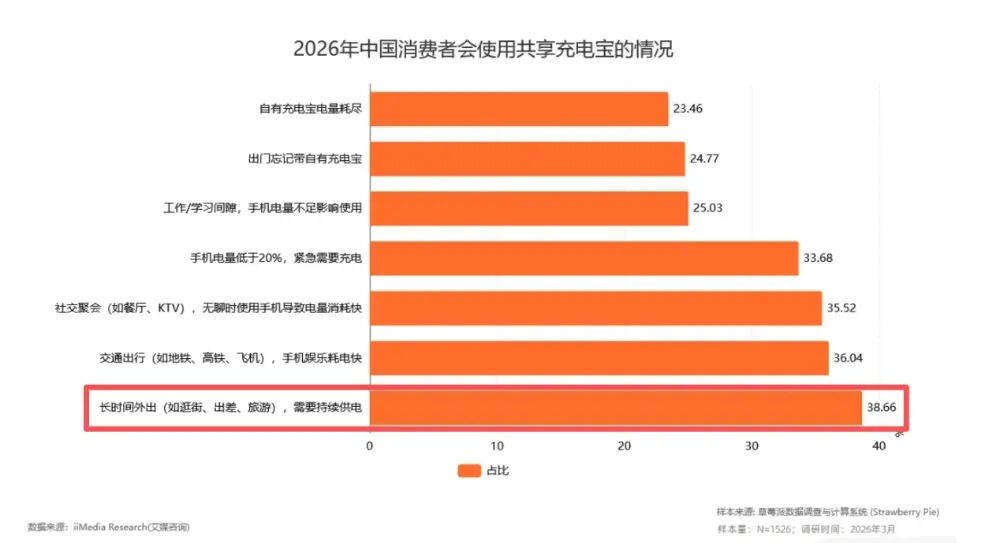
Usage scenarios of shared portable chargers. Source: iiMedia Research
Data from iiMedia Research shows that more than 90% of consumers still frequently encounter the problem of insufficient battery power when going out. "Long-term outings" account for 38.66% of the usage scenarios of shared portable chargers, ranking first.
Smartphones with super-large batteries are gradually downgrading portable chargers from "a necessity" to "a backup."
Industry research is more intuitive. 33% of users no longer carry a portable charger with them after replacing their phones with ones that have a 10,000 mAh battery, but 61% of people still prepare one for business trips.
A New Way of Survival
Globally, Chinese users have a more urgent need for battery life.
Because the "mobile phone addiction" in China is more serious than in any other country. Mobile payment, social networking, shopping, food delivery, and government services are all tied to one mobile phone, and the usage frequency and duration far exceed those in other countries.
Data from RUNTO shows that the overall scale of the Chinese mobile power market will reach 48.6 billion yuan in 2026, a year-on-year increase of 9.0%. Among them, the growth rate of personal consumer-grade mobile power will slow down to 5.0%, reaching 17.88 billion yuan.
With its status downgraded and the growth rate slowing down, where is the future of portable chargers?
Anker has already taken action.
In 2017, the revenue contributed by Anker's charging business once reached as high as 73.34%.
Since then, with the expansion of product categories, the proportion of the charging business has declined year by year, reaching a record low of 44.31% in 2020.
By 2025, Anker's total revenue exceeded 30.5 billion yuan, and the proportion of revenue from traditional portable chargers was less than 12%.
