2026's biggest biotech myth: a Phase II drug with 261 employees sold for $10.9 billion
On June 20th, a piece of news shook the global biomedical industry: AbbVie announced that it would acquire Apogee Therapeutics, a biotechnology company with only 261 employees and no approved products on the market, for approximately $10.9 billion in cash. The premium was as high as 60%. And it all started with an IL - 13 inhibitor called Zumilokibart (APG777).
What's astonishing about this deal is that Zumilokibart is still in the Phase II clinical stage, yet it has received a huge amount of financing that is usually only triggered after a successful Phase III. This is not only a milestone for Apogee but also a vane for the entire Inflammation and Immunology (I&I) field. The capital market is voting with real money, believing that Zumilokibart is an "evolved version of Dupilumab" and is capable of disrupting the treatment landscape of atopic dermatitis (AD) and even a wider range of type 2 inflammatory diseases.
Apogee Therapeutics was founded in 2022. On December 7th, 2022, it announced a $169 million Series B financing. In July 2023, it went public on the NASDAQ and raised $300 million. It took only 7 months from its official entry into the public eye to its IPO. As of June 18th, 2026, its market value was $6.814 billion.
This Biotech, which has been established for only four years, has leveraged an IL - 13 antibody to enable its existing shareholders to cash out $10.9 billion. Behind this capital myth is the pre - positioning for the next - generation king status after Dupilumab's patent cliff (expiring in 2031).
Why is a drug still in Phase II worth $10.9 billion?
01
Structural Design: The "Ultra - Long - Acting" Code under YTE Modification
Zumilokibart is a humanized IgG1 monoclonal antibody targeting interleukin - 13 (IL - 13). IL - 13 is the core cytokine driving type 2 inflammatory responses and plays a key role in the pathological processes of diseases such as atopic dermatitis, asthma, and eosinophilic esophagitis. By binding to IL - 13 with high affinity, Zumilokibart blocks the binding of IL - 13 to IL - 13Rα1, thereby preventing the formation of the IL - 13Rα1/IL - 4Rα active signaling complex - this mechanism of action is similar to that of the approved IL - 13 inhibitor Lebrikizumab.
The real innovation of Zumilokibart lies not in the target but in engineering design.
This antibody has introduced a triple amino acid modification - the "YTE" mutation - in its Fc segment. This modification enhances the binding affinity of the antibody to the neonatal Fc receptor (FcRn). The function of FcRn is to "recycle" antibodies, saving them from the lysosomal degradation pathway and releasing them back into the bloodstream. The YTE modification significantly extends the "survival time" of Zumilokibart in the body - with a half - life of approximately 77 days. In non - human primate models, the serum half - life of APG777 is about twice as long as that of the control IL - 13 inhibitor.
The clinical significance of this structural design is very intuitive: a longer half - life = fewer injections. Currently, the mainstream biologic agents on the market - Dupilumab is injected once every two weeks, and Lebrikizumab is injected once every four weeks. The maintenance - phase dosing regimen for Zumilokibart is once every three months or once every six months.
From "once every two weeks" to "once every six months" - this is not a gradual improvement but a paradigm - level leap.
02
Efficacy and Safety: Phase II Data Fully Compares with the "Blockbuster Drug"
1. Efficacy Data: Beyond EASI - 75
On May 27th, 2026, Apogee announced the 16 - week induction - phase data of Part B of the Phase II APEX trial for Zumilokibart. The trial enrolled 346 adult patients with moderate - to - severe atopic dermatitis, who were randomly assigned to high - dose, medium - dose, low - dose, or placebo groups.
The data from the medium - dose group was the most impressive:
- EASI - 75
(≥75% improvement in the Eczema Area and Severity Index): 65.9%, compared with 23.4% in the placebo group (p < 0.001)
- IGA 0/1
(lesion clearance or almost clearance): 46.0%, compared with 10.9% in the placebo group
- EASI - 90
: 47.4%, compared with 9.3% in the placebo group
- EASI - 100
(complete clearance): 16.5%, compared with 3.4% in the placebo group
≥4 - point improvement in the pruritus NRS score: 50.5%, compared with 13.9% in the placebo group
Particularly noteworthy is the vLDA (very low disease activity) endpoint - which requires both EASI - 90 and pruritus NRS 0/1 (no pruritus). 20.6% of patients in the medium - dose group reached this strict endpoint, while only 4.5% in the placebo group. Ruth Ann Vleugels, a professor of dermatology at Harvard Medical School, commented: "Significant improvement in both lesions and pruritus was achieved in more than one - fifth of patients - this is a result that no biologic agent has reported so far."
2. Efficacy Comparison with Dupilumab
In terms of efficacy, the EASI - 75 of the medium - dose group of Zumilokibart at 16 weeks was 65.9%, which is comparable to the EASI - 75 of Dupilumab, which is about 58% - 64%. Professor Vleugels more clearly pointed out that in high - threshold endpoints such as EASI - 90 and IGA 0/1, Zumilokibart "has a numerical value 10 to 15 percentage points higher than other biologic agents currently available to us." This means that Zumilokibart is not only comparable to Dupilumab in terms of the "response rate" but may also be superior in terms of "deep response."
3. Safety: The Incidence of Conjunctivitis Is Lower than Expected
Conjunctivitis is a recognized class - effect adverse reaction of IL - 4/IL - 13 pathway inhibitors. In the Phase II trial of Zumilokibart:
The incidence of conjunctivitis in the medium - dose group was 10.6%
In the high - dose group, it was 20.7%
The 10.6% incidence of conjunctivitis in the medium - dose group is lower than the rate reported in the published Dupilumab trials. Therefore, the medium dose achieved the best balance between efficacy and safety and was selected as the dose for the Phase III clinical trial.
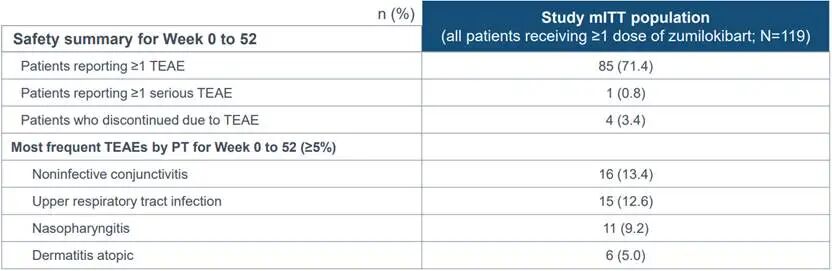
In the 52 - week long - term safety data, the rate of serious adverse events of Zumilokibart was only 0.8%, and the rate of discontinuation due to adverse events was 3.4%. No adverse effects related to APG777 were observed in the 27 - week toxicology study in non - human primates.