Behind the Scale of 40 Trillion Yuan Funds: A Massive Migration of Equity and Bond Capital
The public offering fund market once again delivered a performance report with a record - high total in May, reaching 39.48 trillion yuan, which is the highest in history.
However, the detailed performance of the public offering scale this time is even more remarkable.
According to data from the Asset Management Association of China, as of the end of May 2026, 165 public offering management institutions in China (including 15 asset management institutions with public offering asset management qualifications) managed a total entrusted fund asset of 39.48 trillion yuan, an increase of 122.754 billion yuan compared with the end of April, refreshing the historical high of the scale. During the same period, the total share of public offering funds was 33.51 trillion shares, an increase of only 284 million shares compared with the end of April, and the share remained almost unchanged.
The details of the internal structure are even more astonishing. In May, the shares and scale of public offering bond funds and money market funds increased simultaneously, becoming the main support for the industry scale. The shares of hybrid funds and QDII funds decreased while their scales increased. At the same time, both the scale and shares of equity - type funds decreased.
For investors, the information conveyed by this set of data is straightforward: In May, public offering funds experienced a situation of "bonds advancing and stocks retreating", among which the shares of equity - type funds dominated by passive products continued to decline. The decline in shares of active funds was offset by the increase in unit net value.
01
Record - high scale, "stagnant" shares
According to the statistics of the association, as of the end of May 2026, there were a total of 165 public offering fund management institutions in China, including 150 fund management companies and 15 asset management institutions with public offering qualifications. The total net asset value of public offering funds managed by these institutions was 39.48 trillion yuan.
In terms of total volume, the scale of public offering funds continued to expand in May, but the expansion method changed. The net asset value increased by 122.754 billion yuan compared with the end of April, continuing to reach a historical high; the total shares increased by only 284 million shares. Compared with the total of 33.51 trillion shares, the increase was almost negligible.
This means that the industry growth in May was not driven by the expansion of the market - wide shares. More precisely, the scale growth came from two parts:
First, the shares of debt - biased funds increased significantly, mainly bond funds and money market funds;
Second, the net value of hybrid products mainly composed of active equity increased, driving up the net asset value.
According to the listed categories, the total new shares of bond funds and money market funds in May were 223.681 billion shares; the total reduction in shares of equity funds, hybrid funds, QDII and FOF was 222.705 billion shares. The increase and decrease basically offset each other.
In other words, the overall capital of public offering funds did not shrink, but the internal capital flow has changed significantly.
02
ETF scale "shrinks"
Among them, the overall scale loss of ETFs should be the main reason for the "sluggish shares" of equity funds this year.
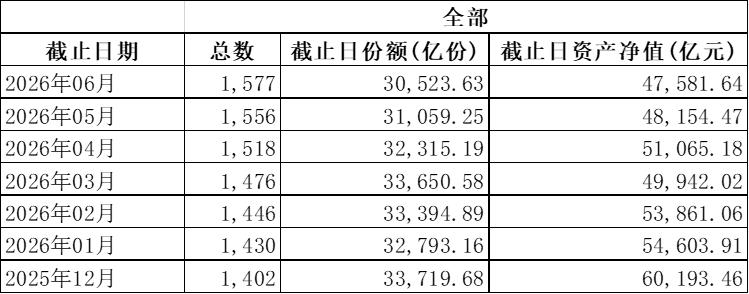
According to the statistics of WIND on the funds listed on the two stock exchanges, at the end of December 2025, there were a total of 1,402 ETF products, with a total existing scale of 6.02 trillion yuan.
By mid - June 2026, the number of ETF products increased to 1,577, but the existing scale as of that day decreased to 4.76 trillion yuan, a net decrease of 1.2 trillion yuan.
In terms of shares, from the end of last year to the same period in June, the total shares of ETFs decreased from 3.37 trillion shares to 3.05 trillion shares, a decrease of about 10%. Based on this estimate, the decline in unit net value was 13%.
By simple estimation, equity funds lost about 21% of their scale this year, among which the net redemptions by holders were about 10%, driving the net value to decline by 13% during the same period.
03
January and May are the main periods
Specifically regarding the adjustment time, by observing the statistical data of the association, it can be found that January and May were the main occurrence times.
The recently released data shows that the shares of equity funds at the end of May have dropped to less than 3.62 trillion shares, a decrease of 153.583 billion shares compared with the end of April; the net asset value also decreased from 5.28 trillion yuan at the end of April to 4.96 trillion yuan, a decrease of 317.450 billion yuan.
Therefore, among all major fund categories, equity funds had the most obvious decline in the scale of public offering funds in May. The monthly scale decline was second only to those in January and March this year.
By reviewing the share change chart of ETFs during the same period, it can be found that the scale of ETFs changed more significantly in January, April and May this year. Overall, the scale adjustment of ETFs is the main reason for the mediocre share performance of equity funds and even the entire public offering fund this year.
In addition, both the shares and scale of FOF products decreased. As of the end of May, the shares of FOF were 306.314 billion shares, a decrease of 7.306 billion shares compared with the end of April; the net asset value also decreased by 7.043 billion yuan compared with the end of April. This is also the first time that the latter type of products has faced scale pressure this year.
04
Debt funds receive a large amount of incremental funds
At the same time, it is obvious that the scale of debt - biased funds has increased significantly this year.
The data shows that in May, bond funds and money market funds achieved a simultaneous increase in shares and net asset value. Especially for money market funds with "bottom - hitting" yields, the increase in shares is quite surprising.
Among them, bond funds were the largest contributor to the scale growth of public offering funds in May. As of the end of May, the shares of bond funds reached 9.55 trillion shares, an increase of 184.132 billion shares compared with the end of April; the net asset value reached 11.67 trillion yuan, a month - on - month increase of 274.126 billion yuan.
Money market funds also maintained steady growth. In May, the shares and scale of money market funds increased by 39.549 billion shares and 39.660 billion yuan respectively.
05
Hybrid and QDII funds drive growth through net value
It is worth noting that not all scale growth comes from share expansion.
In May, both hybrid funds and other funds including QDII experienced a situation where shares decreased while scale increased.
For hybrid funds, as of the end of May, the fund shares exceeded 2.55 trillion shares, but decreased by 45.037 billion shares compared with the end of April; the net asset value reached 4.28 trillion yuan, a month - on - month increase of 120.760 billion yuan. This shows that the growth of the scale of hybrid funds comes more from the contribution of net value growth.
QDII funds also had similar performance. At the end of May, the shares of QDII were 921.683 billion shares, a decrease of 16.779 billion shares compared with the end of April; but the net asset value rose to nearly 1.09 trillion yuan, an increase of 33.485 billion yuan compared with the end of April.
The former verifies the characteristic of the appreciation of domestic equity assets without an increase in shares, while the latter continues the "boom" of overseas investment.
06
Future focus: When will the scale of equity funds achieve positive growth?
The core of the public offering fund data in May is not the "record - high scale" itself, but the structural differentiation behind the new high.
If split according to capital behavior, public offering funds in May can be divided into three categories: bond funds and money market funds drive scale growth through share expansion; hybrid funds and QDII push up the scale through net value growth; equity funds and FOF face double pressure on shares and scale.
This also means that when investors observe the public offering market, they cannot only look at the total net asset value. The increase in the total scale may come from new subscriptions or net value changes; the change in shares can better reflect the flow direction of funds among different products.
The data in May gives a relatively clear conclusion: the total scale of the public offering industry continues to expand, but funds have not entered the market comprehensively. Fixed - income products have taken on the main share of incremental funds, and the internal performance of equity - related products is differentiated, with equity funds under the most pressure.
For investors and fund managers, the more critical observation points in the future are whether this structural differentiation will continue and whether the shares of equity funds can stabilize.
This article is from the WeChat official account "Capital Deep Dive", author: Jia Er, editor: Yuan Chang. Republished by 36Kr with permission.