Yingjie Technology: The Spatial Intelligence "Wager" of a Post-2000s Team | Underwater Project
When humanoid robots perform the yangko dance on the Spring Festival Gala and stride briskly in marathons, an awkward reality emerges: robots can move and are very flexible, but they can't do work. The former tests the motion control ability, while the latter requires robots to truly understand the physical environment, remember the positions of objects, and reason about spatial relationships.
The perception bottleneck is a reality that almost all practitioners of embodied intelligence cannot avoid today. "MirrorSpace", a company founded less than three months ago, is trying to make up for this shortcoming in the embodied intelligence industry chain. MirrorSpace was founded by a team of three doctors with an average age of only 24. It focuses on the algorithm and hardware research and development of the visual spatial perception system for embodied robots and is committed to becoming an infrastructure service provider in the era of world models.
"We noticed that there is no relatively mature and complete spatial perception solution on the market at present. Most sensor companies just throw the raw data of devices such as radars and cameras to the body manufacturers and let them figure out how to process it themselves," said Jin Yili. "We hope to provide a complete set of spatial perception capabilities to bridge the gap in the application and implementation of robots in open scenarios."
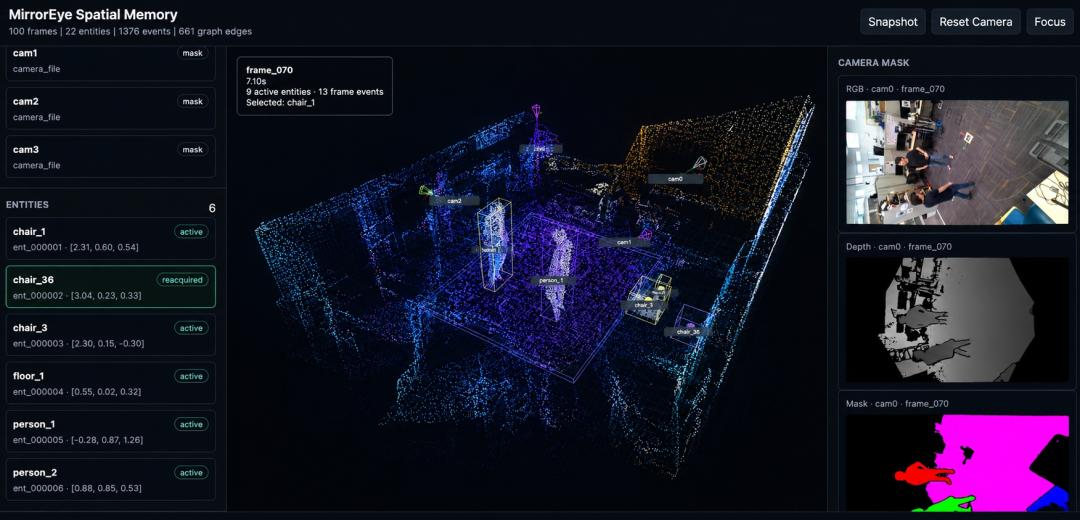
Product examples of MirrorSpace
In the middle of this year, MirrorSpace just received a seed-round investment of tens of millions of yuan from Songhe Capital and MiraclePlus. Wang Yang, the managing partner of Songhe Capital, once said that spatial intelligence is an indispensable infrastructure layer for robots to evolve from automated machines to physical AI agents, and he values the "judgment beyond their age" of the MirrorSpace team. MiraclePlus values the team's "complete cognitive chain from academia to industry" and the "real willingness to pay in industrial scenarios" of the products.
Jin Yili, the founder of MirrorSpace, holds a doctorate from McGill University and has been deeply involved in the fields of spatial intelligence and multimedia systems. Co-founders Hu Kaiyuan and Duan Xize are also doctoral students at McGill University, engaged in research on multi-modal spatial scenes, holographic video communication, and intelligent system engineering. The mentor of the founding team, Liu Xue, is an academician of the Canadian Academy of Engineering, a tenured professor at McGill University, and an IEEE Fellow. He once served as the vice president of Samsung North America Research and the chief scientist of Tinder, with nearly 20 years of experience in the cross-field of spatial intelligence and machine learning.
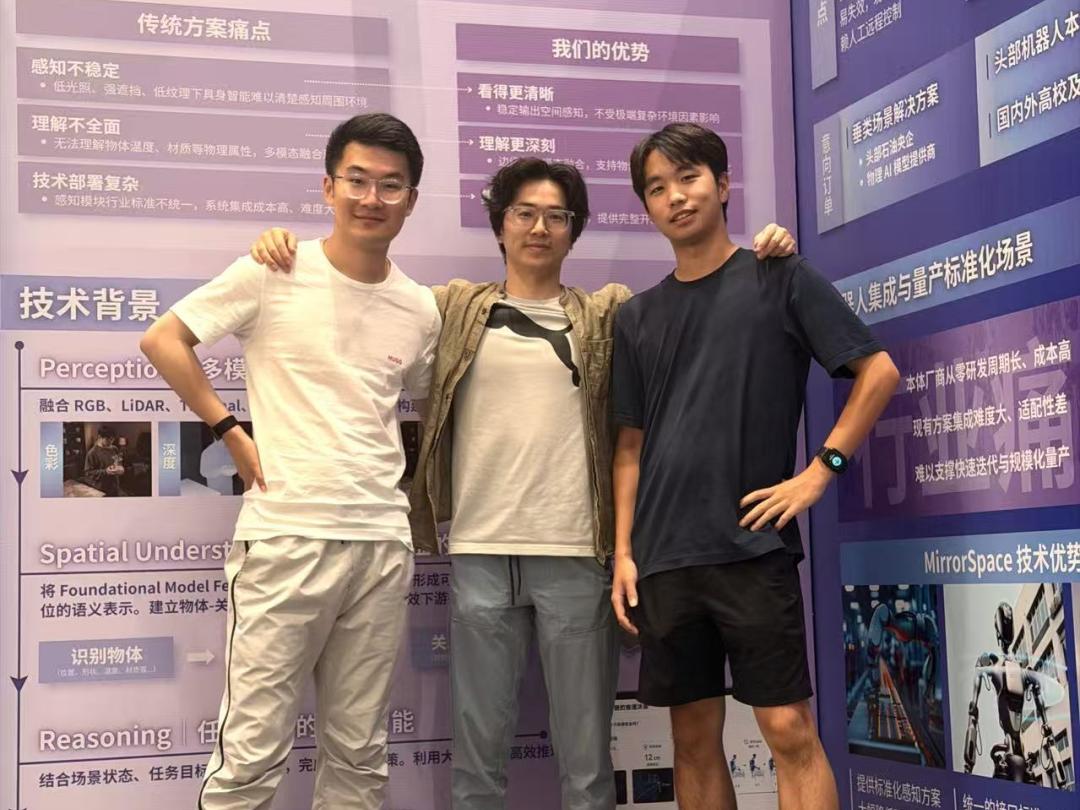
The founding team of MirrorSpace
Jin Yili revealed that MirrorSpace is about to launch the prototype of the perception module MirrorSense, which is "hardware-software integrated and plug-and-play". Although the product has not been officially released yet, it has received clear intentions from various types of customers, and it is expected to achieve orders of over ten million yuan in 2026.
In terms of multi-modal perception, on the basis of conventional vision and LiDAR, MirrorSpace integrates the non-visual feature of temperature into the spatial representation matrix. By achieving deep pre-fusion of raw data from heterogeneous sensors at the edge, it realizes lossless spatio-temporal alignment of RGB, depth, and thermal data, thus providing more stable spatial perception input for robots in extreme environments such as night, backlight, low texture, and occlusion.
Different from traditional spatial perception, which mainly focuses on static three-dimensional modeling, MirrorSpace integrates "time" as the fourth dimension into spatial modeling, thus forming a spatio-temporal continuous perception stream and solving the "blindness" problem of traditional static three-dimensional models in dynamic scenarios.
"What we do is to enable robots to understand space more deeply and accurately and accumulate spatio-temporal data, so that robots can form memories," explained Hu Kaiyuan. The Mirror-Mind decision-making center deeply aligns the 4D Gaussian representation after multi-modal fusion with the large model (VLM), compresses and stores semantic information, and forms spatial memories that can be queried by large language models.
Putting MirrorSpace's products in the scenario of a robot making coffee, the robot can autonomously form action decisions based on its previous observation and memory of the spatial relationship between the cup, the coffee machine, and the table, and complete the action of "going to the kitchen to get the heated cup". Even if the cup is blocked at this time, the robot can still judge its position by combining historical observations and spatial relationships.
Currently, the company's business model can be divided into two categories: one is to directly sell the spatial perception solution to robot body manufacturers to replace or enhance the original perception modules of robots. The company has reached intended orders with several body manufacturers; the other is to complete delivery through cooperation with industry integrators and platform providers. The application scenarios being explored include industrial fields such as power inspection and petrochemicals, as well as pan-entertainment industries such as overseas high-end real estate, commercial retail, and holographic panoramic sports.
While continuously deepening its existing application scenarios and running through the closed-loop of mass production and delivery, MirrorSpace is also cooperating with universities to promote the formulation of spatial intelligence standards, and ultimately become the standard configuration and infrastructure for all robots to interact with the physical world.
Beyond application implementation, MirrorSpace has a longer-term layout: MirrorSense itself is a spatio-temporal data collector. As the modules are deployed on a larger scale in more scenarios, MirrorSpace will continuously accumulate multi-modal spatio-temporal data of the real physical world, providing basic data infrastructure for the training of the next-generation world models. "Spatial perception is not only the eyes of robots, but also the entrance for world models to understand the physical world," said Jin Yili.
Jin Yili admitted that for the young team of MirrorSpace, the current core challenge lies in the lack of engineering implementation ability, and the team needs to continuously accumulate practical experience in hardware production, supply chain management, on-site delivery, etc.
"In the early stage, we didn't directly participate in the bidding and actual project delivery of some large customers. We also wanted to focus our energy on world model research and product development," Jin Yili said. "Customers ultimately look at who has stronger algorithm capabilities and more user-friendly products. We have advantages in scientific research capabilities, so we want to polish the products and technologies first."
Although in the current visual spatial perception track, there are listed companies such as Orbbec and Hikvision providing mature and mass-producible perception hardware in the front, and body manufacturers such as Unitree Technology self-developing perception solutions in the back, the young and optimistic MirrorSpace is confident in establishing its own technological barriers in the gap and withstanding market tests.