Stanford Report: China's Independently Trained Top AI Talents Are on the Rise
The Hoover Institution at Stanford University tracked the complete career trajectories of 356 researchers behind seven papers of DeepSeek. The most outstanding AI talents trained in the United States are flowing back to China on a large scale, and China's domestic pipeline has been able to independently produce core contributors to cutting - edge models.
On June 15th, the Hoover Institution at Stanford University and the Human - Centered Artificial Intelligence Institute (HAI) released a white paper, tracking the career trajectories of 356 researchers behind seven core papers of DeepSeek.
https://hoover-s3-website.s3.us-west-2.amazonaws.com/s3fs-public/research/docs/WhitePaper_Hoover_HAI_DeepSeek_FINAL%203.pdf
The core data revealed in the report leads to a brand - new conclusion. Among the 80 DeepSeek researchers with experience in US institutions, the average number of citations is 4108, making them the group with the highest academic achievements in the entire author pool. The vast majority of them are now in China.
Thirteen long - term researchers who have worked in the United States for more than five years have spent a total of over 119 years in US academic institutions. Nine of them eventually returned to China. The longer they stayed in the United States, the probability of their return did not decrease.
A researcher moved between Beth Israel Deaconess, Rockefeller University, MIT, Baylor College of Medicine, and the University of California, San Diego in the United States for 18 years and finally returned to China.
Another researcher who stayed in the United States for 28 years with nearly 30,000 citations decided to stay, but this is a minority.
This report was co - written by Amy Zegart, the director of the Technology Policy Accelerator at the Hoover Institution, and research assistant Emerson Johnston. It is the annual update of the first DeepSeek talent report in 2025.
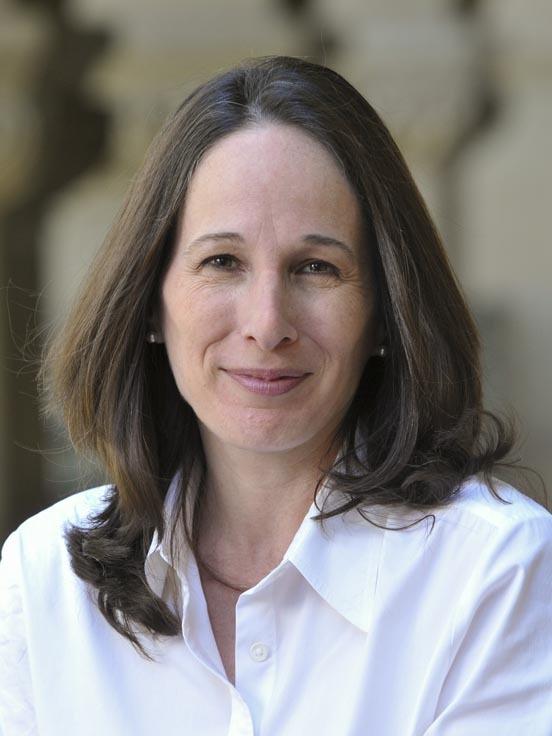
Amy Zegart

Emerson Johnston
356 People, an X - ray of Talent
The scope of analysis in the report has expanded from five papers in 2025 to seven, with the addition of DeepSeek V3.2 (December 2025) and V4 (April 2026).
The author pool has grown from 223 to 356 people. Among them, 282 people can have their complete institutional resume files constructed through the academic database OpenAlex, with the earliest traceable time going back to 1989.
There is an important adjustment in the methodology.
This analysis only counts the members of the research and engineering teams, excluding data annotation, business, and compliance personnel.
Calculated on a comparable basis, the team has expanded by 57% within a year. The latest two papers have added a net of 141 new contributors in 14 months.
Only 33 people left during the same period, meaning for every four new hires, one person leaves.
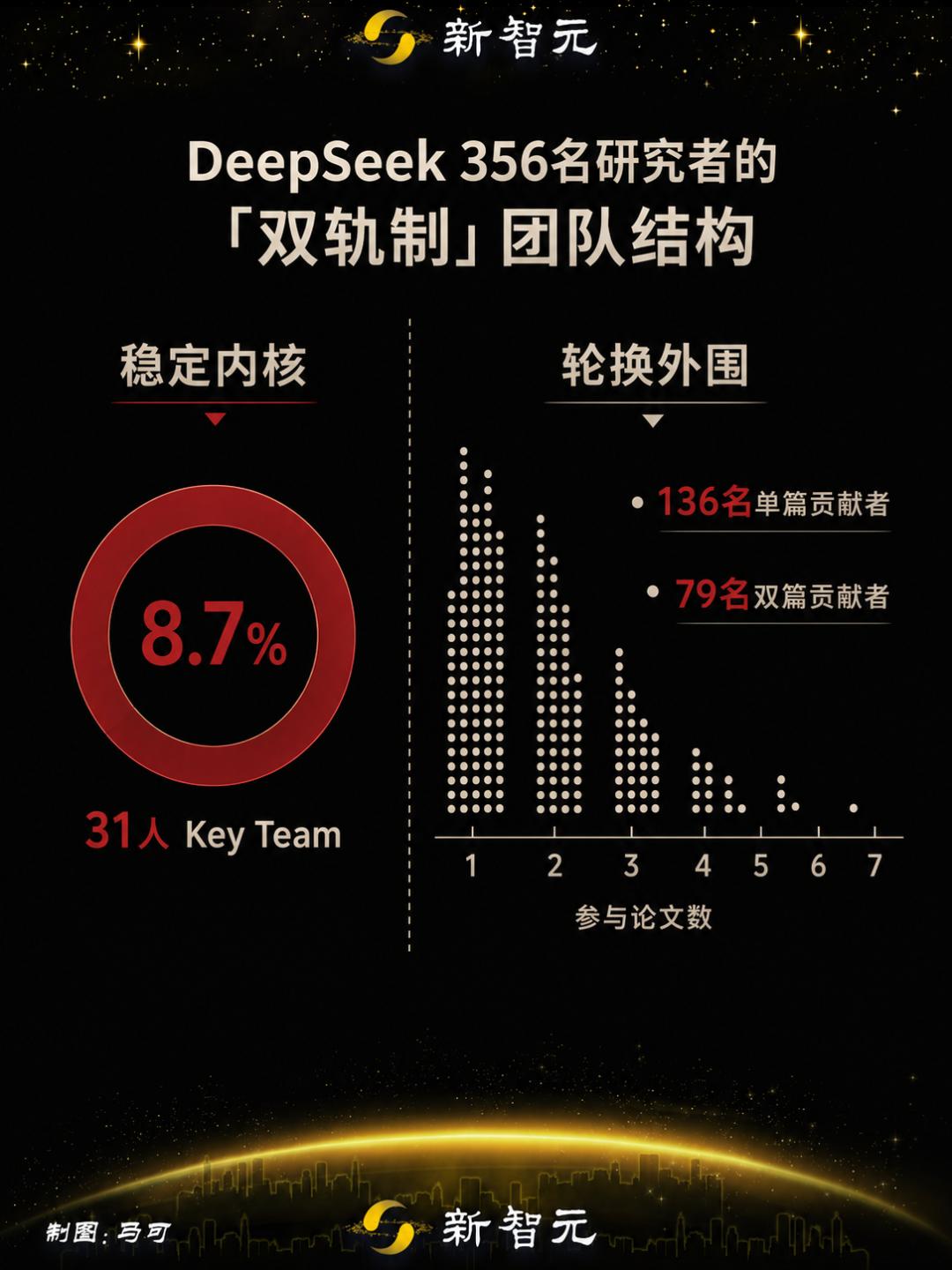
The team structure presents a stable "dual - track system."
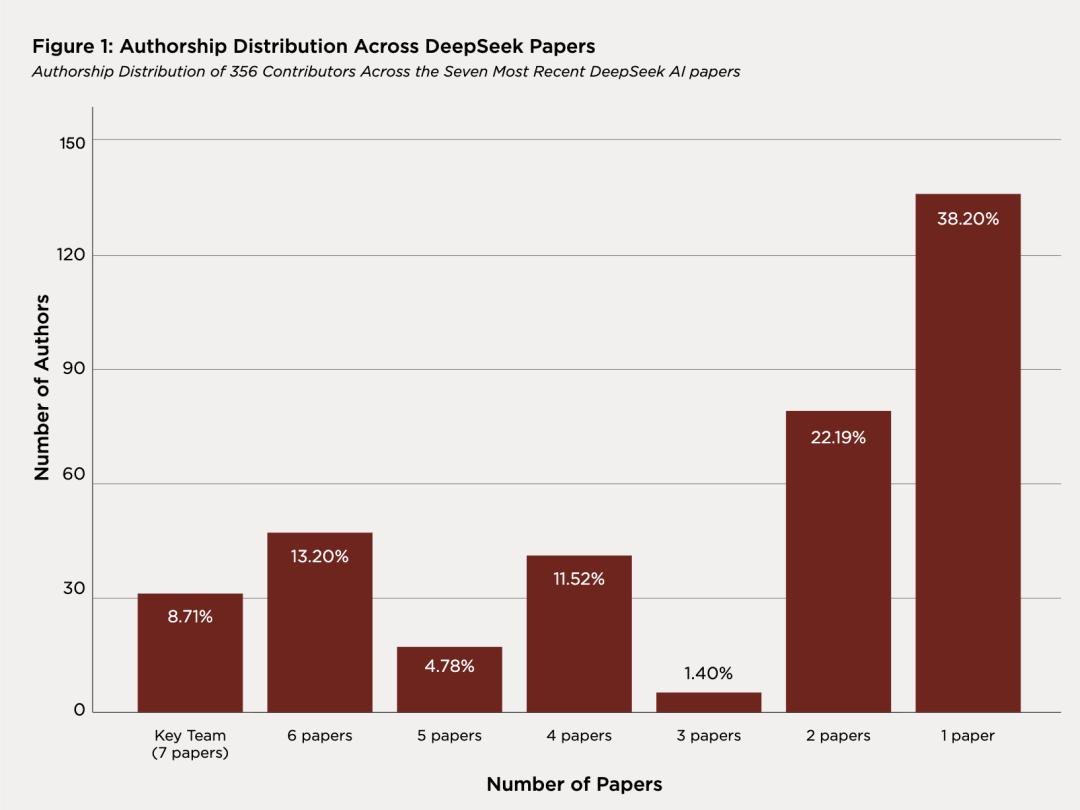
Thirty - one researchers appear in all seven papers. The report calls them the "Key Team," accounting for 8.7% of the total number of people.
Forty - seven people appear in six papers. These two groups form a stable core that participates in everything.
In contrast, there are a large number of rotational contributors. 136 people only appear in one paper (accounting for 38.2%, compared to only 10.3% in 2025), and 79 people appear in two papers.
Only 63 people appear in three to five papers.
This distribution has remained consistent in 2025 and 2026.
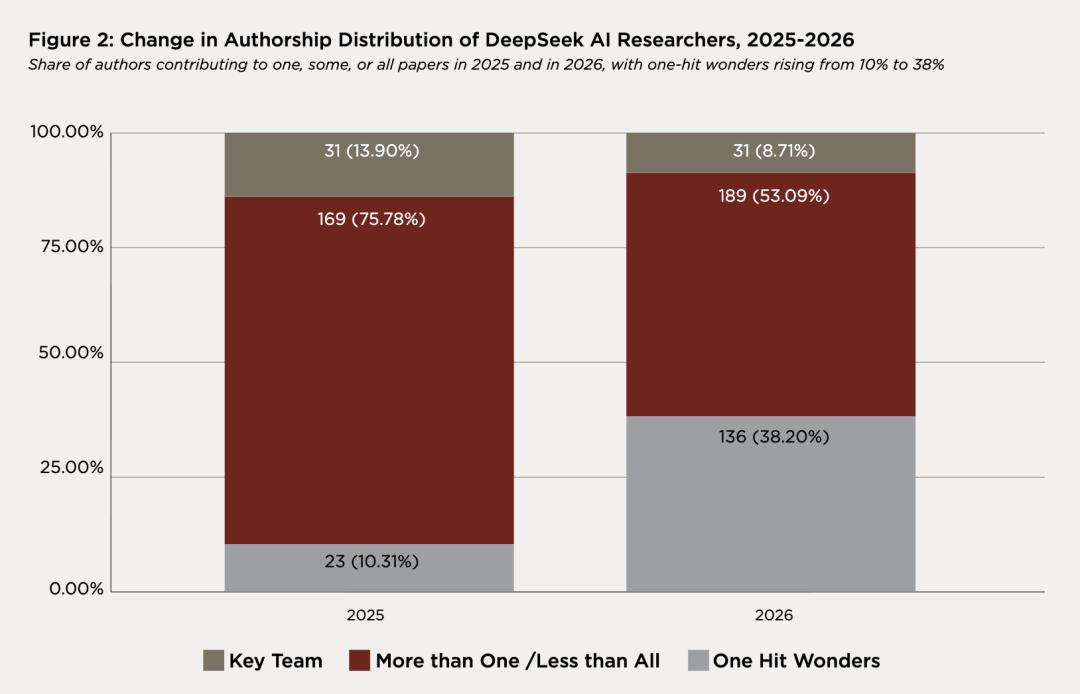
Either enter the core and make continuous contributions, or be seconded in to solve specific problems and then leave.
The growth of the team entirely comes from the rotational side, and the core remains those 31 people.
53.5%, Never Left China
Let's get back to the core issue of talent sources.
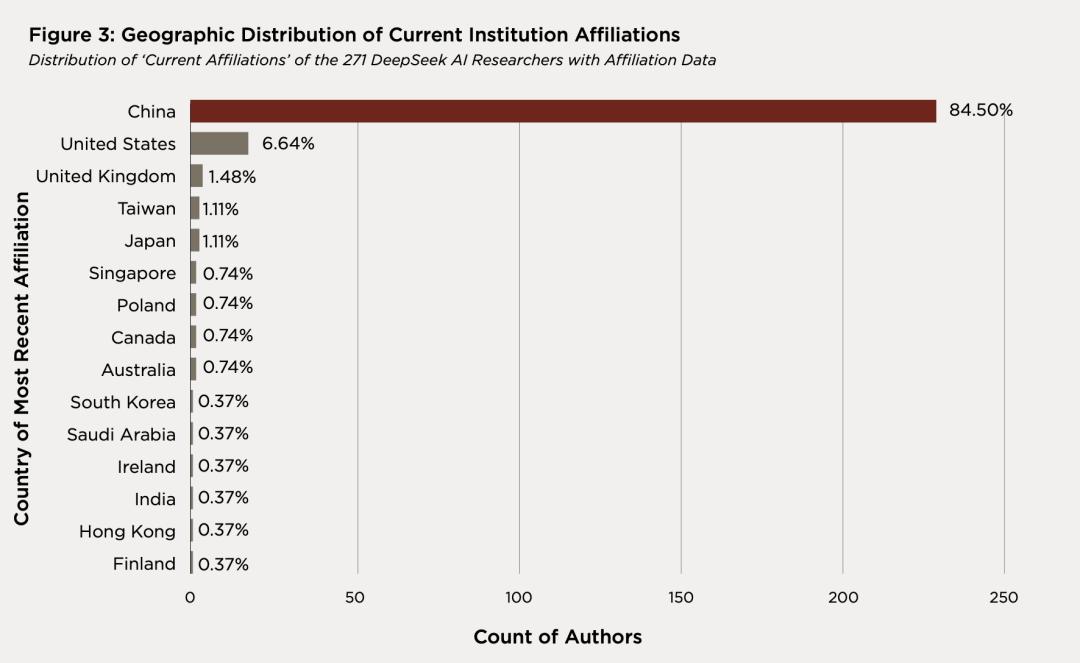
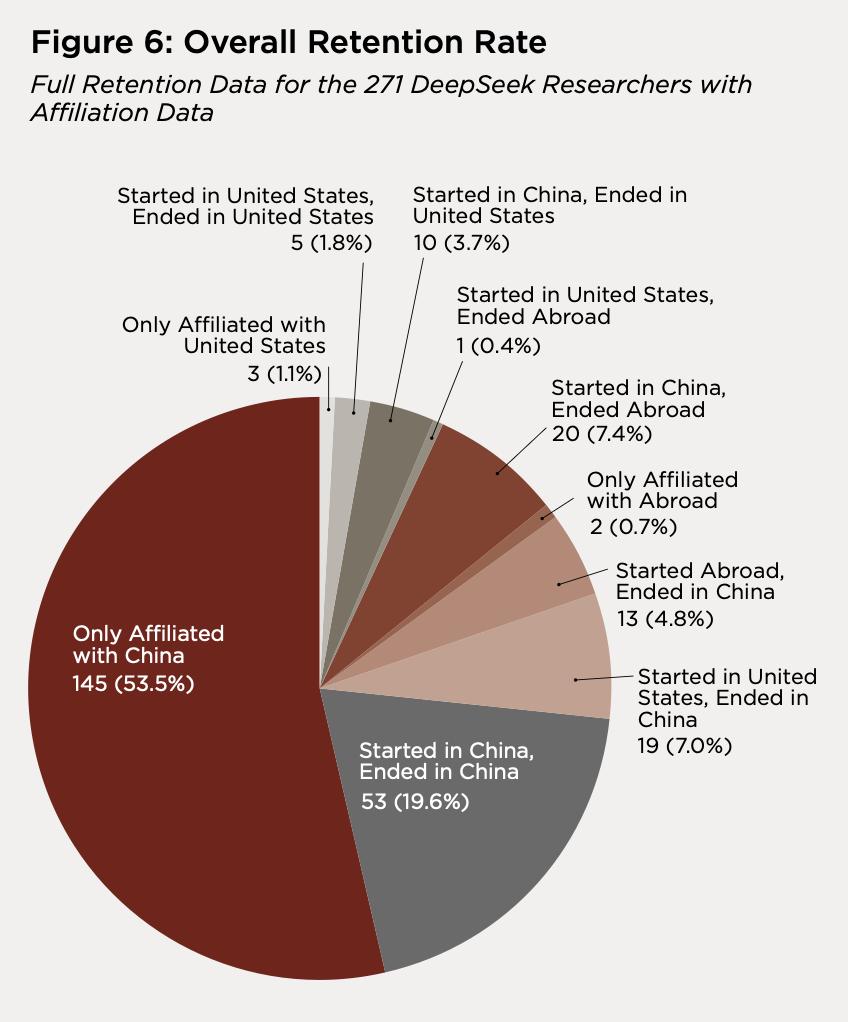
Among the 271 researchers with institutional affiliation records, 145 people (53.5%) have never been associated with any institution outside China throughout their recorded careers.
They have never studied overseas, never published papers overseas, and never held positions overseas.
This proportion is basically the same as the 55.2% in 2025, indicating that it is a stable structural feature.
From the perspective of the core team, the impact is even greater.
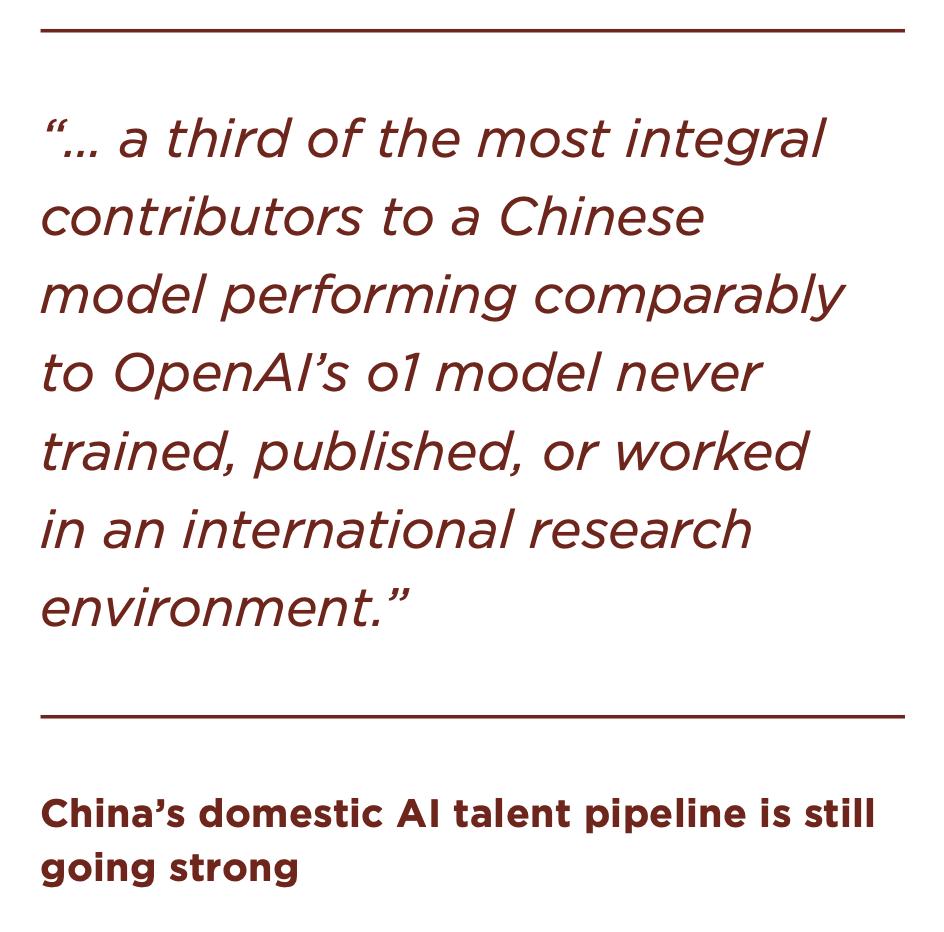
Among the 31 core researchers, 10 have never left China.
For a cutting - edge model (DeepSeek - R1) that benchmarks against OpenAI o1 in reasoning benchmark tests, one - third of the most core contributors are entirely trained by China's domestic education and research system.
The institutional network supporting this domestic pipeline is also expanding rapidly.
The network composed of the Chinese Academy of Sciences and its 170 affiliated institutions has seen the number of associated researchers double from 53 last year to 104, covering 37% of the entire author pool;
Tsinghua University has increased from 16 to 46 people, a nearly 200% increase;
Zhejiang University has increased from 8 to 25, and Peking University has increased from 21 to 29.
Some schools that were on the periphery of DeepSeek last year have risen rapidly. Southeast University has increased from 1 to 15 people, Beihang University has increased from 3 to 14, and Lanzhou University has increased from 0 to 10.
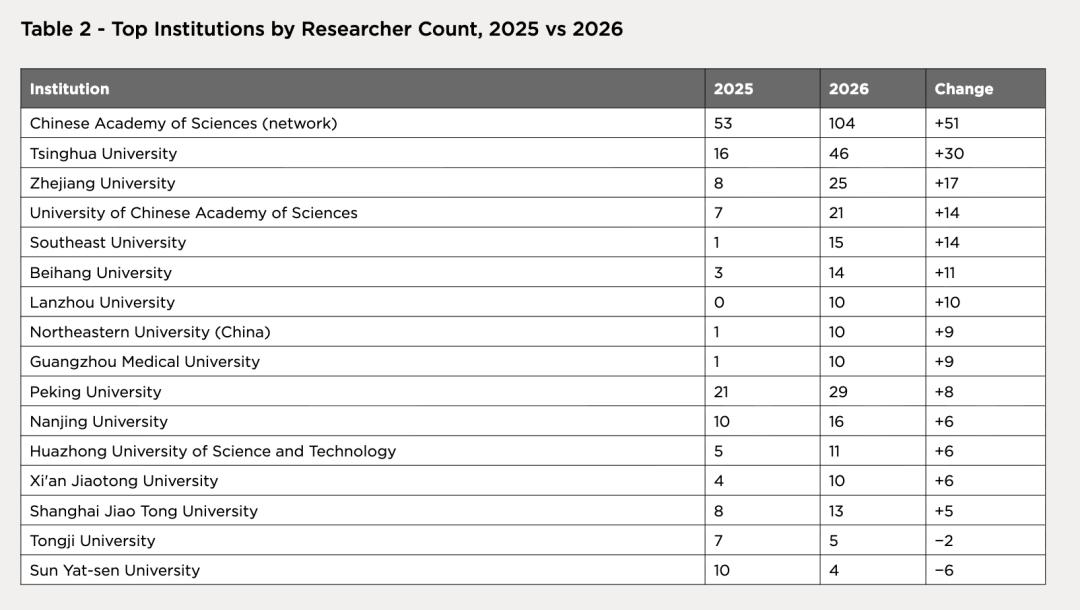
The talent supply for DeepSeek comes from a wide network of Chinese universities, far from being the exclusive privilege of a few elite institutions.
119 Years, the AI Talents the US Can't Keep
The report has made significant revisions to the "US experience."
In the 2025 data, among the 49 researchers associated with the United States, 63.3% only had one - year experience in the United States.
In the new expanded data set, this proportion has been further reduced to 35%.
Nearly half (48.8%, 39 people) stayed in the United States for 2 to 4 years, and 16.3% (13 people) stayed for more than five years.
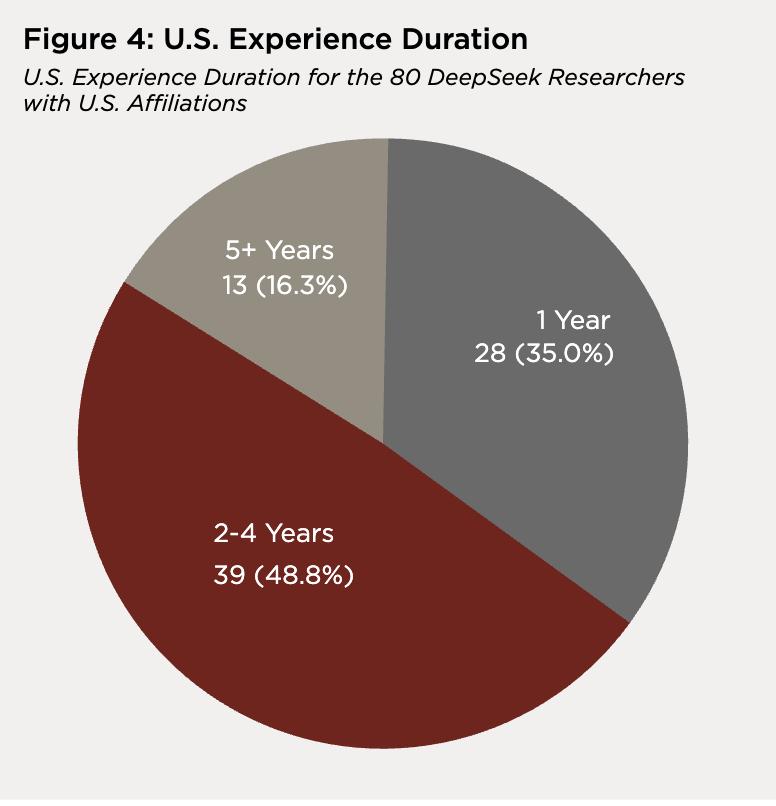
This group of researchers has deeper, longer, and more formative experiences in the United States.
Among the 80 researchers with any experience in US institutions, the most common mobility pattern is "China → US → China," accounting for 38.8%.
The second - largest group is "starting in the US and ending in China," accounting for 23.8%.
Only 12.5% (10 people) took the path of "China → US → staying in the US."
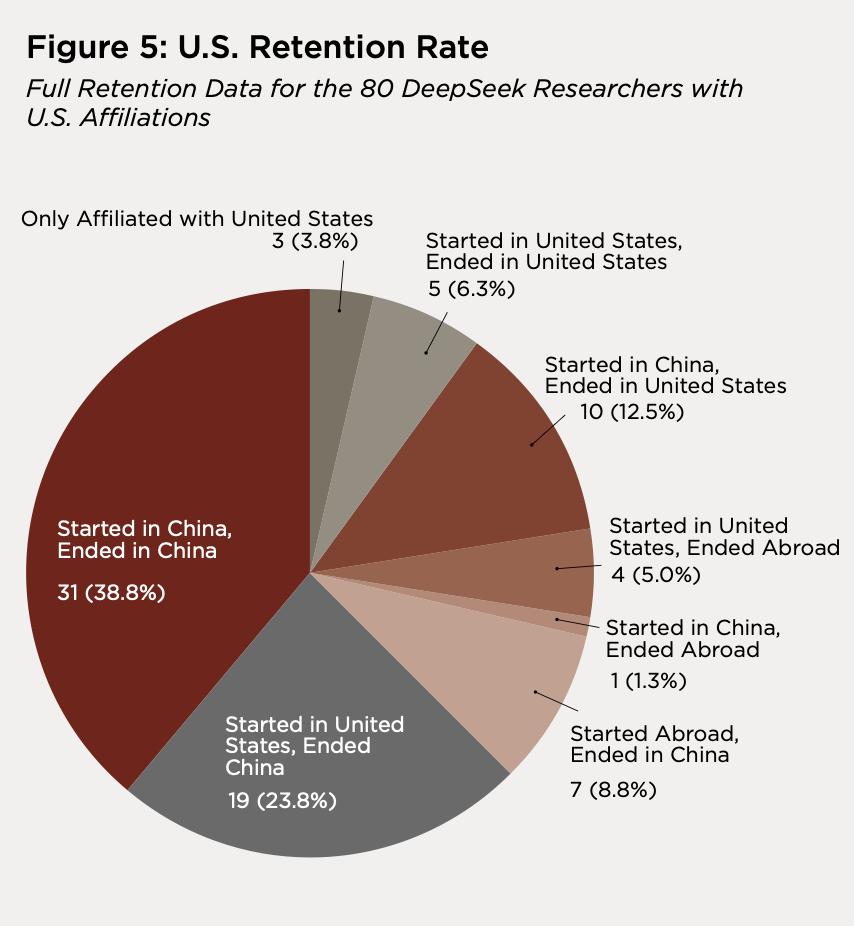
Among the entire group with international mobility experience, 70.3% eventually returned to China.
The career trajectories of the 13 long - term US - based researchers are particularly worth examining.
Their paths are rarely a linear narrative of "going to the US → staying for a long time → returning to China."
Nine of them made multiple international transitions between the United States, the United Kingdom, Brunei, Japan, Sweden, and other countries.
The United States is just a node in their globalized careers.
The Rapid Maturity of the Team
When Liang Wenfeng became popular in early 2025, he was interviewed by 36Kr and said that most of the core technical positions were filled by researchers with one or two years of work experience. DeepSeek recruits based on "enthusiasm and curiosity."
Now, the data shows that the DeepSeek team has rapidly grown into a quite mature research team.
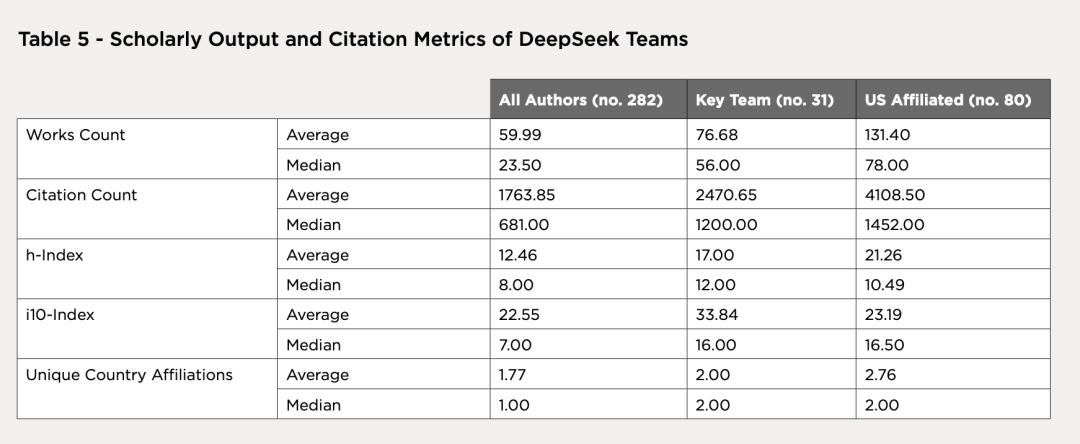
The median number of citations of all authors has doubled from 249 to 681, and the entire distribution curve has shifted upward.
The average number of citations of the core team has jumped from 1554 to 2470, a 59% increase, and the median has increased from about 700 to 1200.
This jump is partly attributed to DeepSeek's own papers. R1, V3, and V2 were widely cited by the academic community in 2025, and the core team members are the authors of all these papers.
A comparison with top US laboratories can better illustrate the problem.
The 894 authors of OpenAI have an average number of citations of 2481.5, seemingly comparable to DeepSeek.
However, the median of OpenAI is only 100.5, and the mean is 25 times the median.
This extreme imbalance indicates that a few superstars have pulled up the overall average.
The median h - index of OpenAI is only 2.
The median number of citations of Anthropic and Google is only 15% and 20% of their respective means.
The median number of citations of DeepSeek is 35% of the mean.
The academic influence is more evenly distributed within the team. The overall average level of the whole team is higher, and the dependence on a few stars is lower.
Two Problems, a Debate
The report finally breaks down the dilemma faced by the United States into two independent challenges.
The first is retention.
The 80 researchers trained in the US system are the group with the highest academic achievements among all DeepSeek authors, with an average of 4108 citations and a median h - index of 16.5.
They have returned to China with the methods, connections, and