Employee morale at Meta has hit a 20-year low, with public outbursts during internal live streams, and the CTO admitting the AI restructuring was a complete fiasco.
Morale inside Meta has almost hit rock bottom.
The one who said this is Meta CTO Andrew Bosworth (nicknamed "Boz") — one of Mark Zuckerberg's most trusted deputies and a technical soul figure who has worked at Meta for 20 years.
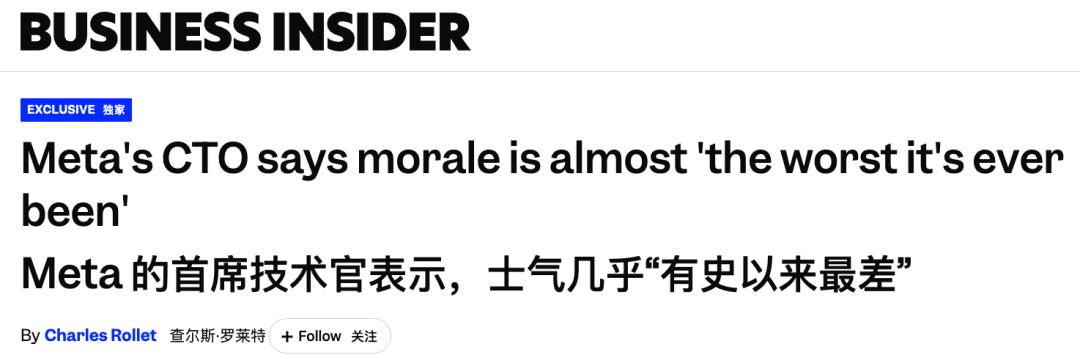
At the internal meeting "Tuesdays with Boz", he personally admitted this and used a rather serious word to describe the company's recent AI department restructuring —
atrocious.
Boz admitted that this restructuring has shaken employees' triple trust in the company:
Trust that their expertise will be recognized, trust that they can grow here, and trust that their work truly has an impact.
What forced him to write this "apology letter" were several events that exploded one after another in the past week.
The most explosive scene occurred during an internal Meta live stream watched by thousands of people.
An employee directly grabbed the microphone and shouted obscenities, asking everyone present to tell a certain Meta AI executive — "He's a piece of sh*t."
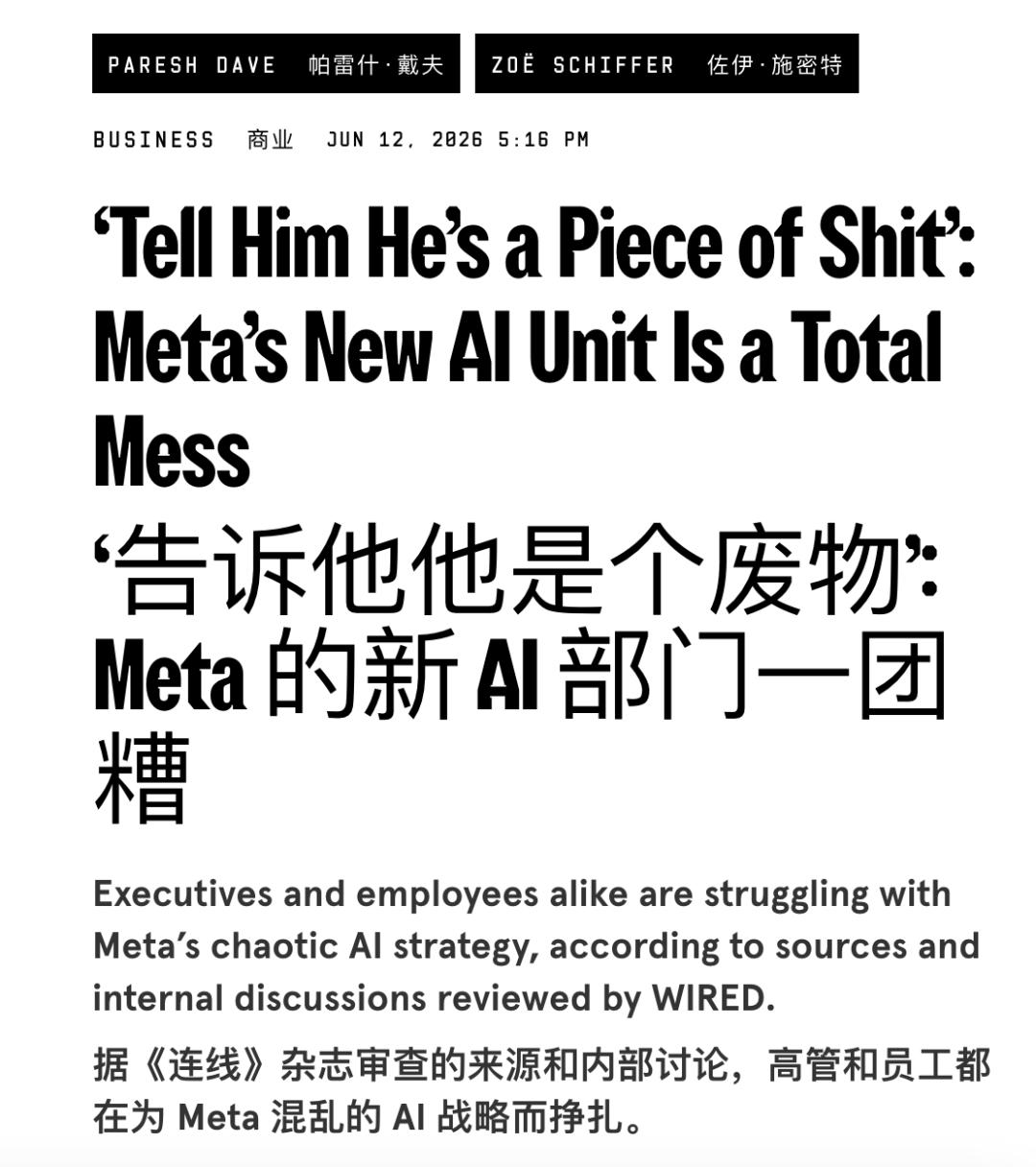
The presenter covered his face with his hand on the spot and asked everyone to mute immediately; after order was restored, employees brushed the message "It's been a bit exciting to start the morning" in the chat area.
Some employees also described the newly established Applied AI department as "gulag" — the work here is as oppressive as serving hard labor.
Almost everyone is unhappy. This job is simply suffocating.
On one hand, Meta is spending huge amounts of money externally and scrambling for AI talents globally; on the other hand, internally, employees say the new department is like serving hard labor, and they openly scold, and the morale of their own people has collapsed to the point where the CTO has to come out and apologize.
Meta, which has been the most aggressive in talent recruitment, seems to have cracked from the inside first.
What exactly did Boz apologize for?
Almost all the points in Boz's memo are directed at a department called Applied AI.
This department was established in March this year and has a scale of about 6,500 people, all of whom are engineers and product managers.
Its positioning is to cooperate with the researchers in Meta Superintelligence Labs.
But it's not the same as the star lab led by Alexandr Wang, which was recruited at a sky - high price. Applied AI does more "down - to - earth" work.
The person in charge is Maher Saba, a veteran who has worked at Meta for 12 years and was previously the VP of Reality Labs. This line ultimately reports to CTO Boz himself.
Reality Labs is the metaverse/AR - VR department that has burned $83 billion before.
Boz himself also serves as the head of Reality Labs. They are old comrades - in - arms in the metaverse line.
So, what are the 6,500 people in the newly established Applied AI department specifically busy with?
According to Wired, their task is to create programming problems and design evaluation tasks to train AI and teach the model how to perform operations on the computer like a human.
It sounds like pure dirty work... It seems that Zuckerberg is asking people to manually create training data and be a training partner for the model.

Moreover, many employees learned that they were going to be transferred to the new department only after receiving an unexpected email.
For them, it feels like being stuffed into a new position with an unclear direction, doing trivial, repetitive, and uncreative work.
Not only is the work trivial, but it also has little technical content. It's much easier than the software development work they did before.
No wonder employees complain that it's like serving hard labor...
Moreover, Zuckerberg also explained why he uses his own people instead of outsourcing:
Firstly, Alexandr Wang, who joined through a nearly $14.3 billion deal with Scale AI and now heads the Superintelligence Labs, is well - versed in the business of data annotation. So, it's quite useful for Applied AI to support him.
Secondly, the average IQ of Meta employees is "much higher" than that of third - party outsourcing, so it's a more cost - effective choice.
To put it simply, Zuckerberg means: I'm treating you as tools.

Boz admitted in the memo that the company did a terrible job in explaining the vision of this transformation and supporting employees through the transition period.
He also admitted that frequent changes in the team structure and repeated changes in strategy have left the entire team in a state of limbo.
Interestingly, at the beginning of 2025, when facing employees' dissatisfaction with layoffs and policies, Boz also dropped a harsh word:
Don't like it? Then you can quit. I'm serious.
One year later, now the situation has suddenly changed to him actively apologizing.
It shows the large scale of this turmoil at Meta and also indicates that the senior management is under great pressure.
How did Meta's morale collapse step by step?
The public scolding in the live stream at Meta happened because the fire behind it has been burning for a long time.
Looking back at the timeline, the keyword for Meta in the past two years has almost been "turmoil":
In May this year, Meta laid off a total of 8,000 people, accounting for about 10% of the total number of employees, and another 6,000 recruitment positions were cancelled.
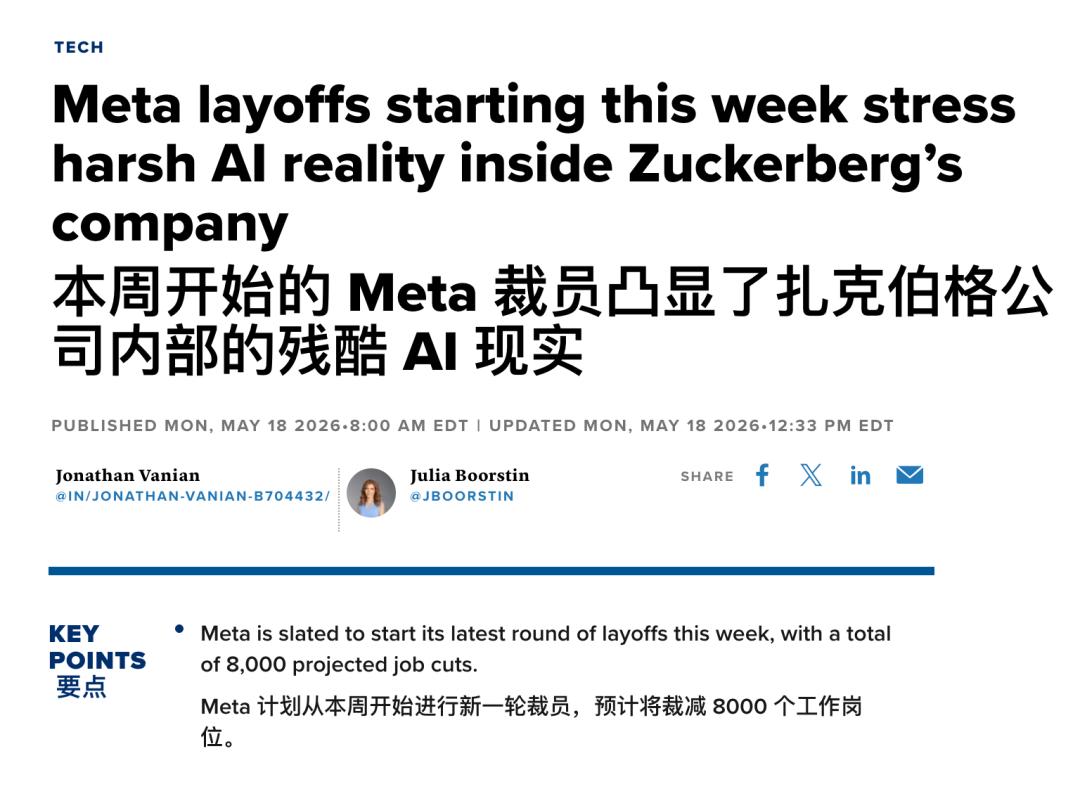
At the same time, Meta's recruitment rhythm has been inconsistent, sometimes expanding rapidly and sometimes cutting drastically. According to statistics, since 2022, Meta has cut nearly 30,000 positions in four years.
On the other hand, Zuckerberg is still recruiting AI researchers for Alexandr Wang's MSL at sky - high prices, even offering salaries of over $100 million, which forms a sharp contrast with the overall layoffs of the group.
During the restructuring period, direct managers have also been changing frequently. The newly established Applied AI in March this year is designed to have a super - flat structure, and one manager has to lead up to 50 people.
To make matters worse, there have been repeated transfers of resources and personnel. According to relevant reports, many engineers from the infrastructure and security teams have been transferred to support Applied AI by a single order.
Employees often don't get a clear explanation — what does this mean for my long - term goals? No one can say clearly.
Maher Saba, the person in charge, initially recruited volunteers, but by spring this year, he simply notified the selected people that "job transfer is no longer an option" on the grounds that "the strongest people need to be transferred here".
Priorities change every week, and a sense of direction has become a luxury.
The pent - up emotions finally exploded collectively.
The first to bear the brunt was the scene where an employee grabbed the microphone and swore during an internal Applied AI demonstration. This brief loss of control precisely reflects the pent - up anger in this department that is only three months old.
But the conflicts don't stop there. Recently, more than 1,600 Meta employees have signed a joint protest against a company - launched project — monitoring employees' clicks and keyboard records to generate AI training data.
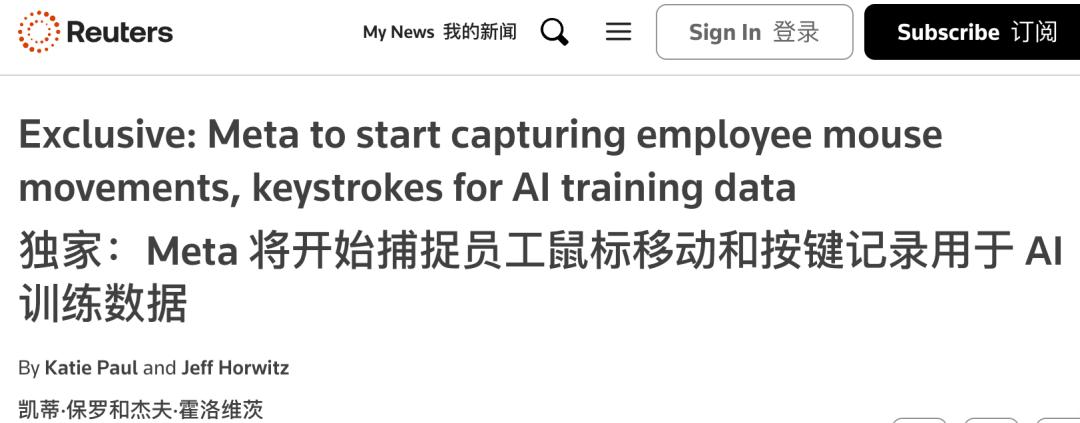
This project is called Model Capability Initiative (MCI) and was officially launched in April.
It will monitor employees' mouse movements, keyboard inputs, clicks, menu/drop - down operations, and take regular screenshots, covering hundreds of applications and websites.
And the company - provided devices do not have an opt - out option, which was confirmed by Boz and is the core of the public outrage.
Meta employees suspect that their every move is being used to feed the model, which touches the red line of privacy.
Layoffs, forced job transfers, keyboard monitoring, and compressing the team into a super - flat structure... Every move of Meta points in the same direction — betting on AI more quickly and aggressively.
But it's also these same actions that are quickly burning through employees' trust in the company.
The harder Meta steps on the gas in AI, the faster the trust accumulated within the organization is being overdrawn.
The senior management starts to put out the fire collectively
With the fire burning to this extent, Meta's senior management has started to put out the fire collectively.
Zuckerberg rarely came out to apologize. He issued an internal memo, admitting that the company did make mistakes in this round of restructuring and gave several reassurances:
Promise not to conduct large - scale layoffs in 2026, increase the budget for team activities, and restore fixed workstations for many employees.
He also reiterated the so - called "North Star" — to be the best place for the world's top talents to exert their influence.
Chief Product Officer Chris Cox couldn't sit still either. At an internal meeting, he publicly admitted that these recent days have been both "difficult" and "cruel" and specifically comforted the employees who are still persevering in their work.
Boz started to adjust the organizational structure, reducing the number of subordinates directly managed by one manager from a maximum of 50 to about 20; at the same time, reducing the frequent changes of managers during the restructuring period; and providing more personalized management support.
He also restored a number of cut - off benefits, such as the office mini - tea rooms, travel budgets, and team - building funds.
If we take a broader view, Meta's internal turmoil is more like the "human cost" paid in this round of AI arms race.
In the past two years, almost all large companies have been undergoing drastic restructuring around AI: Google merged its teams into DeepMind, and Microsoft absorbed hundreds of people from OpenAI into its own system.
Everyone has the pain caused by restructuring, but so far, no company has had such a big mess as Meta.
And employees' real uneasiness may not lie in the tea rooms and team - building activities.
The ultimate goal of the Applied AI department is to let AI agents take over most of the work of building, testing, and launching products, and engineers will take a back - seat as "supervisors" —
To some extent, these 6,500 people are training a system that will replace themselves.
In the same memo, Boz also quoted an old saying in the industry to respond to this concern:
AI won't take your job but someone who knows AI might (AI won't take your job, but someone who can use AI might).
This statement is more like adding insult to injury than a comfort.
Now, Meta has realized the seriousness of the situation and has urgently introduced a series of remedial measures.
But the question is: Can simply providing snacks and restoring workstations regain trust?
The giant that has been the most aggressive in talent recruitment must first stabilize its own people.
Reference links:
[1]https://www.wired.com/story/mark - zuckerberg - meta - employee - meeting - interrupt - ai/
[2]https://www.businessinsider.com/meta - cto - andrew - bosworth - addresses - morale - after - layoffs - ai - shift - 2026 - 6
[3]https://techcrunch.com/2026/06/12/metas - months - old - ai - unit - is - a - soul - crushing - gulag - say - the - engineers - stuck - inside - it/
This article is from the WeChat official account "QbitAI", author: Tingyu. Republished by 36Kr with permission.