The full story of Moli Milk White closing its New York stores: a "lose-lose" battle between the brand and franchisees
Author | Sijia Xiao
Editor | Qian Qiao
In 2024, the Flushing, New York store of Molly Tea achieved monthly revenues of approximately $500,000.
For a brand that only had a hundred stores in China at that time, the performance of this "first overseas store" was nothing short of a myth. In North America, the single - store sales of Chinese new tea beverage brands generally range from $150,000 to $300,000. Even Heytea, which entered the North American market earlier and was ahead of Molly Tea, only had a maximum store record of $400,000.
In the wave of tea beverage brands going overseas in recent years, most brands only dared to start exploring in neighboring Southeast Asian markets, but Molly Tea immediately challenged the most difficult market, the United States. In the following two years, Molly Tea rapidly expanded overseas, opening stores in Canada, Australia, the UK, Thailand, Indonesia, and Singapore.
"No brand has had such a smooth start in the US market as Molly Tea," said Mr. Liu, the person - in - charge of the Flushing store of Molly Tea, almost gritting his teeth in June 2026. Recently, his four stores in New York have been involved in a store - closing dispute, including the aforementioned first overseas store in Flushing.
On June 11, the official overseas Xiaohongshu account of Molly Tea posted an announcement stating that, according to the injunction of the US Federal District Court, the Flushing, Brooklyn, Chinatown, and Columbia University stores in New York were to stop using the Molly Tea trademark and intellectual property. The reason given in the announcement was that the partner had committed multiple serious breaches of contract recently, and communication attempts had been unsuccessful.
Meanwhile, on the other side of the ocean, to express his protest, Mr. Liu covered the signs of several New York stores with a board with white question marks. The store's "Molly Tea" was renamed "? Tea". The menu pictures, staff uniforms, and decorations inside the stores were also densely covered with black question marks.
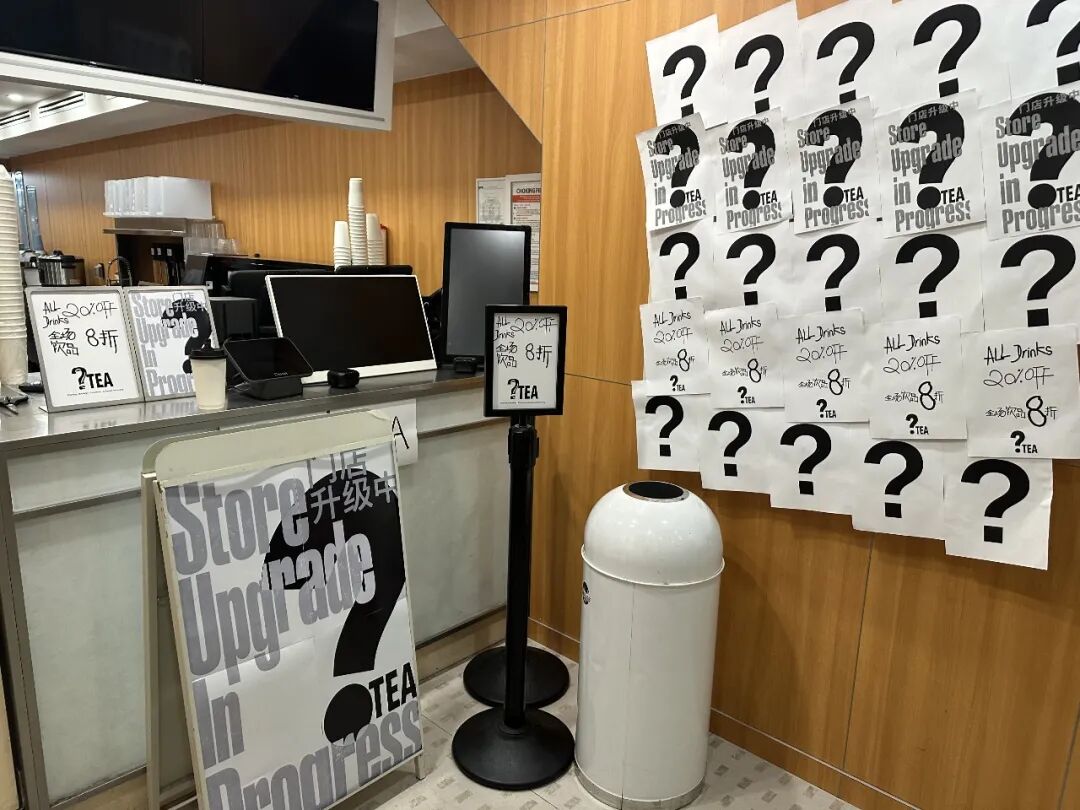
The New York stores of Molly Tea operated by Mr. Liu
The incident quickly attracted public attention on social platforms. However, in this store - closing dispute, the two parties involved presented two completely different accounts: The brand accused the partner, Mr. Liu, of opening stores without permission and violating brand operation regulations, which ultimately led to the store closures; the partner claimed that the brand "kicked the ladder after crossing the river", intending to seize control of several New York stores after the partner took risks to open up the US market from scratch.
It should be said that this is a highly representative business case in the process of Chinese new consumer brands going overseas. The United States is undoubtedly a "high - ground" for going overseas - it has the world's strongest consumer power. The world's best brands all hope to gain a foothold here. However, at the same time, it operates a set of business rules that are completely different from those in the domestic market. Chinese catering brands going overseas used to win one competition after another in the domestic market with the narrative of high - speed expansion of thousands of stores.
But the new market tests the patience of long - term cultivation more.
From being business partners who struggled side by side at the beginning to ending up in court, behind the two narratives is not only the interest game between the brand and the franchisee, but also the result of the collision and friction of different business, cultural, and institutional systems in human nature. The process of brands going overseas is gradually moving from the early pioneering stage to the deep - water area, and the contradictions that were once covered up by growth are beginning to surface one by one.
01 The Beginning and End of the Dispute
Three years ago, Mr. Liu and Molly Tea were concerned about the same question: how to open stores in New York. Three years later, they had a disagreement. The focus of the debate shifted to how to distribute the fruits of their efforts.
In December 2023, MHL NY LLC (hereinafter referred to as MNL), represented by Mr. Liu, as a partner, signed a "Brand Authorization and Technical Service Cooperation Contract" with the headquarters of Molly Tea, initially reaching a cooperation. He was allowed to develop and operate five stores in the New York area. The former provided support in technology, operation, supply chain, etc.; the latter paid brand usage fees, brand security deposits, management fees, etc.
However, in fact, the cooperation had already begun. According to Mr. Liu, when the contract was signed, the Flushing store of Molly Tea in New York was already in preparation for opening. In April 2024, the Flushing store of Molly Tea opened, and the business was booming. In the following year, Mr. Liu quickly opened the second and third stores in Brooklyn and Manhattan's Chinatown in New York.
As previously agreed, in July 2025, the two parties supplementary signed three "Limited Liability Company Agreements" to establish a joint - venture company and clearly divide the equity structure of the three stores: the brand held 19.9% of the shares, and MNL held 80.1%. In the second half of 2025, Mr. Liu began to promote the opening of a new store, the Columbia University store in New York. Everything should have gone smoothly.
But things changed. In January 2026, Molly Tea sent three new "Shareholder Agreements", adjusting the shareholding ratio of the two parties in the three stores to 35% and 65%. Almost at the same time, Molly Tea sent the Franchise Disclosure Document (FDD) to MNL for the first time. According to regulations, this is a document that the brand needs to disclose in advance before formal franchising. However, when Molly Tea provided the FDD to Mr. Liu, more than two years had passed since the two parties reached the cooperation.
Mr. Liu said that some clauses in the FDD agreement damaged his interests and were difficult to accept:
First, the agreement stipulated that the initial franchise term was only one year. When renewing the contract, the franchisee needed to sign a brand - new franchise agreement, and some of the clauses might change significantly.
Second, the agreement also clearly stated that the brand did not provide "regional protection". In other words, after the franchisee invested a large amount of money to open a store, they might still face the risk of continuous dense layout of stores of the same brand in the surrounding area. In the mature franchise system in the United States, regional protection is usually regarded as an important mechanism to balance brand expansion and franchisee interests.
Although the headquarters sent an email in March to explain that signing the document only proved receipt and did not mean accepting all the clauses inside, Mr. Liu still refused to sign this late - coming FDD. This became the direct fuse for the breakdown of the cooperation between the two parties.
Also in March, when negotiating the joint - venture agreement for the upcoming new store, the Columbia University store in New York, the headquarters proposed an equity plan where the brand would hold 70% of the shares and MNL would hold 30%, a significant adjustment compared to the ratio of the first three stores. Mr. Liu did not accept this plan, and the operating entity of the Columbia University store was never transferred to the joint - venture framework like the first three stores.
Under the intersection of these two lines, the contradiction broke out intensively at the end of March.
On March 31, Mr. Liu received a WeChat message from the overseas director of Molly Tea, saying that if he did not sign the FDD, "all stores would be suspended". Mr. Liu regarded this as pressure and still did not sign. The cooperation relationship further deteriorated.
On April 2, the headquarters, on the grounds that "currently, the relevant stores cannot conduct effective communication with the headquarters in a timely and proper manner regarding franchise contracts and other relevant matters", officially notified several stores in Flushing, Brooklyn, Chinatown, Los Angeles, Salt Lake City, etc. to "suspend business for rectification indefinitely", and successively interrupted the support of the supply chain, logistics, food delivery platforms, and POS systems from the next day.
It is worth mentioning that the stores in Los Angeles and Salt Lake City and several stores in New York were operated by different partners. According to 36Kr, these stores were all notified to suspend business for rectification because they did not sign the FDD. This means that this conflict is not just an individual case but involves the adjustment of the brand's management strategy across the United States.
On April 16, Mr. Liu sued the headquarters of Molly Tea in the Queens County Court of New York State, demanding that the headquarters immediately resume operational support. The judge signed a writ to accept the case the next day and issued an immediately effective "temporary restraining order", prohibiting the headquarters from interfering with the operation of MNL's stores. Subsequently, on April 17, without reaching a joint - venture agreement, the Columbia University store in New York opened in violation of regulations. The headquarters of Molly Tea believed that this meant that the partner had acted outside the brand framework.
On May 1, the lawyer of the headquarters of Molly Tea sent a letter to terminate MNL's authorization to use the Molly Tea brand. On May 15, the headquarters of Molly Tea filed a counter - lawsuit in the Southern District Federal Court of New York, accusing MNL and its affiliated parties of trademark infringement. The cooperation relationship between the two parties completely broke down.
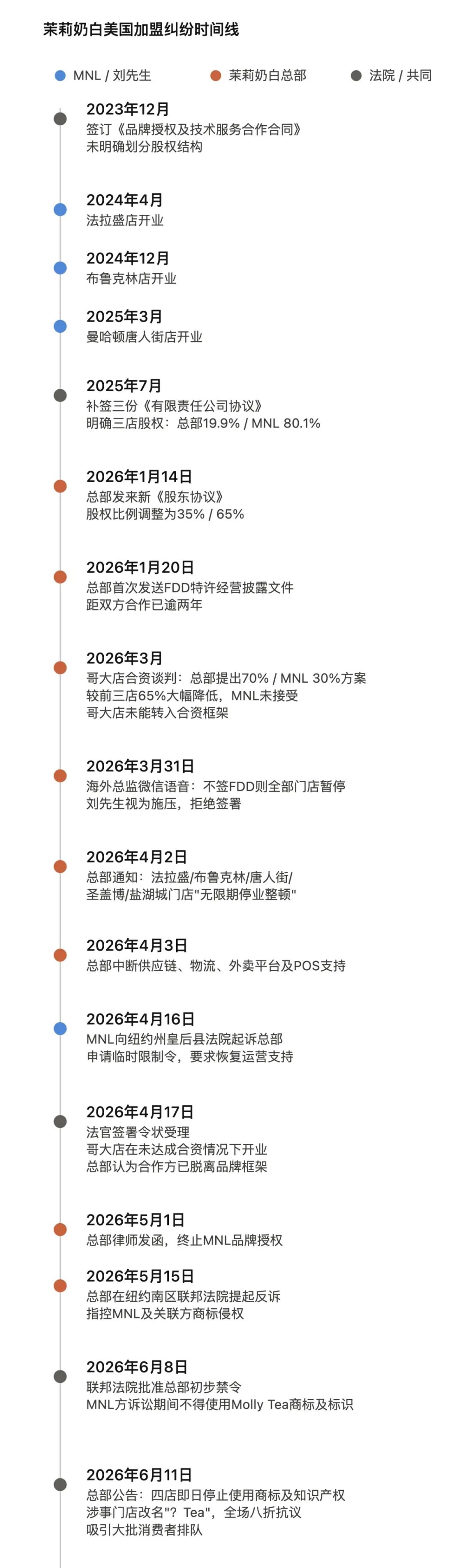
Compiled based on public court documents and relevant signed documents provided by the interviewee, Mr. Liu
This is a conflict caused by the struggle for control under the joint - venture structure. Currently, the federal court has approved the "preliminary injunction" of the Molly Tea brand, requiring MNL not to use its trademark during the litigation, but this is not the final judicial decision. At present, both parties are still continuing the subsequent litigation process.
An important accusation in the litigation is that MNL privately established a new company, Genesis Brand Management LLC, without the headquarters' equity, and signed the lease for the Columbia University store in New York, which was a breach of contract expansion, and the store was never officially authorized. This is one of the core reasons for Molly Tea to claim more than $5 million in compensation from Mr. Liu.
However, Mr. Liu argued that opening the Columbia University store was within the scope of the two parties' plan. The headquarters participated in the whole process from the early site selection, signing, design, and preparation for the opening event, and even sold its own special decoration and operation materials. It was not until the two parties had a disagreement over the equity structure that the headquarters denied the legitimacy of the Columbia University store on the grounds of lack of authorization.
It's just that during the "honeymoon period" of cooperation, trust filled the loopholes in the rules; when the relationship broke down, these loopholes based on "convention" were put on the table.
As of press time, Molly Tea responded that the case is in the judicial process, and the final court decision will be followed. It is not convenient to publicly respond to specific accusations for the time being.
02 Pioneer or Passer - by?
What is the relationship between the two parties in the cooperation, and what rights and responsibilities should they each bear? In this conflict, this may be a question worth asking.
"I've never defined myself as a franchisee," Mr. Liu said when recalling the three - year cooperation. "I would get angry when people inside the company called me 'General Manager Liu, the franchisee'." Mr. Liu runs a consulting and management company in the United States and has been helping Chinese catering brands expand overseas since 2016. In early 2023, on a trip back to China, he accidentally drank Molly Tea in a shopping mall and was amazed by the taste of the product. "It's very refreshing and can relieve greasiness and spiciness." So he had the idea of bringing Molly Tea to New York.
In April of the same year, he said he contacted Zhang Bocheng, the founder of Molly Tea, and straightforwardly put forward three requirements: not to do franchising, only to do joint operations; to be the major shareholder; and not to deal with the cold chain. Mr. Liu said that these requirements were all agreed to at that time. "They didn't care at that time. They didn't have high hopes for the North American market," he said.
Molly Tea was established in 2020 and started with direct - operated stores in second - and third - tier cities. It wasn't until June 2023 that the number of stores just exceeded 100. At that time, other players in the new tea beverage track had already entered the fierce competition in the red - ocean market. Another rising star, Ba Wang Cha Ji, which also follows the light milk tea route, had more than 1,000 stores. Busy expanding in the domestic market, Molly Tea didn't have time to look overseas.
After getting the promise, Mr. Liu returned to New York to look for a storefront. He chose a location in the Flushing neighborhood, where there is a large Chinese population, and paid a transfer fee of $120,000. The day he negotiated and signed the lease with the landlord was in the afternoon in the United States, which was early morning in China. At that time, he had been looking for a store for several months without success. "Because no one knew about Molly Tea," Mr. Liu said. He had found a store before, but it was taken by a more well - known brand. This happened at least four or five times. He didn't want to miss the current opportunity, so he signed the lease for the store on the same day without discussing it with the domestic team.
Compared with China, the commercial real estate leasing system in the United States is complex. High - quality storefronts not only face competition from multiple brands but also require long - term negotiation with landlords on different leasing policies. For Chinese brands entering the US market for the first time, due to the lack of local popularity and business records, it is difficult to gain the trust of landlords, and landlords will not easily rent the storefronts to them. It may take years of exploration and setbacks to open a store.
Therefore, many brands choose to cooperate with local Chinese. The latter have long been rooted in North America, are familiar with market rules, and have real - estate resources and networks. They usually provide personal guarantees for the lease, persuade landlords to gain trust, and can sign the store lease at a lower rent, helping brands quickly open up the market and complete the establishment.
However, this kind of help is not without cost. Once there are problems in the store operation or a breach of contract occurs, the landlord can pursue compensation from the guarantor through legal procedures and even dispose of their personal assets. To some extent, this means that they are not only risking their funds but also their credit and wealth accumulated over the years in the United States.
In April 2024, the first store of Molly Tea in New York opened successfully. It took less than a year from signing the lease to opening for business. In Mr. Liu's view, the Flushing neighborhood is an excellent location. There are many Sichuan cuisine and hot - pot restaurants in the Chinese areas of New York, and there are restaurants like Tai Er Sour Fish, Xiao Long Kan, and Chongqing Old Stove around the store. "It must be surrounded by them." After eating heavy - oil and spicy food, consumers are likely to want to order a cup of Molly Tea to relieve greasiness.
Everything progressed as expected. After the Flushing store opened, it quickly became popular. "The turnover increased for more than a dozen consecutive months. A 50 - square - meter store could achieve a monthly turnover of four to five million RMB," Mr. Liu recalled. Subsequently, he opened the second and third stores in other Chinese - populated areas such as Brooklyn and Chinatown. In the summer of 2025, through his own accumulated network resources, Mr. Liu also facilitated a sponsorship cooperation between Molly Tea and the NBA Brooklyn Nets and the Barclays Center.
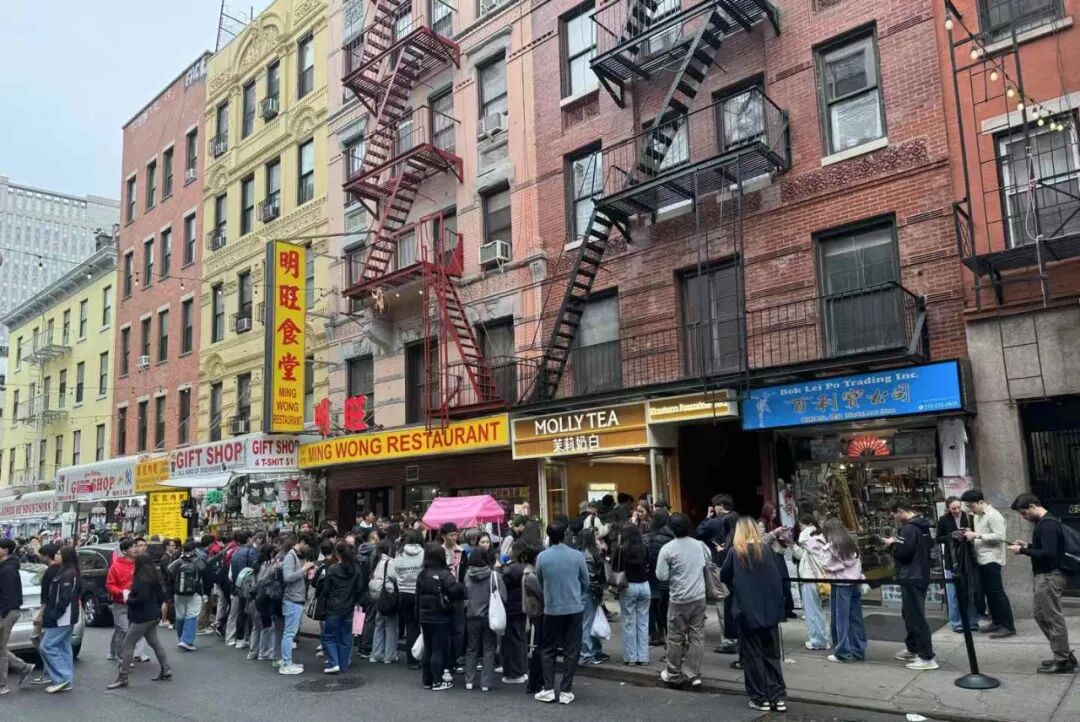
The queuing craze caused by the Molly Tea store in Manhattan's Chinat