The "Big Advertising" Era of Embodied AI: Companion Robots May Be the Only Way Out
On June 20th, Brett Adcock, the CEO of Figure, posted a chart on X. The curve of the number of robots has exceeded the curve of the number of employees.
The caption reads: "For the first time, robots now outnumber humans at Figure."
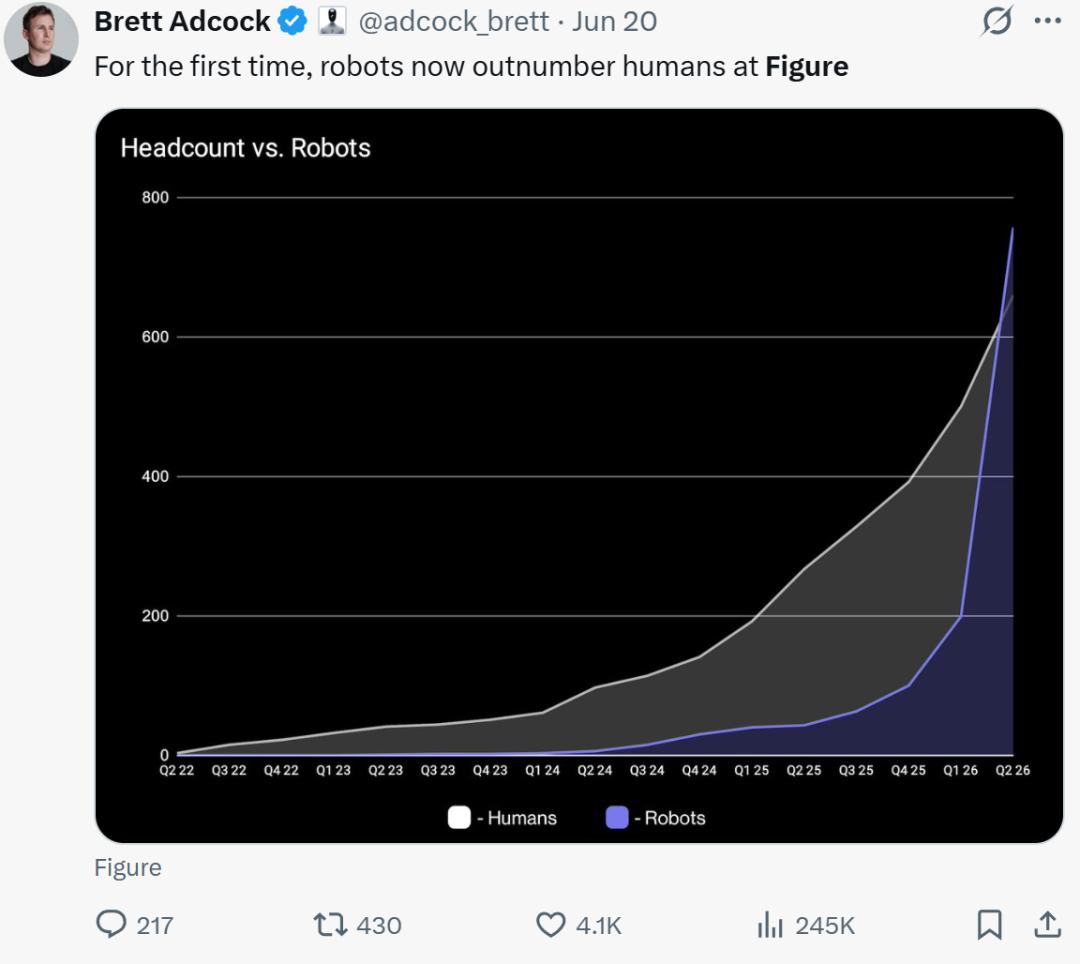
Some people on X cheered "turning point", while others joked "Good luck humanity". Tech media quickly followed up, and words like "milestone" and "historic moment" began to appear in the headlines.
However, few people noticed that the prelude to this chart was a 200 - hour live broadcast a month ago. Three robots sorted nearly 250,000 packages beside the conveyor belt. A 10 - hour human - machine comparison test showed that the robots took 2.83 seconds per package, while human interns took 2.79 seconds, with a difference of less than 0.04 seconds.
The two announcements were only a month apart. The first one proved "capability", and the second one proved "mass production". The rhythm seemed perfect, but in fact, it was a well - orchestrated expectation management. After all, in the tech circle, it is often easier to create a beautiful chart than to build a robot that can repair itself.
200 - hour live broadcast: The most opportunistic test scenario was chosen
From May 14th to 22nd, Figure live - streamed for eight days at its San Jose headquarters. Three F.03 robots stood beside the conveyor belt, repeating one thing: identifying packages, picking them up, rotating them, scanning the barcodes, and putting them back on the conveyor belt with the barcodes facing down.
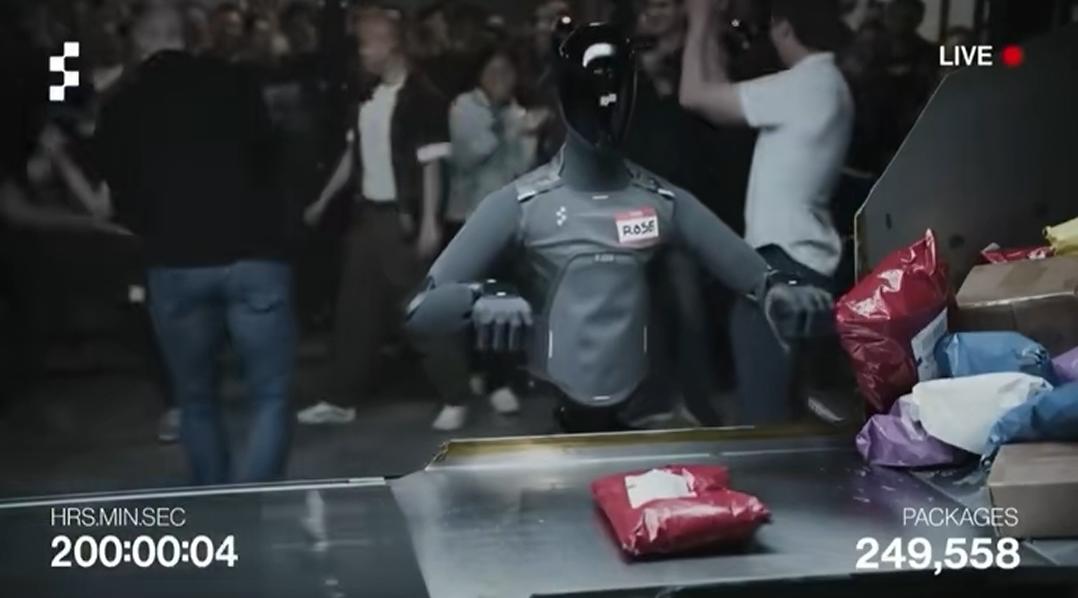
Nearly 250,000 packages were sorted non - stop for 200 hours. It sounds impressive, but in fact, this is the most classic scenario in industrial automation. The conveyor belt runs at a constant speed, the package specifications are fixed, the barcode positions are known, and the actions are single and repetitive. Traditional robotic arms are far superior to humanoid robots in terms of efficiency, accuracy, and stability in this scenario, with lower costs, lower failure rates, and easier maintenance.
Figure barely caught up with the speed of human interns in the optimal environment. This is not a breakthrough; instead, it exposes the embarrassment of humanoid robots: In the scenario most suitable for automation, it has just reached the entry - level of human performance. Even in the most friendly scenario of logistics sorting, humanoid robots cannot be said to be leading.
The express sorting robots of ABB (a Swiss industrial robot giant) can process 1,500 packages per hour per unit. The AGV (Automated Guided Vehicle) sorting system can process an average of 640 to 1,100 packages per hour. Three Figure robots working together completed 12,732 packages in 10 hours, about 424 packages per hour per unit. This is not a matter of "approaching human performance"; it can't even catch up with the exhaust of traditional robotic arms.
What really tests humanoid robots is never standardized sorting. "Long - tail anomalies" such as sudden conveyor belt shutdowns, damaged and leaking packages, and blocked barcodes are the real challenges. These were deliberately avoided in the live broadcast. The robots only processed standard packages. Abnormal packages were either pushed off the conveyor belt or triggered "automatic reset" and waited for remote processing by back - end engineers.
Ayanna Howard, the dean of the College of Engineering at Ohio State University, commented that this demonstration is more like a scientific project and is still far from a mature commercial service.
Figure doesn't need you to remember the anomalies, the resets, or the expert evaluations. They only need the public to remember three numbers: 250,000 packages, 200 hours, and approaching human speed. And these numbers became the best footnote for the narrative of "the number of robots exceeding humans" a month later.
Number surpassing: Triple concept substitution in the digital magic
The 200 - hour live broadcast was a "proof of capability", and the "number of robots exceeding humans" on June 20th was a "proof of scale". The two events filled the narrative gap from "capability to scale". However, there are tricks in each link.
Logistics sorting is the most "cheating" scenario for humanoid robots, which is structured, standardized, and anomaly - free. Using this to deduce that "robots can replace workers" is like saying that a person can conquer all mountain terrains just because they ran a marathon on a treadmill. Deducing the substitution ability of the entire industry from the performance in the optimal scenario is the first level of substitution.
The chart shows that the number of robots has significantly exceeded the number of employees. However, this curve represents the total production since the start of production. According to manufacturing industry conventions, it includes semi - finished products on the assembly line, equipment waiting to be shipped in the warehouse, and prototype machines in the laboratory. According to publicly disclosed customer cases, there is a significant gap between the actual number of robots deployed on the customer production lines for stable work and the total production. Equating "self - produced and self - used production capacity" with "full - time workers" is like a cake shop saying "I have more molds than bakers". No matter how many molds there are, they are just inventory if no cakes are baked. Passing off the total production as the on - the - job labor force is the second level of substitution.
These robots don't reduce the manpower; instead, they require more people to support them. Data annotators annotate action samples, motion control engineers debug gait algorithms, and on - site maintenance personnel handle system crashes. The so - called "robot replacing humans" just moves the manpower from front - line operation positions to back - end technical positions. The total amount doesn't decrease, and the cost structure becomes more complex. Substituting cost arbitrage for efficiency advantage is the third level of substitution.
Figure 02 once conducted an 11 - month pilot at the BMW Spartanburg plant, participating in the production of more than 30,000 X3s and handling more than 90,000 parts. This seemingly good report card actually exposes the efficiency ceiling. Based on a total working time of 1,250 hours, it's about 72 parts per hour. For handling parts of the same specification, it's normal for a skilled worker to process hundreds of parts per hour. This level of 72 parts per hour would lead to a talk with a worker.
Why does BMW still use them? The robots are not very efficient, but they are cheap enough. The price of Figure 03 is about $25 per hour, lower than the average wage in the US manufacturing industry. However, being cheap and technological substitution are two different things. The logic of substitution is "I'm better than you, so I replace you", while Figure's current logic is "I'm cheaper than you, so you can tolerate my low efficiency". There is a big gap between cost arbitrage and technological revolution.
What's more interesting is that the pilot of Figure 02 at BMW ended in November 2025. There are currently no Figure robots at the Spartanburg plant, and BMW has not announced a schedule for repurchase or expansion. Even in BMW's new pilot in Europe, it didn't choose Figure 03 but the AEON robot under Hexagon. After the customer's trial, they didn't place an order and turned to another company.
This is not just a problem with Figure. The humanoid robot industry is collectively falling into a "scenario trap": the first scenarios to be implemented, such as logistics sorting and production line handling, are exactly the scenarios that least need humanoid robots. Traditional robotic arms and AGV trolleys have lower costs and higher efficiency. The core value of humanoid robots is universality, but for the sake of commercialization, the industry is all crowding into the scenarios that least need universality to tell stories. Deducing the future of all scenarios from the performance in the optimal scenario, the entire industry is painting a pie for itself.
Understand the screws in non - standard scenarios first
Of course, we can't completely deny the technical value of Figure. The 200 - hour public live broadcast is indeed an important step in the embodied intelligence industry. It moved humanoid robots from the concept videos in the laboratory to a publicly observable real - world scenario for the first time. However, progress is one thing, and narrative is another. Demonstration and commercial maturity are two different things.
Domestic humanoid robot companies are also following a similar path. In 2025, Unitree Technology shipped more than 5,500 humanoid robots, and Zhipu Robotics shipped more than 5,100. These two companies accounted for nearly 80% of the domestic market share. However, like Figure, these numbers are more about "production capacity" and "shipment volume" rather than "on - the - job replacement of the labor force".
UBTECH's situation is more representative: Its Walker S2 was piloted in industrial scenarios, with annual orders of nearly 1.4 billion yuan, but the delivery volume was only a few hundred units. At the same time, UBTECH recently launched the consumer - grade U1 series, which focuses on emotional companionship and comes in male and female models. The pre - orders reached nearly 4,000 units in 10 days, far exceeding the annual sales of humanoid robots last year. The product is marked "For adults only" on the official page.

Behind the "tens of thousands of units" narrative, the orders are supported by scenarios such as data collection centers, exhibitions, education and training, and emotional companionship. The proportion of real production line replacement is limited, and the humanoid robot industry is generally caught in the dilemma of "the disconnection between technological ideal and commercial implementation". When the repurchase rate in industrial scenarios doesn't increase for a long time and the efficiency ceiling of production line replacement has been hit for 11 months, humanoid robot companies find that the customers who are willing to pay may be in the living room rather than in the factory.
In the short term, there won't be large - scale "robot replacing humans". Humanoid robots will serve as "expensive special tools" and perform single auxiliary tasks in highly standardized assembly lines. Workers do complex tasks, and robots do repetitive tasks. Human - robot collaboration is the mainstream.
The commercial turning point of embodied intelligence never depends on "how many robots a factory can produce per hour". Three hard indicators are more worthy of attention: Whether the full - life - cycle profit of a single robot can exceed the labor cost of an engineer in the same position; Whether the customer's paid repurchase rate can change from "pilot cooperation" to "continuous procurement"; Whether the continuous operation time without human intervention can break through from 200 hours to 1,000 hours, and not beside the conveyor belt but in a real environment with anomalies, changes, and interferences.
Technically, NVIDIA recently released the SpatialClaw spatial reasoning framework, which uses code as an action interface, allowing intelligent agents to flexibly combine perception tools and adapt to environmental changes without retraining for each new scenario. This points to a key direction: Only when robots can autonomously understand and work when entering a new scenario will the era of general embodied intelligence truly arrive.
When Figure dares to announce: "We have laid off half of the maintenance engineers because the robots can troubleshoot and repair themselves", that's when the real turning point of substitution will come.
Before that, the production capacity numbers on the chart are just costs to be digested, far from "replacing the human labor force".
Now, understand the screws in non - standard scenarios first.
This article is from the WeChat official account "AI Contrarian", written by Lei Ou, and published by 36Kr with authorization.