Selling the company allowed 50 employees to achieve financial freedom.
This scene began with Elon Musk's large - scale acquisition —
Recently, SpaceX announced that it would acquire Anysphere, the parent company of Cursor, for $60 billion (approximately 400 billion RMB). According to estimates, each of the top 50 founding employees could receive tens of millions or even hundreds of millions of dollars in returns.
In short, if you were among the first group to join Anysphere three years ago, you are now financially free.
Back in 2022, four post - 2000 students from the Massachusetts Institute of Technology founded Anysphere. Its product, Cursor, has become the world's hottest AI programming tool in the past two years. Eventually, Elon Musk extended an olive branch.
One can't help but sigh that the wealth - creating wave brought by AI is more powerful than ever before.
Four post - 2000s create a unicorn worth 400 billion
Surprisingly, the story starts with four post - 2000s.
Growing up in New York, Michael Truell showed extraordinary programming talent from a young age. He started learning programming at around 10 years old. At 15, he developed a programming game with his classmates and won a $10,000 prize from a top mathematics association. He finished the approximately one - hour freshman programming exam at the Massachusetts Institute of Technology in less than 10 minutes.
At MIT, Truell majored in a double degree in computer science and mathematics and began to conceive of entrepreneurial ideas. In 2022, he joined hands with three classmates, Aman Sanger, Sualeh Asif, and Arvid Lunnemark, to found Anysphere.
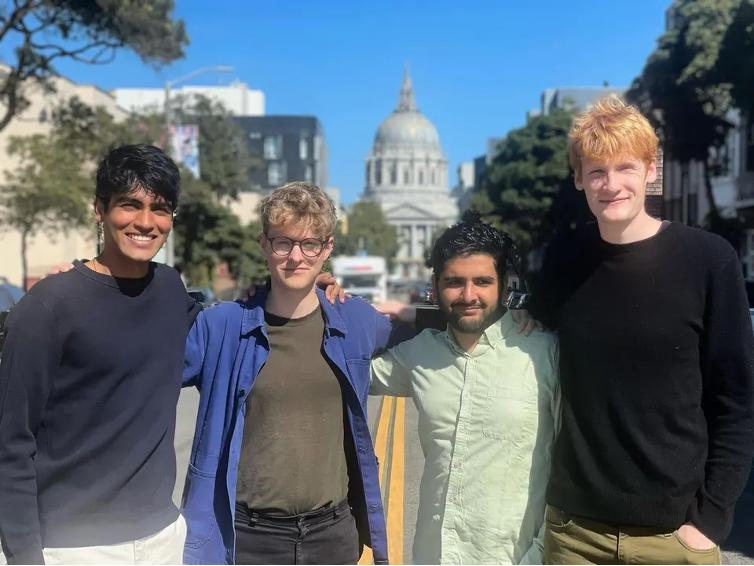
Initially, the four of them wanted to build an AI model for mechanical engineers, but they failed due to a lack of professional knowledge. After much thought, they decided to return to the familiar software field and developed an AI - driven code editor. Cursor was officially launched in March 2023 and quickly became extremely popular.
At that time, Microsoft's programming tool, GitHub Copilot, was already well - known, but Cursor was even more powerful: it could automatically generate, edit, and review code with just one sentence of requirements, and developers could switch between several mainstream AI models.
The vice - president of Cloudflare once shared a video: his 8 - year - old daughter successfully built a chatbot webpage using Cursor in just 45 minutes. The "Kitten Fill Light", which once topped the paid ranking on the App Store, was developed by a developer using Cursor.
Remember the "vibe coding" trend that emerged last year. Users didn't need to write code line by line; they could generate a runnable program just by presenting their ideas, and it became popular around the world. This concept originated from Cursor.
Soon, the number of Cursor users began to grow exponentially. It achieved an annualized revenue of $100 million in just one year. In 2025, it exceeded one million daily active users, and its annual revenue exceeded $1 billion. More than half of the world's Fortune 500 companies are their customers.
Investors flocked to them. In 2024, the company's valuation was less than $10 billion. In November 2025, it raised $2.3 billion at a post - investment valuation of $29.3 billion. Just before the acquisition, Anysphere was still in talks for a new round of financing at a valuation of $50 billion.
However, despite Anysphere's remarkable growth, it also has its own hidden problems.
The core issue is that it doesn't develop its own model but packages the model capabilities of Claude into a user - friendly development tool. As the supplier enters the market directly, its already thin moat becomes more vulnerable.
According to Ramp's data, Cursor's share in the AI programming tool market has dropped from 41% in June 2025 to approximately 26% in May 2026, while Claude Code accounts for about half.
"We must not fall behind." Anysphere decided to develop its own model, which requires a huge amount of computing power — this is where SpaceX's Colossus computing cluster comes in handy. For Elon Musk, AI programming is also an extremely attractive piece of the pie that needs to be supplemented.
Maybe in the future, the code for rockets to go into space will be written by Cursor.
After three years of joining, they achieved financial freedom
For the early employees of Anysphere, wealth came unexpectedly.
Initially, the company was very cautious in recruitment, and the number of team members remained in the single digits for a long time. The four founders built the foundation step by step. After the business model was verified, the number of the team quickly reached nearly 700.
Those who are enjoying the wealth feast are the earliest entrants — if you joined Anysphere in 2023 and were among the top 50 employees, you are probably financially free after the acquisition.
According to the option arrangement of Silicon Valley startups, on average, each of these 50 founding employees can get nearly $100 million in returns. However, Anysphere didn't disclose the relevant details. Here is a reference version provided by Doubao:
Usually, the employee option pool accounts for 15% in total, with a value of approximately $9 billion;
The top 50 early core employees divide 85% of the total pool, totaling approximately $7.65 billion;
These 50 people are further divided into three levels: core veterans, early backbones, and early employees. The average equity value for each level is approximately $300 million, $130 million, and $96 million respectively;
Deedy Das, a partner of a Silicon Valley venture capital fund, also did a calculation: according to the equity incentive information, each of the top 50 Cursor employees is expected to receive between $20 million and $500 million.
Of course, the biggest beneficiaries are undoubtedly the four co - founders. According to Forbes' estimates, each of the four post - 2000 co - founders holds approximately 4.5% of the company's equity. Through this acquisition, their average net worth will reach approximately $2.7 billion (approximately 18 billion RMB).
The earlier you join and the higher your position, the greater the multiple of equity you get. For employees at the same level, the return gap may exceed 100 times.
This is the wealth realization path of startups — compared with monthly salary, how many options you get is often more important. Ability determines whether you can get hired, but time may determine how much you earn.
"Joining a good company is the best investment", and the value of this statement is getting higher and higher.
No AI, no wealth: the wealth lottery for this generation
The wealth - creating speed in the AI era is more amazing than ever.
At the beginning of this year, OpenAI spent $100 million to acquire the AI startup Torch. This is a company that uses AI to process medical information. It has been established for only one year, and its product is still in the internal testing stage. It has only completed a small - scale seed financing round and is operating with a light load.
Notably, the Torch team has only four people, including a person with a Chinese face. It can be said that they were sold to OpenAI in a package. Roughly calculated, each person's return is approximately $25 million, and the early investors also exited completely.
Earlier, the overseas Internet giant Wix announced the acquisition of the AI startup Base44 for $80 million (approximately 570 million RMB). The founder, Maor Shlomo, is a post - 1990s programmer who is very popular in the "Vibe Coding" circle.
Base44 didn't conduct any external financing after its establishment. Shlomo is the sole shareholder, and he has 8 employees under him. In other words, in just half a year of starting a business, Shlomo successfully cashed out at least 400 million, and his employees easily became multimillionaires.
Looking back at the domestic situation, AI is also rewriting the wealth path of workers.
Here, we have to mention Zhipu. According to the prospectus, approximately one in every two people at Zhipu is a shareholder. Roughly calculated, the average market value of their shares is over 10 million Hong Kong dollars, and there are even many billionaires. The early agreements have gradually turned into real money, which is enviable.
There is also Zhongji Xuchuang, whose stock price soared due to the computing power wave. This year, the vesting conditions of multiple equity incentive plans have been met. The latest situation is that 803 employees of Zhongji Xuchuang will vest 1.63 million shares, corresponding to a stock market value of approximately 2.2 billion yuan.
"No AI, no allure; no AI, no high valuation; no AI, no wealth." AI has become the biggest investment theme globally, and the resulting wealth wave is beyond imagination.
Looking back at the past few decades, most of the well - known billionaires come from the energy, real estate, and traditional manufacturing industries. Capital scale and channel resources are the core moats, and the accumulation of wealth is often a long - term story that lasts for 10 or 20 years.
However, the arrival of AI has changed all this — only a small team is needed to quickly launch products and achieve expansion. Market verification is extremely fast, and technology has become the core lever. Wealth creation may only require a single model explosion.
Of course, the voice of the bubble cannot be ignored. Jeff Bezos, the founder of Amazon, previously said bluntly that "a company of six people getting billions of dollars in financing" is not a rational behavior, but it is happening every day.
However, the bubble is not entirely equivalent to falsehood. In many cases, it only means that imagination arrives ahead of time. The real problem is what kind of stance to take at the table after the tide recedes.
Let's wait and see.
This article is from the WeChat official account "Investment Community" (ID: pedaily2012), author: Yu Mengying. It is published by 36Kr with authorization.