Extending the "lifespan" of AI chips, China's lab-grown diamond sector has seized a major opportunity
AI has popularized memory chips, and the prices of upstream helium, special metals, transformers, etc. have also increased.
Unexpectedly, the price of artificial diamonds has also been driven up by AI.
In the first half of this year, more than 80% of enterprises in the diamond industry issued price increase notices.
How important is diamond, which seems "unrelated", to AI?
Will AI chips rely on Chinese technology to "extend their lives"?
01
Heat dissipation capacity is computing power
In March this year, NVIDIA officially announced at its annual developer conference that the next - generation GPU will use the Vera Rubin platform. The power consumption of a single chip has exceeded 2300W, and the heat flux density has exceeded 1000W/cm². The traditional copper - aluminum heat dissipation solution has reached its physical limit, and the "diamond - copper composite heat dissipation + liquid cooling" solution will be fully adopted.
Jensen Huang said that the chips do not need additional coolers to cool down.
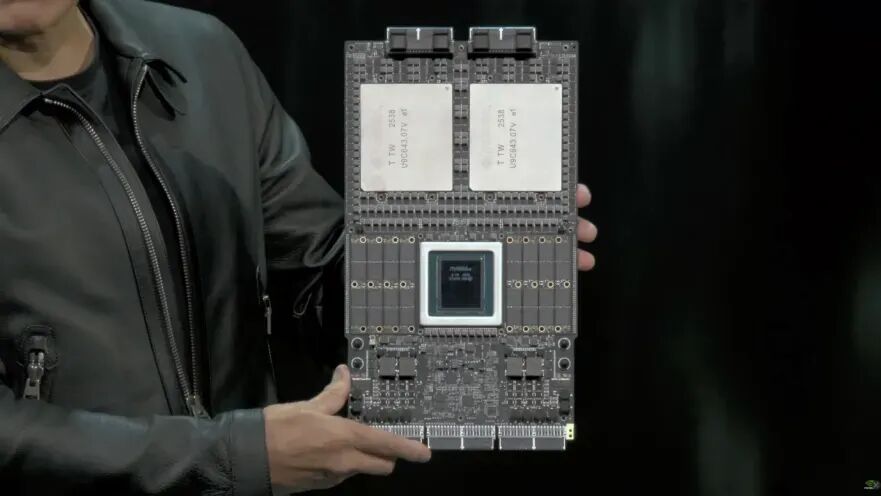
The next - generation GPU products shown by Jensen Huang
It includes a Vera CPU and two huge Rubin GPUs
At the same time, AMD also launched the MI350X AI server equipped with a diamond cooling system.
The similar technical routes of the two giants have officially elevated diamond to the standard core position for AI computing power heat dissipation.
The heat dissipation of AI chips has officially entered the era of "material revolution".
The expansion and mass production of new technologies will definitely lead to a shift in the supply chain, and this time it has fallen on the diamond industry.
Why did the two giants change the heat dissipation technology route?
Before clarifying the underlying logic, it is necessary to figure out a question: how much does heat dissipation affect the computing power of chips?
For example, when you play games or watch videos on your phone for a long time, the phone body will get hot.
If the heat dissipation is poor and the high temperature does not drop, the screen will start to dim, and the game will experience severe frame drops.
At this time, if you don't let the phone cool down, a high - temperature warning will pop up and force the phone to shut down.
"High temperature" can determine the upper limit of the phone's use, and the heat waves behind each AI chip also determine the upper limit of AI computing power.
The essence of AI large - model training is large - scale parallel computing.
The thermal design power of today's high - end chips has entered the kilowatt - level era of 1000W or even 1200W, and the heat flux density of the third - generation semiconductor devices has exceeded 500W/cm².
Imagine concentrating a heating power of over 1000W on a chip the size of a fingernail. The heat generation per unit area exceeds the heat flux density of a rocket engine nozzle.

NVIDIA's Blackwell B200 platform with a power consumption of up to 8000W
Everyone is afraid of their phones getting hot suddenly, and chips are even more afraid of heat.
When the temperature of a chip is too high, it will trigger a thermal throttling protection mechanism and automatically reduce the frequency to reduce heat generation.
Once a chip gets hot, its computing power will be reduced.
Data shows that for every 10°C increase in temperature, the chip performance will be lost by about 3 - 5%.
If the chip's operating temperature is between 70 - 80°C, for every 2°C increase in temperature, the performance will decrease by 10%.
Most chip tests are conducted on single chips, but in large - scale AI operations, thousands of computing cores are often integrated into a very small volume, and the heat accumulates at an exponential rate.
A large amount of heat is wrapped around the chips and cannot be dissipated. Each cabinet is like a volcano.

The cabinets filled with chips in a supercomputing center
What's even more fatal is that high temperature will also significantly shorten the lifespan of semiconductor devices.
There is a "10 - degree rule" in the chip field, which means that within the normal operating temperature range of a chip, for every 10°C increase in temperature, its operating lifespan will be halved.
In large - scale supercomputing centers, the cost of an AI server is as high as hundreds of thousands or even millions of yuan. Premature scrapping will directly increase costs and expenses.
It can be said that heat dissipation capacity is computing power, and heat dissipation "extends the life" of AI.
Before diamond, the mainstream heat dissipation technology routes were mainly air cooling, liquid cooling, and passive heat dissipation.
Air cooling is relatively common, which relies on fans blowing heat sinks to take away heat. Liquid cooling uses the high specific heat capacity and high thermal conductivity of liquids to dissipate heat.
Passive heat dissipation achieves heat transfer through passive means such as high - thermal - conductivity materials, heat pipes, and phase - change materials.
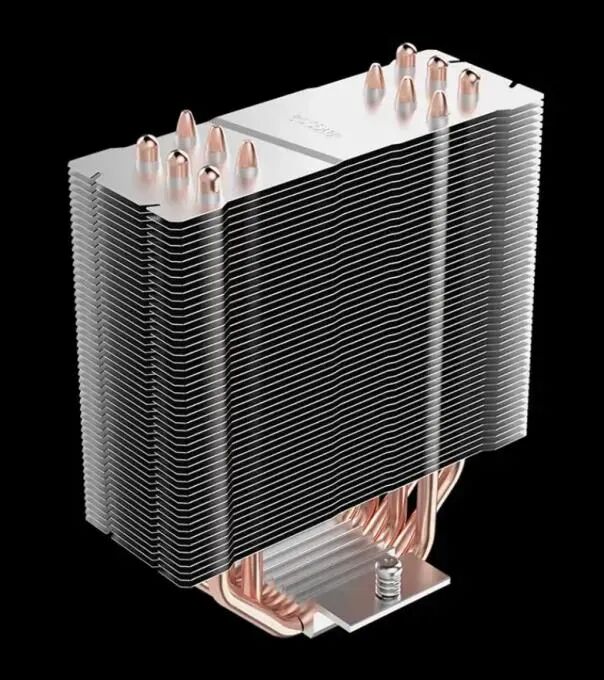
Common copper - aluminum heat sinks
These methods all have deficiencies and are difficult to meet the heat dissipation requirements of AI chips.
In order to dissipate heat, various enterprises have come up with "unique tricks".
Microsoft directly submerged its servers in the sea, using the natural cold source of seawater at a constant temperature of 10 - 15°C throughout the year to take away heat.
Tencent dug a cave - based computer room relying on the unique karst mountains in Guizhou. The mountain is more than a hundred meters thick, and the cave has a constant temperature and humidity of 18 - 22°C throughout the year, which is equivalent to a natural giant thermal insulation cold storage.

Tencent's Qixing Data Center
Finally, major manufacturers have set their sights on diamond.
02
Superb thermal conductivity
When it comes to diamond, people will think of its hardness.
In fact, in terms of heat dissipation technology, diamond also has natural superb thermal conductivity.
Diamond is currently the material with the best known thermal conductivity. Its thermal conductivity of 2000 - 2200W/(m·K) is 5 times that of copper, 8 times that of aluminum, 4 times that of silicon carbide, and 13 times that of silicon.
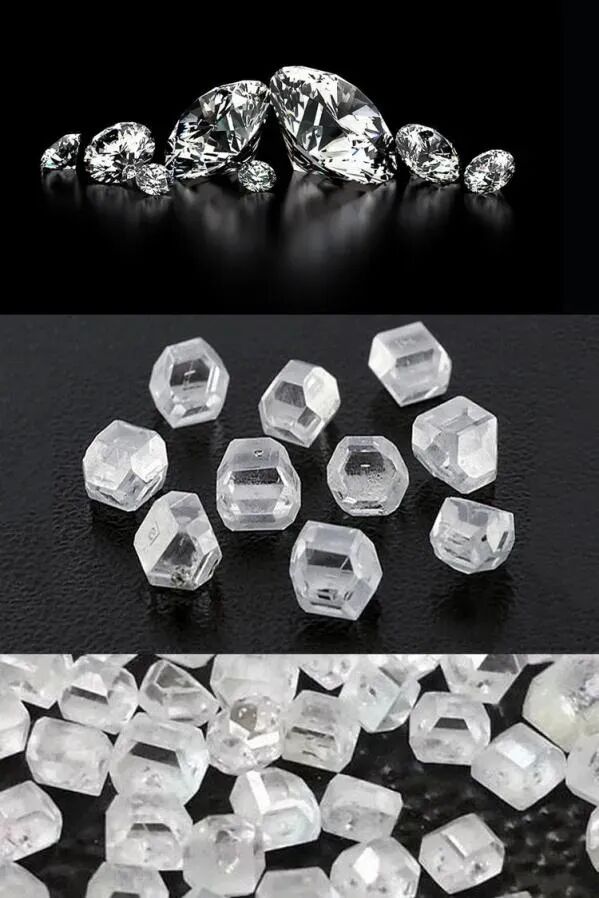
Several types of artificial diamonds
This advantage is even more amazing in extreme scenarios.
In an experimental environment, a micro - channel heat sink based entirely on diamond has successfully achieved heat dissipation at an ultra - high heat flux density of 10000W/cm².
In comparison, the local hot spots at the moment when the chip is fully loaded seem a bit weak.
The natural thermal expansion coefficient of diamond also makes it the optimal solution for current heat dissipation.
When the chip is working, it alternates between hot and cold, and its volume will expand and contract slightly like breathing.
If the expansion degree of the heat dissipation material is inconsistent with that of the chip, a huge stress will be generated between them, which will eventually lead to chip warping or solder joint cracking, affecting subsequent heat dissipation.
Diamond belongs to the same group as silicon, and its thermal expansion coefficient is highly matched with that of mainstream semiconductor materials such as silicon and silicon carbide.
This means that it can achieve almost perfect "synchronized breathing" with the chip during thermal expansion and contraction, significantly improving the reliability and stability of the chip and the heat dissipation interface.
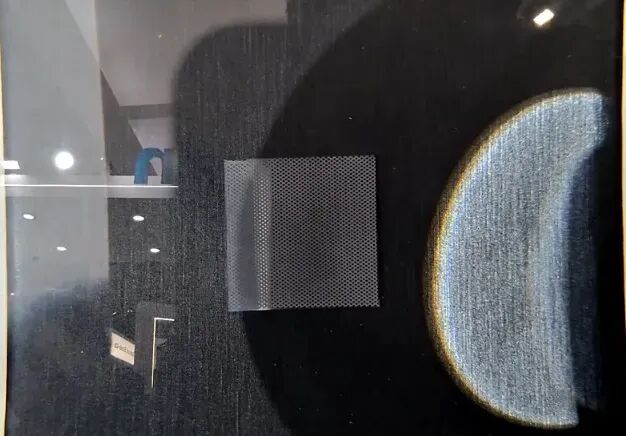
Diamond - silicon composite heat dissipation substrate
In addition, the "dimensionality reduction strike" of diamond in the heat dissipation field also lies in its excellent insulation.
Metals such as copper and aluminum are indeed good conductors of heat, but they are also good conductors of electricity. Therefore, they cannot directly contact the tiny circuits inside the chip, otherwise, it will cause a short - circuit.
Therefore, when using metal heat sinks for passive heat dissipation, a layer of thermal paste or thermal gasket must be placed in the middle for electrical isolation.
Diamond itself is an excellent electrical insulator and can absorb heat in a "skin - to - skin" way close to the chip without worrying about any electrical interference.
For high - frequency AI chips that pursue extreme signal integrity, this advantage is crucial.
In addition to the above advantages, the stable physical and chemical properties and reaction inertness of diamond itself also enable it to perform stably in extreme environments.
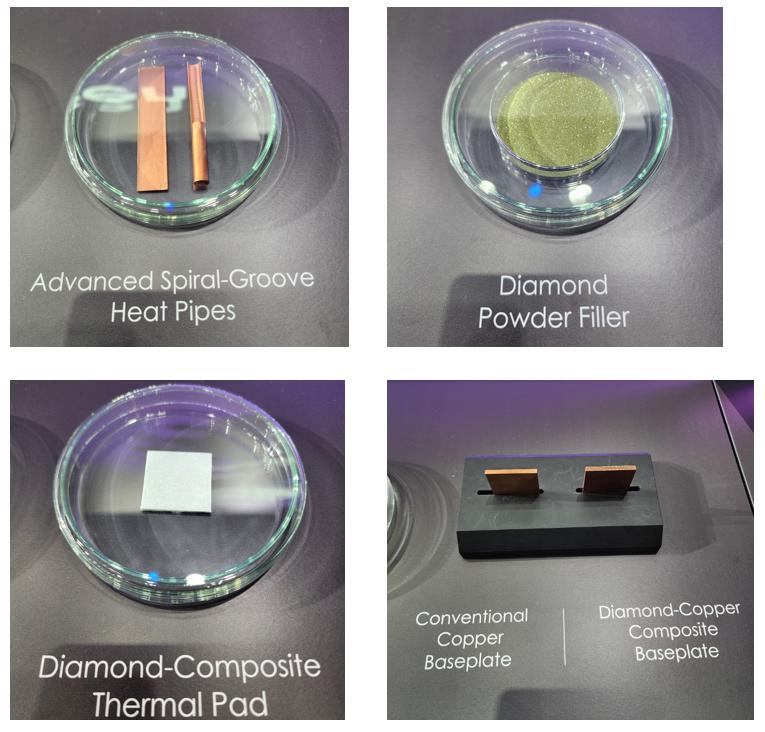
The new - generation heat dissipation architecture announced by MSI
Obviously, any heat dissipation technology relying solely on the excellent properties of the material itself is far from enough. It must also cooperate with other technologies to create an effect of 1 + 1>2.
NVIDIA's H200 GPU uses a diamond - silicon carbide composite material, with a 40% increase in peak computing power and no throttling.
Diamond heat dissipation can also be used in conjunction with liquid - cooling technology, reducing the hot - spot temperature of the GPU by 10 - 20°C, enabling a 25% overclocking, and increasing the computing power by 3 times compared with traditional heat dissipation solutions.
In the field of AI chips, diamond heat dissipation technology is the only choice.
03
Chinese diamonds lead the world
It should be noted that the diamonds required for heat dissipation are not natural gemstones.
Because the purity of natural diamonds is not high, and some even contain trace amounts of volatile substances, which will explode when heated. Therefore, artificial diamonds with higher purity and more perfect quality must be used.
Speaking of artificial diamonds, China has a great relationship with them.
As introduced in the article "Diamonds are not selling well! The biggest 'hoax' in business history has been exposed by Henan" on Zhengjieju, China's artificial diamond industry ranks first in the world.
In 2025, China's output of artificial diamonds accounted for 95% of the world's total output.
Among them, the production and sales of industrial - grade diamonds both accounted for more than 90% of the world's total, and the total output value of the industry exceeded 17 billion yuan.
With overwhelming production capacity, China occupies an absolute dominant position in the global market.
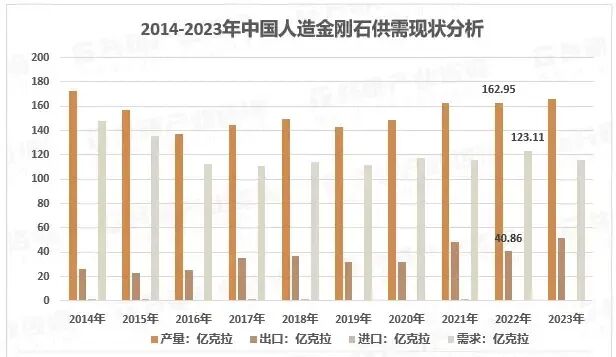
Supply and demand data of Chinese artificial diamond production
Not only is the output large, but China is also making great strides forward in the manufacturing technology of artificial diamonds.
In 2025, Jilin University and Sun Yat - sen University cooperated to synthesize high - quality hexagonal diamond blocks. The hardness is 40% higher than that of traditional cubic diamonds, and the thermal stability exceeds 1100°C, creating new possibilities for applications in extreme environments.
In terms of heat dissipation technology, China is also seeking breakthroughs.
In 2023, Huawei, Harbin Institute of Technology, and Xiamen University cooperated to develop a silicon/diamond three - dimensional integrated chip hybrid bonding technology, which can reduce the maximum junction temperature of the chip by 24.1°C, opening up an industrialization path for the direct thermal integration of AI chips.
In September last year, the team of Academician Hao Yue from Xidian University achieved efficient bonding of gallium oxide and polycrystalline diamond, reducing the interface thermal resistance to about 1/10 of the traditional technology (only 2.82mm²·K/GW). This achievement provides a new idea for heat dissipation of high - power electronic devices.
China's diamond industry has developed for many years and has a mature industrial cluster. It not only includes the R & D, large - scale production, and sales of diamond products but also forms a perfect closed - loop from raw material synthesis to high - end products.
