Led by Huawei and Cambricon, domestic chip players are accelerating their grab of NVIDIA's market share.
New players are quietly joining the top - tier domestic GPU market.
Recently, according to media reports, ByteDance is in talks with Daysci to purchase at least 50,000 AI chips, mainly for inference tasks. The chips involved in this negotiation are mainly the Cloud Inference GPUs of Daysci's Zhikai series, while the Tiangai series is used for training scenarios.
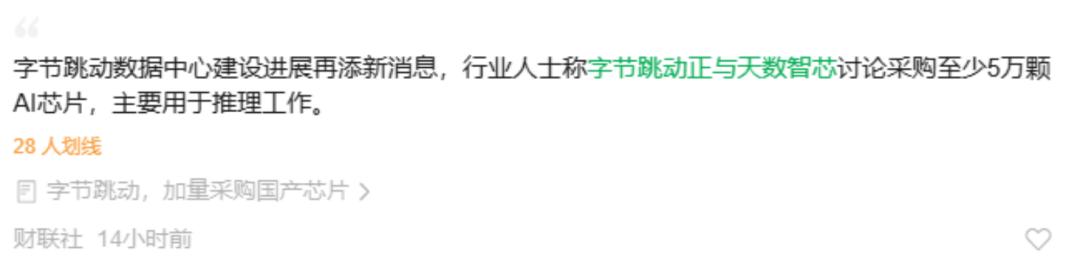
Screenshot from media reports
As soon as the news came out, the market was in an uproar. After all, ByteDance is the largest domestic buyer of AI computing power - it plans to increase its capital expenditure by more than 200 billion yuan in 2026.
However, as of now, neither ByteDance nor Daysci has responded.
If this deal is finalized, Daysci will become ByteDance's third - largest domestic GPU supplier after Huawei and Cambricon.
For Daysci, which went public on the Hong Kong Stock Exchange in January this year, this is not just about a huge order, but also about getting the "certification from big tech companies".
However, what's more worthy of attention than the order is the signal behind this event - domestic AI chips are truly entering the application scenarios of Internet giants from "policy - driven procurement and industry pilots", shifting from alternative options to essential computing power support.
01 No Choice but to Buy
ByteDance does have options.
The United States has currently approved some Chinese companies to purchase NVIDIA H200 under controlled conditions. However, the "back - door incident" of H20 has put Chinese buyers under additional compliance and security review pressure when making purchases. It has become a basic practice for domestic big tech companies to avoid putting all their eggs in one basket.
More importantly, ByteDance's computing power demand is undergoing a structural change.
QuestMobile data shows that as of March 2026, the monthly active users of Doubao, the AI intelligent assistant under ByteDance, have reached 345 million. The pressure brought by user growth comes not only from model training but also from the continuous inference cost after the launch. The requirements for chips in inference scenarios are one level looser than those in training in terms of inter - connection bandwidth, video memory, and ecological maturity. Domestic chips have reached a usable level on the inference side.
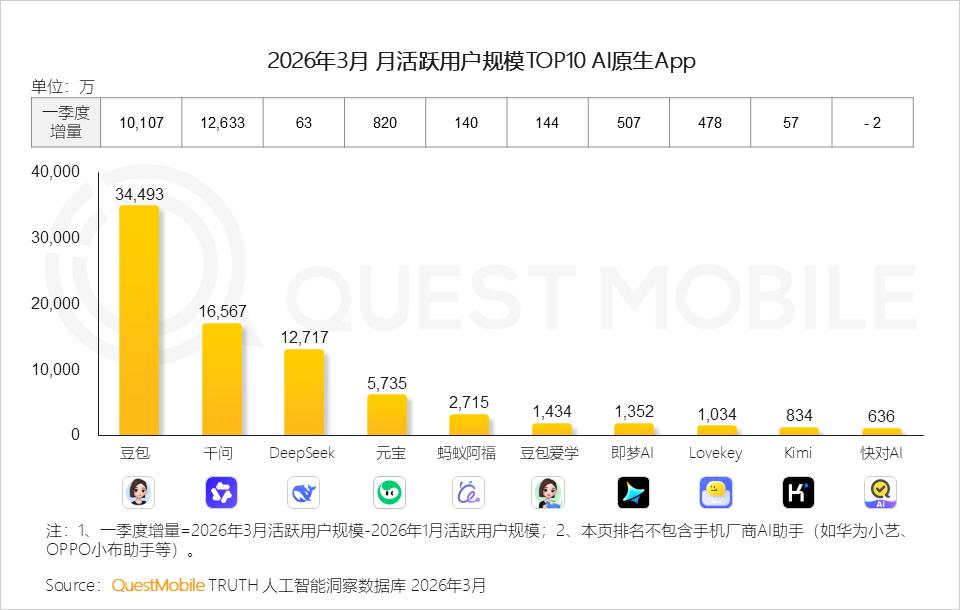
Image source: QuestMobile
As of March 2026, the daily average Token call volume of the Doubao large - model has exceeded 120 trillion, a thousand - fold increase compared with the initial launch. According to the pricing of Volcengine and user behavior, the daily computing power consumption cost has reached tens of millions of yuan - not including one - time investments such as the purchase of intelligent computing centers and chips.
Although the inference efficiency of Doubao 2.0 has increased by 43% and the cost per 10,000 Tokens is only 38% of that of the compliance link of overseas leading models, it is still difficult to fill the loss gap with 345 million monthly active users using it for free.
Under pressure, ByteDance has started a "bold bet" - style investment.
According to multiple media sources citing the South China Morning Post, in 2026, ByteDance's budget for capital expenditure on AI infrastructure has been increased by about 25% to 200 billion yuan. This increase is mainly driven by two factors: one is the continuous increase in the company's investment in the field of artificial intelligence, and the other is the rising cost of memory chips.
There are also reports that ByteDance is considering raising the expenditure cap in 2026 to 70 billion US dollars. In 2025, the company's net profit shrank by more than 70% year - on - year. With such a huge gap between profit and expenditure, Zhang Yiming's bold bet on computing power may be for the company's position in the next five years.
ByteDance's computing power supply chain strategy is clear: use Huawei Ascend and Cambricon's high - end training cards for training, and introduce Daysci's Zhikai series for inference, with three parallel paths. This approach of "walking on two legs for training and inference and making preparations for both domestic and imported chips" is becoming the "standard configuration" for Internet giants.
02 The "Circle of Friends" of Biren and Others
However, while the news of ByteDance's plan to buy domestic chips is all over the news, the actions of another domestic GPU manufacturer are more worthy of attention.
On the evening of June 16th, Zhipu officially open - sourced its new - generation flagship model GLM - 5.2. The next day, Biren Technology and Moore Threads successively announced the completion of "Day - 0" adaptation. Biren Technology's Bili 166 series completed the adaptation and optimization based on the vLLM inference framework and was the first to provide a rapid deployment solution for developers. After the news was announced, Biren Technology's stock price rose by 7.09% on the same day.
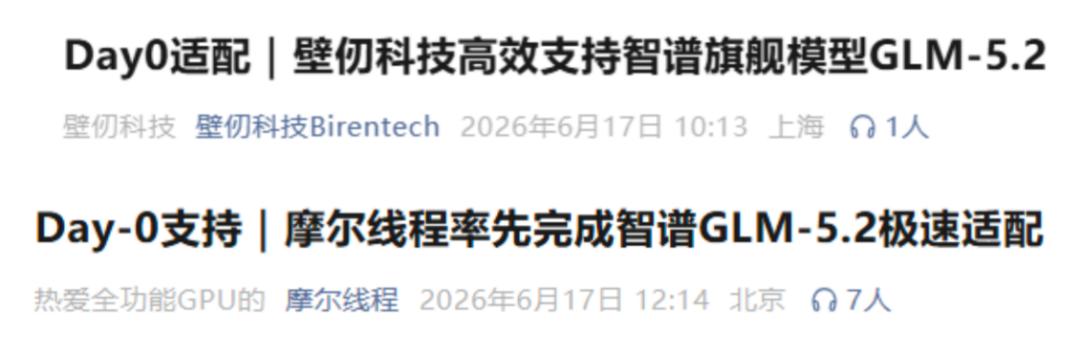
Screenshot from relevant official account tweets
"Day - 0 adaptation" is the key to understanding the competitive landscape of domestic GPUs - it means the model can run on the day of its release. This means that chip manufacturers not only need to have good hardware but also need to keep up with the software stack, toolchain, and developer ecosystem. Biren Technology already has an obvious first - mover advantage in this regard.
More than 20 domestic leading large - models, such as Tencent Hunyuan Hy3 preview, Alibaba Tongyi Qianwen Qwen3.6, DeepSeek full - series models, MiniMax M3, Zhipu GLM full - series, and Kimi, have all completed the Day - 0 level synchronous adaptation with Biren Technology's chips. Among them, DeepSeek is particularly noteworthy. It is reported that Biren completed the full - series adaptation in just a few hours, setting a record for the response speed of domestic chips.
If we put this adaptation list together with ByteDance's supplier list, a clear signal emerges: Biren Technology can now stand in the same line as Huawei and Cambricon.
Huawei has long been firmly in the leading position. The ecological depth and ten - thousand - card cluster capabilities of Ascend are still benchmarks that other domestic manufacturers can hardly reach. Cambricon entered the commercial market earlier and has been stably supplying chips to ByteDance, making it a core player in the big tech companies' computing power supply chain. Biren Technology has obtained an equal position as a new force with national - level certification, capital favor, and large - model ecological layout.
Everything seems to be a natural result.
In May 2026, the country first established an AI chip category in the security and reliability assessment. Nine domestic chips were rated at the highest security and reliability level, Grade I, including Huawei Hisilicon, Alibaba T-Head, Biren Technology, Hygon Information, Daysci, Muxi Co., Ltd., and Moore Threads. In the coordinate system of national - level certification, Biren Technology can stand in the same row as Huawei and Alibaba T-Head.
The capital market's vote is more direct: Biren Technology was listed on the Hong Kong Stock Exchange on January 2nd, 2026, and its stock price soared by 82% at the opening, with its market value once exceeding 100 billion Hong Kong dollars, becoming the first GPU stock in the Hong Kong stock market.
The value of this "circle of friends" lies in that it forms a positive cycle: the more models run on Biren Technology's chips, the more mature its software stack will be; the more mature the software stack is, the faster new models can be adapted; the faster the adaptation is, the more model manufacturers will be willing to choose Biren. This is the "flywheel effect" of the ecosystem.
Of course, Biren Technology is not fighting alone. The entire domestic GPU track is witnessing an arms race around large - model adaptation.
As mentioned before, the ecological depth of Huawei Ascend is hard to match by its peers. This time, Zhipu GLM - 5.2 completed the inference adaptation with Ascend on Day 0. Cambricon completed the Day0 adaptation on the day of the release of DeepSeek - V4. As one of ByteDance's current two GPU suppliers, the influence of its NeuWare software stack continues to expand.
Moore Threads has continuously completed the same - day adaptation of MiniMax M3 and Zhipu GLM - 5.2 since June, and the response speed of its MTT S5000 is no less than that of any competitor.
Enflame Technology is focusing on the cluster direction. It jointly released the commercial version 3.0 of the "Liaoyuan" intelligent computing cluster with Tencent Cloud, which has been adapted to mainstream large - models such as DeepSeek, Tencent Hunyuan, and Zhipu AI, and completed the deployment of thousands - card and ten - thousand - card clusters.
It is also worth mentioning that Enflame Technology passed the review on June 15th. If it goes public smoothly, the "Four Little Dragons of Domestic GPUs" - Moore Threads, Muxi Co., Ltd., Biren Technology, and Enflame Technology - will gather in the capital market for the first time.
03 What Does the End - Game Depend On?
If we only look at single news reports, it's easy to think that it's just a matter of several domestic chip manufacturers competing for orders and headlines. But when we put all the clues together, the logic is completely different.
The golden window period for domestic GPUs has opened, but it won't stay open forever. NVIDIA's next - generation Rubin architecture is on the way. Once the United States relaxes export restrictions on China, the "time - difference" advantage of domestic chips may disappear quickly.
The actions of big tech companies have said it all. ByteDance will invest more than 200 billion yuan in AI infrastructure in 2026, Alibaba's single - quarter capital expenditure exceeds 38 billion yuan, and Tencent will introduce a large amount of domestic computing power in the second half of 2026. All these have turned domestic chips from "spare tires" into "main forces". However, the premise of this systematic replacement is an established ecosystem. Only those who don't fall behind in "Day - 0 adaptation" can get the entry ticket for big tech companies' procurement.
Now, Biren Technology has completed the same - day adaptation of more than 20 leading models, and Cambricon remains on ByteDance's supplier list. The gap in the ecosystem is widening, and the time window for latecomers to catch up is narrowing.
What's even more critical is the computing power cost. ByteDance is still insisting on a 200 - billion - yuan investment in computing power despite a more than 70% decline in net profit, which shows that the entire industry has reached a critical point where cost reduction is a must. The advantage of domestic chips on the inference side is not only security and self - sufficiency but also the ability to save a large amount of money for big tech companies.
For example, the pricing of Daysci's Zhikai series is only 60% - 70% of that of NVIDIA's same - level products. With the increase in production capacity and yield rate, there is still room for further price reduction.
However, beyond the cost advantage, production capacity is the real bottleneck. Domestic GPUs are generally restricted by the production capacity bottleneck of advanced processes. The production schedule of SMIC's N + 2 process is already full of orders from various chip manufacturers.
Policy dividends have opened up the demand - side space, but the ceiling on the supply side determines who can really enjoy the benefits. In May 2026, nine domestic chips were rated at the national highest security and reliability level, and the demand for information technology application innovation soared. However, the delivery ability determines who can cash in on the dividends.
The window period for domestic GPUs won't last forever. Ecosystem, cost, and production capacity are three hurdles in front of all players. Time is limited. When the big tech companies' ten - thousand - card clusters are up and running by the end of the year, the shipment volume will tell who is the filler, the path - maker, and the follower.
This article is from the WeChat official account "Source Media Hub", author: Xie Chunsheng, published by 36Kr with authorization.