How much can Messi earn by scoring a goal in the World Cup?
"They said it was the twilight of the gods in the last World Cup, but it seems only Cristiano Ronaldo took it to heart."
Whose homepage hasn't been flooded with news about the FIFA World Cup 2026 in the United States, Canada, and Mexico?
"Before the games started, everyone waved their hands and said they wouldn't watch. But after the games began, one hot topic after another popped up on the trending list."
Lionel Messi equaled a record, Spain surprisingly drew with Cape Verde, and goalkeeper Wojciech Szczęsny became a legend in one game...
"Now the pressure is on Cristiano Ronaldo."

Source: Weibo topic
But with the latest games over, news came from the front -
Portugal surprisingly drew 1 - 1 with the Democratic Republic of the Congo. 41 - year - old Cristiano Ronaldo started the game, but had zero shots on target throughout...
After the game, Cristiano Ronaldo responded, "We lack nothing. That's football."
Winning and losing are common on the football field, but it still makes many people worry, "Does 41 - year - old Cristiano Ronaldo need a rest?"

Some people also began to wonder if the value of star players with poor performance would be affected if their form continues.
And, how much money can Lionel Messi actually earn for each goal he scores in the World Cup?
After all, on the field, players fight for every second, and the games are intense. Off the field, players' performances are translated into commercial value, and money "flows".
How much are the World Cup bonuses?
The first definite income for participating in a World Cup is the "bonus".
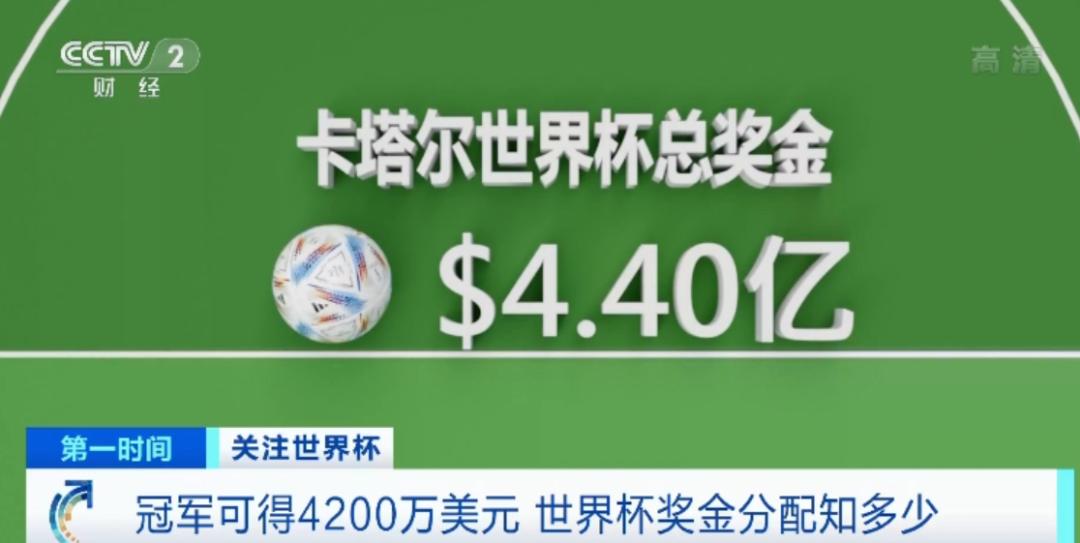
The total bonus for the 2026 FIFA World Cup in the United States, Canada, and Mexico is expected to reach a record high.
At the end of 2025, FIFA announced a plan: Teams participating in the 2026 FIFA World Cup in the United States, Canada, and Mexico will receive a total of $727 million in bonuses and subsidies.
Of course, this is related to the increase in the number of participating teams from 32 to 48.
But it doesn't matter that there are more teams. As long as there are more bonuses.
In April, FIFA announced that it would increase the total bonus pool to $871 million. In comparison, the bonus for the 2022 FIFA World Cup in Qatar was $440 million.
Source: CCTV News
How to distribute so much money? The method is "simple and crude".
All participating teams, whether they are eliminated in the group stage or win the championship in the end, will receive corresponding rewards.
And the better the ranking, the higher the reward.
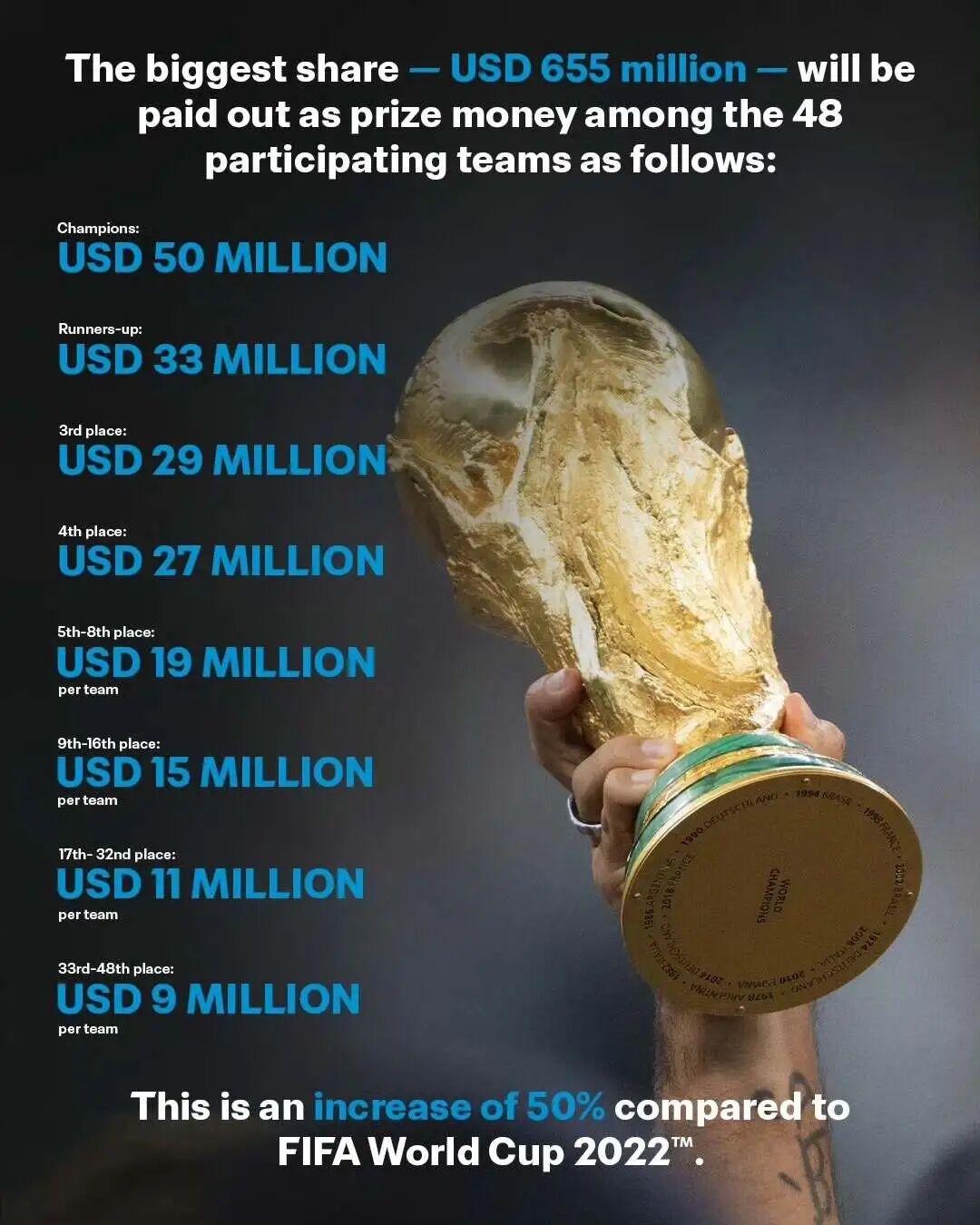
The bonus for the champion team is expected to exceed $50 million, and teams in the group stage will also receive at least $10 million in participation fees - an overall increase compared to the previous World Cup.
In the previous 2022 FIFA World Cup in Qatar, the champion Argentina team received a $42 million bonus, and the runner - up France team received a $30 million bonus.
"Even getting the minimum bonus is enough to support the youth training investment of small and medium - sized football associations such as Cape Verde and Jordan for the next few years."
The bonus mentioned here is not directly equivalent to the players' actual income.
FIFA will pay the bonus in one lump sum to the national or regional football associations to which the teams belong.
How to distribute it specifically is decided by each national football association.
For example, for some champion bonuses, the football association and the team divide it proportionally, with each taking 50%. Then the players' team will conduct a second - round distribution, either equally or in other ways.
Most football associations will deduct a part from the total bonus for the long - term development of football.
Such as the daily operation of the association, the construction of the national team, investment in the youth training system, improvement of infrastructure, subsidies for domestic leagues or clubs, etc.
The retention ratio of the football association often varies from country to country.
In countries with mature football systems, such as Germany and France, where the football associations have sufficient operating funds, they may directly distribute a higher proportion of the bonus to the players and the coaching team.
Some developing football countries tend to retain a larger share for strategic investment.
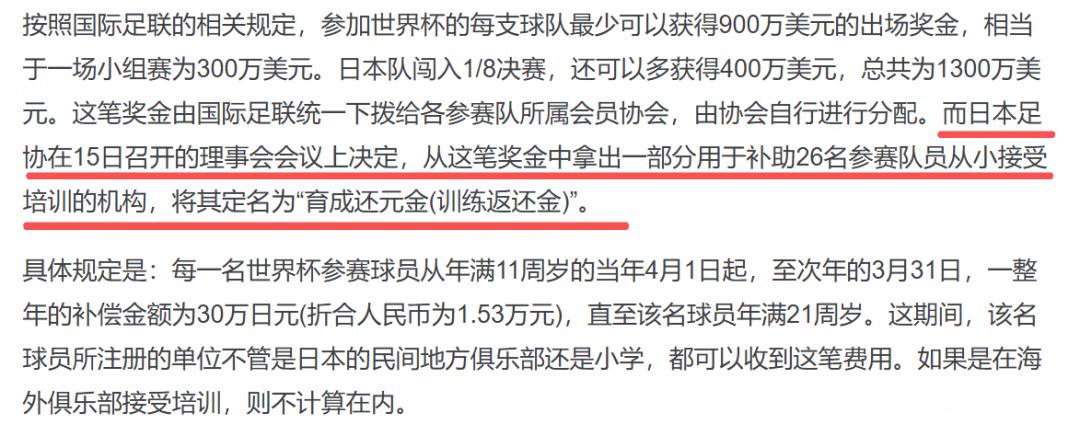
For example, in the 2022 FIFA World Cup in Qatar, the Japanese team advanced to the round of 16 and received a total of $13 million in bonuses from FIFA.
The Japanese Football Association did not distribute all the money directly to the players. Instead, it created a unique distribution mechanism called "Nurturing Return Money".
Source: Sports Network
Regarding the bonus for the players and the coaching team, it is usually fixed in the form of an agreement before the game.
The average distribution model is the most common.
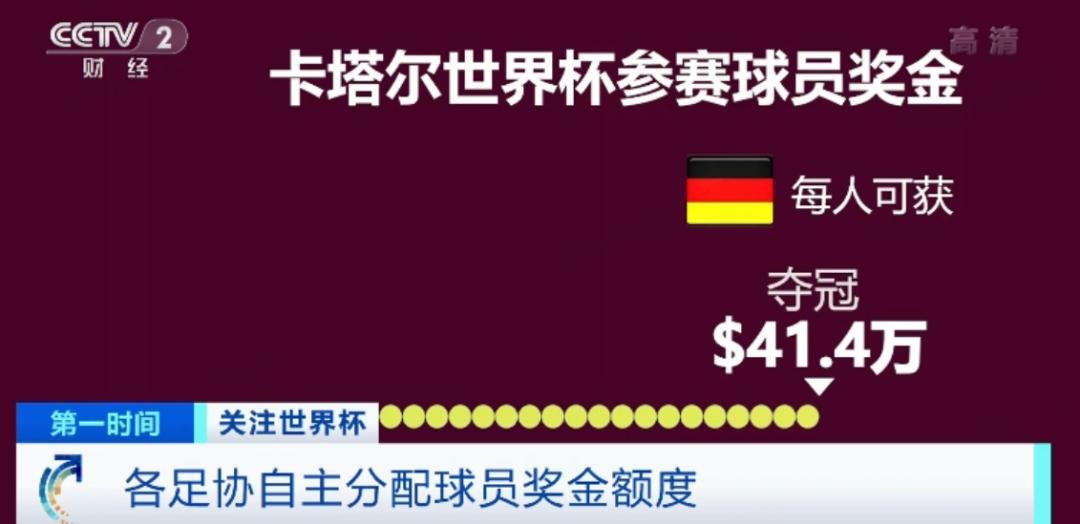
That is, regardless of whether the player is a starter or a substitute, and regardless of the playing time, all 23 participating players (sometimes also including players who did not make the final list but participated in important stages such as the qualifiers) divide the bonus belonging to the player group equally.
The members of the support staff, such as the coaching staff, team doctors, and physiotherapists, also often follow this model or receive rewards according to the pre - agreed proportion.
There is also a distribution model based on contribution.
A few teams will conduct a gradient distribution according to factors such as the players' playing time and contributions (such as goals and assists).
The bonuses for starting players will be higher than those for substitute players. The main idea is "more work, more pay".
Looking back at the bonus distributions of the champions of recent World Cups, we can also see the differences in the distribution methods.
In 2022, the Argentine Football Association reached an agreement with the players and distributed most of the $42 million champion bonus to the players and the coaching team.
In 2018, the French Football Association promised before the game that if they won the championship, each player would receive a €300,000 bonus (this money came from the total bonus).
The specific distribution this year is not yet known, but it is certain that everyone will get a lot from the bonus.

How else can players make money besides the bonus?
Let's go back to the question, "How much money can Lionel Messi earn for each goal he scores in the World Cup?" First, we need to look at the composition of players' income.
Scoring a goal or having other outstanding performances -
For example, the Cape Verdean goalkeeper made 7 saves, keeping a clean sheet - besides helping the team get points, advance, or even win the championship, and thus affecting the bonus, it also directly relates to the player's image and thus affects the commercial value.
For a top - tier star like Lionel Messi, the increase in value brought by excellent performances is relatively limited, but it will definitely have a positive impact on future business cooperation:
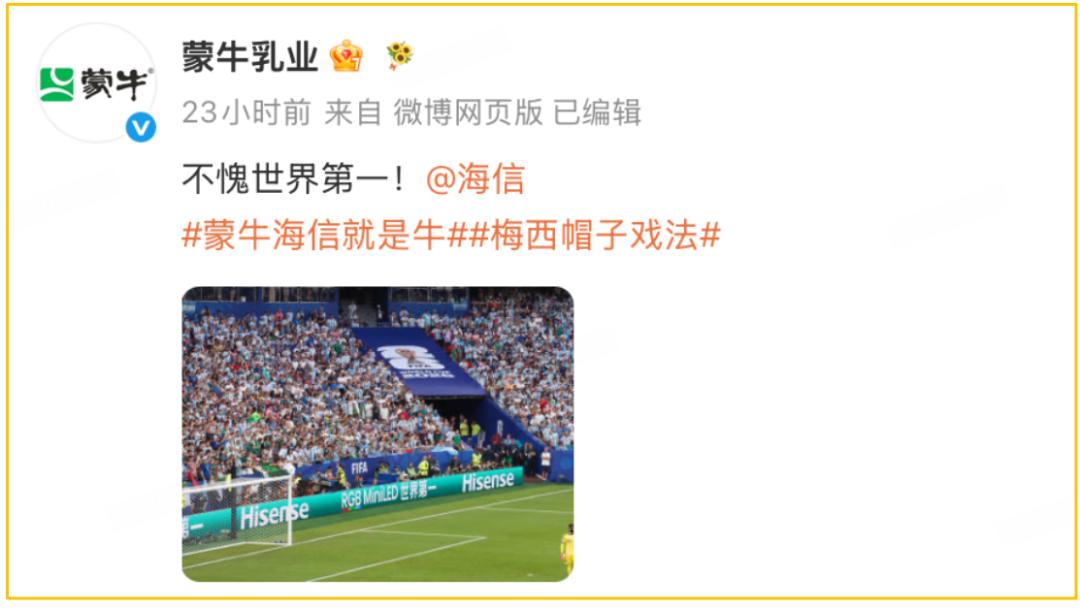
For example, Mengniu, which has signed Lionel Messi, posted four Weibo posts to celebrate after Messi scored a hat - trick.
After all, the bonus income during the World Cup may be just a "small part" for top - tier players.
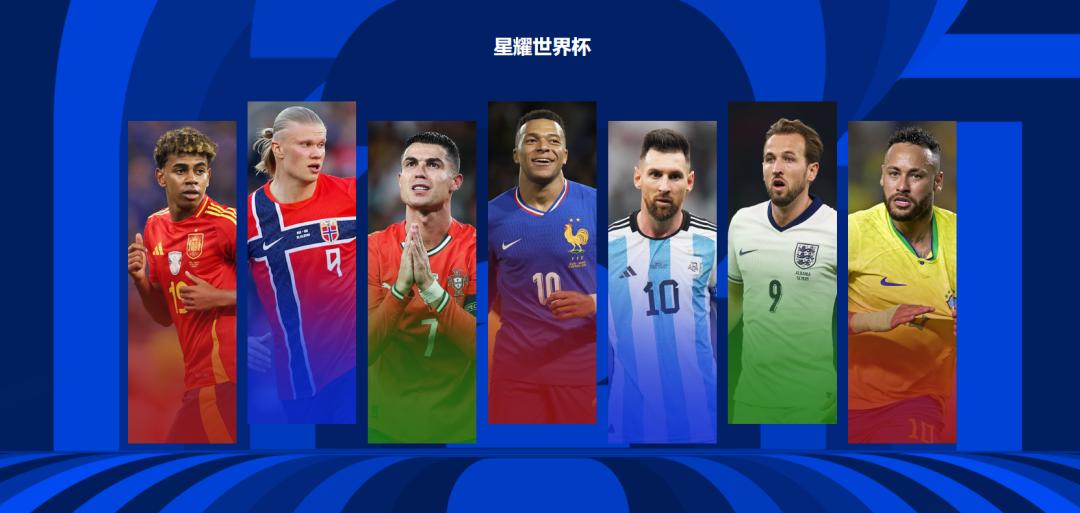
"A World Cup goal, or even an outstanding performance, is enough to raise a player's value from the million - level to the ten - million or even billion - level."
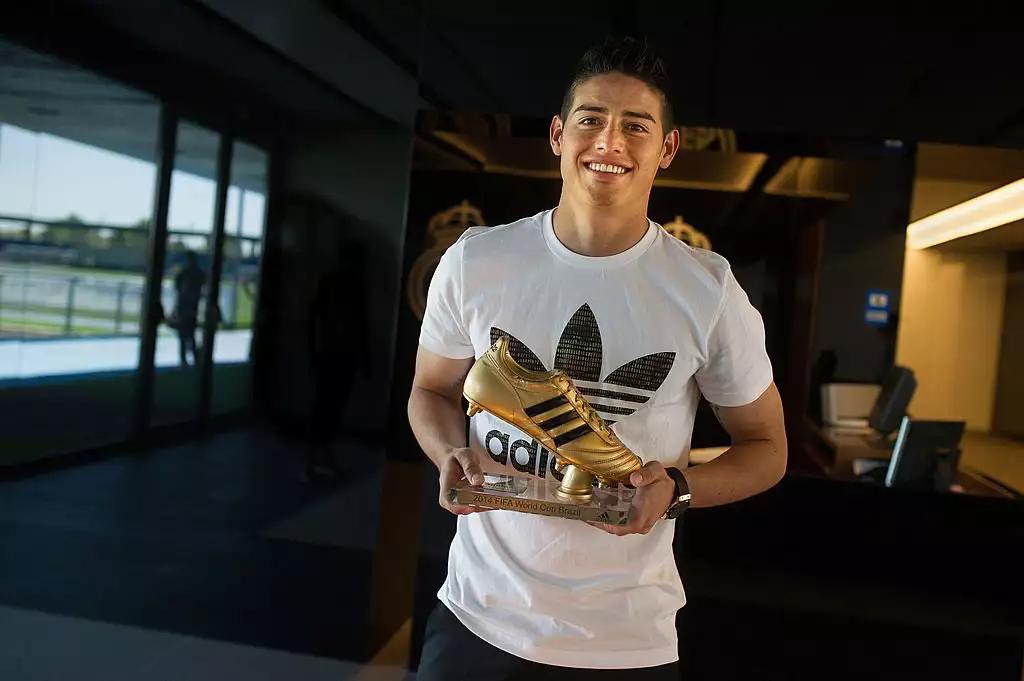
In 2014, 22 - year - old James Rodríguez scored 6 goals in 5 games and won the Golden Boot at the World Cup.
That year, he transferred from Monaco to Real Madrid, and the transfer fee of £71 million was almost twice that when he joined Monaco in 2013.
Source: GIVEMESPORT
Not to mention the commercial value or other values brought by the World Cup to players, which can be seen from various income lists.
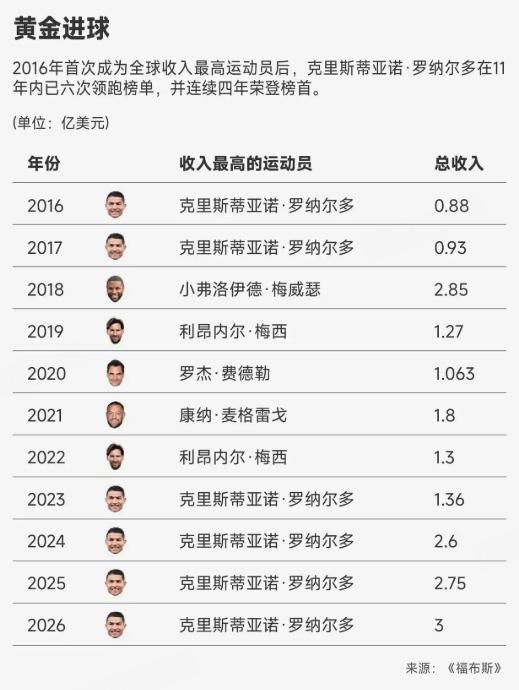
According to the latest global athletes' annual income list released by Forbes, among the top 20, there are 5 football players, and 4 of them will participate in this World Cup.
In the list, the 5 football players are ranked from highest to lowest in terms of income as follows -
Cristiano Ronaldo, $300 million;
Lionel Messi, $140 million;
Kylian Mbappé, $95 million;
Erling Haaland, $80 million;
Lamine Yamal, $43 million.
Source: Forbes China
Specifically, the income of professional players is divided into two parts: on - field salary and bonus, and off - field endorsement, brand cooperation, and investment.
For example, Cristiano Ronaldo, who ranks first in the global athletes' income list.
In the past year, his total income reached $300 million, ranking first in the global athletes' income list for the 4th consecutive year, and this is also the 6th time he has topped this list in his career.
Among them, his on - field income was $235 million, mainly from his contract with Al Nassr FC in Saudi Arabia.
Calculated, Cristiano Ronaldo earned more than $640,000 per day on average in that year, and nearly $447 per minute.
His off - field income reached $65 million, covering commercial endorsements, commercial appearances, image licensing, and derivative businesses.
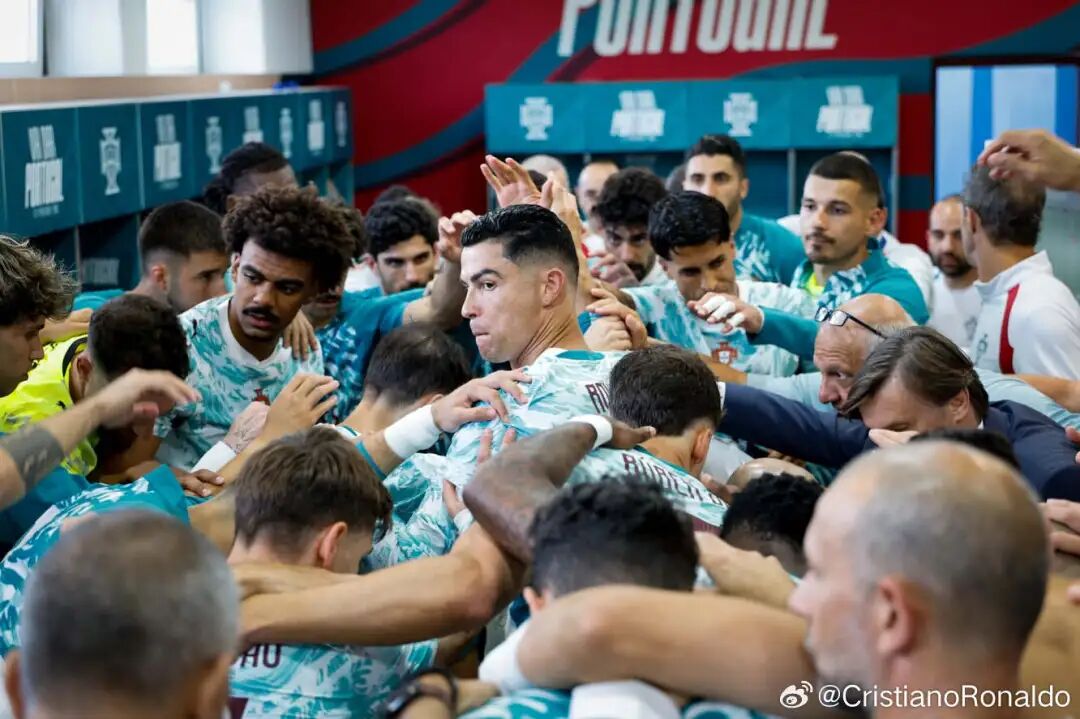
Source: Cristiano Ronaldo's Weibo
Lionel Messi, who is participating in the World Cup for the 6th time, has a more balanced income structure in comparison.
As the soul and tactical core of the Argentine team, Lionel Messi's total income in the past year reached $140 million, ranking third in the Forbes global athletes' income list.
Among them, his on - field and off - field incomes were both $70 million.
Although his guaranteed annual salary at Inter Miami CF in the United States is only $28.3 million, the contract includes a number of long - term rights and interests.
For example, the exclusive revenue - sharing agreements between Major League Soccer and platforms such as Adidas and Apple TV have significantly increased the actual value of the contract.
Lionel Messi is also one of the most favored partners of major brands.
In April this year, Lionel Messi completed