Behind the $300 million financing and $2 billion valuation, China's AI application field has for the first time successfully produced a mature "product matrix".
Over the past year, the narrative focus of the AI industry has been centered on models.
From OpenAI, Anthropic to DeepSeek, large model companies have captured the vast majority of public attention. Meanwhile, another commercialization path is emerging rapidly — AI applications.
Recently, Evoken, the parent company of LiblibAI, has completed nearly 300 million US dollars in Series B+ financing, with a post-money valuation exceeding 2 billion US dollars — this is also the largest single round of financing for Chinese AI application companies to date.
This round of financing was jointly led by Granite Asia, Tencent and Shunwei Capital, with joint participation from HT Investment and Vision Capital. Existing shareholders including Gaorong Capital, Ant Group, Decheng Capital, Matrix Partners China, Source Code Capital, HSG and several other well-known investment institutions have continued to increase their holdings to support the company.
Compared with the financing figure, another set of data is more noteworthy: As of May 2026, Evoken's ARR has reached 300 million US dollars, nearly tripling from the completion of this round of financing.
In China, this is one of the few AI application startups that have entered the "100-million-level ARR" club outside of large tech giants.
This means that Evoken's revenue growth leverage is not a single product that accidentally exploded, but is built on the basis of successfully verifying PMF for multiple AI products in a row.
Looking back at the evolution of the AI industry over the past three years, we can clearly see the three most important application waves: image generation, Agent, and video generation. Evoken has launched its representative work in almost every cycle:
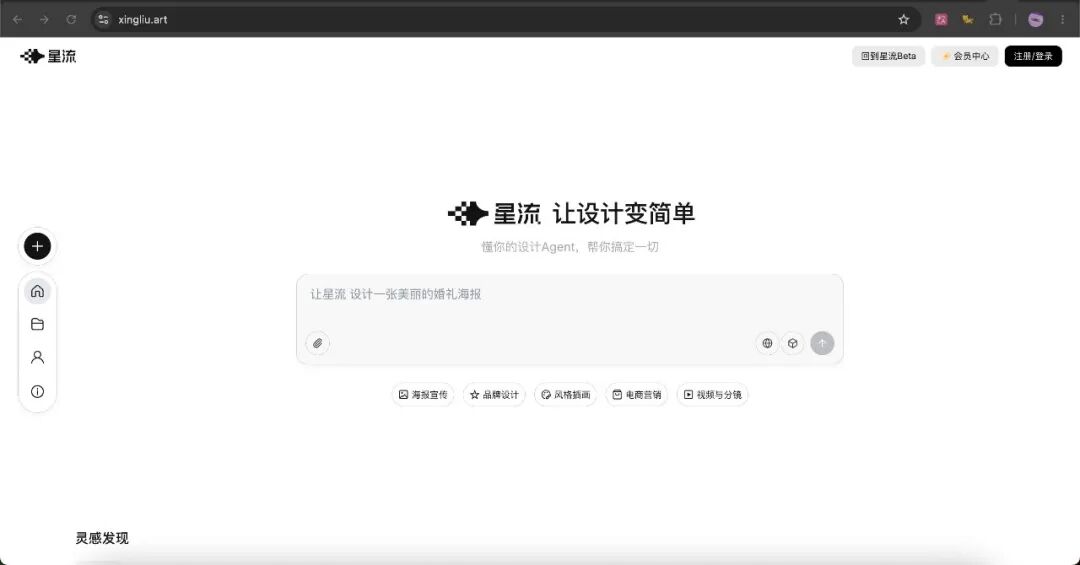
LiblibAI, an AI creator community launched in 2023, has accumulated more than 30 million users. One in every three designers in China is an active user of LiblibAI; Xingliu, an AI design Agent released in July 2025, has served tens of millions of users in total.
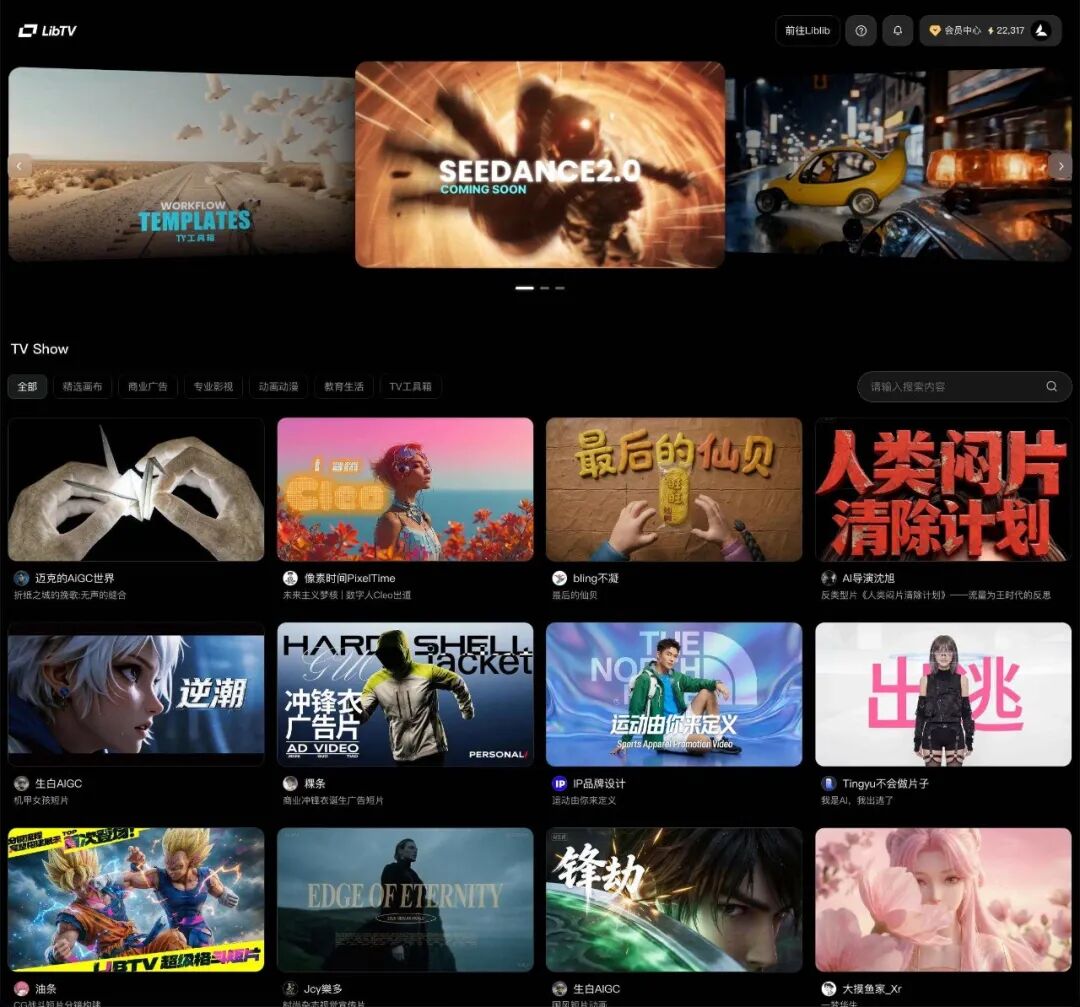
LibTV, an AI video creation platform launched in February 2026, has refreshed the speed of self-sustainability of domestic AI applications — In the first month of launch, LibTV's single-day revenue exceeded 1 million US dollars; two months after launch, the product's revenue increased by more than 13 times.
While the industry is still discussing how to find AI PMF, this company has already begun to answer a more realistic question: How exactly can AI become a viable business?
From LiblibAI to Xingliu, and then to LibTV, what this company is trying to build may not be just a single hit application, but the first AI content matrix in China.
With three products, becoming one of the most profitable AI companies in China
The AI industry never lacks hit products, but lacks companies that can continuously produce hit products.
A large number of star products have been born in the AI industry over the past three years, but most companies are still stuck in the stage of "only one super product". For example, Cursor is labeled as AI Coding, and Suno is labeled as AI Music — there is no doubt that these products have achieved great success, but up to now, these super products still bear the main pressure of generating revenue for their parent companies.
This actually stems from a dilemma: most AI companies can find one PMF, but do not have the ability to replicate PMF continuously. For example, Character.AI has tried multiple directions such as communities, Agents, and games, but the label that people always remember is still "AI character companionship", and the second growth curve is not easy to establish.
In contrast, from LiblibAI to Xingliu, and then to LibTV, Evoken has almost fully experienced the three technology cycles of image generation, Agent and video generation:
In 2023, as Midjourney and Stable Diffusion brought AI image generation to the public eye, a large number of startups began to pour into this track. LiblibAI launched by Evoken chose to cut in from the creator community and model ecosystem, filling the gap of the "shovel seller" for domestic multimodal models.

Subsequently, AI applications entered the Agent era. Represented by Manus, the industry began to explore how to enable AI to move further from "generating content" to "completing tasks". At this stage, Evoken launched Xingliu, the AI design Agent.
This year, with the release of high-performance video models such as Seedance 2.0 and Kling 3.1, as well as the rapid growth of the downstream short comic drama market, Evoken quickly launched LibTV, taking the lead in establishing the mindset of "delivering finished films" among downstream customers in the video generation track that emphasizes "single shot" generation.
For the AI industry, successfully verifying PMF once proves product capability; successfully verifying PMF three times in a row proves organizational capability even more.
One of the methodologies of the Evoken team is to discover opportunities brought about by changes in model capabilities earlier than others. Chen Mian, founder of Evoken, once summarized it as two things in an interview: first, closely follow model iterations; second, the team has internally aligned an assumption: models are getting stronger, but in the short term they are more like humans, and have not yet surpassed humans.

△ Chen Mian, Founder of Evoken
In his view, the required course for application-layer companies is "how to leverage cutting-edge models", that is, to make good use of the latest models in the shortest possible time. Compared with model companies that focus on capability boundaries, application companies care more about capability inflection points: when a model acquires a new capability, what problems that could not be solved in the past can be addressed? What new interaction methods will be spawned? Which workflows will be reconstructed?
The birth of Xingliu is a typical case.
Before the launch of high-performance image generation models such as GPT-Image-1, the Evoken team judged that model manufacturers were focusing on solving problems such as complex multi-turn instruction understanding, consistency control, and editing capabilities.
If these problems are solved, the core interaction method of design software may change — users no longer need to learn complex toolchains, but collaborate continuously with AI through natural language to complete designs. Based on this judgment, the team bet on the "ChatCanvas" product form in advance for Xingliu.
However, merely understanding technological changes is not enough. Over the past few years, a large number of AI startups have been keenly aware of model progress, but may not be able to translate technical advantages into real demand. Compared with discovering technical opportunities, identifying market opportunities is often more difficult.
The second capability of Evoken is to decompose, reconstruct downstream demands, and finally turn them into products.
LibTV is an application born at the intersection of model capabilities and downstream demands. From the outside world, the core problem of the video generation track is whether the shots are beautiful and whether the understanding is accurate. But after communicating with a large number of customers, the team found that what short comic drama teams, MCN institutions and advertising companies really lack is not single-shot generation capability, but complete content production capability.
Only by integrating into the entire production chain and helping customers deliver finished works can real commercial value be created. Therefore, LibTV has not targeted the video generation model itself from the very beginning, but the video production workflow.
This idea has actually run through Evoken's product development path over the past few years: LiblibAI solves the problem of creators acquiring and managing AI materials; Xingliu solves the problem of the design workflow for human-AI collaboration; LibTV solves the problem of finished film delivery.
On the surface, they belong to different tracks, but they follow the same logic behind them: do not look for the strongest part of the model, but look for the links in the industrial chain that most need to be reconstructed.
And this may also be one of the most important rules for AI application entrepreneurship: in a high-growth incremental market, the most important thing is not to be unconventional, but to do the right thing at the right time.
China's AI Applications Are Beginning to Enter the "Group Warfare" Era
At the beginning of 2026, the popularity of AI remains, but many "hit products" have been declared "dead". According to statistics from AI Graveyard, 392 AI tools around the world stopped service in 2025. This means that on average, one AI product died every day over the past year.
The most stunning "sudden death" came from AI giant OpenAI. On March 25, 2026, OpenAI announced the removal of the Sora application — this hit product whose download volume exceeded 10 million as soon as it was released, only survived for 25 months.
As Bryan Kim, partner of a16z, said: "There is no moat at all in the consumer AI sector." A clear signal is: The narrative of relying on a single hit product is becoming outdated.
The rapid iteration of model capabilities is swallowing up AI applications. At the same time, the iteration of coding capabilities has rapidly reduced the cost of replicating hit products. This leads to a shorter lifecycle of hit AI applications, intensified competition at the product level, and a corresponding rise in customer acquisition costs — according to feedback from some practitioners, the average customer acquisition cost (CAC) of AI products was 20 to 30 yuan in 2024; now, the figure has risen to 100 yuan.
In this context, "collectivization" has begun to become a new way for AI enterprises to build moats.
Compared with a single product, a multi-product matrix has stronger commercial risk resistance. More importantly, collectivization means that enterprises no longer compete for a certain tool track, but for the ecological niche of the industry. For latecomers, replicating a product may not be difficult, but replicating an ecosystem composed of multiple products, tens of millions of users and a complete business system is far more difficult.
Evoken is one of the first batches of AI application companies in China to enter the stage of "group-based operations".
Let's first look at the horizontal product matrix. From LiblibAI to Xingliu, and then to LibTV, Evoken's product evolution has a clear main line: creative content delivery that spans AI technology cycles.
This means that the users of the three products are highly overlapping, and compared with single-point products scattered in different scenarios, they can realize the sharing of users, data and commercial capabilities.
For example, image creators in the LiblibAI community may need a design Agent to further assist their creation; image creators may then be converted into video creators — different products serve as traffic entrances for each other, naturally extending the user lifecycle.
Then look at the vertical content industry ecosystem. From LiblibAI providing creative inspiration and material generation, to Xingliu and LibTV delivering visual design, Evoken's multiple products together form a complete content production chain.
In particular, LibTV, which took the lead in proposing the "dual entrance of users and Agents", is not just a product designed for humans, but more like building infrastructure for the Agent era. As AI moves from "answering questions" to "completing work", more and more content production links will be encapsulated into callable capability modules, and video generation is the most core part among them.
In other words, LibTV today serves creators, and LibTV in the future may serve Agents. When more and more Agents begin to participate in creative and content workflows, whoever masters the key production capabilities such as image, video and design will have the opportunity to become an important entrance to the next-generation content ecosystem.
In business history, it is not uncommon for companies to become bloated in organization and deformed in action as their business expands. When an enterprise that is only 3 years old quickly grows into a "group", the tests its organization faces are becoming more and more severe: How to improve organizational efficiency? How to maintain accurate decision-making?
Evoken's core answer is: speed.
In public interviews, Chen Mian once mentioned: "Speed is the scarcest moat in an era of frequent model updates and short product lifecycles." For example, 36Kr learned that LibTV only took 1 month from project initiation, user interviews, R&D to final launch.
Behind the speed is an organization built around creative content products. Chen Mian described Evoken's organization as "no product managers, only designers" and "only 'people who teach AI'".
The logic behind this employee profile is that "when tools are intelligent enough, 'people who manage demands' are no longer needed, but 'people who define demands' become more important" — simply put, "industry Know-How" will become the core asset of the team.
Placed in the coordinate system of global AI application companies, Evoken's valuation logic may need to be re-examined.
From the simplest perspective of PS (Price-to-Sales Ratio), Evoken is in an obvious valuation depression globally. A typical comparison is: Suno, an AI music creation tool founded in the United States, reached an ARR of 300 million US dollars in March 2026, corresponding to a valuation of 5.4 billion US dollars; while Evoken, which has the same ARR volume, has a post-financing valuation of only about 2 billion US dollars, less than half of Suno's.
In terms of revenue scale, growth rate and commercial capability, the two have entered the same magnitude, but there is a significant gap in the pricing given by the market.
But what is more noteworthy may not be the PS itself, but the fact that the valuation system for AI application companies is changing.
Over the past two decades, the capital market has been accustomed to measuring software enterprises with the logic of SaaS companies: software is just a tool, and it is the people who use the tools that truly create value. Therefore, the valuation of an enterprise ultimately depends on indicators such as subscription revenue, number of customers and renewal rate.
However, in the AI era, the role of tools is undergoing fundamental changes. As Chen Mian said: "We cannot use the thinking of the tool era to understand the tools of the AI era. The essence of SaaS is that services are provided by people, and people use tools. But now, AI has become the main body that provides services."
Therefore, The value anchor point of AI applications is shifting from "software seats" to "labor seats".
In the past, enterprises purchased software, but in the future, enterprises will purchase a digital employee that can continuously deliver results. The criteria for measuring an AI company will gradually shift from how many tools it sells to how much work it undertakes and how much productivity it creates.
In this sense, Evoken's value should not be simply regarded as an AI tool company. The AI content creation matrix it builds is essentially reconstructing the production mode of the content industry.
When the market begins to measure AI applications by "digital labor" instead of "software tools", Evoken's 2 billion US dollar valuation may well be just the beginning.