SpaceX wants to turn space computing power from science fiction into reality, but is it cost-effective?
On June 12th, SpaceX went public on the NASDAQ at an issue price of $135 per share, raising $75 billion in funds and setting the largest IPO record in human history. In its 280 - page prospectus, SpaceX estimated the total potential market to be as high as $28.5 trillion, with over 90% coming from the AI sector. However, this part will be severely restricted by "the Earth's inability to rapidly expand its power - generation capacity."
Facing the power shortage, SpaceX's answer is to move data centers into space. On the eve of its listing, Elon Musk said in a video about the design sketch of the AI - 1 satellite that AI satellites don't require any miraculous technology, as these technologies have already been implemented in the Starlink V3 satellites. When it comes to the timeline, Musk estimated that SpaceX will achieve an annual deployment rate of 1GW of space AI computing power by the end of 2027 and will increase the scale year by year.
Is this just a story for the IPO, or is it the real direction for the next - generation computing infrastructure? Can a space data center be technically realized? Even if it can be built, is it really more cost - effective than building one on the ground?

In this episode of "Silicon Valley 101", we invited Lewis Hong, a partner at Aris Fund and a former SpaceX executive, and rocket enthusiast Liu Bingyan to discuss the challenges faced by space data centers one by one.
Let's start with a math problem: 1 gigawatt of space computing power means sending approximately 10,000 AI satellites into space, which is equivalent to at least 100 launches of the Starship. Only when the launch cost of the Starship drops below $200 per kilogram can this be barely cost - effective. The reduction of cost depends on the iteration of the Starship itself, the improvement of the recovery level, and large - scale operations.
After calculating the launch cost, let's break down those inevitable physical problems one by one:
- Space heat dissipation - Why is it so difficult to dissipate heat in space even though it's so cold? By deriving from the black - body radiation formula, we can find that the key to heat dissipation lies in utilizing "heat" itself.
- Cosmic radiation - What's the risk of a satellite full of GPUs being hit by high - energy particles in space? Will it affect the stability of computing power?
- Debris impact - When the density of satellites in orbit exceeds the critical point, will a single impact trigger a chain reaction? Is the Kessler effect just science fiction or a real threat that has been overlooked?
Finally, we talked about the lunar exploration program that was restarted after being put on hold for half a century, the permanent lunar base in 2030, and the completely different underlying concepts of the "Lunar Faction" and the "Martian Faction". This discussion about sending computing power into space ultimately points to the rationality and romance of human space exploration.
The following is a selection of the content of this conversation:
01 What does it mean to send 1 gigawatt of computing power into space?
Hong Jun: Before recording this podcast, Lewis just went to the SpaceX headquarters with Chen Qian from our video team and also visited the newly - built SpaceX launch base. Do you want to share your impressions of this visit?
Lewis: If you're visiting Los Angeles, you should definitely visit the SpaceX headquarters. There's the world's first recovered rocket there, which was successfully launched and landed on December 21st, 2015. SpaceX spent a great deal of effort transporting it from Florida back to Los Angeles. It's a very meaningful landmark.
This was my second visit to the Starship base with Chen Qian. The first time was in 2018 when the base was just starting out and was still a desolate place.
Hong Jun: After eight years, what do you think has changed compared to 2018? I remember you once said that the conditions were extremely tough when you went there in 2018, and they basically built a rocket launch pad from scratch.
Lewis: You're right. At that time, it was really in the middle of a jungle. People worked in tents during the day and employees lived in campers nearby. There were all kinds of strange wild animals like big spiders and vultures around.
This time when I went, the entire base had been built. The new SpaceX headquarters building and all the sub - component assembly facilities were completed. There are also two large MegaBays, and there are probably countless Tesla Cybertrucks parked there, giving it a very futuristic feel. I even don't know which smart person reserved a location for a "Mars Embassy" there, and there are a lot of activities going on.
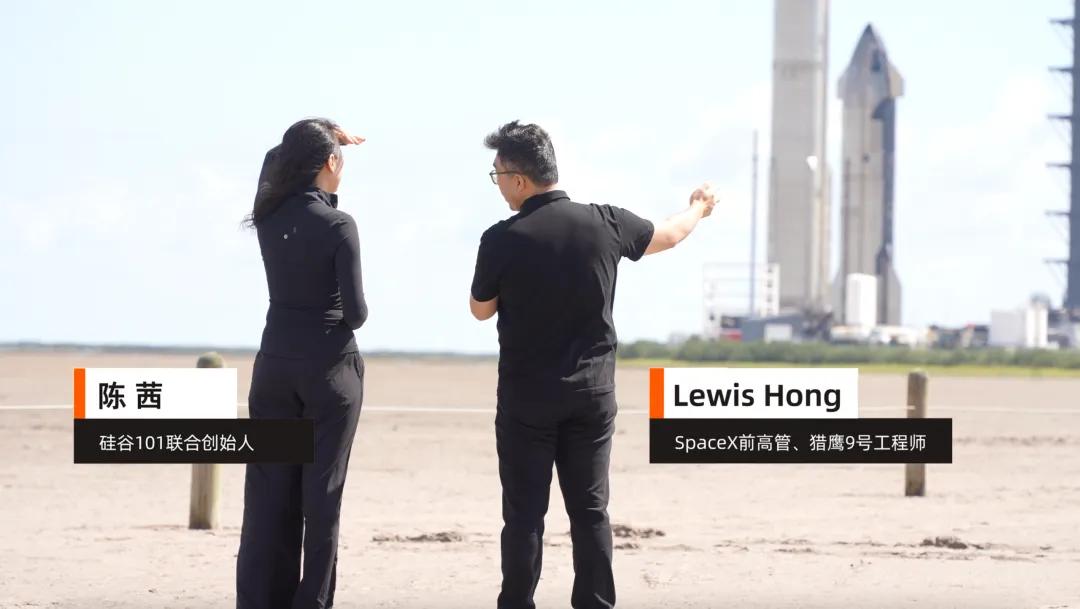
Lewis and Chen Qian visit Starbase
Hong Jun: When you were standing there, by the Starship launch site, were there any details that suddenly came to your mind?
Lewis: As we all know, the Starship and the operation area are huge, about 40 stories high. But it's not until you stand in front of it and actually feel it that you realize how big it is. SpaceX is going to mass - produce such a huge rocket and building. This is what impressed me the most. People think this IPO is a milestone, but for SpaceX, it's just a to - do item. There's still a lot to do tomorrow, and there are many things to be developed in the next two or three decades. It's very exciting.
Hong Jun: Has anyone read SpaceX's prospectus? Are there any highlights that you're particularly interested in?
Lewis: I think it's quite in line with Elon and SpaceX's long - standing positioning of "pushing the limits". People may focus more on the timing and execution details, but I'm not surprised by the general direction. This is a brand - new computing platform, and Starlink is the first application. You can imagine that all kinds of computing things on the ground can be re - created in space, and there are some unique advantages in space.
Liu Bingyan: Developing a new platform in space can reduce the cost to a fraction of the original. The value is definitely there, and the direction is definitely right. But I'm skeptical about the timing. You know, it's "Elon time".
Lewis: But "Elon time" is becoming more regular now. We know many people who work at SpaceX and haven't left, so we regularly check some points with the people actually doing the work there. Of course, Elon is quite optimistic, but the difference isn't that big. The first goal is to send 1 Gigawatt into space, which is considered a milestone by all insiders. I think the plan to support it is quite specific.
Hong Jun: What does it mean to send 1 Gigawatt into space?
Lewis: Currently, the internal design baseline at SpaceX is to use 100 kilowatts per satellite as the standard unit. To achieve 1 gigawatt, approximately 10,000 satellites are needed.
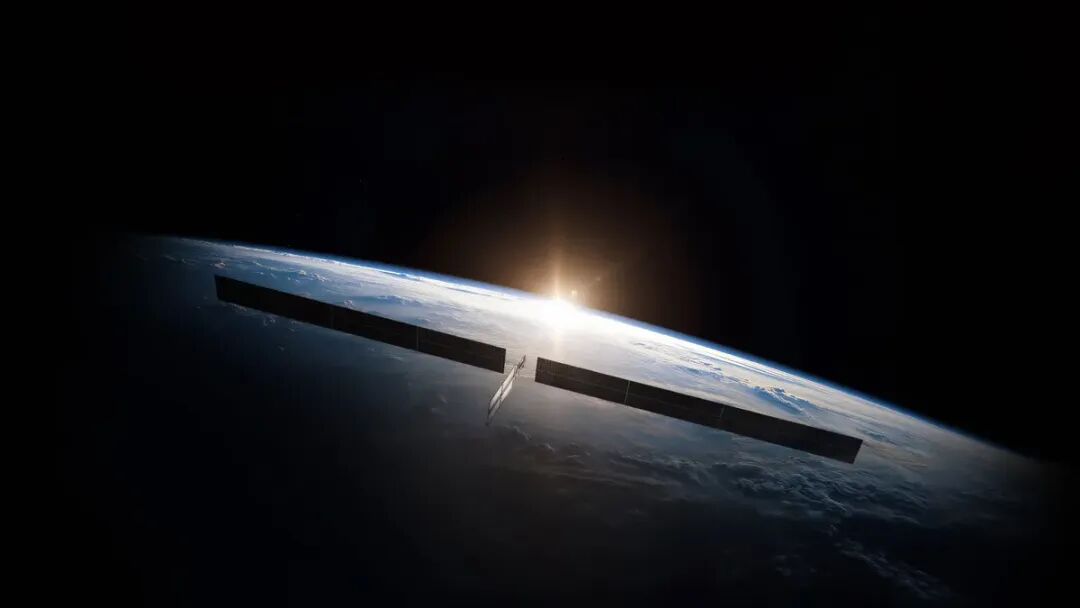
Rendering of the AI - 1 satellite planned by SpaceX. Image source: SpaceX
Liu Bingyan: I think it's not just a computing device. The largest part is the energy device, which may take up the most space in terms of area and other aspects. It probably requires about 1 million square meters of solar panels, which is also the most spectacular part. Leaving a safety margin of at least dozens of kilometers between two satellites, if you calculate roughly, with an orbital circumference of 40,000 kilometers and 10,000 satellites, it will basically occupy an entire orbit.
Hong Jun: I noticed that the satellite orbit Musk mentioned isn't just an ordinary low - Earth orbit. He wants to save the most energy, so he's actually talking about a dawn - dusk orbit, which means the satellite always flies along the Earth's terminator, so it's always facing the sun, and it's only blocked by the Earth for at most 35 minutes a day. This is the most efficient orbit he imagines.
Liu Bingyan: This orbit is a relatively rare resource. Among the orbits that are not too far from the Earth that we can access, it's still very limited.
Hong Jun: I'm quite surprised that filling an entire dawn - dusk orbit with 10,000 satellites can only generate 1 gigawatt of electricity.
Liu Bingyan: But perhaps some satellites are designed to have a long lifespan and are sent to very high orbits, or they carry some batteries so that they can still work on the dark side. With some adjustments, there's still room.
Hong Jun: When do they plan to start and finish sending 1 gigawatt of computing power into space?
Lewis: This is the hottest topic right now. How many launches does SpaceX need to conduct to produce 10,000 satellites? If we follow the new 100 - kilowatt data center, which they internally call "AI mini", one launch of the Starship can carry about 100 satellites (each weighing about 1 ton). That's roughly the framework. So we need 100 launches of the Starship to reach the scale of 1 gigawatt.
Hong Jun: How many times does the Starship launch in a year now? I remember it was in single digits last year.
Lewis: Yes, but the number is increasing. It's still in the development stage, and each launch is specifically designed for iteration. The Starship has now advanced to its third version. The Falcon 9 advanced to its fifth version before reaching its current lift - off mass and launch frequency. I think the Starship will follow a similar path. The third version will test some extreme conditions, such as landing, and start transporting some things into space. Looking back at 2018 and 2019, the number of Falcon 9 launches per year basically increased exponentially.
So 100 launches may sound like an impossible task. Maybe there will be 5 launches this year, 10 next year, but what about the year after? Maybe it will be a benchmark of 50 launches, and the year after that, it may not be 100 launches but hundreds.
If you compare the progress of the Starship with that of the Falcon 9, the Falcon 9 took about 10 years to reach its current stage, while the Starship has reached this progress in 5 years. To predict the future of the Starship, I think the entire process will be even shorter than that of the Falcon 9.
Regarding when it will reach 1 gigawatt, I personally think 2028 is a bit optimistic. If I were to bet, I'd bet that they can launch the Starship 100 times in 2029, and SpaceX can achieve a 1 - gigawatt space data center in 2029. It's definitely possible in 2030, but I'd bet on 2029.
Hong Jun: This bet is quite bold.
Liu Bingyan: Your assumption is based on the premise that the space data center product has been finalized so that large - scale launches can be carried out. But all your previous assumptions are based on the rocket reaching that level. Isn't there a gap in between?
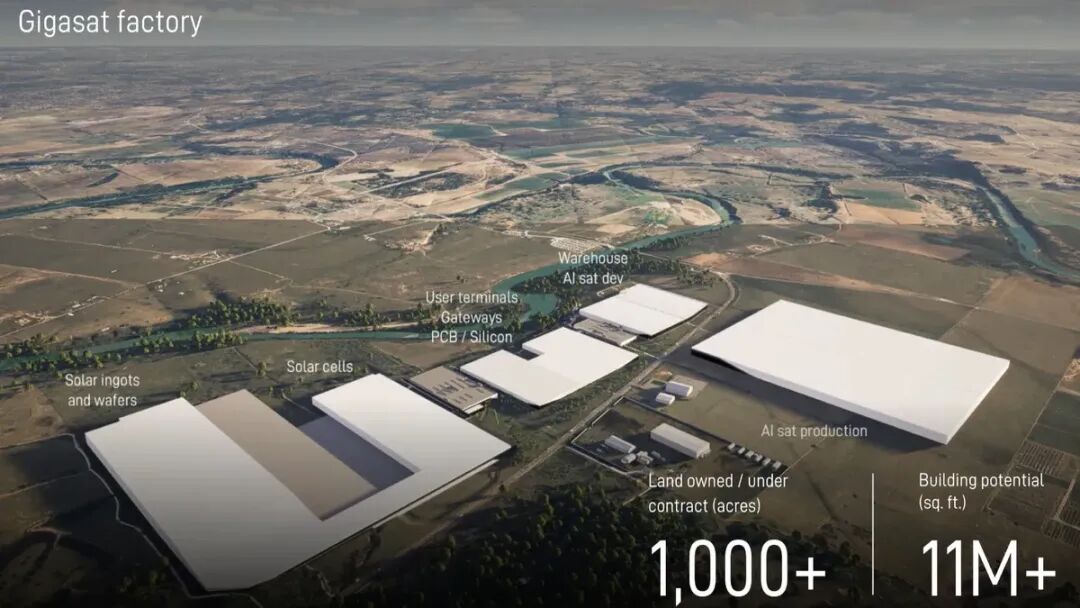
Rendering of the "Gigasat" factory planned by SpaceX for mass - producing AI data center satellites. Image source: SpaceX
Lewis: Actually, there are only three aspects. The first is the launch, which is the most direct one currently. The second is the satellite itself. Comparing with Starlink, it took 5 years to increase its carrying capacity by 50 times and reduce the unit cost by 5 times, and it's almost at its final version. I think a large part of the experience learned from Starlink will be applied to the so - called AI mini. There are also two relatively big problems now: How to set up such a large - scale solar power - generation structure? And more importantly, how to deal with the radiator that everyone is worried about? I think these things are being promoted simultaneously.
Liu Bingyan: This is what I'm worried about. If you're betting on 100 Starlink launches, I believe it. But for a 1 - gigawatt data center, I think it's still a long way off. I wouldn't even bet on when it will happen. I actually don't see the necessity of this.
02 Sending 10,000 AI satellites into space: A major challenge for Starship launch cost
Hong Jun: I think we can break down the problem of the space data center. Let's look at the details of the difficulties of the space data center. Just now, Lewis mentioned that the Starship can achieve 100 launches in 2029 and 2030. Actually, this is from the perspective of sending satellites into space. But we not only need to consider whether it can send them up but also the cost of building it in space, how to handle energy and heat dissipation, how to deal with space radiation, how to repair the data center if it breaks down... Finally, assuming it's all built, how to deal with the Kessler effect, that is, the risk of a chain reaction of satellite debris collisions. I think we can break these problems down and discuss them one by one.
Let's start with the cost that everyone is most concerned about. Currently, according to the data released by NVIDIA, the cost of building a 1 - gigawatt data center on the ground is about $50 billion. Among this $50 billion, about 50% or even more than 60% of the cost is mainly due to GPUs. Electricity is not the major cost, but it's currently in short supply on the ground.
So, to build a 1GW data center in space with 100 Starship launches, let's first see how high the launch cost is?
Liu Bingyan: In terms of pure cost, it's not very expensive. And if the Starship can use a stainless - steel rocket and is fully reusable, the main cost will be fuel. So, a very interesting calculation is how long it takes for the fuel needed to send a solar panel into space to be paid back by the electricity it generates? After calculation, this figure is about two months. (Note: This assumption is based on the power - generation efficiency of a 500W/kg solar panel and a rocket efficiency of about 40%.)
Since our premise is that there's almost free electricity in space, which can generate electricity at five times the efficiency of solar power on the ground. So, on the premise