Spending 8.1 billion yuan to buy back its autonomy, Pizza Hut must travel light.
On June 16th, Yum China bought out the ownership of the Pizza Hut brand in mainland China from its parent company, Yum! Brands, for $1.2 billion in cash.
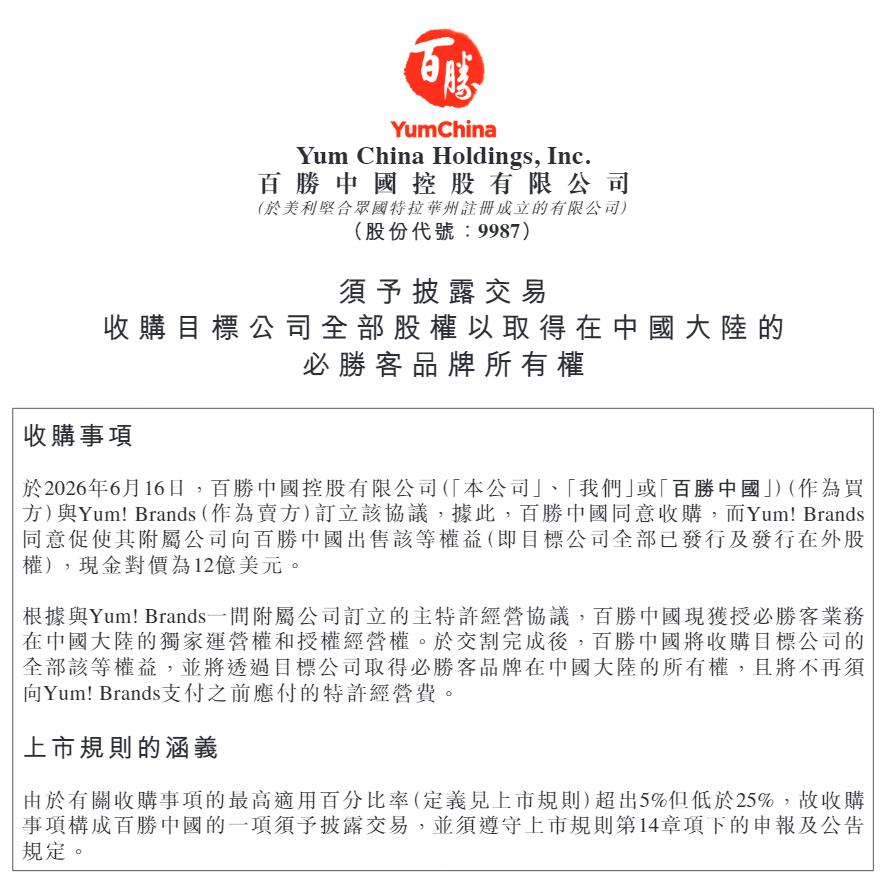
On paper, this is a cost - effective deal: Yum China no longer has to pay the annual franchise fee of nearly 500 million yuan and can have full autonomy in menu, stores, and operations. Yum! Brands' calculation is also straightforward - it gets a lump sum of cash and gets rid of the operational complexity in the Chinese market; Yum China obtains the right to define the brand and is no longer restricted by the headquarters' style. Each side gets what it wants.
However, what really deserves attention in this deal is not the price, but the timing.
The pizza market in China is undergoing a rapid reshuffle. In the eyes of analysts, the total market volume is increasing. It reached 48 billion yuan in 2024 and is expected to exceed 77 billion yuan in 2027 - but the money is not evenly distributed. A three - tiered structure featuring efficient takeaways, mid - priced products, and affordable options for the lower - tier markets is rapidly taking shape, and players are vying for positions in each tier.
As the creator and the largest player in this market, Pizza Hut has a market share of over 30%, leading by a large margin. But precisely because of this position, it is facing pressure from three directions.
Buying out the brand ownership for $1.2 billion is not just about saving the franchise fee. More importantly, it gets a ticket to "redefine itself". In a market that is being segmented, this is more valuable than ever.
1. The Three - Tiered Differentiation of the Pizza Market
Pizza Hut entered the Chinese market in 1990. For a long time after that, "eating at Pizza Hut" was almost equivalent to "eating pizza" - the brand became synonymous with the category, and Pizza Hut defined all the imaginations of Chinese consumers about this category: with an average per - capita consumption of about 100 yuan, it was the standard choice for Western dinners, birthday parties, and business banquets.
This situation began to change around 2015 and accelerated after 2020.
The logic behind this is not complicated. Once the penetration rate of takeaways increases, the sense of ceremony of dining in a restaurant is no longer automatically valuable. If pizza can be delivered to your home in 30 minutes, who would want to sit down in a restaurant and pay the 100 - yuan premium?
Meanwhile, consumption itself is being segmented - there are young people in first - tier cities who are willing to pay for efficiency and quality, and there are also a large number of consumers in lower - tier markets who are extremely price - sensitive. A unified price range can no longer accommodate everyone.
The market has thus split into three tiers.
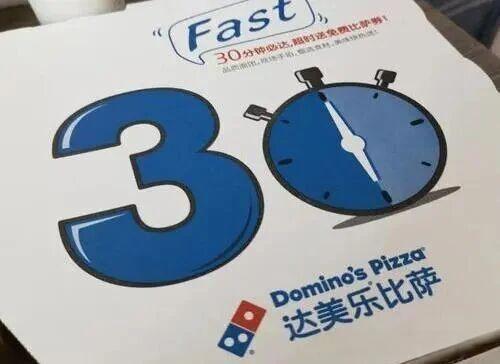
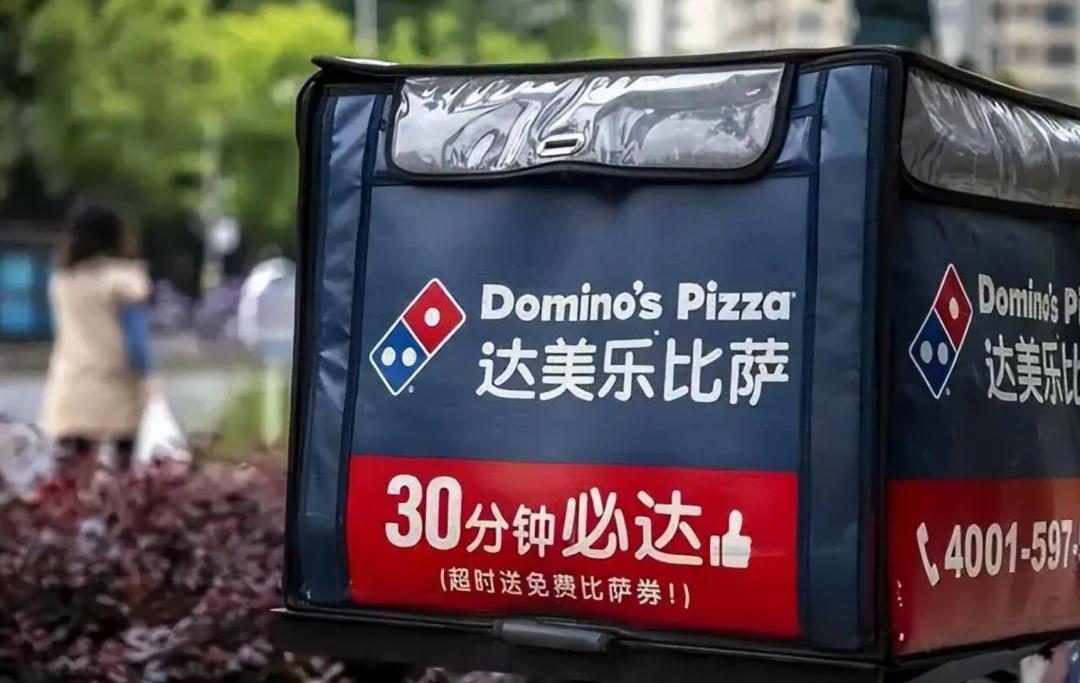
The upper tier is characterized by efficient takeaways. Domino's is the representative of this tier. It doesn't try to replicate Pizza Hut's in - store dining experience but rebuilds the entire model around takeaways - small - scale stores, dedicated delivery riders, and a guarantee of delivery within 30 minutes. In 2025, Domino's China had an annual revenue of 5.382 billion yuan, a year - on - year increase of 24.8%. Its 1,315 stores covered 60 cities. Its delivery cost is 41% lower than that of Pizza Hut, and the efficiency gap is obvious.
The lower tier is about affordable options for lower - tier markets. Jumbo Pizza is the most typical example - a 30 - square - meter store with two employees, a 150,000 - yuan franchise threshold, and 25 - yuan pizzas delivered directly to colleges and communities in third - and fourth - tier cities.
By 2025, Jumbo Pizza had over 3,000 stores, with a market share of 5.6%. As of 2025, pizza stores with an average per - capita consumption of less than 30 yuan accounted for 48.1% of the entire industry, a nearly 10 - percentage - point increase compared to 2023.
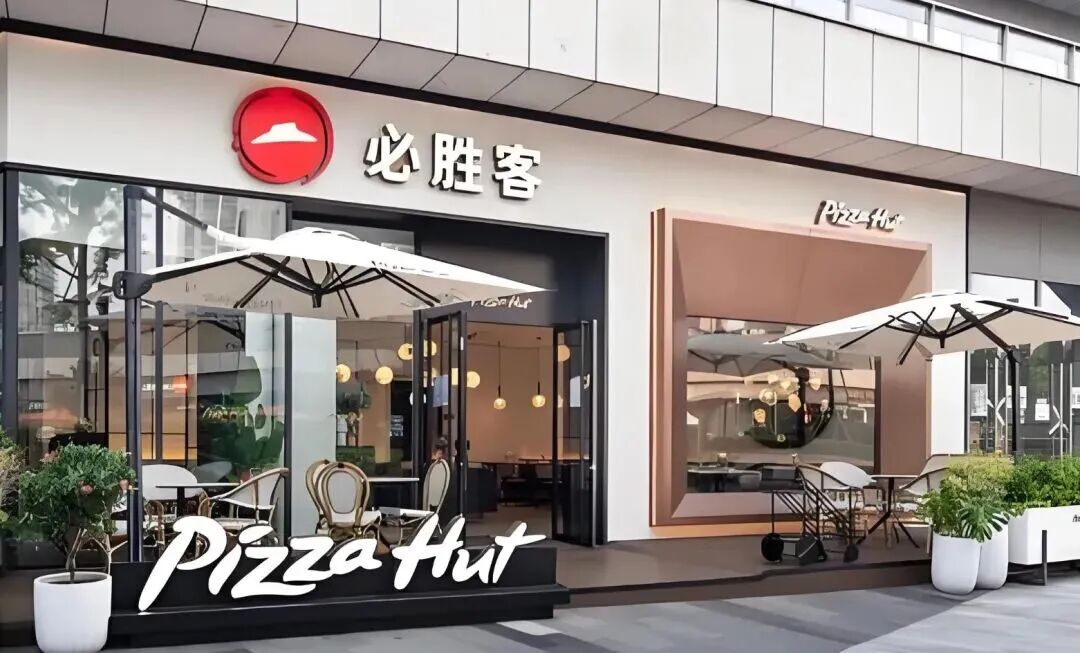
The middle tier was originally Pizza Hut's territory. However, the proportion of stores in the 50 - 80 - yuan price range has decreased by 7.2 percentage points compared to 2023. Squeezed from both sides, Pizza Hut's average customer spending has dropped from about 120 yuan in 2019 to 76 yuan in 2025, a decrease of more than one - third.
However, the three - tiered differentiation also brings another signal: Each tier has its own ceiling, and they are all starting to hit it.
Domino's same - store sales turned negative for the first time in recent years in 2025; the GMV of Jumbo Pizza's stores in the first three quarters of 2025 decreased by about 16% year - on - year; after Sarashina broke its "no - price - increase" promise in 2024, its operating profits in Beijing, Shanghai, and Guangzhou decreased by 20.3%, 23.6%, and 27.3% respectively. After the price war reaches its limit, the market is looking for a new direction.
This is where Pizza Hut's opportunity lies.
2. The Competitive Boundaries on Three Tracks
The pressure Pizza Hut faces does not come from a single unified competitor but from three battles fought in different areas - takeaway efficiency, lower - tier market prices, and cost - performance reputation. There are players vying for positions in each battle.
However, each competitor also has its own insurmountable obstacles.
Domino's competes on speed. Its real barrier is a self - developed delivery system: dedicated riders, intelligent order dispatching, and a "timely delivery" coverage rate of over 93.1%. As of March 2026, its membership exceeded 38.8 million, and the proportion of orders from the mini - program exceeded 70%.
In first - tier cities, this system exerts substantial pressure on Pizza Hut. The average customer spending of the two is similar (about 82 yuan for Domino's and about 76 yuan for Pizza Hut), but the gap in the takeaway experience is obvious. The attitude of the capital market speaks for itself: the forward price - to - earnings ratio of Dashi Co., Ltd. is 30 times, while that of Yum China is 17 times.
However, this system has an insoluble problem: empty return trips of riders.
In first - tier cities with dense stores, the algorithm can optimize the routes. But in lower - tier markets where orders are scattered, this advantage disappears. Domino's has reduced or even cancelled takeaway services in some non - first - tier cities, and the proportion of takeaway delivery revenue has decreased from 59.2% in 2023 to 46.1% in 2024.
Domino's boundary lies below the third - tier cities. Coincidentally, this is where Pizza Hut's WOW stores are expanding on a large scale - with a light investment of 600,000 - 850,000 yuan, an average customer spending of 30 - 40 yuan, and relying on third - party delivery. 62% of the newly opened stores in 2024 were in third - tier and lower - tier cities. Domino's digital advantage in the lower - tier markets becomes a cost burden here.
Jumbo Pizza is fighting a different battle. Its 25 - yuan pizzas have permanently lowered the psychological price of the entire pizza category. Once this anchor is set, it won't disappear even if Jumbo Pizza has problems - even if Jumbo Pizza closes tomorrow, consumers will no longer accept a 100 - yuan pizza meal.
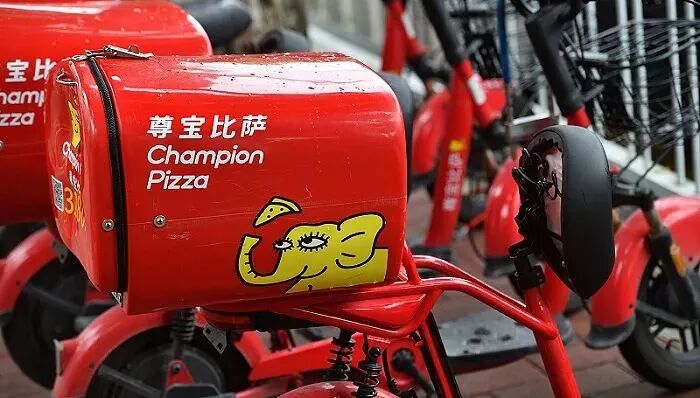
However, Jumbo Pizza's own situation is quite poor.
Its 3,000 stores have an annual revenue of 2.1 billion yuan, with an average annual revenue of about 700,000 yuan per store, which is less than one - fifth of Domino's per - store revenue. In the first half of 2025, food safety issues were reported in many of its stores. The quality control team covers less than 15% of the stores, and 30% of the franchisees reported that it would take more than two years to recoup their investment.
Once the label of "cheap" is attached, it's almost impossible to move up. It has broken Pizza Hut's price moat but is also trapped in its current position.
Compared with Domino's and Jumbo Pizza, Sarashina's threat is more hidden. It never targeted pizza, but the customers it attracts - students, young white - collar workers, and wage earners - are exactly the ones Pizza Hut wants to retain the most. Its founder, Masahiko Shogaki, has a firm belief: "1 second = 0.22 yen", which means in plain words that every second wasted is like throwing away a penny. Its "three - no kitchen" (no chefs, no kitchen knives, no open flames) allows Sarashina to maintain a gross profit margin of over 60% at an average per - capita consumption of 40 yuan.
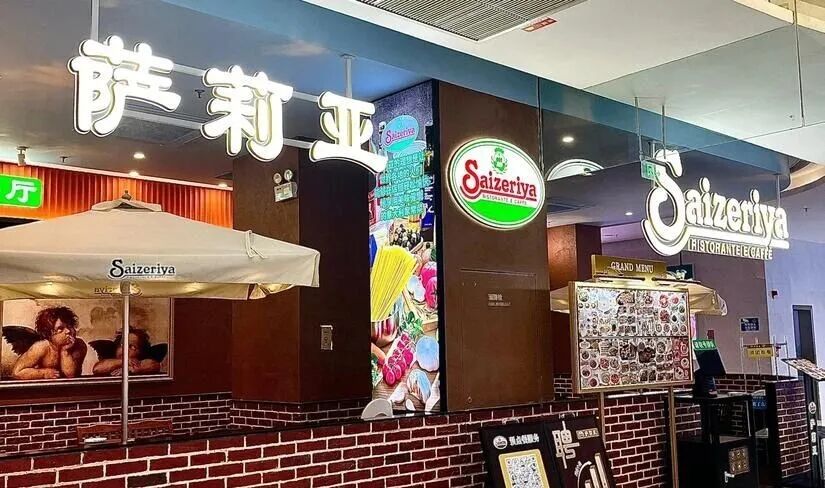
However, Sarashina hardly does official takeaways. In today's market where the takeaway penetration rate of the pizza category has exceeded 60%, this is a significant drawback. After the price increase in 2024, its cost - performance advantage began to narrow: the average per - capita consumption rose to 47 yuan, while the average customer spending of Pizza Hut's WOW stores is between 30 - 40 yuan, and the price gap between the two has significantly decreased. In the fiscal year 2025, Sarashina's revenue growth rate in China dropped sharply from 27% to 6.3%.
For Pizza Hut, Sarashina is more like a mirror: The idea of efficiency can be learned, and Pizza Hut's WOW stores have already pre - arranged some production steps at the supplier end. And the takeaway network that Sarashina lacks is something Pizza Hut already has.
3. What Does $1.2 Billion Buy?
Looking at the three competitors together, there is an interesting pattern: Domino's wins in efficiency but struggles in lower - tier markets; Jumbo Pizza wins in price but has no way to move up; Sarashina wins in cost but misses out on the takeaway market. Each of them locks in one dimension and is trapped in that dimension.
Pizza Hut is the only player in this market that has brand recognition, a takeaway network, diverse store types, and a national supply chain at the same time. It has a 51.3% consumers' first - choice recognition rate, and is part of Yum China's ecological system with 575 million members. Its local supply chain covers Yunnan truffles, Fujian tea, and Shaanxi apples. No competitor can assemble these resources in the short term.
However, there has always been one thing that Pizza Hut couldn't fully control autonomously: the right to define the brand.
Previously, Yum China paid a 3% franchise fee of its sales revenue to Yum! Brands every year. There has always been room for localization, and the WOW stores and local menus were developed independently. However, when it comes to the major direction of brand positioning, it still had to operate within the global framework.
After the buy - out, this premise has changed.
The expansion of WOW stores into lower - tier markets can be more thorough, without having to constantly weigh between the global brand image and local pricing; menu innovation can be more boldly tailored to Chinese tastes, rather than making selections from the global standard version; and the pace of franchise expansion can be more in line with the actual situation of the Chinese market. The transaction is expected to immediately increase the earnings per share in 2026 and bring mid - single - digit continuous growth from 2027 to 2028.
Yum China aims to expand Pizza Hut's stores from 4,375 to over 6,000 by 2028 and double its profit target compared to 2024.
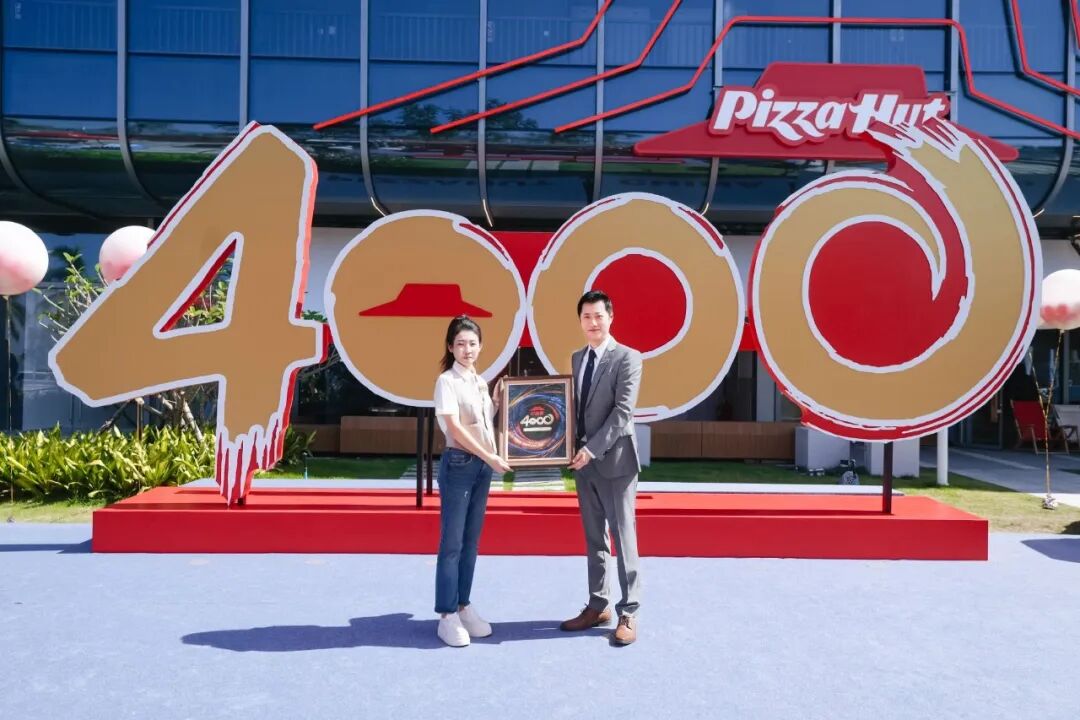
However, the real challenge is not money but management and control - among the 444 newly opened stores in 2025, the proportion of franchise stores has increased to 31%. Whether the WOW stores in different cities and at different levels can maintain a certain standard will determine whether this expansion will result in book profits or real profits.
To be honest, the market has not fully sorted out yet. There is still room for growth from 48 billion to 77 billion yuan. There are only 8.5 pizza stores per million people in cities below the third - tier, while in first - tier cities, it is 45.2 - The gap represents opportunities. After the price war reaches its limit, quality, experience, and brand recognition will be the next dimensions of competition. This is exactly where Pizza Hut has the deepest accumulation.
After obtaining the brand ownership, Pizza Hut has the opportunity to re - answer a question that should have been clearly answered: In the minds of Chinese consumers, what exactly is Pizza Hut?
Is it the Western restaurant in the 1990s that made people feel it was a decent thing to go to, or a chain fast - food restaurant that relies on discounts to maintain customer flow?