A former ByteDance employee born in the 1990s has secured another 2 billion yuan in financing
Investment community learned that Evoken announced the completion of a nearly $300 million (approximately RMB 2 billion) Series B+ financing round, with a post - investment valuation exceeding $2 billion.
It was co - led by Granite Asia, Tencent, and Shunwei Capital, with HT Investment and Jeneration Capital participating in the investment. Existing shareholders such as Gao Rong Capital, Ant Group, Yingce Capital, Mingshi Venture Capital, Source Code Capital, Sequoia China, and several other well - known investment institutions continued to increase their support.
At first hearing, "Evoken" may sound unfamiliar, but the popular "LiblibAI" in the venture capital circle originated from here. Today, with this record - breaking AI application financing, Chen Mian, a post - 90s founder, made his first public appearance with the group brand "Evoken". Behind this AI unicorn, a long line of investors has already gathered.
Looking into the distance, the curtain of the new era of AI applications is slowly rising.
Leaving ByteDance, a Post - 90s Entrepreneur Dives into AI Startup
This story starts with the helmsman behind Evoken.
Chen Mian, born in 1992, graduated from Southeast University with a bachelor's degree. In his previous career, he worked at Mobike, Didi, and Missfresh. Later, he joined ByteDance and became the global commercialization director of Jianying. At the age of 28, he reached the 4 - 1 rank, becoming the youngest product 4 - 1 in ByteDance's history at that time.
In May 2023, as the wave of large models swept through, Chen Mian decided to leave ByteDance and start his own business. At the beginning of its establishment, he set the core strategy of first entering the professional market and the production end.
In Chen Mian's view, in the early stage of a new technological revolution, changes in the tool end are often the fastest. On the one hand, new technologies can significantly improve efficiency in complex scenarios. Therefore, changes often occur first at the production end of content creation, especially the professional production end. For example, in the PC era, the well - known software that emerged earliest were Office and Adobe.
On the other hand, To C products have a low tolerance for AI hallucinations and technical flaws. Only when new technologies are mature enough will ordinary C - end users be willing to use them. Therefore, the popularization cycle of mass To C entertainment products is often longer.
"When starting an application - based business, the core is how to leverage the underlying intelligent changes that will occur in the future. Maybe now you'll find that nothing is ready. Then you need to think first, and when it's ready, you should go all out." Chen Mian once summarized.
Based on the above judgment, Evoken launched LiblibAI first. In just three years, the platform has grown into one of the largest AI material websites and creator communities in China, with more than 500,000 original models and over 100 million professional pictures and video materials.
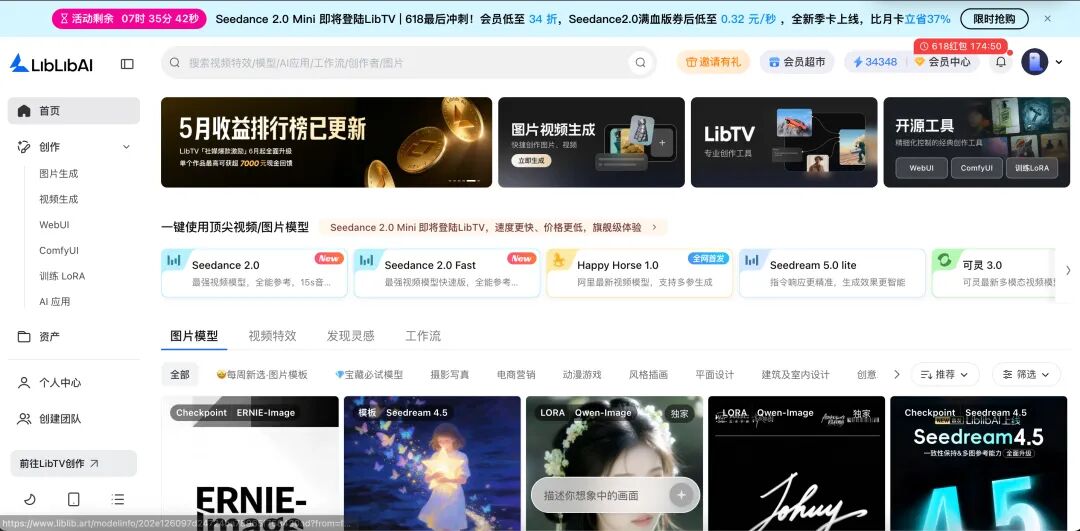
Moreover, Evoken launched Xingliu Agent in July last year. This product has full - stack intelligent design capabilities. By integrating multi - modal models and agent capabilities, it can help users complete the entire process from creative conception to design delivery, truly realizing the concept of "you say a word, and it completes a set of creative designs".
Of course, the exploration continues. In March this year, on the verge of its nearly three - year anniversary, Evoken officially released LibTV, a one - stop AI video creation system. Focusing on the field of AI video creation, it provides professional video production capabilities for creators, studios, brands, and film and television teams.
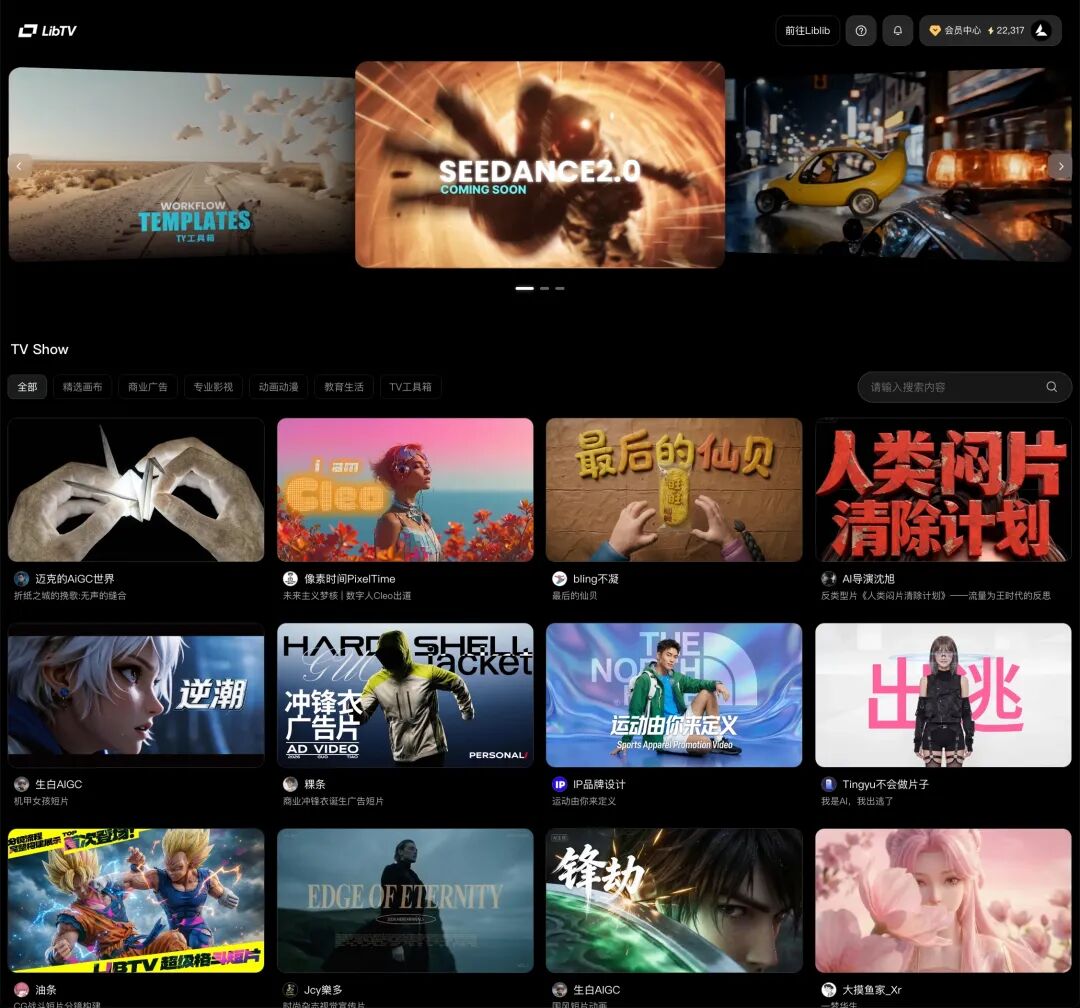
As Chen Mian said at the press conference at that time, most AI video tools still adopt the "model - first" design logic, which is essentially a collection of single - point tools rather than a systematic creation environment. The core innovation of LibTV lies in its "system - first" architecture concept, which for the first time realizes the equal collaboration between human creators and AI agents at the product level, solving the pain point that the entire process from script, storyboard to final output needs to be completed on multiple platforms with poor consistency.
Looking back on the past two years, the Chinese AI industry is actually not short of excellent products. However, the competition in the AI application layer has long been dominated by the "single - point thinking". There are clear barriers between these products, and users need to switch between different tools repeatedly, and each step requires re - adapting to a new interaction logic.
In contrast, Evoken has chosen a completely different path. Starting from LiblibAI, then entering the AI design field with Xingliu Agent, and then venturing into AI video creation with LibTV, Evoken's product matrix seems to span three different fields: community, video, and design. However, it always revolves around the same core proposition: the production of AI - creative content.
Furthermore, Evoken has taken the lead in achieving the leap from single - point breakthrough to group - based development. In the domestic AI application track, it is the only one with such a layout and cannot be replicated.
The value presented behind this is far more than the stacking of the number of products. The deeper meaning lies in: when a company simultaneously masters the AI capabilities of three key nodes in content creation, namely pictures, videos, and design, it gets the ticket to build the content production infrastructure. Creators no longer need to move materials back and forth between different platforms and switch workflows but can complete the entire process from inspiration to finished product delivery within the same ecosystem.
In other words, the competition logic of this AI application race has been quietly rewritten by Evoken.
Well - Known VC/PEs Gather, Valuation Exceeds RMB 10 Billion
Along the way, Evoken has left a deep impression on the venture capital circle.
Back in July 2023, Evoken completed its angel - round financing, with Source Code Capital, Gao Rong Venture Capital, and GSR Ventures as the investors. At that time, only two months had passed since its establishment, which was regarded as "light - speed financing" at that time.
After that, Evoken started a non - stop financing rhythm. First, in January 2024, it completed the Pre - A round of financing from strategic investors. Then, in July of the same year, it received Series A financing led by Mingshi Venture Capital. By then, Evoken had completed three rounds of financing in just one year, with a total amount of hundreds of millions of yuan.
After three rounds, the lineup of investors is also worth savoring. Both Source Code Capital and Gao Rong Venture Capital invested in MoonCell, and Mingshi Venture Capital invested in MiniMax. It is rare in the industry that the investors of two leading large - model companies simultaneously invest in the same AI application company.
At that time, Zhu Xiaohu, the managing partner of GSR Ventures and one of the earliest investors in Evoken, said that Evoken's thinking about the history of technological changes and the deduction of the development path of AI technology reflected the company's profound thinking and bold decision - making ability in strategic direction. "In just one year, LiblibAI successfully topped the domestic list, presenting an excellent report card for the implementation of the strategic decision."
Xia Ling, a partner of Mingshi Venture Capital, recalled to the investment community that he first met Chen Mian in 2023 when the latter was still exploring and planning the AI product to be developed. After that, Xia Ling and his team regularly followed up and visited Chen Mian, and Chen Mian's understanding of AI always surprised the Mingshi team.
One day in May 2024, the Mingshi team invited Chen Mian to the office to meet Huang Mingming, the founding partner of Mingshi Venture Capital. After chatting for less than 20 minutes, Huang Mingming sent a WeChat message to the investment team: "Lock Chen Mian in the meeting room. Don't let him leave until the TS is signed today!" Immediately, Mingshi Venture Capital took the lead in the Series A financing and made large - scale over - investment in subsequent financing rounds.
Soon, investors continued to queue up to invest. In February 2025, LibLibAI received another hundreds of millions of yuan in financing, led by Shunwei Capital and Yingce Capital, with old shareholders such as Mingshi Venture Capital making over - investment. Giant Network served as the industrial investor in this round.
This financing came at a critical juncture when generative AI entered the value - verification period. Evoken's ability to win the favor of investors again is due to its innovative and diverse commercialization models and steady user growth. This financing not only refreshed the financing speed record in the domestic AI application track but also marked the market's high recognition of the strategy of "reconstructing the AI - native workflow".
When talking about this financing, Cheng Tian, a partner of Shunwei Capital and one of the leading investors in this round, believed at that time that text - to - image technology is an important application in the AI technological revolution and has the potential to extend to broader fields such as text - to - video. As the AI generation ability improves, the demand of professional users for precise control of image generation is increasing, promoting the rapid development of this track. "As a leading domestic image model community, LiblibAI has been deeply involved in image models. With its accurate market positioning and professional operation, it has accumulated a large user base and commercialization achievements in just one year, successfully achieving the bilateral effect and steady growth."
Eight months later, Evoken received a $130 million Series B financing, co - led by Sequoia China, CMC Capital, and a strategic investor. Old shareholders such as Shunwei Capital, Source Code Capital, Mingshi Venture Capital, and Yingce Capital all increased their holdings, and institutions such as Lenovo Capital and Incubator Group participated in the investment.
It is worth mentioning that this once again refreshed the previous financing record set by Evoken, becoming the largest financing in the domestic AI application track last year.
Until now, the Series B+ financing has been revealed. When a group of well - known VC/PEs gather here, it sends a clear signal: as large models are gradually becoming a game for a few leading players, capital is refocusing on AI platforms that can truly implement multi - modal capabilities in creation, production, and consumption scenarios. Investors are no longer just chasing single blockbusters but are turning to bet on platform - type enterprises that can build a complete business map.
More convincingly, Evoken's post - investment valuation of over $2 billion not only proves that the platform - based narrative of AI companies has been strongly recognized by the primary market but also is the most intuitive confirmation of its established AI content ecological advantages.
Watershed, Re - evaluate Chinese AI Applications
Currently, the Chinese AI industry is experiencing a crucial turning point.
The same question is in front of all AI companies: how to convert technological breakthroughs into commercial value. The standard for verifying value has also been upgraded from a single - dimension technology competition to a comprehensive competition of ecological capabilities, commercialization efficiency, and scale effects. Following this logic, Evoken's path becomes clear.
Users are undoubtedly the core assets of AI products. Experience has shown that a large number of users can form a positive cycle - that is, the more users there are, the richer the content; the richer the content, the faster new users will pour in, thus continuously strengthening the ecological barrier.
So, how is Evoken doing? Take LiblibAi for example. It currently has over 30 million cumulative users. In addition, data shows that one out of every three designers in China is using LiblibAI for creation. Obviously, it has gathered the most active AI creator ecosystem in China.
For designers, Xingliu Agent is a better one - stop creative design partner, and the data also proves this - its cumulative number of service users has also exceeded 10 million.
LibTV, which was launched only three months ago, has shown amazing growth power: within the first month of its launch, its daily revenue exceeded one million US dollars, and it served nearly a thousand short - drama teams, film and television production institutions, advertising companies, and brand customers. That is to say, LibTV has become an important infrastructure for many professional content teams to enter the AI video era.
This reminds people of what Wang Guangxi, the vice - president of Lenovo Group and the managing partner of Lenovo Capital and Incubator Group, a Series B investor in Evoken, mentioned before. The core of AIGC - empowered productivity lies in the in - depth combination of tools and creators, continuously iterating the creation mode, and finding the balance between tool upgrade and usability. "Relying on solid technological accumulation, the Evoken team has built a bilateral flywheel effect between creators and consumers through a comprehensive layout of 'technology + ecosystem', showing significant growth potential."
With the user scale in place, the ultimate test is commercialization. For a long time, ARR (Annual Recurring Revenue) has been regarded as one of the most core growth indicators in the technology industry and an important reference for a company's business quality and growth ability.
In this regard, Evoken has presented an excellent report card: the current ARR is close to $300 million; in May 2026, the group's overall revenue increased by more than 3000% year - on - year, and the revenue of LibTV in May was more than 13 times that of its first - month launch. This set of data shows Evoken's strong product vitality and commercialization ability.
Looking at the entire industry, most domestic AI application companies' revenues are highly dependent on a single product, with weak risk - resistance ability and an obvious ceiling. However, Evoken's revenue comes from the collaborative contributions of three core products. It is this diversified revenue structure and strong growth potential that enable it to gradually widen the gap with its competitors.
So far, in terms of financing scale, revenue scale, user scale, and business matrix richness, Evoken has established the most complete business map in the Chinese AI application industry and has become one of the few AI enterprises with continuous growth ability, commercialization ability, and platform - building ability.
This is why Evoken will use the group brand "Evoken" to communicate with the outside world for the first time. This move is by no means a simple brand upgrade - a technology group built around the AI - creative content industry is emerging, aiming to seize the development opportunities of the entire AI content ecosystem rather than just a single tool track.
If we expand our vision globally, a picture becomes particularly thought - provoking: Evoken's user scale, revenue growth rate, and multi - product commercialization ability are all at the global leading level. It is in the same first echelon as companies such as Cursor, Higgsfield, Suno, and HeyGen. However, there is a significant gap between Evoken's valuation range and those of its global peers.
It cannot be denied that Evoken's valuation is still at an obvious low point globally. A $2 billion valuation is obviously conservative for an AI platform with tens of millions of users, an ARR of $300 million, and still in high - speed growth.
In the entire AI industry, large - model companies are the most discussed. Among them, valuations of tens of billions of dollars are common. However, it should be noted that most large - model companies still rely on continuous financing to support training investment, and their commercialization paths are not yet fully clear. The loss scale may even increase as the model scale expands.
In contrast, Evoken has completed the PMF verification through multiple products, forming a business structure with high revenue, high growth, and healthy cash flow. This means that Evoken's valuation logic is fundamentally different from that of large - model companies. The former is not betting on a technological direction that may explode in the future but is continuously expanding its advantages in a proven market.
In a financing environment that increasingly emphasizes "business verification" rather than "technological stories", this practical attitude should deserve a valuation premium. More importantly, Evoken has jumped out of the single - tool thinking and achieved a balance between commercialization and growth with a full - link ecosystem - this is the fundamental reason why it is most worthy of being re - priced.
The story of re - evaluating the value of Chinese AI has just begun.