300,000 AI Agents Enter the Workplace: OpenAI Invests $150 Million to Transform Your Reimbursement and Weekly Reports
On June 14th, OpenAI allocated $150 million with the goal of training 300,000 "AI consultants" by the end of 2026. Anthropic, which started earlier, has already received applications from 40,000 enterprises and certified over 10,000 Claude consultants. The battle of models is almost over, and a new front is opening up right at your daily workplace.
The model war might be coming to an end.
On June 14th, OpenAI announced a plan called the Partner Network, investing $150 million to train and certify 300,000 consultants by the end of 2026.
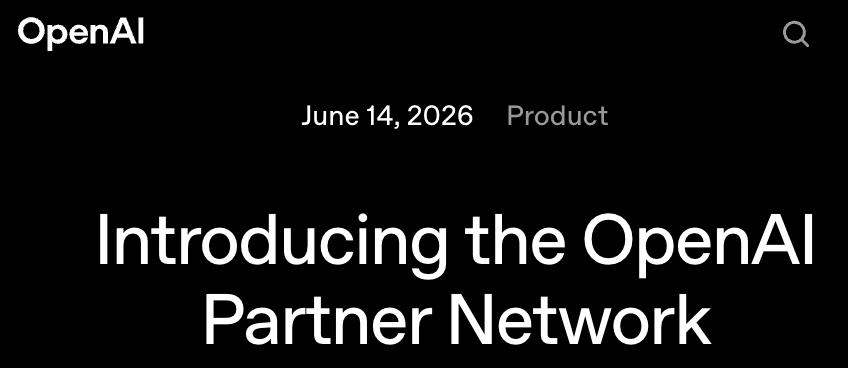
Global top consulting firms such as McKinsey, BCG, Bain, Accenture, and PwC will all be brought into this network.
Their sole task is to integrate OpenAI's AI into the workflows of enterprises worldwide.
This is a signal that the competition among AI giants has shifted from model rivalry to your daily workplace.
Anthropic is constantly launching new models, and there's still no sign of GPT - 5.6. Why doesn't OpenAI invest this $150 million in R & D to train a more powerful model?
Because in OpenAI's view, the battle of models is almost over.
The capabilities of cutting - edge models from OpenAI, Anthropic, and Google are rapidly converging. When choosing a model, users are less concerned about its raw power and more about its ability to perform in real - world scenarios.
A sobering statistic: 97% of companies fail to demonstrate the commercial value of their early generative AI projects.
They've spent money and purchased models, but still can't put them to use.
BCG has coined a term for this state: "stuck in the experimental phase." The goal of its collaboration with OpenAI is to move customers from "trying" to "using it daily."
This is what the Partner Network truly aims to address.
What exactly will 300,000 AI transformation experts do when they enter your company?
Officially, OpenAI refers to these 300,000 people as "certified consultants."
It may sound like a sales position, but it's not. Their real job is to transform your current work using AI. Specifically, it involves three tasks: rewriting work processes, integrating AI into existing systems, and helping employees adapt to new ways of working.
Where will these people come from? OpenAI doesn't plan to recruit them on its own. Instead, it will enlist top consulting firms as the "implementation layer."
OpenAI has set three tiers for these consultants: Select, Advanced, and Elite. Each tier has high - standard requirements for sales performance, technical capabilities, joint sales participation, and deployment experience.
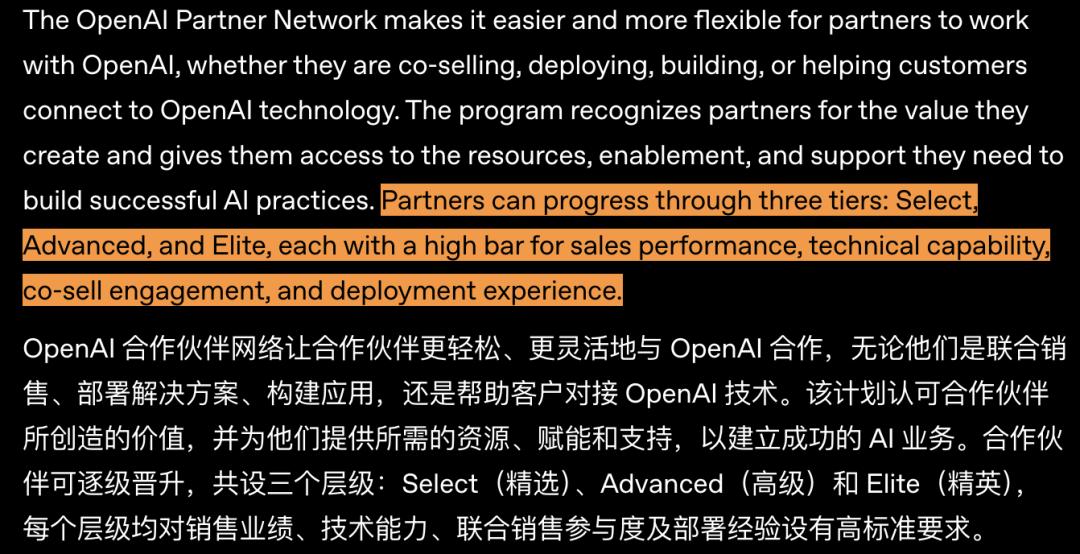
This means that to climb up the tiers, one has to compete in terms of performance, technology, and real - world achievements.
Above the tiers, there are also specialized directions, such as specializing in Codex, cybersecurity, or AI agents.
Experienced players will immediately recognize this strategy. Salesforce and SAP used to build their business through a graded partner system, turning "certification" into a must - have for enterprise purchases.
An Elite - level partner can outperform uncertified competitors in a bid, not just because of their skills, but also because of the endorsement of the tier itself.
In addition, OpenAI has introduced the Forward Deployed Experts mechanism.
In simple terms, it means directly sharing OpenAI's internal engineering team's approach and implementation plans with its partners, and having them work on - site at the customer's premises together with OpenAI engineers.
Palantir has been using this strategy for over a decade. Engineers stay at the customer's company for months or even years to thoroughly understand the business, and they bring back real - world expertise from the customer's business.
OpenAI has also provided several successful implementation cases.
Paychex, a payroll company, collaborated with Bain and OpenAI to develop a payroll automation system. The results were astonishing: the waiting time was reduced by 80% compared to manual processing, and the working time for requests that required manual review was further reduced by 30%, without sacrificing accuracy or security.
T - Mobile partnered with Accenture, eBay with Artium, and Agilent with BCG. Behind each partnership is a redesigned real - world business process.
The common feature is that AI is no longer just a novelty but has started to become an integral part of the company's daily operations.
OpenAI has a more subtle motive for this investment. Once a company pays for its employees to obtain OpenAI's certification, switching to other models will be more costly.
Certification itself is a moat.
This is also the first time OpenAI can do this.
Not long ago, it decoupled from Microsoft, allowing it to independently manage certification and sales without relying on Microsoft's channels. The Partner Network is an important step in this "independence."
According to multiple media reports, OpenAI also established a professional services company called Deployment Company in May, with a reported scale of $4 billion, also focusing on the implementation of AI in enterprises.
Both giants have realized: the battle of models is over
Actually, OpenAI is not the first to recognize this.
Anthropic took the lead.
As early as March, Anthropic launched the Claude Partner Network, investing $100 million. On June 3rd, it added the Services Track and Partner Hub to the network.
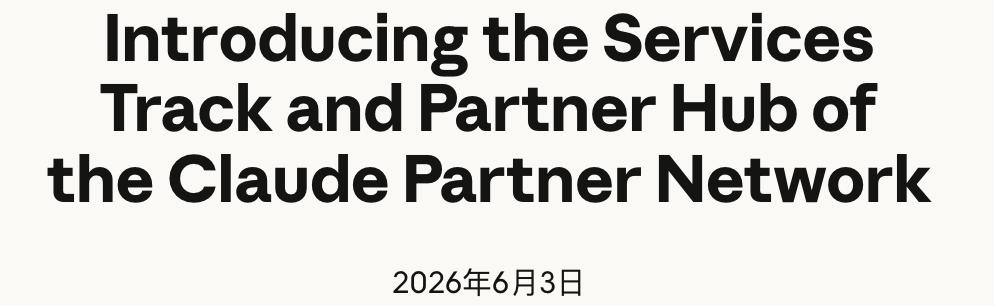
On June 3, 2026, Anthropic added the Services Track and Partner Hub to the Claude Partner Network, which was launched in March.
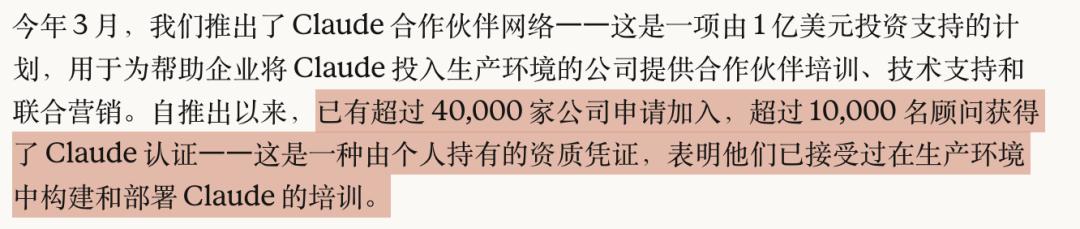
From March to now, over 40,000 companies have applied to join, and over 10,000 consultants have obtained the Claude certification.
OpenAI's investment of $150 million this time clearly shows a defensive strategy.
Anthropic took the early lead with applications from 40,000 companies and 10,000 certified consultants, while OpenAI is aggressively catching up with a target of 300,000.
The competition of models has truly shifted from parameter competition to implementation.
AI is changing from "a tool you open" to "the default environment"
What does this have to do with ordinary people?
It has a huge impact: it changes how you go to work every day.
In the past, you actively used AI. You opened ChatGPT to help you write an email or modify code, and then closed it after use. It was just a tool in your hand.
Now, the situation has reversed.
The company hires "AI consultants" to completely overhaul the entire workflow. You don't "open" AI; instead, you are pushed into a workflow that has been reorganized by AI.
In the future, AI won't even be considered "software." It will be like electricity, becoming an integral part of your work environment.
It's foreseeable that every company will have an "AI transformation specialist" in the future. Their responsibility will be to rewrite your work methods using AI.
One day, you may return to your workstation and find that the reimbursement process, the scheduling logic, and even the template for writing weekly reports have changed.
It's not that the company has switched to a new system; someone has re - engineered your job according to AI logic.
This is what makes the $150 million investment and 300,000 people truly terrifying.
For office workers, whether to use AI is no longer a question: it has already penetrated into your office environment and started to reshape every step of your work.
Reference materials:
https://openai.com/index/introducing-openai-partner-network/
This article is from the WeChat official account "New Intelligence Yuan", author: ASI Revelation. It is published by 36Kr with authorization.