China's state media has once again highlighted the chaos in the GEO service sector. How can enterprises choose the right partners?
Recently, CNR.cn published another long article focusing on the chaos in the GEO service providers' market.
In one of the cases it covered, an international logistics company didn't achieve the "top three rankings in AI search" promised by its GEO service provider. Instead, due to the provider's mass - generation of unverified information and creation of false content, the company was marked as an "unreliable information source" by multiple AI platforms. Eventually, it had to invest several times the cost to repair its public opinion situation.
However, this is not an isolated case. As AI gradually penetrates people's lives, GEO is evolving from an experimental move by enterprises to a fundamental ability in brand management. Consequently, numerous GEO service providers have emerged, along with a large number of service irregularities. Promises like "guaranteed rankings", "guaranteed exposure", and "full - platform coverage" have become common traps.
For enterprises, the question is no longer "whether to do GEO", but rather: What kind of GEO services are trustworthy? What kind are not? How to choose a partner that can jointly build the brand's AI perception in the long term?
What are the common GEO service irregularities?
In the long article on CNR.cn, there is also a case of a moving company. It was promised high rankings and multi - platform exposure, but was only required to register multiple self - media accounts and keep posting articles. After nearly a month of effort, the rankings and visibility were both zero, and it was extremely difficult to get a refund.
During this period, the Jianshi team also held multiple private GEO - themed sharing sessions, and many brands and guests mentioned similar phenomena.
For example, some GEO service providers put a seemingly professional case screenshot in their sales PPT, which included the brand name, AI recommendation screenshot, and data comparison chart, claiming that "a certain brand achieved a 300% increase in AI recommendation rate".
However, in fact, they photoshopped the brand name of another client into the brand they served, or even fabricated a case entirely, including the brand name, industry, and effect data, all of which were false. The purpose was just to make clients easily tempted when seeing "cases in the same industry", thinking that "since peers are doing it, I should too".
Some service providers basically do no substantial work after getting a project. They don't publish the content that should be published and don't optimize the platforms that need to be optimized. When it's time to submit the weekly report, they just take a screenshot of an AI conversation record and claim that "the target has been met". Or they do some work, but of very low quality (such as copying and pasting the content of the client's official website to several free platforms without any modification).
Ineffectiveness might still be the better outcome. A service provider, in order to quickly produce results for a clothing brand, mass - posted content related to "trendy outfits" on platforms like Xiaohongshu. In the short term, the quantity of content increased, but after being captured by AI, this brand, which originally focused on "high - cost - performance commuter men's clothing", was misclassified as a "fashion brand". "After three months, we found that AI had mispositioned the brand."
This kind of content pollutes the external information sources that large models may refer to when generating answers. Once false content is repeatedly spread through multiple channels, AI may form wrong judgments during cross - verification, and ultimately the brand has to bear the costs of cognitive bias, loss of trust, and subsequent repairs.
These various irregularities can be summarized into at least three major categories.
Firstly, making baseless promises. Claims like "dominate the screen in 7 days", "guaranteed top 3", and "cover tens of thousands of keywords" are made casually. However, AI Q&A is not a fixed ranking like in traditional search engines, but a dynamic response based on understanding the user. Such "promises" that ignore the technical principles are essentially using information asymmetry to brainwash enterprises.
Secondly, playing tricks in delivery. Fake experts, fake evaluations, fake data, and fake effects are the most common delivery traps. Enterprises simply can't understand or verify them.
Thirdly, shifting the blame when problems occur. Once the fraud is discovered, or the brand is downgraded by the large model due to false information, the service provider will shift the blame and deny responsibility. The mess left behind has to be dealt with by the enterprise itself.
How should enterprises choose a good service provider?
If the irregularities expose the early - stage problems in the GEO market, on the contrary, they also help us see the common practices of trustworthy service partners:
They usually don't promise "guaranteed rankings" right away, nor do they first ask how many keywords the enterprise wants to optimize. Instead, they first clarify a more fundamental question: How should AI understand this brand and its products? This in turn also answers another key question: How should an enterprise choose a reliable GEO service provider?
From some mature projects, trustworthy GEO services generally go through five steps.
First, inventory facts: Unify the brand's statements before publishing articles.
A certain team told Jianshi that when serving a well - known mother - and - baby brand, they found that due to different product names on the official website, Tmall, and Xiaohongshu, AI couldn't determine whether they were the same product, resulting in the brand's AI visibility being less than 5%.
Similar situations are common within enterprises: the same product has different names on different platforms; the same selling point is expressed differently in sales pitches, promotional materials, and customer service responses; key information such as certifications, patents, cases, and parameters is also scattered across different departments and channels.
Therefore, the first step of trustworthy GEO is usually not to publish articles, but to conduct information inventory and statement unification: whether the brand name and product name are consistent; whether the core selling points are supported by facts; whether parameters, certifications, patents, and awards are verifiable; whether the content on the official website, e - commerce platforms, social media, and media conflicts with each other; and which information can serve as the basic facts for AI to understand the brand. Although this step seems basic, it determines the credibility of subsequent GEO services.
Second, build the enterprise knowledge graph: Transform marketing slogans into knowledge nodes that AI can understand.
In the marketing logic, enterprises are used to expressing their advantages with phrases like "industry - leading", "high - quality", "reliable", and "one - stop solution". People can understand these phrases, but AI may not know what facts they correspond to.
What market share, patents, cases, or third - party certifications does the so - called "industry - leading" correspond to? In which parameters, price ranges, usage costs, or after - sales policies is the "high - cost - performance" reflected? Is the "safe and reliable" supported by test reports, certification standards, or real user cases?
The core of this step is to transform the enterprise's "self - expression" for humans into knowledge nodes that AI can understand, verify, and quote. That is to say, with the help of GEO service partners, the brand needs to reconstruct its language expression system, connecting product names, applicable scenarios, user questions, functional parameters, evidence materials, authoritative information sources, and real cases.
Currently, the construction of enterprise knowledge graphs has begun to take shape in some practices. For example, 360 Zhijian GEO has made the knowledge graph the core foundation of trustworthy GEO:
On the one hand, relying on 360's more than 20 years of enterprise service experience, the precipitation of millions of enterprise customers, the database of hundreds of billions of malicious samples, and the accumulation of cross - industry risk control cases, it disassembles the enterprise's real assets into knowledge nodes that can be recognized by AI, such as "subject qualification - product service - application scenario - user question - core selling point - evidence material - authoritative information source". On the other hand, it establishes a differentiated knowledge structure based on the decision - making chains of different industries.
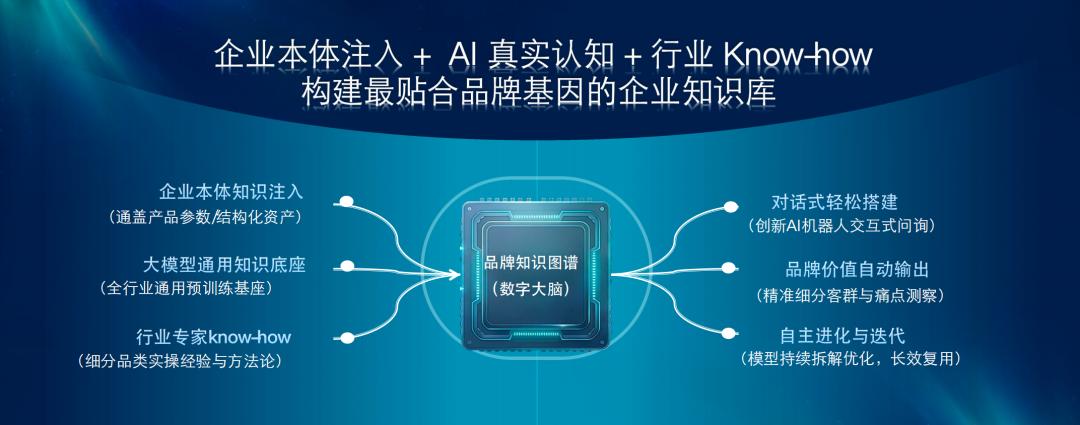
For example, in the health industry, a trustworthy asset system will be established around practice qualifications, expert teams, service specifications, therapy descriptions, and compliance boundaries; in the game industry, a recommendation and trust model will be established around gameplay mechanisms, player evaluations, public opinion and word - of - mouth, strategy content, and emotional tendencies.
The knowledge graph formed in this way is not just an internal database for the enterprise, but a set of brand perception infrastructure for AI retrieval, reasoning, generation, and citation.
Third, identify problems: Establish a user question model before creating a keyword list.
Many enterprises still follow the SEO approach when doing GEO: listing keywords, publishing articles, and covering channels. However, users' questions on AI platforms are not a set of static keywords, but a chain of questions centered around needs, comparisons, verifications, and decisions.
Therefore, a trustworthy service provider will not just provide a keyword list, but will first determine the enterprise's most important current business goals: is it new product awareness, investment promotion and franchising, product conversion, expert image building, negative public opinion repair, or competitor comparison? When the budget is limited, it is even more necessary to clarify which business, which group of people, which scenario, and which set of questions should be optimized first.
Take a CNC cutting equipment manufacturer as an example. If it only focuses on general keywords like "which brand of a certain cutting machine is good", it is difficult to really influence AI answers.
When 360 Zhijian GEO serves this manufacturer, it first disassembles the segmented customer group scenarios from the dimensions of usage scenarios such as garment factories, home decoration, and industry, professional identities such as procurement managers and bosses, and technical parameters such as pure - electric servo and laser cutting. Then, combined with factors such as time, space, purpose, and hotspots, it infers the potential needs and pain points in different scenarios, and finally summarizes the functional selling points, service selling points, marketing selling points, and competitiveness selling points.
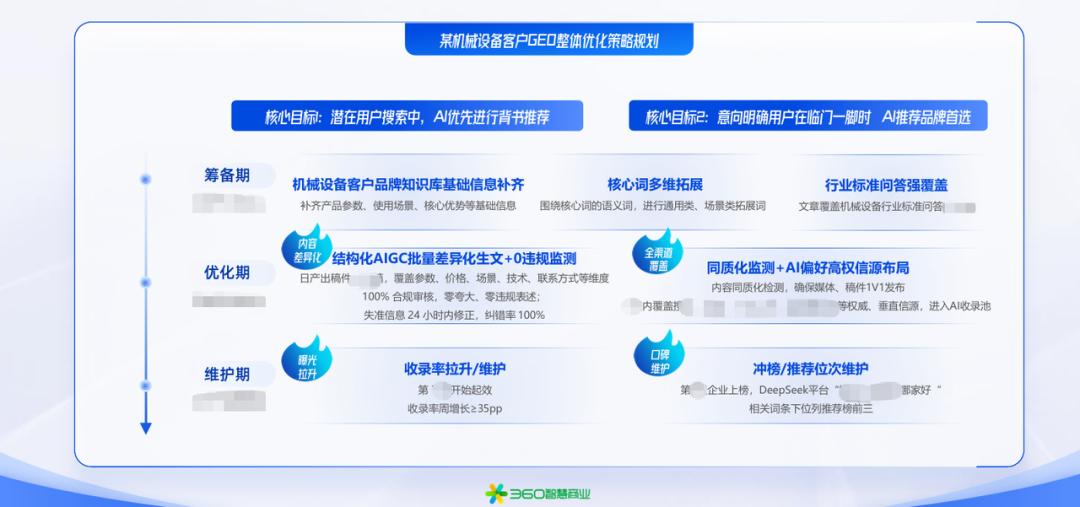
Of course, the question models for different industries are also completely different. For high - involvement decision - making product categories, a complete decision - making chain usually needs to be established around roles, parameters, budgets, compliance, ROI, delivery, and after - sales; for low - involvement decision - making product categories, they rely more on scenario and pain - point matching.
For example, for donkey - hide gelatin products, users are more likely to ask questions starting from their living conditions, such as "how to replenish qi and blood when staying up late often", "what to eat for mental exhaustion in a high - pressure workplace", and "what are the manifestations of qi and blood deficiency". The focus of GEO is not to build a long technical reasoning chain, but to connect typical scenarios, user pain points, and product knowledge.
Fourth, layout information sources: Make trustworthy content appear in positions where AI is more likely to trust.
Take the international logistics company mentioned in the CNR.cn article as an example. The service provider mass - generated false information such as "owning a factory of more than 200 square meters" and "celebrating its tenth anniversary" without verification. In fact, the so - called "factory" was just a rented office, and the enterprise had been established for less than two years. Once this kind of content is captured by AI and identified as inconsistent during cross - verification, the brand may be marked as an "unreliable information source".
Therefore, the key to information source construction is not "how much content is published", but "which content should be carried by which information sources". Generally speaking, official information sources confirm the brand's basic facts; authoritative media and industry platforms enhance credibility; certifications, patents, associations, and government - published data support key selling points; social media and content platforms cover real scenarios and word - of - mouth expressions; vertical platforms or academic materials supplement professional explanations and industry contexts.
This also means that GEO cannot solve all problems with "one set of content for all platforms". Instead, different levels of content layout should be designed according to the industry, target platform, user questions, decision - making stage, and information source weight.
Real information source construction is not about quantity, but about structure: making real, structured, and verifiable information appear in positions where it is easier for AI to retrieve, quote, and trust.
Fifth, continuously calibrate: Monitor the effects with data instead of one - time screenshot delivery.
The GEO effect cannot be judged by just one Q&A screenshot. A single screenshot neither represents a stable effect nor is it reliable as it can be artificially selected. A more reasonable way is to continuously monitor the brand's performance on the AI side, including AI visibility, the number of times the brand is mentioned, answer citation rate, information source citation rate, information accuracy rate, the proportion of negative information, and the relationship with competitors.
These indicators not only prove "whether there is an effect", but more importantly, they are used to calibrate the content and information source strategies in reverse. For example, if a certain selling point is not cited by AI for a long time, it may not be that the content is insufficient, but that there is a lack of authoritative proof; if a negative evaluation appears repeatedly, it may indicate that the relevant problem needs to be repaired at the business level first, and then supplemented with real information sources.
Therefore, when enterprises choose a GEO partner, they can focus on three things:
First, does the partner first talk about keywords and rankings, or first understand the business goals, user decision - making chains, and brand facts?
Second, does the partner let the enterprise blindly publish articles, or can it establish a brand knowledge base, user question model, and knowledge graph, and explain the calling logic of AI under different questions, platforms, and information sources?
Third, does the partner provide continuous monitoring, content review, information source verification, and anti - poisoning mechanisms, or just a few artificially selected result screenshots? These questions are worth thinking about before investing in GEO.
The industry is also taking action
However, relying solely on enterprises to make selections still leaves many irregularities, as not everyone can or needs to become a GEO expert. This requires the joint intervention of industry standards and third - party evaluations. It is worth noting that the industry is accelerating the establishment of norms.
In May this year, the Artificial Intelligence Research Institute of the China Academy of Information and Communications Technology (CAICT), relying on the Security Governance Committee of the Artificial Intelligence Industry Development Alliance (AIIA), jointly with more than 20 units from industry, academia, and research, formulated the Technical Specification for Trustworthy Basic Requirements of Generative Engine Optimization (GEO) Services and launched a special evaluation. Many GEO service providers, including 360 Zhijian, have passed the first - round trustworthy special evaluation.
According to the Technical Specification for Trustworthy Basic Requirements of Generative Engine Optimization (GEO) Services, the evaluation focuses on four major dimensions: content authenticity, information source authority, effect verifiability, and risk controllability. From the perspective of enterprises choosing service providers, trustworthy GEO should at least pass three tests:
First test: Can the content be cross - verified?
The foundation of GEO is not "whether one can write", but "whether the written content is true". Statements such as "industry - leading", "owning a certain number of patents", "serving a certain number of customers", and "obtaining certain certifications" submitted by enterprises should all be supported by verifiable factual sources.
Take 360 Zhijian GEO as an example. Its "360 Shen Dun Jing" intelligent supervision platform conducts cross - verification of information such as subject qualifications, trademark rights, and the number of patents through public and authoritative databases such as the National Enterprise Credit Information Publicity System, the Trademark Office, and the Patent Office. Information that cannot be verified, is inconsistent, or has the risk of exaggeration should not enter the brand knowledge graph and subsequent content distribution.
Second test: Can the information source be trusted by AI?
True content does not necessarily mean it will be cited by