Ranking 48th on the bestseller list, a Beijing-based developer emerges as a dark horse in the SLG mini-game sector?
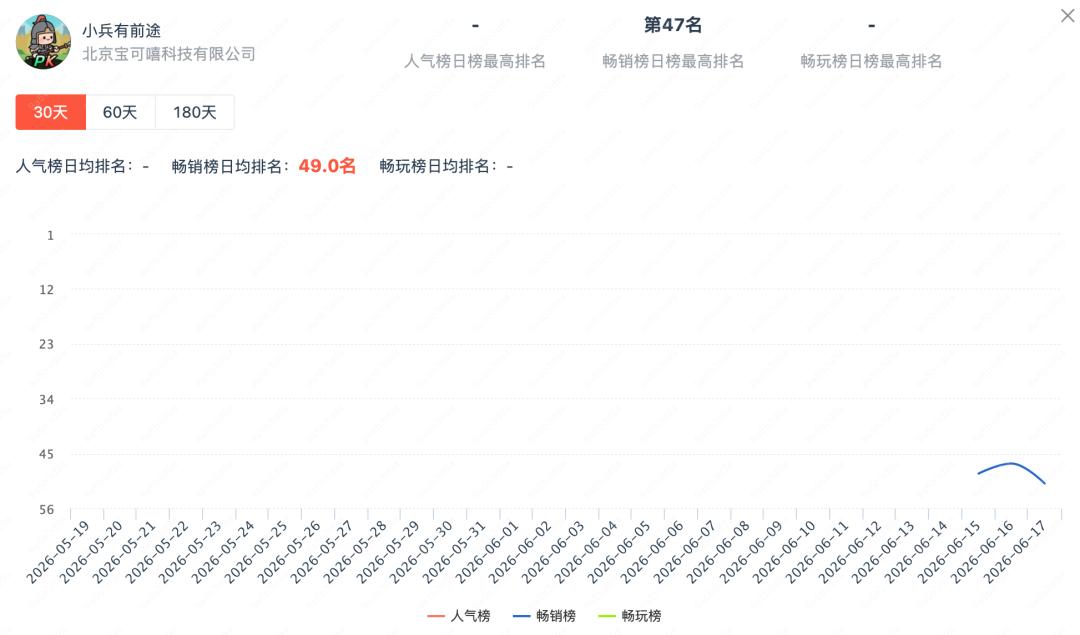
Recently, Beijing Baokexi launched a new WeChat mini-game SLG titled "Little Soldiers Have a Future", and it reached the 49th place on the WeChat mini-game bestseller list on June 15.
What's the specific situation? What makes "Little Soldiers Have a Future" special? What are the highlights in the marketing market? Today, the DataEye Research Institute conducts a detailed analysis of the game's market performance, advertising material creation, and core logic to provide a reference for similar products in the industry.
Market Performance and Gameplay Content
DataEye-ADX shows that "Little Soldiers Have a Future" entered the top 49 on the WeChat mini-game bestseller list on June 15, and once reached as high as the 48th place.
Currently, the mini-game SLG track has long been monopolized by the Three Kingdoms city-building framework. Most products generally force players to start with resource development and building construction, and engage in long-term repeated city sieges and looting. The gameplay cycle is single, and the entry threshold is high. However, "Little Soldiers Have a Future" breaks away from the traditional template, with innovations concentrated in three core dimensions: new player entry design, numerical consumption closed-loop, and theme and character packaging, creating a composite product form of "simulation management at the base + SLG battle at the end".
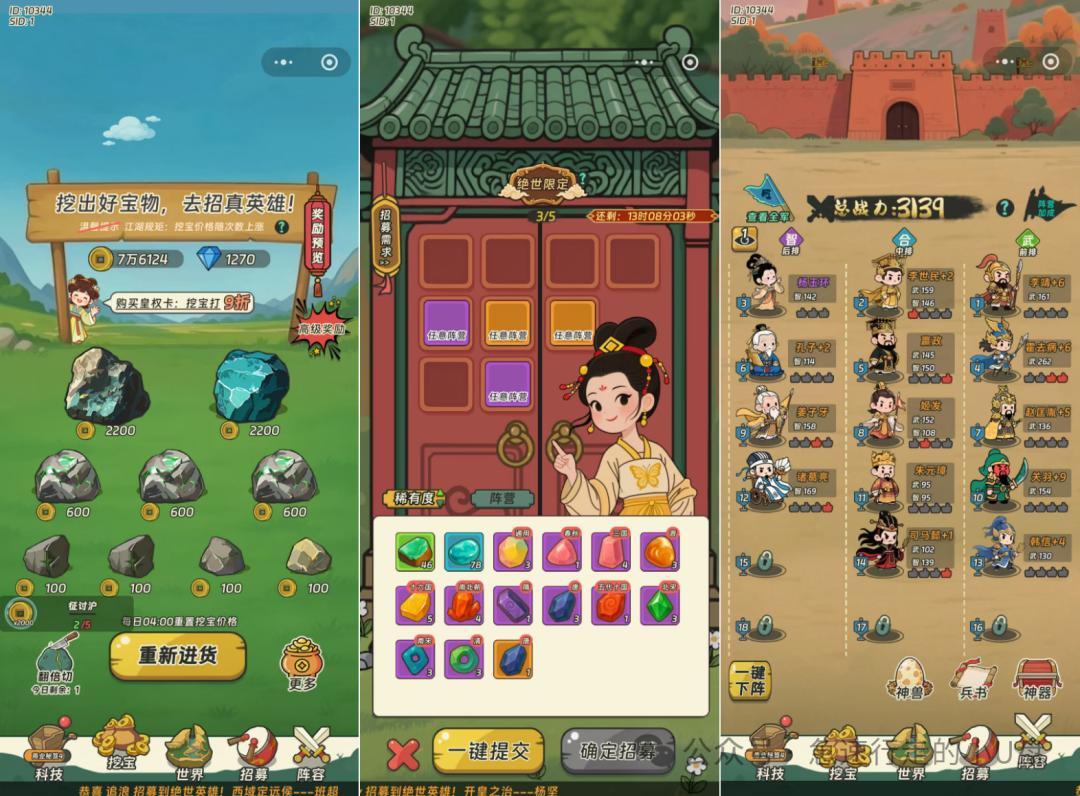
Most SLG mini-games in the market uniformly adopt the fixed starting pattern of "main city construction → resource hoarding → recruiting troops to siege cities". "Little Soldiers Have a Future" reverses the new player guidance logic, taking the light strategy of merchant running as the main line and core checkpoint at the beginning of the game. Players don't need to engage in complex city construction when they start the game, achieving positive feedback of "low investment, immediate returns".
The entire merchant running system is not just a simple side gameplay embellishment, but the underlying economic foundation that connects the entire cultivation chain. In essence, the product forms a composite gameplay system with simulation management as the core and sandbox SLG battle as the long-term goal.

In addition to the merchant running economic system, the game adds a special module similar to "stone gambling and treasure hunting". Different payment levels of players are provided with graded raw stone options, with a clear payment gradient and no forced payment design. Gems are the only core directional material for the entire cultivation process, only used for hero recruitment, star promotion, and skill breakthrough.
The entire numerical link forms a closed loop: running a business to hoard goods and earn currency → using currency to buy raw stones for stone gambling → using gems to cultivate powerful heroes → heroes improving merchant running income and battle strength. The income of each link can be intuitively perceived, and the motivation to pay is naturally generated, avoiding the numerical fault problem of traditional SLGs where "payment only increases combat power and resource acquisition is fragmented".
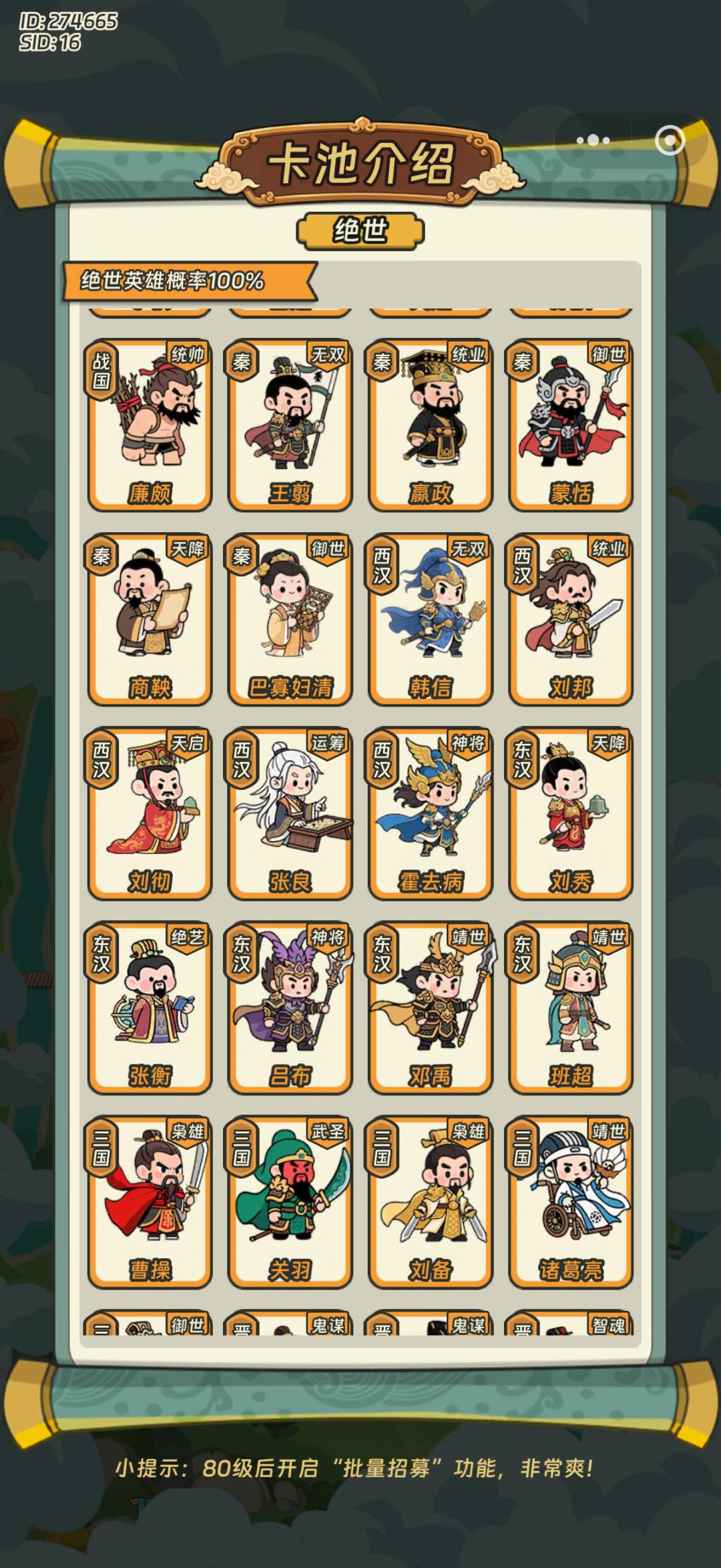
In terms of theme, most SLG mini-games in the market are highly concentrated in the single historical frameworks of the Three Kingdoms and the Sui and Tang Dynasties, causing serious aesthetic fatigue among users. "Little Soldiers Have a Future" adopts an imaginary world view that combines the historical span from mythological legends to the Qing Dynasty with well - known overseas characters, breaking the limitation of a single historical IP and making the character design more memorable. The art style uses soft Q - version cartoon character illustrations, with a lightweight and cute style.
Objectively speaking, "Little Soldiers Have a Future" still has some product shortcomings: First, there is insufficient content for long - term high - combat - power player confrontation, and the repetition of late - stage gameplay increases. Second, the exposure of hardcore SLG battle content is insufficient, making it difficult to attract core strategy players. Third, the world - view plot foreshadowing is weak, and there is a shortcoming in retaining plot - oriented players.
Advertising and Creativity
【Facts & Data】
(1) Advertising Placement
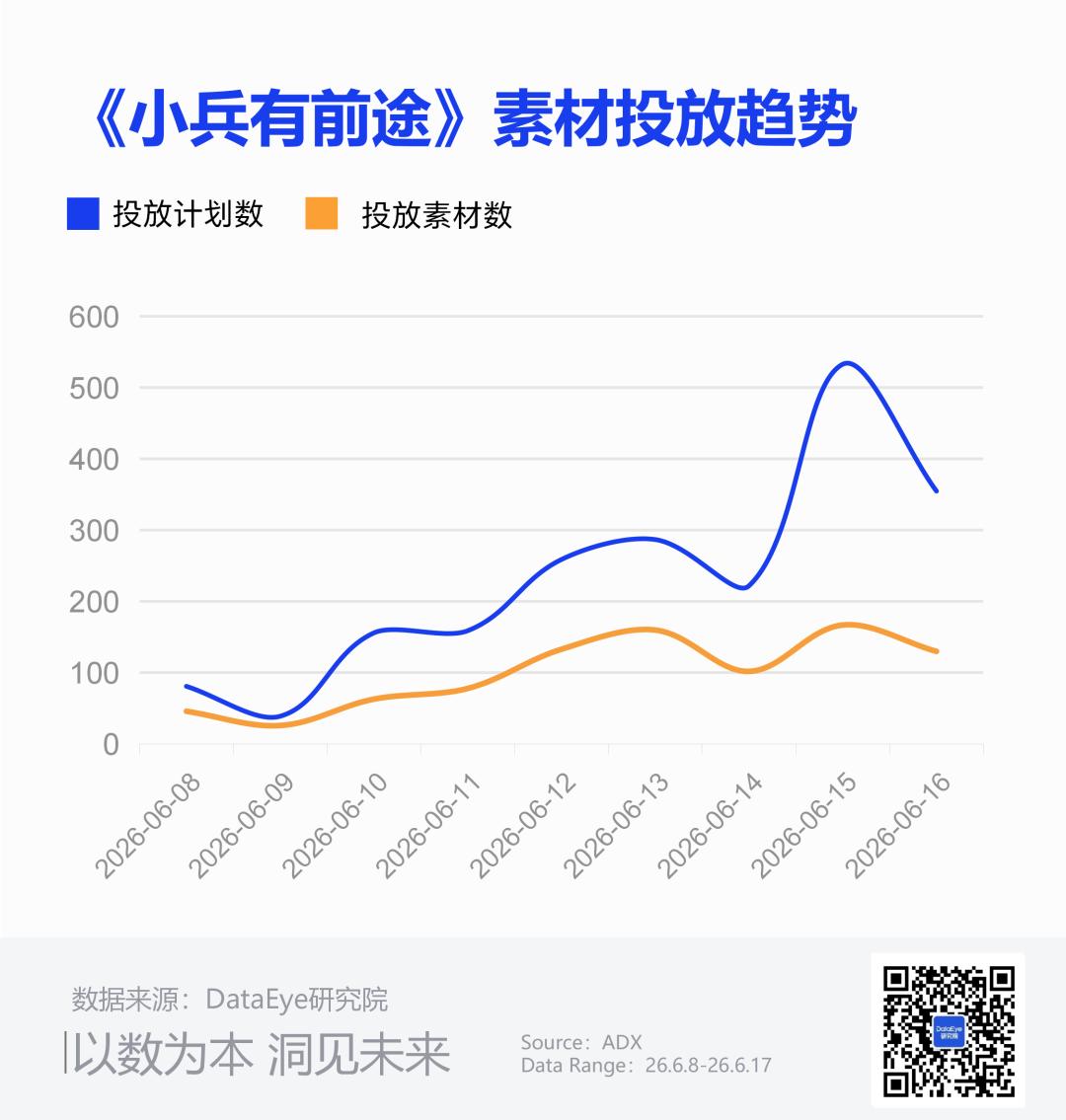
DataEye - ADX placement data shows that "Little Soldiers Have a Future" started advertising material placement on June 8, but the overall volume of advertising material placement is not prominent, maintaining a placement volume of two - to three - digit numbers.
(2) Creative Advertising Materials
The creative advertising materials with high exposure of "Little Soldiers Have a Future" counted by DataEye - ADX mainly have the following characteristics.
1. Comic - drama - style lead - generation materials: The beginning uses a comic - drama narrative form, with "an ordinary food delivery guy accidentally traveling back to ancient times" and "a modern office worker possessing a little soldier" as strong hooks to quickly capture users' attention. In the middle of the plot, there is a rapid reversal, intuitively showing the core exciting point of "a little soldier making a comeback to become a famous general", and conveying the dual gameplay experience of "low - threshold management + famous general SLG battle".

2. AI - oriented materials: Use AIGC to quickly generate ancient - style virtual character images, build interesting and contrasting plots, and capture the attention of short - video users through dialogue conflicts and reversal plots to complete traffic guidance.

3. Real - person - oriented materials: Use the template of beautiful real - person appearance for lead - generation as a supplement to exposure. The real - person shot quickly grabs users' attention in the first 3 seconds, and in the middle, real - game merchant running and general battle scenes are interspersed to balance the breadth of materials and expand the overall traffic exposure pool.

【DataEye Research Institute's Viewpoint】
By horizontally comparing with multiple WeChat and Douyin mini - games launched during the same period in June, "Little Soldiers Have a Future" has formed a differentiated approach in the logic of advertising material production and the rhythm of traffic placement, which has extremely high reference value:
First, it abandons the idea of involution with a large number of materials. Most top WeChat mini - games generally place more than a thousand groups of new advertising materials per day, relying on the wide - net - casting model to obtain exposure, resulting in high placement costs. However, "Little Soldiers Have a Future" only places about a hundred groups of advertising materials per day, indicating that it does not rely on high - cost advertising to acquire customers.
Second, it selects three types of lightweight and eye - catching materials, targeting the pain points of short - video users. Comic - drama time - travel, AI short dramas, and real - life beautiful women are all high - retention traffic elements verified by the market on short - video platforms, which can capture users' attention in the golden three seconds and increase the traffic ceiling of a single material with low - cost creativity.
However, this placement model also has some shortcomings: The material system over - emphasizes casual management and time - travel comeback exciting points, and the proportion of materials related to large - scale sandbox SLG battles and alliance strategy confrontation is extremely low. Long - term placement will solidify users' single perception of the product as a "simulation management mini - game", making it difficult to attract in - depth SLG strategy players. In the future, the placement of real - game battle materials can be balanced and expanded to improve the material structure.
AI Brings More Possibilities for Mini - Game Manufacturers
Recently, the DataEye Research Institute has successively reported on "Three Kingdoms: The Re - emergence of Destiny" by Xinghui Entertainment, "Zhao Yun and A Dou" by Honey Pot Workshop, and "City - Occupying Master" by Wuhan Duoqu.
It can be found that there are obvious differences in the placement logic between WeChat mini - games and Douyin mini - games. "Zhao Yun and A Dou" and "City - Occupying Master" focus on pure gameplay materials, and the marketing content is highly vertical. While "Little Soldiers Have a Future" and "Three Kingdoms: The Re - emergence of Destiny" pay more attention to the placement of AI materials.
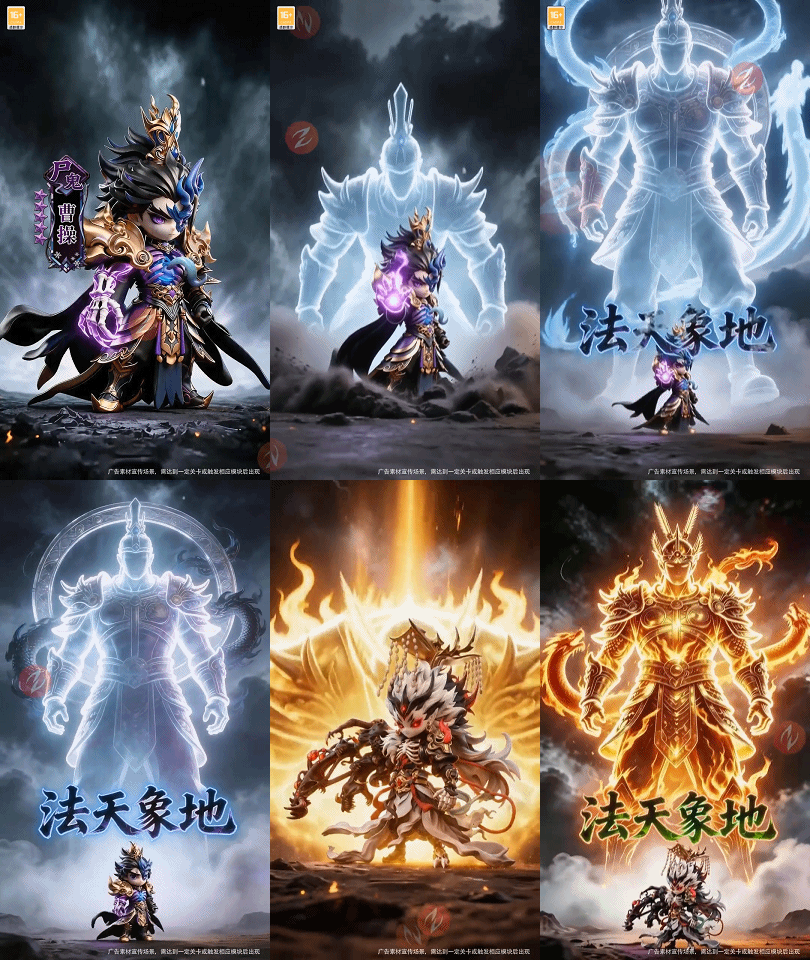
An example of AI material placement for "Three Kingdoms: The Re - emergence of Destiny"
There may be two reasons for this:
(1) Douyin's traffic distribution is centered around the short - video content recommendation algorithm. Users have a strong sense of entertainment randomness when browsing videos and have no clear game search needs. Platform users value the authenticity of advertising content more and dislike exaggerated lead - generation materials with inconsistent plot and real - game content. At the same time, Douyin mini - games mainly rely on advertising for monetization, and users pursue a lightweight and intuitive game experience. Understanding the gameplay at a glance is the key to conversion.
Therefore, Douyin mini - game manufacturers are more willing to place pure real - game gameplay materials without packaging or additional plots, directly showing the core content of the game, reducing the gap between users' expectations, with higher material authenticity and a shorter conversion link. Once the plot materials are over - packaged, it will inevitably lead to users' disappointment and negative reviews, which will affect the traffic rating of the materials.
(2) WeChat platform users browse videos at a slower pace and have a higher acceptance of plot - oriented and story - oriented content. Crude and straightforward pure gameplay materials are likely to cause aesthetic fatigue. AI comic - drama - type materials combined with time - travel and comeback - type plots are more likely to arouse the empathy of office workers, increasing users' willingness to click. The threshold for material volume increase is lower, further promoting manufacturers to increase the placement of AI materials.
Before the large - scale application of AI materials, small and medium - sized manufacturers were restricted by capital and manpower shortages, and could only follow the trend and copy general template materials, falling into low - price involution and having difficulty in creating differentiated content. The Matthew effect in the track became more and more serious.
After the AIGC technology was applied to mini - game advertising, it reconstructed the material production link: manufacturers only need to input the plot script, and they can quickly generate AI virtual characters and AI comic - drama videos.
For small and medium - sized manufacturers, AI materials bring three core values: First, produce differentiated creative content at low cost and get rid of the involution of general materials. Second, quickly test multiple versions of plot hooks, locate high - conversion advertising content, and reduce the trial - and - error cost of placement. Third, even with a small budget, high - quality plot materials comparable to those of large manufacturers can be created, and breakthroughs can be achieved through creativity rather than budget.
Combined with industry data, AI is no longer just a marketing bonus, but a basic standard ability for mini - game advertising.
This article is from the WeChat official account "DataEye" (ID: DataEye), author: Yj, published by 36Kr with authorization.