When AI enters organizations, why choose Feishu?
In the past two years, companies thought it was simple to claim they "had AI": connect to large models, create a few intelligent assistants, and then launch a set of Agents.
However, by 2026, the situation has changed.
Companies are no longer just asking "Do we have AI?" Instead, they are starting to ask more specific questions: Can AI be integrated into real - world workflows? Can it understand the internal permissions, knowledge, and business context of the company? Can it participate in cross - departmental collaboration? Can it transform individual experience into organizational capabilities? Can it be tracked, reused, and continuously iterated?
We can see that companies' focus on AI has shifted from a "function competition" to "organizational implementation."
This is why platforms that were previously regarded as office collaboration tools are being re - evaluated, turning it into a battle that no major company can afford to lose.
According to insiders, since 2026, 90% of new Feishu customers have purchased Feishu's AI capabilities. The significance of this data is not that companies are more willing to buy an AI product, but that the purchasing logic of companies is changing: they are no longer willing to pay for "seeming to have AI," but are starting to pay for an infrastructure that allows AI to be integrated into organizational operations.
At this stage, model capabilities are still important, but they are no longer the only answer. What companies truly need is the ability to enable AI to understand the organization, connect processes, access knowledge, handle permissions, and enter the business scene. This is precisely what puts collaboration platforms in a new position.
Companies Don't Want More AI Features, They Want AI to Truly Enter the Workplace
There have been two subtle but highly significant changes in Feishu's recent offline advertisements.
One is the iteration of the slogan. It has evolved from the previous "Advanced teams use Feishu first" to "Advanced teams use Feishu for AI."
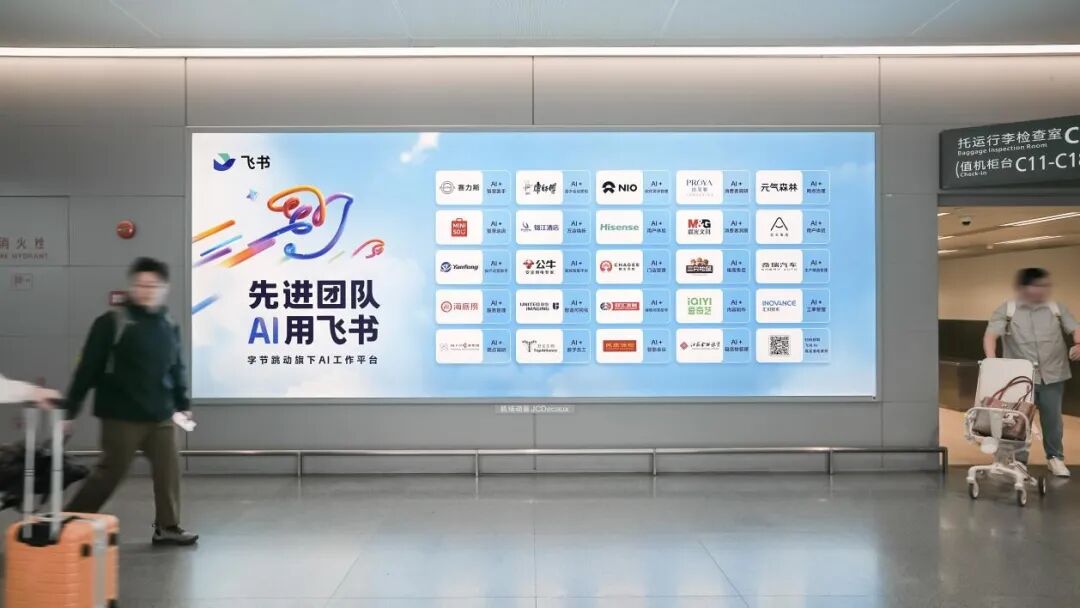
The other is the expansion of the reach radius. Feishu's advertisements are no longer limited to airports in first - and second - tier cities. They are now appearing at high - speed railway stations, in the mass media of regional cities, and even on TV channels, being aired during prime time on multiple CCTV channels. It can be seen that compared with the previous vanguard expression targeting internet geeks and vertical advanced organizations, Feishu is accelerating its reach to a wider and more diverse customer base of traditional enterprises.
The expansion of the advertising coverage radius means that the basic market for Feishu's services is sinking and becoming more generalized; the leap in brand expression means that the core value it outputs is being reconstructed.
In the past, Feishu emphasized collaboration efficiency. However, as corporate AI enters the second half, Feishu has noticed that people's focus has shifted to how to truly integrate AI into the organization. "Use Feishu for AI" is Feishu's sensitive response to the phased leap of corporate AI.
This change is not only reflected in the brand.
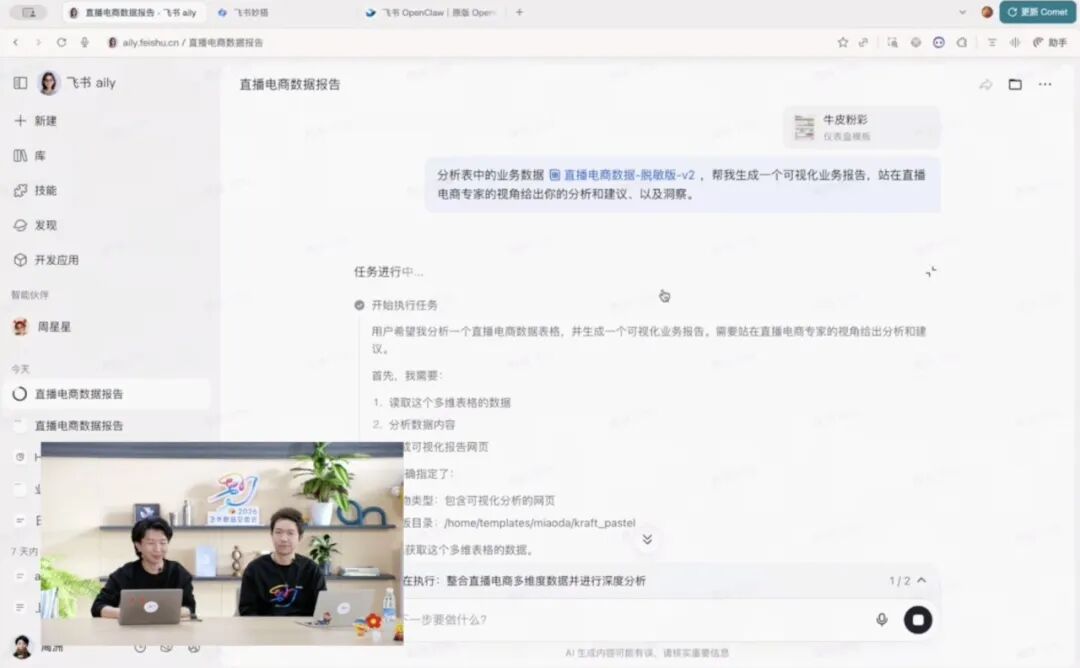
At this year's spring press conference, Feishu presented AI in a way of "full - length live demos, no PPTs." It even brought real - world workflows onto the stage for demonstration, rather than telling stories with carefully edited videos or conceptual product images. Behind this is actually a response to the most practical concerns of corporate customers: rather than having one more AI feature, companies are more concerned about whether it can actually get the job done.
In July 2025, Feishu released an AI application maturity model, dividing AI applications into different stages from proof - of - concept to full - scale application. The value of this model does not lie in creating a set of new terms, but in reminding companies that the standard for judging AI should not be just the number of features, but its usability in real - world business.
This matter, viewed today, exactly corresponds to the change in companies' payment logic.
It's not "Does my company have AI?" but "Does my company have the ability to integrate AI into work?" If AI lacks a permission system, has no context awareness, cannot connect workflows, and fails to achieve knowledge precipitation and data connection, it is likely to become a "personal add - on": individual employee efficiency may increase, but experience cannot be reused, knowledge cannot be precipitated, and the collaboration mode does not really change.
Therefore, compared with a single model, a single feature, or an isolated product, companies' positioning of AI is more important and precise. They need a whole set of high - dimensional operating environments for AI. These collaboration tools, such as documents, messages, meetings, knowledge bases, approval processes, multi - dimensional spreadsheets, and business connectors, also become natural entry points for AI to truly enter workflows, organizational flows, and business flows.
The popular open - source project OpenClaw at the beginning of this year is an excellent observation window. On the surface, Feishu has caught the wave of developer enthusiasm, but the deeper logic is that developers are "voting with their feet." They naturally choose a closed - loop platform that already has real organizational scenarios, multi - dimensional data, and natural workflows.
Subsequently, Feishu's CLI (Command - Line Interface), which achieved over 10,000 stars on GitHub in May this year, further proves that Feishu can not only "catch a wave of AI enthusiasm" but has also long - term planned to actively build the next - generation workplace platform in the Agent era, deeper connecting developer capabilities, agent capabilities, workflow capabilities, and organizational collaboration capabilities.
At "Luo Yonghao's Crossroads," Li Xiang, the CEO of Li Auto, mentioned that all AI Agent entrances within Li Auto are placed on Feishu. This statement is important because it clarifies Feishu's position in the AI era: within some advanced enterprises, Feishu has begun to assume the role of an Agent entrance.
First, we need to make AI truly run within the organization before we can implement concepts, cognition, and products.
Similar changes have begun to appear in real - world industrial scenarios. At the beginning of this year, at the Beiqi Foton Changsha Super Truck Factory, it used to take 6 people to search for data across systems, summarize, and analyze for an operation daily report. It could take as fast as 2 hours or as slow as half a day.
Now, the intelligent agent "Changchao Xiaofu," built based on Feishu and the OpenClaw technology framework, can complete the daily report in 2 minutes, connect orders, production, and inventory, and directly provide problems and adjustment suggestions. This is not a typical "office efficiency improvement" story, but an AI workflow case in the manufacturing field. AI is no longer just answering questions, but starting to participate in information aggregation, anomaly identification, decision - making assistance, and continuous tracking.
In high - compliance and strongly - audited innovative pharmaceutical companies, AI has also begun to enter the quality management scene. Junshi Biosciences introduced Feishu aily and multi - dimensional spreadsheets in the clean production area to build the "GMP - VisionGuard" intelligent inspection system. The system identifies violations through the edge - side model, then the large model explains the reasons, captures the monitoring images in seconds, and automatically generates an evidence package containing video clips and timestamps, which is pushed to the inspection group. This has shortened the anomaly discovery time from "hours" to "seconds" and reduced the manual audit workload by more than 50%.
Feishu's leading position in this competition is not only because it has more aggressively embraced AI. More importantly, it prepared the foundation earlier. At the underlying level, Feishu naturally has the infrastructure to organize, precipitate, access, and reuse knowledge and workflows, making it the most suitable "black land" in the current market to undertake AI workflows.
Therefore, the reason why more and more companies choose Feishu because of AI may not be the number of features.
From this perspective, what Feishu delivers to companies is actually four levels of progressive capabilities: at the product level, it provides native AI that is easily accessible and ready - to - use; at the workflow level, it naturally connects AI with documents, processes, knowledge, and collaboration; at the organizational level, it transforms AI from a geek experiment in local departments into the organizational capabilities of the whole company; at the methodology level, it helps companies establish talent mechanisms, usage cultures, and new production relationships that are compatible with AI. Today, when companies buy Feishu, they are not just buying an AI product, but a set of methodologies that enable AI to truly enter the organization and play a role.
The Past Collaboration Accumulation is Being Re - Amplified by AI
At this moment, as corporate AI enters the second half, Feishu's past accumulation has formed a compound growth effect. This compound effect comes from at least three levels of market changes.
First, it is the "scenario compound effect" brought by advanced organizations.
In the past few years, Feishu often first entered companies with the fastest organizational changes and the highest collaboration complexity.
In the new - energy vehicle track, from NIO, Li Auto, and XPeng to Xiaomi Auto, Voyah, IM Motors, and Avatr, Feishu covers a group of the most representative high - growth vehicle manufacturers in the industry; in the large - model industry, from DeepSeek, Zhipu to MiniMax, a group of the most cutting - edge AI companies have also built their organizational collaboration on Feishu; in addition, high - growth consumer brands such as Yuanqi Forest and Miniso. Although these companies seem to belong to different tracks, they face the same type of organizational problems: rapid business changes, fast organizational expansion, intensive cross - departmental collaboration, and high - speed updates of knowledge, processes, and decision - making chains.
These companies initially chose Feishu mainly to solve the collaboration efficiency problems in the high - growth stage: to make information flow faster, project progress more transparent, and cross - departmental communication costs lower. However, in the AI era, the same set of collaboration relationships has begun to generate new value.
For AI to truly enter the organization, it first needs to enter the most real - world work scenes of the company: R & D processes, production management, sales operations, store execution, knowledge bases, meeting minutes, project collaboration, and decision - making chains. The higher - growth and more complex the organization, the earlier these problems are exposed, and the more it needs AI not only to answer questions but also to participate in processes, access knowledge, assist in judgment, and precipitate experience.
The advanced customers that Feishu has accumulated in the past are not just "high - quality customers" in terms of brand, but a group of high - density scenarios that are naturally suitable for verifying organizational - level AI. In these companies, Feishu originally carried the collaboration between people; now, AI can enter the knowledge flow, business flow, and decision - making flow along these existing collaboration links. Therefore, Feishu's value has been upgraded from "improving collaboration efficiency" to "helping AI enter organizational operations."
This compound effect is also reflected in time.
In 2025, Zhang Wenzhong, the founder of Wumart Group and Multi - point Dmall, mentioned that Wumart was one of the earliest companies to use Feishu. In 2019, when Feishu was not yet officially open to the public, after extensive domestic and international comparisons, Wumart judged that Feishu was "ahead" and migrated to the Feishu platform at the fastest speed. Looking back a few years later, this has proven to be a "very correct choice."
This statement has a clearer meaning in the AI era.
Companies that chose Feishu early are not looking for new tools after the arrival of the AI wave, but are continuing to evolve on the existing organizational foundation. The documents, meetings, projects, approvals, knowledge bases, multi - dimensional spreadsheets, and collaboration habits that have been precipitated on Feishu in the past few years have become ready - made entry points for AI to enter the organization.
Therefore, Feishu's "stock compound effect" is not the halo brought by the customer list itself, but the workflows, knowledge flows, and collaboration relationships that these companies have accumulated during long - term use are being re - activated by AI. The earlier an organization precipitates its operations on Feishu, the easier it is for the company to transform its past digital assets into new organizational capabilities when AI arrives.
Second, it is the "incremental compound effect" of traditional industries breaking through the circle.
If internet companies, new - energy enterprises, and large - model companies are more receptive to AI, the choices of traditional enterprises are often more indicative of whether AI has truly entered the mainstream business scene. Because traditional enterprises are more cautious. They pay more attention to stability, security, compliance, and long - term certainty. They will not easily replace the organizational foundation for a new concept unless this change is directly related to business efficiency, business response speed, and organizational transformation. This is also where the recent change in Feishu's customer structure is worth observing.
The new trend is that Feishu's customer list is rapidly breaking through the internet, and more and more leading companies in various tracks are starting to choose Feishu because of AI. For example, Haitian Flavoring & Food, Seres, Jinjiang Hotels (China Region), Hisense Group, Shuanghui Group, etc.
Many retail enterprises that are undergoing in - depth adjustment and transformation have also placed Feishu at the core of their organizational reform and business transformation. For example, Wang Shoucheng, the CEO of Yonghui Superstores, once said: "Feishu will become one of the core engine projects for our second - stage adjustment work. Choosing Feishu is a strategic decision after careful consideration and rigorous verification."
A more representative change comes from high - compliance industries. In the past, such enterprises were more inclined to private deployment to ensure security, stability, and controllability. However, in the AI era, the platform's continuous iteration ability has also become equally important. Since 2026, some customers who have used the private version of Feishu for many years have started to switch to the SaaS version. This is not a simple software migration, but a re - balance of security, openness, and technological iteration by enterprises. For them, the organizational foundation in the AI era needs to not only maintain the boundaries of permissions and compliance but also be able to continuously access new capabilities.
At the same time, front - line employees have become the real "protagonists" of AI implementation.
Many companies tend to think that AI implementation is the responsibility of the technology department. However, when AI truly enters the organization, its greatest value often occurs not only in the technology department but in the front - line where people understand business pain points best. Because front - line employees know best where there is repetition, inefficiency, errors, and where standardization is needed.
They understand the business but may not be able to write code; they know how to optimize processes but may not be able to build tools; they know where the problems are but find it difficult to transform personal experience into organizational capabilities.
At Atour Hotels, the front - line team created a "AI Food Safety Protection Plan" based on Feishu's multi - dimensional spreadsheets, AI Agents, and Internet of Things technology. In the past, pasting expiration date labels on food ingredients was a purely physical task, requiring manual label printing and verification; now, through voice or photo, label printing and warehousing can be automatically completed, transforming non - standard operations into standard data streams. This solution has increased efficiency by more than 300,000 hours per year for Atour, saved 7.5 million yuan in labor costs, saved 25 minutes per day per store, and has been implemented on a large scale in stores.
The most interesting part of this case is not how much cost was saved, but that the people who created this system are not programmers but front - line employees. This shows that AI implementation does not necessarily start from the technology department but can start from the people who understand business pain points best.
The story of NavInfo also illustrates this point. In the past, the pre - launch review of products required more than a dozen business colleagues to handle centrally, checking hundreds or thousands of documents one by one, and more than twenty to thirty review experts to conduct long - term manual comparisons. The whole process often lasted for weeks. Later, an employee who was not a programmer built the Smart QMS system using Feishu's aPaaS and AI capabilities, allowing AI to take over the repetitive review work, reducing the original weeks - long work to a few minutes, saving an average of 300 hours per review, and reducing the annual cost by about 25 million yuan.
This kind of case is more convincing than grand AI narratives. It proves that when tools are close enough to the business, ordinary employees can transform experience, processes, and judgments into system capabilities