Executives take pay cuts, rank-and-file workers get pay rises, and this time the bank isn't just making empty promises.
Let employees' "wallets" bulge! Banks are taking swift action to implement this.
Tianyancha shows that in 2025, the salaries of the management of listed banks overall "shrank". Only 6 out of 42 banks recorded positive growth.
Meanwhile, the "trimmed fat" didn't disappear out of thin air. Instead, it flowed to a large number of front - line employees, and more banks achieved an increase in per - capita salary in 2025.
This means that the balance is tilting towards the grass - roots level, and it also reflects that the salary structure of banks is undergoing profound adjustments.
01 Bonuses for Front - line Employees
A customer manager of a city commercial bank in Inner Mongolia found that his monthly salary steadily increased from 8,000 - 9,000 yuan in 2024 to about 10,000 yuan. He also gets a fixed monthly subsidy of 500 - 800 yuan, and additional transportation subsidies for rural services.
Li Na, a teller at the Bank of Communications, happily revealed, "My annual salary increased by about 3% last year, reaching between 100,000 and 130,000 yuan."
Li Xiang, who has worked at the Agricultural Bank of China for five years, has a say. His total income in hand in 2025 increased by nearly 20,000 yuan.
On Xiaohongshu, there are also many posts about salary increases in banks, mainly targeting grass - roots employees.
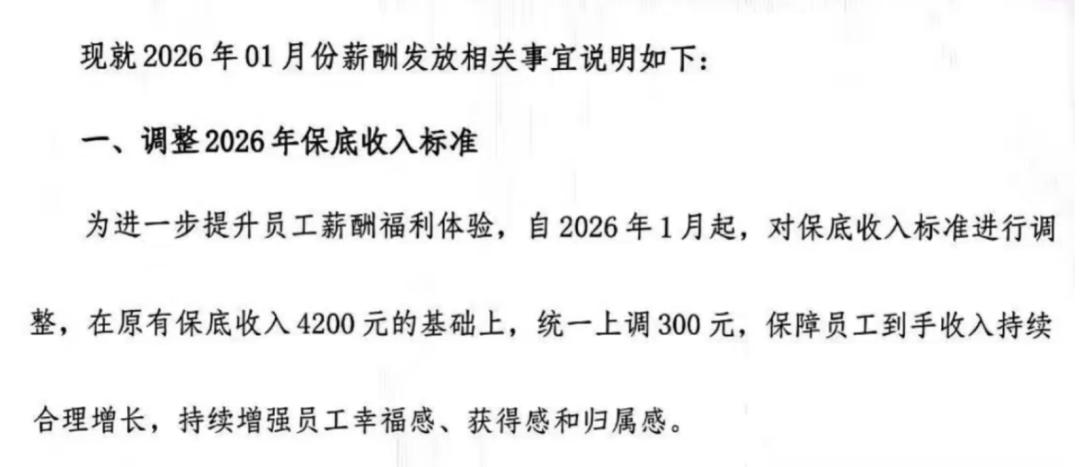
Qicaijing noticed that recently, a large bank issued a notice: Starting from January 2026, it will adjust the minimum income standard, uniformly raising it by 300 yuan on the original basis of 4,200 yuan...
▲ Source: Xiaohongshu
Data doesn't lie.
According to the Wind Financial Terminal, the total labor cost of listed banks in 2025 was about 973.7 billion yuan, showing a slight reverse increase compared with 959.7 billion yuan in 2024.
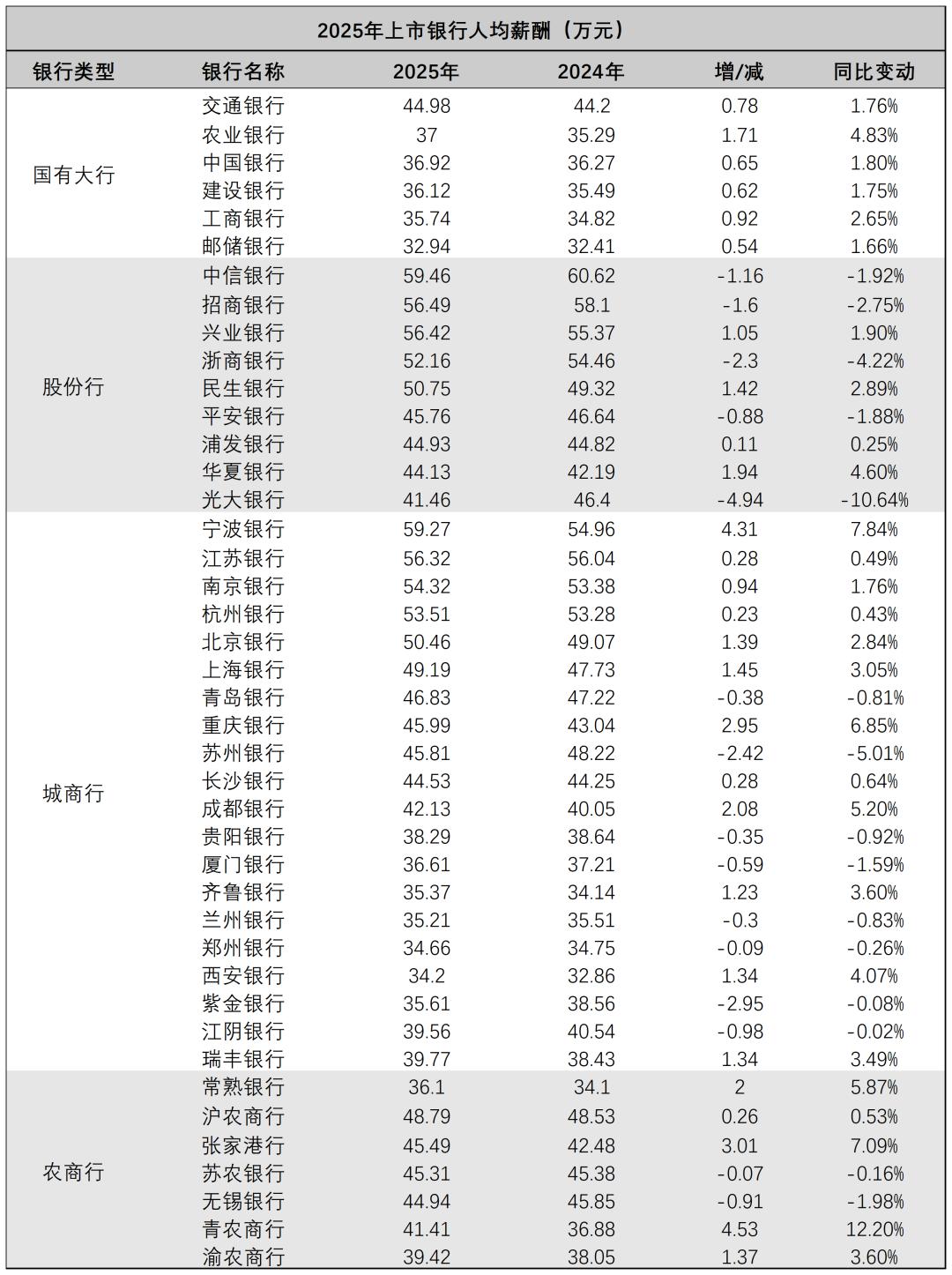
Among them, the state - owned large - scale banks performed particularly well. The per - capita salaries all increased to varying degrees. The Agricultural Bank of China even directly raised its per - capita salary from 360,000 yuan in 2024 to 378,000 yuan, an increase of 18,000 yuan.
Among joint - stock banks, city commercial banks, and rural commercial banks, although there were both increases and decreases, salary increases were the mainstream. Among 36 banks, 21 had salary increases, with city commercial banks as the backbone, accounting for 12 seats.
Specifically, in 2025, the per - capita salary of Ningbo Bank, Chongqing Bank, Chengdu Bank, Xi'an Bank, and Qilu Bank increased significantly, with increases of 7.84%, 6.85%, 5.2%, 4.07%, and 3.6% respectively.
Among rural commercial banks, 5 had salary increases and 2 had decreases. The per - capita salary of Qingdao Rural Commercial Bank increased by 12.2%, and that of Zhangjiagang Rural Commercial Bank and Changshu Bank also increased by 7.09% and 5.87% respectively.
In the joint - stock bank camp, salary cuts were more common. China Everbright Bank even had a significant cut of over 10%. However, it should not be ignored that joint - stock banks have always been high - salary bases. Even if there is a cut of tens of thousands of yuan, the per - capita salary is still far ahead in the industry.
In sharp contrast to the general increase in the industry's per - capita salary, the "wallets" of most bank executives, including directors, supervisors, and senior managers, quietly shrank.
In 2025, the total salary of the management of 42 listed banks was 561.6691 million yuan, a full reduction of more than 145 million yuan compared with 707.0592 million yuan in the previous year.
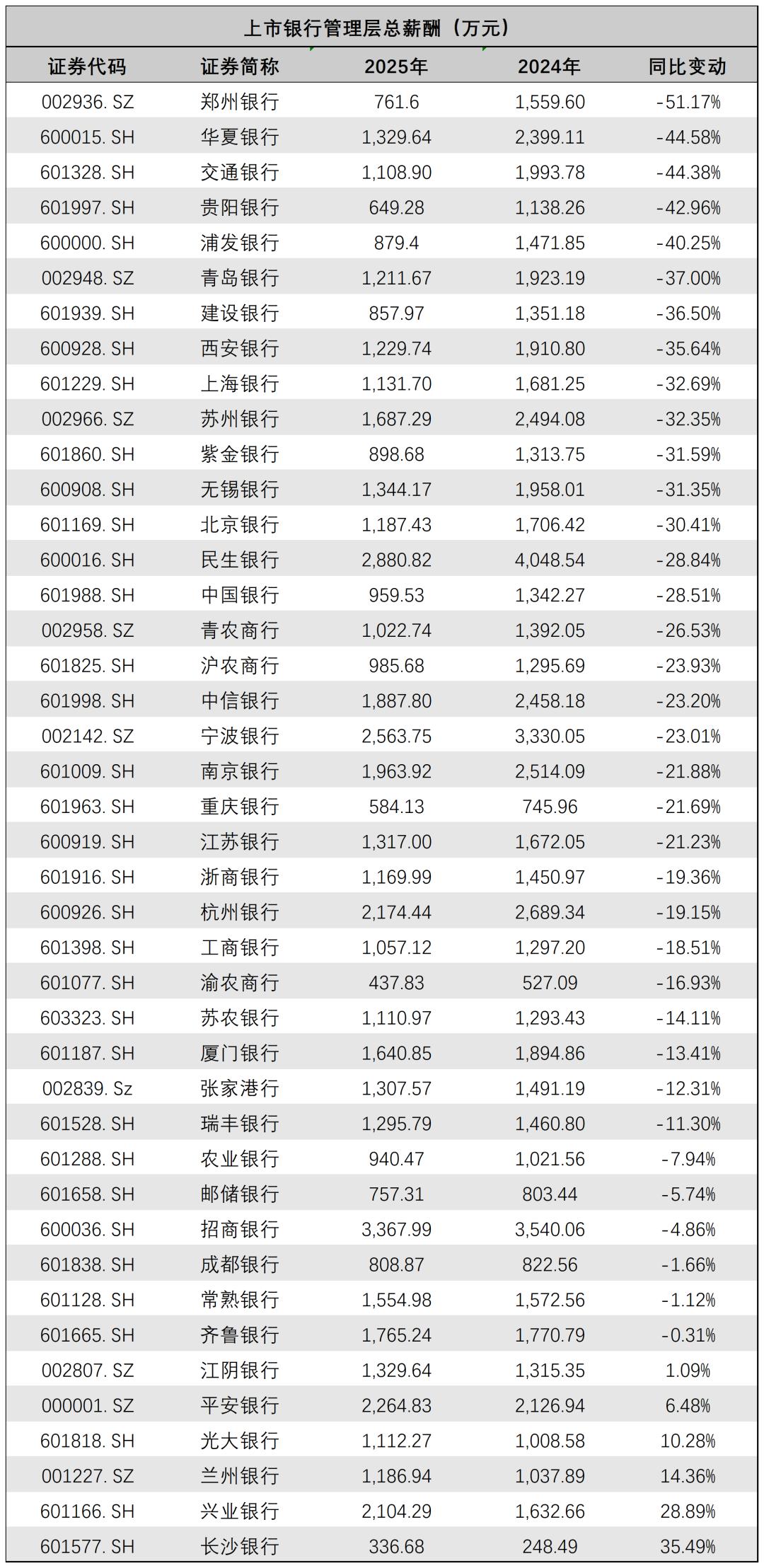
Take Zhengzhou Bank as an example. In 2024, the bank paid a total of 15.596 million yuan to its executives, which suddenly dropped to 7.616 million yuan in 2025, equivalent to a halving.
For another example, Huaxia Bank, the Bank of Communications, Guiyang Bank, and Shanghai Pufa Bank also made significant cuts to their executives' salaries, with the salary cuts of executives all exceeding 40%.
The same is true for Bank of Qingdao, China Construction Bank, Xi'an Bank, and Shanghai Bank, which also mercilessly lowered the executives' salaries.
From an arithmetic perspective, since the per - capita salary is calculated based on all employees, if we exclude bank executives whose "salaries" have dropped sharply, the salary increase of front - line employees in 2025 is likely to be much higher than the increase in per - capita salary.
This pattern of both cuts and increases reflects the fundamental shift in the current "commanding baton" of bank salary distribution from the side.
The Industrial and Commercial Bank of China said in its annual report: "We adhere to the distribution concept of maintaining fairness and unifying incentives and constraints, and strengthen the inclination of salary resources towards grass - roots employees."
The Agricultural Bank of China also wrote: "Allocate county - level salary resources in an inclined manner, and strengthen care and support for grass - roots employees."
The China Merchants Bank follows the salary management principles of "value guidance, linking work efficiency, and risk constraints", and adheres to the principle of "high or low pay according to performance, more pay for more work".
02 Behind the Banks' "Awakening"
Banks are not charities. They won't give up profits for no reason. There are two driving forces behind this salary change of "cutting executives' salaries and increasing front - line employees' bonuses".
The first force is the "strict requirements" of policies.
In 2025, one of the most significant events in the financial circle was the salary guidance document for state - owned financial institutions issued by the Ministry of Finance. The red lines drawn in the document are very clear: The annual salary of the "top leader" of the group, as an administrative cadre, is capped at 1 million yuan, and the annual salary of the head of a subsidiary with the attribute of a professional manager should not exceed 3 million yuan. It is strictly prohibited for subordinates to have higher incomes than their superiors.
According to Caixin, around September 2025, relevant documents from the Ministry of Finance were issued to the headquarters of 27 central financial enterprises. The core orientation of the document is very clear: Salary resources should be inclined towards the front - line and grass - roots levels, and department - level cadres at the head - office level are most affected.
Some industry insiders calculated for this round of reform: The MDs of top securities firms who had an annual salary of tens of millions of yuan in previous years can now only get a maximum of one - third of the original. The total salary of the executives of Citic Securities directly dropped by 69.61%, which is called a "severe cut". Banks may not be as "volatile" as securities firms, but the direction is the same - state - owned financial enterprises should return to their public - welfare nature and can no longer rely on license dividends to support a group of high - paid elites.
In other words, it's not that banks "understood", but that they "had to understand".
The second force is the change in the industry's survival logic.
With the narrowing of interest margins and fierce competition, banks have long bid farewell to the era of "easy money" and are living a tough life. Against this background, "cost reduction and efficiency improvement" has become a high - frequency term in the annual reports of every bank.
But whose "cost" should be reduced? This is a choice. Bank management has calculated clearly: Instead of letting a few executives take the lion's share of the cake, it's better to invest the money in the front - line, because front - line employees are the ones who really create performance.
In 2025, China Merchants Bank conducted all - round recruitment. The retail finance department increased by more than 1,700 people, and the corporate finance department increased by more than 700 people; The total number of employees of the Agricultural Bank of China increased for two consecutive years. At the end of 2025, it reached 458,000, an increase of 3,119 people compared with the previous year; The total number of employees of China Construction Bank was 378,000 last year, an increase of 1,497 people compared with the previous year...
In essence, this is a strategic re - allocation of human capital after the industry has entered the "deep - water area". It is shifting from a "resource - dependent" model to a "talent - driven" model. Those closer to customers should get more.
In addition, the deep - seated mechanism of "reverse salary collection" has also played a promoting role.
In 2025, the Bank of China recovered 47.178 million yuan in salaries from 4,630 people, with a cumulative recovery of over 100 million yuan in three years; China Merchants Bank recovered 43.29 million yuan, involving 4,415 people; Changsha Bank strictly implemented the deferred payment, suspension of payment, and salary recovery system. In 2025, it issued salary recovery notices to 988 people, with a total amount of 24.5 million yuan.
Industry insiders analyzed that this is directly related to the obvious strengthening of regulatory requirements for liability tracing after the implementation of the salary reform plan.
03 Conclusion
By cutting executives' salaries and increasing front - line employees' bonuses, banks in 2025 finally understood one thing - those front - line employees who carry deposit and loan targets every day, sit in front of the counter all day, and travel dozens of kilometers for a single customer are the ones who really support the trillion - dollar giant ships.
Although the "bonus" may be meager, at least the balance has finally tilted in the right direction.
After all, it's better late than never to let ordinary people's "wallets" bulge.
This article is from the WeChat official account "Qicaijing", author: Hua Cheng, published by 36Kr with authorization.