The most miserable employee under Elon Musk: accidentally deleted three weeks of training data for xAI
An employee's slip of the hand caused weeks of training results to evaporate.
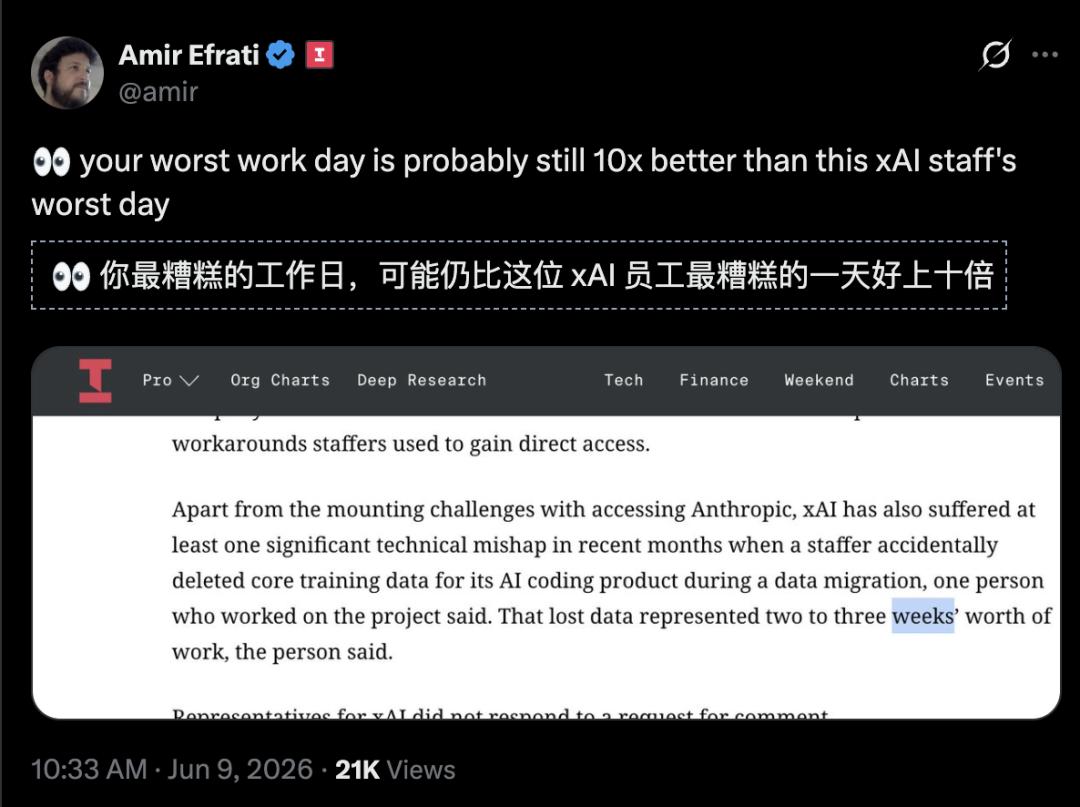
Recently, just as SpaceX was gearing up for an IPO, an embarrassing incident within xAI was exposed by The Information.
According to reports, an xAI employee accidentally deleted the core training data of its programming product during a data migration. A person involved in the project revealed that the deleted data was equivalent to about two to three weeks of work, gone in an instant.
As soon as the news broke, Amir Efrati of The Information reposted the report on X, accompanied by a quip that struck a chord with countless office workers:
Your worst workday is probably ten times better than the worst day of this xAI employee.
The Aftermath of xAI's Restructuring and the Move of V9
The accidental deletion of that two to three weeks' worth of data is less of a slip of the hand and more of a lingering effect of the upheaval caused by Grok's restructuring.
According to TechCrunch in March this year, all 11 co-founders of xAI had left by then. The most concentrated wave was in February. Just a few days after SpaceX completed its acquisition of xAI, the co-founders in charge of reasoning, research, and security successively posted their goodbyes, all within a week.
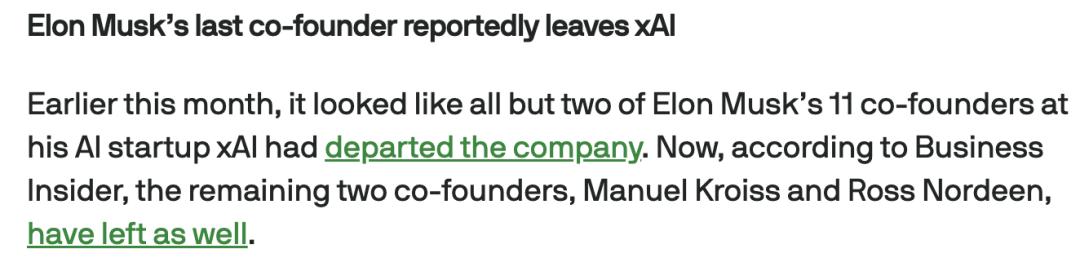
There was another round in May.
According to Fast Company, the CFO resigned, and Heinrich Kuttler, who was in charge of computing power and infrastructure, announced his departure on X.
According to The Information, as the wave of layoffs and departures within xAI intensified, Cursor employees began visiting xAI's offices in early May to meet with employees and discuss their work. About 10 employees of the Grok team were affected by a new round of layoffs.

In a team that is constantly changing, an accidental deletion during a migration was almost inevitable.
On the other hand, the product line has always lagged behind.
In May, xAI launched an early beta version of Grok Build, positioning it as a coding agent and CLI for professional software engineering; at the end of the month, it also launched a public beta of the API for grok-build-0.1, focusing on agentic coding tasks.
It made quite a splash, but it was indeed late to the game. xAI didn't release its first programming-focused model until August last year, when Claude Code and Codex CLI had already gained popularity among developers.
Elon Musk himself admitted that xAI was lagging behind in programming. To compete head-on with Codex and Claude Code, having just the product shell isn't enough; a strong underlying model is also needed, which is why V9 came about.
In mid-May, Musk first hinted that the new base model V9 (1.5T) had completed training and had good benchmark scores, and this didn't even include the Cursor data to be added; the publicly available v4.2 only had about 0.5T and had the old problem of data quality.
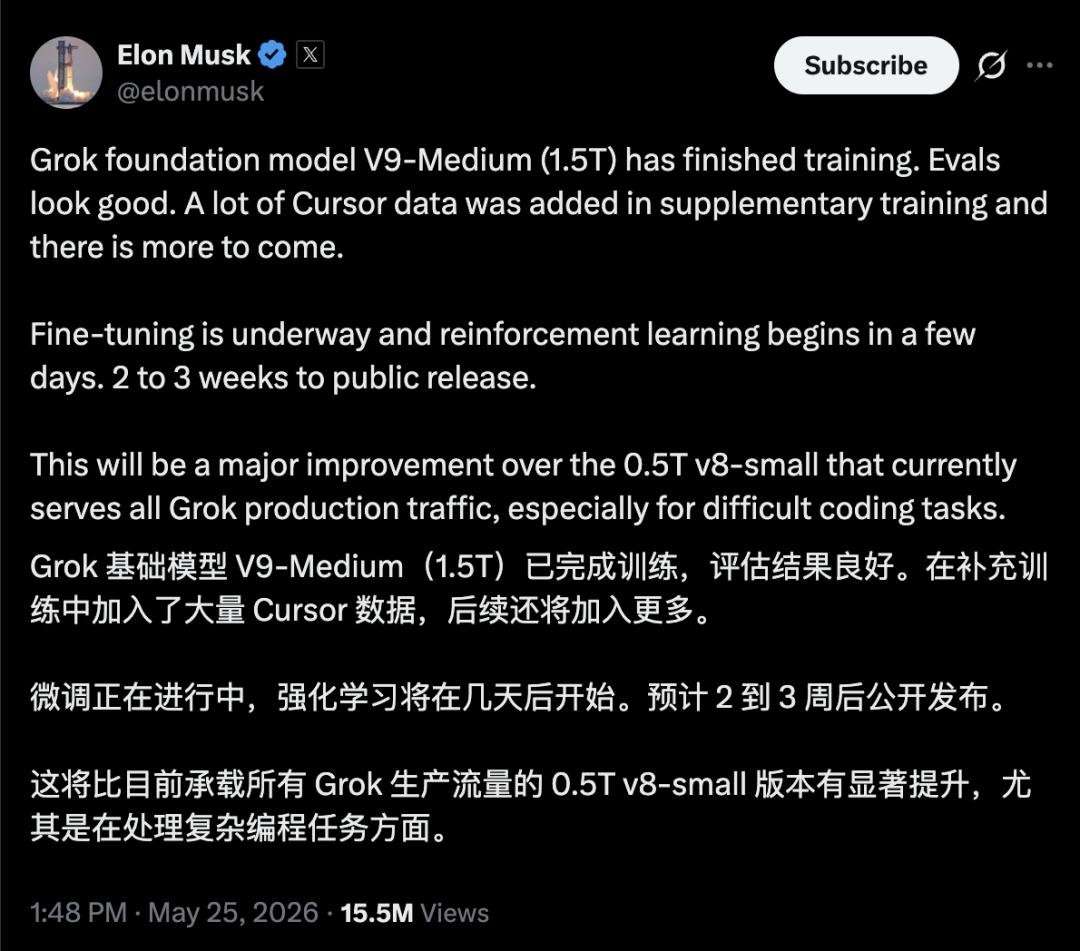
On May 25th, Musk officially announced that V9-Medium had completed training. Its parameter count is about three times that of V8-Small (0.5T), which supports all of Grok's online traffic. It has been optimized for the NVIDIA Blackwell architecture. A large amount of real development data from Cursor has been injected for supplementary training, and more will be added later. It is expected to be launched in two to three weeks.
At this point, the two lines of Cursor have converged: on one hand, its data is being fed into Grok's next-generation model; on the other hand, SpaceX holds an option to acquire it for $60 billion.
After chasing for several years without catching up in programming ability, xAI is now betting on a much younger company.
Ultimately, in the battle of programming models, it all comes down to data. Musk attributes the shortcomings of V8 to the quality, comprehensiveness, and proportion of the data; for V9 to turn things around, the key lies in feeding in higher-quality data that is closer to the real development process.
That's why the deleted two to three weeks of training data is even more important.
xAI Plays a Cat-and-Mouse Game to Catch Up with Claude
Feeding Cursor data and self-developing V9 are the obvious ways to catch up.
In addition, there are some more subtle ways.
According to The Information, two people familiar with the matter said that xAI had carried out a distillation project that lasted for several months, directly using Claude's outputs as training materials for its own programming model.

If the report is true, xAI's approach is right on Anthropic's red line. Anthropic's terms clearly state that it is not allowed to use its outputs to train competing models, and helping third parties do so is also considered a violation.
In the past year or two, Anthropic has indeed been tightening its grip. In August 2025, Anthropic cut off OpenAI's access to its API, saying that the latter's technical staff had violated the service terms; OpenAI responded that its benchmark tests were industry practice.
The situation with xAI is even more complicated.
According to reports, in January this year, xAI co-founder Tony Wu told employees that Anthropic had cut off the company's access. Some engineers were reluctant to give up and continued to use their personal accounts to access Claude, but these accounts were later gradually blocked by Anthropic.
It doesn't end there.
xAI then turned to a crypto intermediary called Blackbox AI to access competing models through it. As of mid-May, it was still using this service for tasks like benchmark testing. Blackbox did not respond to requests for comment.
Musk himself isn't shy about this approach. When facing off against OpenAI in court in May this year, he testified that xAI had "partially" used OpenAI's models to train Grok and said that this was common in the industry.
Building walls, climbing over walls, and building new walls. Testing each other, learning from each other, and blocking each other have become the new normal in the competition among AI companies.
Chasing to the End, Powering the Rival
On May 20th this year, SpaceX submitted an S-1 filing to the SEC. Hidden among the hundreds of pages of risk warnings and rocket accounts is the most bizarre computing power deal of the year.
Anthropic, which was publicly called "evil" by Musk just a few months ago, is now paying about $1.25 billion per month to rent the Colossus 1 data center built by xAI in Memphis, Tennessee, almost fully utilizing its 300-megawatt computing power.
The contract runs until May 2029. Roughly calculated, it's about $15 billion a year, and the entire period could bring xAI more than $40 billion in revenue.
Colossus 1 is the supercomputing center that xAI built specifically for training Grok. Now, as Grok users are leaving, but the computing power is overbuilt, xAI has rented it out to the rival it most wants to catch up with.
SpaceX mentioned in the S-1 filing casually that this deal "allows us to monetize the idle computing power in our infrastructure."
After burning about $42 billion in financing, scrambling for GPUs, circumventing Claude, and going through wave after wave of personnel changes, xAI's most stable source of income now is collecting electricity fees from its rival.
What's even more intriguing is the 90-day termination clause: either party can terminate the contract with 90 days' notice. Musk has repeatedly said recently that this is a short-term deal and also said on X that he hopes the deal will be short because "I think at some point, we may need to get the computing power back."
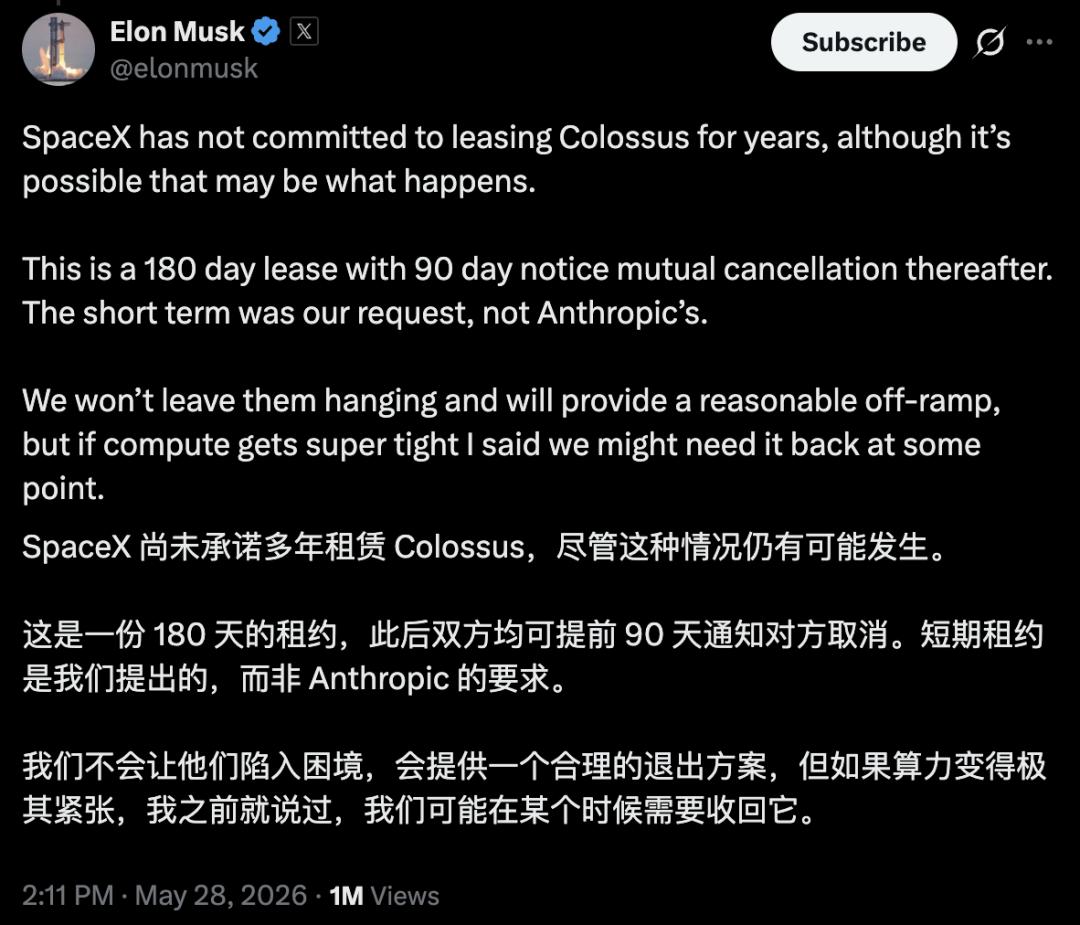
Just a few days ago, Google also signed a similar deal, paying about $920 million per month to SpaceX to rent computing power. Selling computing power to rivals is becoming a business for xAI under Musk.

As for the next-generation Grok? SpaceX said in the prospectus that it is still training a new flagship model in the data center. But not a word was mentioned about the release schedule.
The chase continues. But this time, even the chaser isn't sure where the finish line is.
References:
https://x.com/amir/status/2064173930525675877?s=20%20
https://www.theinformation.com/articles/xai-went-chasing-anthropic-powering?rc=c48ukx
This article is from the WeChat official account "New Intelligence Yuan", author: ASI Revelation. It is published by 36Kr with authorization.