Baidu's "Wild First Half": Investment Volume Surged 200%, with 24 Bets on AI
When the public opinion field raises the question of whether Tencent's AI development is lagging behind, it's hard to say. However, based on public data, it's quite clear that in terms of AI investment, especially this year, Tencent's investment pace has indeed slowed down. Comparing the three tech giants BAT, we find that Baidu has been the most active in AI investment this year, with the highest proportion of investment (without considering the investment amount).
According to data from IT Juzi, in 2026, the Baidu ecosystem (including Baidu and Baidu Ventures) made nearly 40 investments in the first half of the year alone. More than 60% of these investments flowed into the AI and embodied intelligence sectors, a more than two - fold increase compared to the 12 investments in the same period in the first half of 2025.
This drastic shift from "stepping on the brakes" to "stepping on the accelerator" makes it hard not to wonder: Is Baidu in a hurry?
The Trident and the Top Leader: The Power Structure of Baidu's Investment System
To understand Baidu's investment spree in 2026, we must first understand the structure of its investment landscape.
Baidu's external investment has never been carried out by a single team.
In 2016, Robin Li announced Baidu's "All in AI" strategy and split the investment system into a "trident": The original Baidu Group Strategic Investment Department is responsible for internal business collaboration and strategic mergers and acquisitions; Baidu Ventures (BV), established in September of the same year, was given the mission of "exploring the future for Baidu" and focuses on early - stage technology projects such as artificial intelligence, AR, and VR; Baidu Capital (BC), established in October, shoulders the heavy responsibility of "securing Baidu's present" and mainly targets mid - to late - stage projects in the broader Internet field, with single - investment amounts often starting at $50 million.
Robin Li serves as the chairman and the chair of the investment committee of both Baidu Ventures and Baidu Capital, personally setting the strategic direction.
In this structure, Baidu Ventures has the most special status. Nominally an independent VC with a decision - making mechanism of a market - oriented fund, it is essentially the outpost of Baidu's AI strategy, and Baidu remains its largest limited partner.
In February 2017, Liu Wei, a former partner of Lenovo Star, joined Baidu Ventures as the first CEO at the vice - president level, bringing in partners such as Qi Yujie and Cai Wei, and the core team was officially formed. During Liu Wei's tenure, Baidu Ventures completed more than 100 investments, with over 30% of them in artificial intelligence projects, and successfully raised a second - phase fund of nearly 2 billion RMB.
However, at the end of 2020, a key personnel change took place quietly: Liu Wei handed over the positions of CEO and managing partner of Baidu Ventures to Gao Xue, a doctor in materials science from Beihang University and a former senior executive of Xiaomi's investment department. After taking over, he clearly divided the investment strategy into two lines: "AI + Technology" and "AI + Healthcare".
Liu Wei himself did not leave Baidu. Instead, he turned to establish a new company, "Baitushengke", initiated by Robin Li, focusing on biocomputing and AI - based drug development.
Compared with the relatively stable Baidu Ventures, Baidu Capital has been a "hotbed of personnel upheaval". From its establishment in 2016 to 2022, this fund has experienced multiple high - level changes. Zhang Jinling was originally the CFO of Baidu Capital and later became the CFO of Baidu Ventures; the CEO was initially Li Xinzhe, who later stepped down to be in charge of the "Zhangcheng Investment" fund, and Li Xiaoyang took over as the CEO... Frequent leadership changes have severely weakened the department's continuity.
The strategic investment department has also been far from calm. He Junjie, who joined Baidu in 2019, was in charge of Baidu's strategic investment department. In 2021, Li Xiaoyang joined and became the head of Baidu's strategic investment. Later, he also took over Baidu Capital.
According to statistics from IT Juzi, Baidu Capital has only completed about 18 public investments in nearly nine years since its establishment, which is extremely disproportionate to its fund size. Moreover, the last investment was in August 2023, and there have been no public investments in the past three years.
Baidu's "Crazy First Half of the Year": Over 60% of Investments in AI/Robotics
Numbers can most intuitively reflect the situation. In the past two years, only Baidu and Baidu Ventures have been actively making investments.
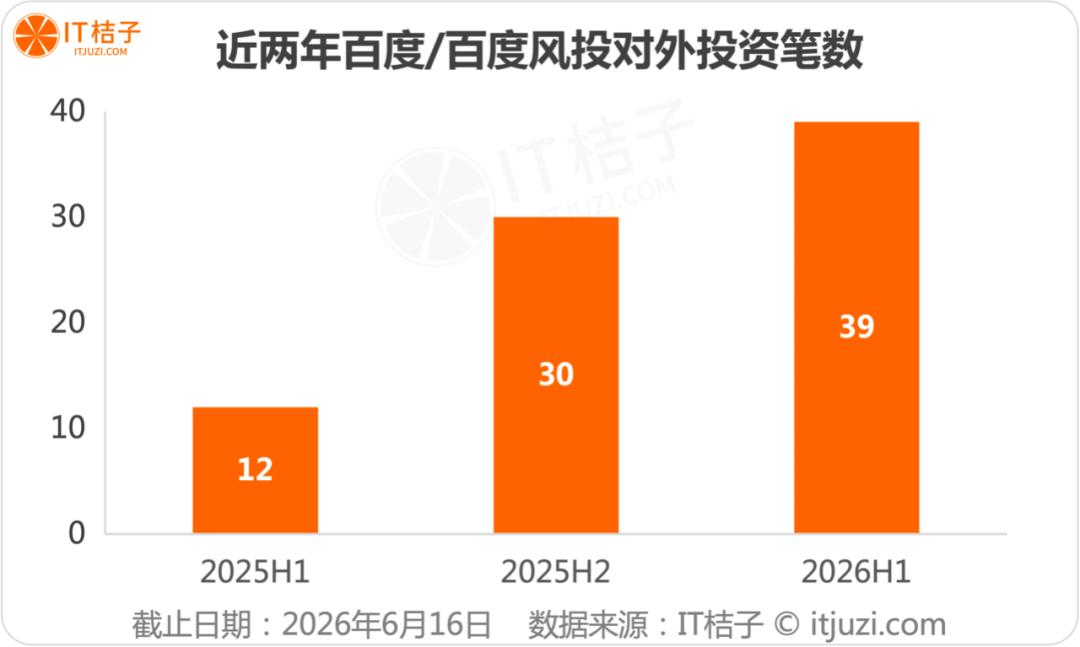
In the first half of 2025, the Baidu ecosystem only completed about 12 investments (including 2 acquisitions), with a conservative pace that was almost "dormant".
Since the second half of last year, its investment pace has significantly accelerated, with the total number of investments in half a year surging to 30. As of June 16, 2026, Baidu has made 39 investments in the first half of the year. In June alone, Baidu announced more than 6 investments in just half a month, becoming one of the most active CVC institutions that month, ranking alongside Sky Workshop Ventures of the Dreame ecosystem.
This "loose - tight" investment rhythm is hardly due to the personal style of the investment leader. It seems more like a strategic shift after the founder's personal supervision.
Moreover, among the BAT companies, Baidu has always had the highest concentration of AI project investments, and this distinct feature continued in the first half of 2026. In addition, it has become the one with the largest number of public investments and the highest investment density.
In the first half of 2026, Tencent made a total of 25 investments, with only 8 in AI and embodied intelligence, accounting for less than one - third. Alibaba and Ant Group made 34 investments, with 18 in AI and embodied intelligence, accounting for more than half. The Baidu ecosystem (Baidu Strategic Investment and Baidu Ventures) made 39 investments at once, with as many as 24 in AI and embodied intelligence, accounting for 62%.
This "crazy" investment is not a scatter - gun approach but has a clear focus on specific sectors.
According to data from IT Juzi, Baidu Strategic Investment mainly bet on strategic "big projects" in 2026: In February, it participated in the 1 - billion - yuan Series B financing of Zhifang, a Chinese embodied intelligence company known in the industry as the "most Tesla - like", with a valuation exceeding 10 billion yuan. In the same month, it also participated in the 700 - million - yuan Series A financing of the Beijing Humanoid Robot Innovation Center, the first "national - local co - built" embodied intelligence innovation center in China.
Baidu Ventures is like a "scanning force", firing intensively in the early - stage battlefields of AIGC and embodied intelligence.
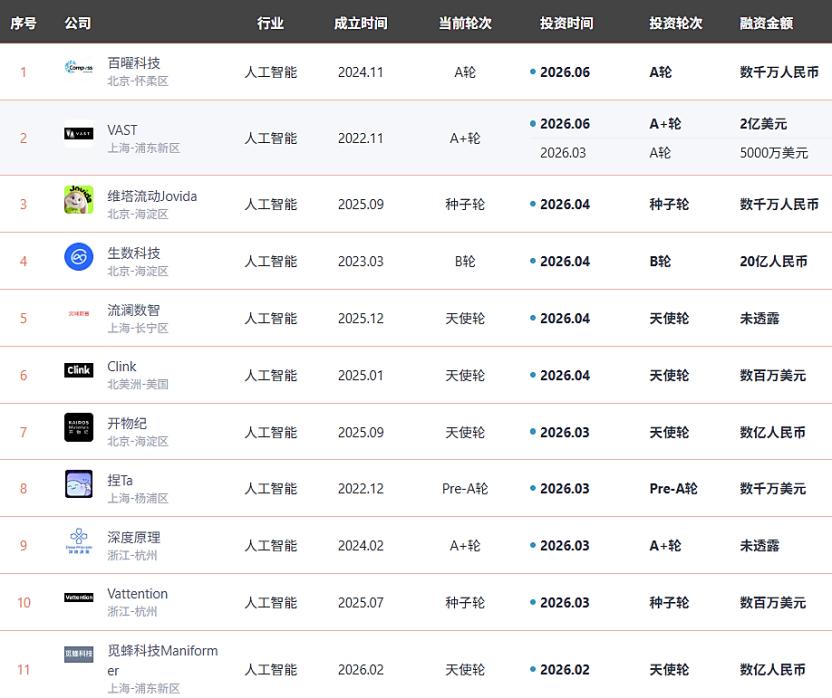
AI projects invested by Baidu Ventures in the first half of the year. Source: IT Juzi
In the AIGC field, it followed up on its investment in Shengshu Technology, participated in the Series A+ financing of VAST AI, and also invested in 3D generation and AI content projects such as Vattention and NieTa.
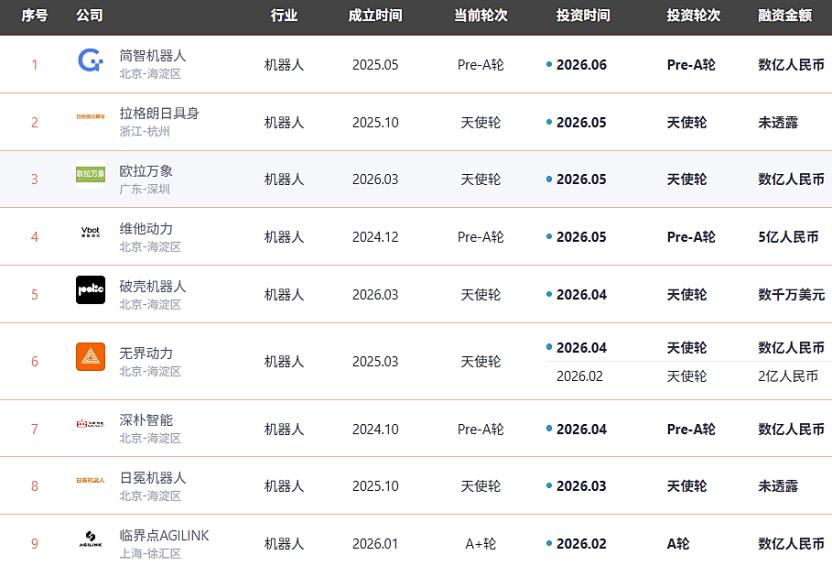
Embodied intelligence projects invested by Baidu Ventures in the first half of the year. Source: IT Juzi
In the field of embodied intelligence, it has covered the entire chain of application scenarios from robot brains to bodies, dexterous hands, embodied intelligence data collection, and service robots. In the first half of this year alone, it intensively invested in a large number of startups, including Jianzhi Robot, Shenpu Intelligence, Wujie Dynamics, Critical Point AGILINK, Coronal Robot, Poke Shell Robot, Euler Vientiane, and Lagrange Embodied.
Among them, several are popular star startup projects sought after by venture capitalists. For example, "Euler Vientiane" was founded by Zhou Shunbo, a robotics doctor from the Chinese University of Hong Kong, a former Huawei genius youth, and the first employee of Huawei's embodied intelligence. Chen Jianxing, the founder of Jianzhi Robot GenRobot.AI, was the former senior director of algorithms at Momenta. Critical Point AGILINK is a dexterous hand company incubated by Zhiyuan Robot.
Baidu's ability to obtain early - stage shares also indirectly confirms its reach and brand appeal in terms of investment resources and channels.
More notably, Baidu Ventures has also extended its reach to the ultimate frontiers of "hard technology" - quantum computing (Huayi Quantum, Liangkun Technology), nuclear fusion (Dongsheng Fusion), and photon computing (Qisuan Guangqi).
These projects are directly related to the anxiety about AI computing power. Baidu seems to be building a complete chain from models to computing power, from the virtual to the physical in its investment layout.
In addition, in Baidu's investments, the total number of angel, seed, and Pre - A round investments exceeds 20, indicating that Baidu is "casting a wide net to seize the initiative". A large number of companies in the 0 - to - 1 stage are labeled as "Baidu - affiliated", paving the way for future ecosystem integration.
What Is Baidu "Making Up For" from AIGC to Embodied Intelligence?
If we take a closer look at Baidu's investment map, we can find a clear logic: It is using capital to buy time to make up for its lag in the C - end application entry.
Baidu was the first Chinese tech giant to release a large - scale model.
In March 2023, ERNIE Bot started its internal testing, with Robin Li personally endorsing it. However, three years later, the first - mover advantage has not been translated into a user advantage.
According to QuestMobile data, as of November 2025, the monthly active users of Wenxiaoyan on mobile devices were only about 5.17 million. In the same period, the monthly active users of ByteDance's Doubao were 226 million, Tencent's Yuanbao were 37.48 million, and Alibaba's Qianwen were 25.72 million. Baidu got off to an early start but ended up trailing behind.
The "red - envelope war" during the Spring Festival in 2026 laid bare this anxiety.
Tencent spent 1 billion yuan in cash on Yuanbao, Alibaba launched a 3 - billion - yuan free - order plan, while Baidu only offered 500 million yuan in red envelopes - the smallest amount but in the most awkward position.
Because the essence of the red - envelope war is no longer about binding payment cards but about competing for "the first entry for users to interact with AI". In this competition for the entry, Baidu has fallen behind.
External investment has become Baidu's core means of "achieving its goals indirectly".
In the AIGC field, investing in Shengshu Technology, VAST AI, and Guangmo Technology is to make up for the ability of "multi - modal content generation". In the field of embodied intelligence, investing in Zhifang and the Beijing Humanoid Robot Innovation Center is to bet on the next carrier for "AI to move from the digital world to the physical world".
A financial VC partner put it bluntly: "This is not about the speed of technological iteration but about the speed of building a capital barrier. Leading institutions are using money to buy time and block the possibility of mid - tier enterprises catching up during the technological gap."
Baidu's anxiety also comes from internal performance pressure.
In 2024, Baidu's total revenue was 133.1 billion yuan, a slight 1% year - on - year decrease. However, Baidu's core net profit increased by 21% year - on - year, which was achieved through "cost reduction and efficiency improvement" with about 3,900 employees laid off throughout the year and more than 5,000 employees laid off in two years. At the same time, the annual turnover rate of P9 - level technical backbones reached as high as 38%, and Alibaba and ByteDance continuously poached Baidu's core AI talents with double - salary offers.
In 2025, Baidu's revenue further declined by 3% to 129.1 billion yuan, and its net profit attributable to shareholders decreased by about 76% year - on - year due to asset impairment.
When layoffs become a means to maintain profits, Baidu needs external investment more than ever to supplement its ecosystem and talent pool.
So, Baidu is indeed in a hurry.
But what it is anxious about is not the investment itself but the strategic dilemma behind it.
The competition in large - scale models has undergone a qualitative change in 2026. The industry has shifted from the parameter competition of the "hundred - model war" to the ecological competition in the "Agent stage".
ByteDance uses "Douyin + Doubao + Volcengine + hardware" to build a closed - loop ecosystem. Alibaba uses "Taobao/Alipay + Qianwen" to promote the implementation of intelligent agents. Tencent uses the WeChat ecosystem to direct traffic to Yuanbao. Baidu's core logic remains "search + AI" - users ask questions, AI provides answers, and advertising generates revenue.
This logic was invincible in the PC era, but in the AI - native era, it may become a path - dependent approach.
Baidu's investment spree in 2026 is essentially an attempt to find an external solution for its "search - based DNA".
It hopes to find a physical carrier for AI through embodied intelligence, a new engine for content production through AIGC, and an ultimate guarantee for computing power through quantum and nuclear fusion.
However, the cruelty of the capital competition lies in the fact that while a small number of equity investments can buy shares, they may not necessarily buy ecological synergy. When Tencent, Alibaba, and ByteDance are also increasing their AI investment at a scale of tens of billions or even hundreds of billions of yuan per year, simply relying on investment "shopping sprees" is not the key to victory.
In the second half of 2026, the investment floodgates of Baidu Strategic Investment may continue to open.
What Baidu may need to prove is that what it invests in is not out of anxiety but an ecological network that can form a closed - loop.
This article is from the WeChat official account “IT Juzi” (ID: itjuzi521). The author is Wu Meimei, and it is published by 36Kr with authorization.