The same industrial chain, worlds apart: A firsthand account of the divergence in the consumer electronics sector after policy easing amid a skyrocketing memory market
In June 2026, a notable structural phenomenon emerged in the A-share consumer electronics industrial chain. The industry-wide excitement brought about by the skyrocketing prices of memory chips coincided with the significant pressure from the concentrated lifting of restricted shares worth over 330 billion yuan within the same time frame. Among the enterprises in the same industrial chain, some shareholders were willing to hold on to their shares, while others were eager to sell.
This is not a matter of emotional divergence but a choice based on the supply and demand of chips.
When observing all these, Insta360 is the ideal entry point. Standing at the "cold end" of the industrial chain, it faced a triple whammy of pressures in the second week of June.
The first pressure came from the patent battlefield. In March, DJI sued Insta360 for infringing six patents in China, and the dispute was still unresolved. On June 10, DJI sued Insta360's Luna Ultra for infringing four utility patents in the United States, and an additional two design patents were added to the lawsuit the next day. Insta360 immediately counter-sued for five invention patents, and both parties requested permanent injunctions. The patent war has spread from China to overseas, putting pressure on both compliance costs and the product iteration rhythm.
The second pressure came from the encirclement of competitors. On June 10, Insta360 launched the Luna Ultra (with a starting price of 3,999 yuan) in an attempt to boost confidence and offset the impact of the lifting of 227 million restricted shares worth approximately 40.4 billion yuan, which were pre-IPO shares, on the next day. However, DJI announced on the same day that its Pocket 4P would be available on June 15, priced at 3,799 yuan, directly blocking Insta360's move.
Before the new product could be tested in the market, it was already surrounded by competitors.
The third pressure came from the release of chips. On June 11, when the restricted shares were lifted, the stock price fluctuated. Compared with the pre-lifting high of 174.60 yuan on June 3, the cumulative decline had reached 10.4%. On June 12, there were five block trades, with institutional investors taking over 155 million yuan of shares at a 1% discount, indicating that the sellers were gradually offloading their shares. On June 15, the stock closed at 156.42 yuan, with a cumulative decline of 4.3% after the lifting of the restricted shares. Since the high point in early September 2025 (377.77 yuan), the stock price had fallen by nearly 60%.
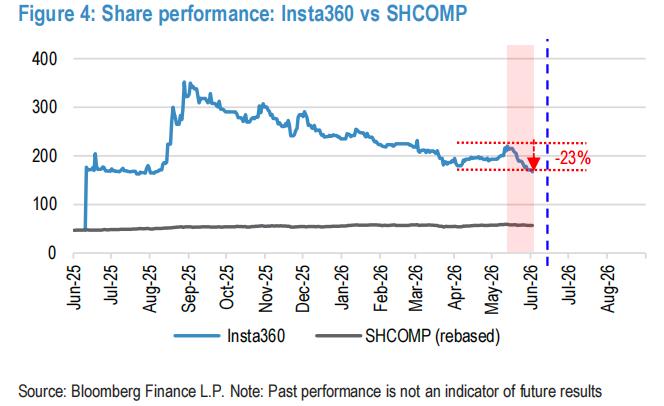
J.P.Morgan Figure 4 - Insta360's stock price vs. the performance of the Shanghai Composite Index (Insta360 fell 23% in the three weeks before the lifting of restricted shares vs. the Shanghai Composite Index fell 1%) (Source: J.P.Morgan)
Meanwhile, J.P. Morgan initiated coverage of Insta360 on June 3, giving it a "Neutral" rating and a target price of 150 yuan, a 14% discount compared to the closing price on the coverage day. The title of the report provided a qualitative judgment: "Impressive story, not yet a great set-up". Although the long-term growth narrative was recognized (with an expected revenue of 30 billion yuan in 2028), "when timing and argument conflicted within the same window, timing won".
With the triple pressures of the lifting of restricted shares, competition from DJI, and the cost of DRAM converging, the stock price needs to "digest" these pressures before its long-term value can be considered.
On the same boat, some are in the wind, while others are in the cold current.
01 The Wave of Lifting Restricted Shares Is Coming. Who Is in Line?
From May to August 2026 was a period of concentrated lifting of restricted shares in the consumer electronics industrial chain.
In June alone, 155 A-share companies faced the lifting of restricted shares, with a total market value of 333.285 billion yuan, a month-on-month increase of approximately 64%. The electronics industry ranked first among all industries in terms of the market value of lifted restricted shares.
There was also an easily overlooked superimposed effect in June and July. These two months were not only the peak period for the lifting of restricted shares in the consumer electronics industry but also a crucial window for institutional portfolio adjustments in the first half of the year in the A-share market. After fund managers completed their performance evaluations for the first half of the year, they tended to adjust their portfolios in the middle and late June, reducing their positions in sectors with a downward trend and increasing their positions in sectors with an upward trend.
The impact of the increased supply of chips due to the lifting of restricted shares, combined with the changes in the flow of funds caused by institutional portfolio adjustments, created a special microenvironment:
The supply was definitely increasing, but the demand was uncertain.
Two types of enterprises had to face this situation, but their shareholders had completely different mindsets.
02 How the Soaring Memory Prices Reshape the Industrial Chain
2.1 The Price Increase Is Not News. The Transmission Path Is.
The current round of price increases for memory chips started in March 2025.
Data from research institution CFM showed that the comprehensive price index of DRAM had been rising continuously since May. The price of the DDR4 3200 16Gb product increased from $3.95 at the end of May to $28 in November, a six-month increase of 608%. As of Q1 2026, the price of consumer DRAM had increased by 75% - 80% cumulatively, the largest single-quarter increase in the past five years.
The transmission path of the price increase was as follows:
The increase in the price of memory chips → Memory manufacturers expand production → An explosion in orders for silicon wafers and equipment → Full production capacity → The improvement of the gross profit margin of upstream enterprises.
Every link in this path was being realized at an accelerating pace.
Take Xi'an Yicai as an example. It is the core supplier of 12-inch silicon wafers for mainstream domestic memory IDM manufacturers globally. Its products have been mass-produced for use in advanced DRAM and NAND Flash with more than 200 layers. During the trough period of the memory industry in the previous two years, the company's gross profit margin once fell to a low of 4.9% in the industry. However, in the second half of 2025, the situation reversed rapidly. The company's annual revenue in 2025 was 2.649 billion yuan, a year-on-year increase of 24.88%. The proportion of qualified products increased to over 70%. The company expected to achieve profitability in the consolidated statements in 2027.
From "continuous losses" to "prospects of profitability", from a "gross profit margin of 4.9%" to a "proportion of qualified products increased to over 70%", the immediate benefits of the memory cycle reversal to upstream enterprises were reflected in every order and every production line.
The performance explosion of memory module manufacturers was more intuitive. In Q1 2026, the revenue of Jiangbo Long was 9.909 billion yuan, a year-on-year increase of 132.79%. The net profit was 3.862 billion yuan, a year-on-year increase of 2644.05%. During the same period, the net profit of Bawell Storage was 2.899 billion yuan, a year-on-year increase of 1567.85%, and the gross profit margin climbed to a new high of 53.3% in the industry. The net profit of Deminli in Q1 was 3.346 billion yuan, successfully turning losses into profits.
Bawell Storage showed in its financial report that affected by the global macroeconomic environment, the memory prices had been declining quarter by quarter since Q3 2024 and reached a phased low in Q1 2025. Starting from Q2 2025, as the memory prices stabilized and rebounded, the company's sales revenue and gross profit margin gradually recovered, and its operating performance gradually improved.
Although the wording was "gradual recovery", in fact, from Q2 2025 to Q1 2026, the memory price index experienced a leap from stabilization to a sharp increase, and the profitability of module manufacturers changed from "gradual recovery" to "explosive growth".
2.2 The Transmission Chain Has a Clear Boundary
However, this transmission chain had a clear end point. It only benefited enterprises directly related to memory.
On the same industrial chain, enterprises not directly related to memory did not feel this wave of dividends at all. Products such as action cameras, RF front-end chips, and smart hardware were not beneficiaries of the memory price increase.
On the contrary, they faced the reality of the lowest global consumer electronics shipments in more than a decade and weak terminal demand.
Counterpoint Research predicted that the global smartphone shipments in 2026 would decline by 13.9% year-on-year to approximately 1.08 billion units, the lowest annual figure since 2013. IDC's prediction was equally pessimistic, expecting a full-year decline of about 13% to approximately 1.1 billion units. The two institutions rarely reached an agreement.
The deeper problem was that the tight supply of memory chips led to an increase in costs, which in turn squeezed the profit margins of downstream terminal manufacturers.
Lu Weibing, the president of Xiaomi, said at the Q1 earnings conference that the memory contract price had increased by about five times since Q3 last year, and the material cost of low-end smartphones had increased by 20% - 30% cumulatively. Counterpoint further predicted that the models below $200 would experience the largest decline in 2026. That is to say, mobile phones in the price range below $100 would gradually lose economic viability due to the long-term high memory costs.
For enterprises not directly related to memory, the memory price increase was not a dividend but a squeeze on the cost side. Their customers were end consumers. When the terminal shipments declined, both orders and gross profit margins were under pressure.
The "wave" of the memory price increase did not reach them at all, but they faced the lifting of restricted shares at the same time as memory-related enterprises.
This is the situation where, on the same industrial chain, there are two completely different worlds.
03 The Divergence of Shareholder Behavior: One Wants to Hold, the Other Wants to Run
3.1 The Confidence of "Reluctant to Sell" Comes from Orders
The difference in the fundamentals' prosperity determined the difference in shareholder behavior.
For memory-related enterprises, the logical chain of improving fundamentals was complete:
Saturated orders → Capacity expansion → Gross profit margin improvement → Increased visibility of profitability.
Under such fundamentals, the rational choice for original shareholders was to continue holding their shares rather than cashing out when the restricted shares were lifted.
For example, the shareholders of Xi'an Yicai faced the situation where the supply-demand gap in the memory market would continue until 2027. The company's production capacity increased from 710,000 wafers per month to 1.2 million wafers per month, and its overseas sales scale continued to grow. The dividends of the industrial chain were far from over. The lifting of restricted shares provided liquidity but was not a reason to sell.
From the perspective of buyers, the support was also sufficient.
In Q1 2026, China's semiconductor sales increased by 74.8% year-on-year (data from SIA). The tight global supply of memory chips drove the continuous high growth of equipment demand. During the semi-annual portfolio adjustment window, the AI computing power and memory industrial chains were the directions for institutional investors to increase their positions. The expression "memory super cycle" in sell-side research reports had changed from an optimistic expectation to a verification of performance. Even if some original shareholders reduced their positions, there was enough buying power to take over.
3.2 The Pressure of "Hurry to Run" Comes from the Ceiling
The shareholders of enterprises not directly related to memory faced an opposite logical chain.
Weak fundamentals → Decline in shipments → The growth story could not be sustained → Valuation under pressure.
Under such fundamentals, the window for lifting restricted shares was the best liquidity exit. Especially for early-stage VC/PE investors, after holding the shares for several years and having high floating profits, it was time to return funds to their LPs.
The situation of OnMicro is quite representative. This RF front-end chip enterprise listed on the Science and Technology Innovation Board in December 2025. Its revenue in 2025 was 1.882 billion yuan, a year-on-year decrease of 10.42%. Among them, the revenue of its core product, RF front-end chips, was 1.455 billion yuan, a year-on-year decline of 18.71%. The company had suffered losses for three consecutive years from 2022 to 2024, with a cumulative undistributed loss of up to 1.279 billion yuan.
For the early shareholders of OnMicro, the window for lifting restricted shares provided a crucial liquidity exit. Although the company had only been listed for half a year, the combination of "high valuation + weak fundamentals" meant that continuing to hold the shares would bear greater uncertainty.
3.3 Who Will Take Over the Lifted Restricted Shares?
It's not just that sellers want to run. Buyers are also voting with their feet.
Data showed that among the top ten industries in terms of the market value of lifted restricted shares in June 2026, the electronics industry, with companies like Huafeng Technology, Insta360, and Yandong Micro, contributed the absolute majority of the market value. However, during the same period, the inflow of institutional funds in the electronics industry was highly concentrated in the memory chain, AI computing power, and semiconductor equipment, which did not coincide with the area where restricted shares were concentrated to be lifted.
The coverage frequency and recommended ratings of sell-side research reports on memory-related enterprises increased significantly in Q1 2026, while the coverage of consumer electronics terminal enterprises became more cautious. The actual flow of funds was mismatched with the supply structure of the lifted restricted shares.
The lifting of restricted shares for memory-related enterprises was more of an "improvement in liquidity", that is, with the support of fundamentals, there was sufficient buying power to take over the lifted restricted shares. For enterprises not directly related to memory, the lifting of restricted shares was closer to a "release of supply", that is, with pressured fundamentals, sellers had the motivation to exit, and buyers were more cautious during the portfolio adjustment period.
The difference between the two was not related to the lifting of restricted shares itself but to "shareholders' confidence in the future".
04 Insta360: A Typical Sample of the Non-Memory-Related Camp
4.1 Industrial Chain Position and Shareholder Structure
Insta360 belongs to the typical "non-memory-related" camp. Its core products (360-degree cameras and thumb cameras) mainly use CMOS image sensors and image processing chips, and the proportion of memory chips in the BOM cost is not high. When the wave of rising memory prices swept through the industrial chain, Insta360 not only could not benefit but also faced the double squeeze of weak downstream terminal demand and intensified competition.
More importantly, the scale of chips released by Insta360 during the window of lifting restricted shares in June 2026 was rare in the entire consumer electronics industrial chain. On June 11, 2026, 227 million shares, with a market value of approximately 40.4 billion yuan, accounting for 56.5% of the total share capital, were about seven times the existing tradable market value. On the day of the lifting of restricted shares, the tradable shares suddenly increased from about 60 million to about 290 million, an increase of nearly five times.
