State Grid, China Three Gorges Corporation, China General Nuclear Power, PowerChina and other central SOEs have collectively moved to sell off their new energy equity stakes. Behind the 37 transactions lies a core logic summed up in just two words: accounting calculation.
In the first half of 2026, state-owned enterprises concentrated on selling their stakes in new energy companies, and the industry shifted towards intensive development.
YuJian Energy recently found through statistics that in the first half of 2026, 37 equity transactions of new energy companies were finalized, with a cumulative transfer base price of 1.172 billion yuan. State Grid, China Southern Power Grid, China Three Gorges Corporation, China General Nuclear Power Group, PowerChina, China Energy Engineering Group, CSSC, and SDIC Power are all on the list. State-owned transferors accounted for 65%, controlling stake transactions accounted for 60%, and targets established within 5 years accounted for 55%.
China General Nuclear Power Group transferred 90% of the equity of a Sichuan photovoltaic company for 34.3 million yuan in January. Shanghai Electric listed a 47.4% stake in an energy storage joint venture on the Shanghai United Assets and Equity Exchange in February, with an intended transfer price of 1 yuan. State Grid cleared all the equity of three new energy subsidiaries in Shanxi, Jilin, and Shandong in one go in April. China Three Gorges Corporation listed a 49% stake in a Henan new energy company in June, with a base price of 1 yuan as well.
YuJian Energy believes that this cannot be simply understood as an adjustment of financial investment, but rather as central and state-owned enterprises redefining their positions in the new energy landscape.
From "expansion" to "contraction", what is the logic behind this round of asset sales by enterprises?
After sorting out these 37 transactions, the target assets show several common characteristics.
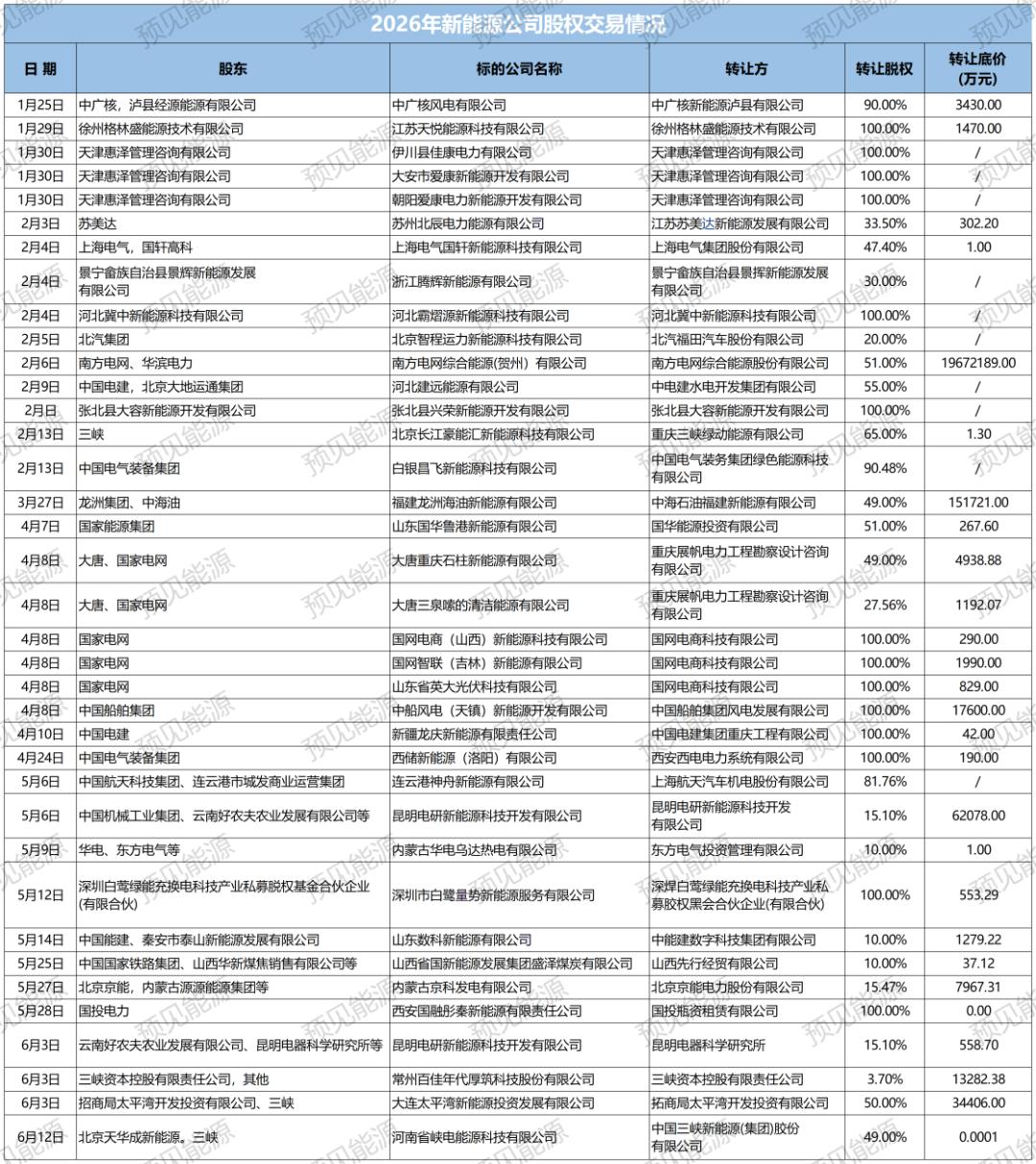
(Compiled by YuJian Energy based on public information. Please leave a message if there are any errors or omissions.)
First, the asset types are mainly small and medium-sized distributed photovoltaic and decentralized wind power projects, which are projects with small single-unit scale and relatively high management costs. The operating income of State Grid E-commerce (Shanxi) New Energy transferred by State Grid in 2025 was only 3.209 million yuan, with a net loss of 14.82 million yuan; the operating income of State Grid Smart Connect (Jilin) New Energy in 2025 was 1.5658 million yuan, with a net loss of 6.87 million yuan. Most of these companies were established between 2017 and 2021, and still failed to achieve profitability after years of operation.
Second, the transfer methods are mainly full clearance or transfer of controlling stakes. Among the 37 transactions, 14 were full transfers of 100% equity, accounting for 38%; a total of 22 transactions had a transfer ratio of more than 50%, accounting for 60%. This is not a small-scale financial reduction, but a complete asset divestiture.
Tianjin Huize Management Consulting Company concentrated on transferring all the equity of three companies at the end of January - Yichuan Jiakang Electric Power, Daan Aikang New Energy Development, and Chaoyang Aikang Electric Power New Energy Development. All three are old projects established between 2013 and 2015. Completely clearing projects over ten years old at once indicates that these assets are no longer regarded as objects for optimization, but as burdens that need to be completely cleared.
Third, there is a significant gap between the transfer price and the book value. The base price for transferring a 49% stake in Datang Chongqing Shizhu New Energy by State Grid in April was 49.3878 million yuan, but the asset appraisal value was only 2.6759 million yuan. PowerChina transferred 100% of the equity of Xinjiang Longqing New Energy in April, with a base price of only 348,200 yuan. The huge gap between the book value and the appraisal value of the assets reflects the real situation of these projects under market conditions, that is, the previous investments have shrunk significantly.
The concentrated divestiture is not a coincidence, and three forces are working together
The concentrated divestiture is not a coincidence. There are three forces working simultaneously behind it.
The first force comes from the policy side. The State-owned Assets Supervision and Administration Commission of the State Council has been continuously promoting central enterprises to divest "two non-essentials" (non-core and non-competitive businesses) and "two types of assets" (inefficient and ineffective assets). As the concluding year of the in-depth improvement action of state-owned enterprise reform in 2025, the disposal of "two non-essentials" and "two types of assets" and the governance of loss-making enterprises are hard tasks. Entering 2026, the requirement has been upgraded from financial optimization to strategic contraction under the constraint of capital return rate.
For central enterprises in the power main business, new energy is still the core track, but high-quality assets with strong synergy with the power grid, prominent scale effect, and stable yield must be retained. Marginal projects with small single-unit scale, poor location conditions, and high subsidy dependence have become targets for clearance under the pressure of assessment.
Under such preconditions, for non-energy central enterprises like CSSC, new energy is a cross-border layout with low synergy with the main business and a lower-than-expected capital return rate. Naturally, they have a higher priority for clearance.
The second force comes from the market side.
According to the summary of "China Electric Power Market Development Report 2025" released by the National Energy Administration, in 2025, the operating pattern of domestic power generation central enterprises showed significant differentiation - the installed capacity was still increasing, but the profits were declining. The direct reason for the differentiation can be understood as the implementation of Document No. 136, which fully marketized the on-grid electricity price of new energy and ended the era of guaranteed quantity and price. In addition, with the overcapacity of photovoltaic production and the sharp decline in component prices, coupled with the withdrawal of subsidies, the yield of projects in many places has fallen below the 6.5% investment red line for central enterprises. For the small distributed projects deployed in the early years, the marginal costs of land, grid connection, and operation and maintenance have been continuously rising, and the unit return rate has been continuously diluted.
Many enterprises have also publicly stated that they are making positive adjustments to their businesses. Shanghai Aerospace Automobile Electromechanical Co., Ltd. basically divested its traditional photovoltaic manufacturing and power station businesses by January 2026, recovering more than 100 million yuan in funds and reducing losses by about 36 million yuan annually. China Southern Power Grid Energy Efficiency Technology Co., Ltd. announced at the end of 2025 that it would no longer increase its photovoltaic holdings in 2026 and would shift to light-asset energy-saving services.
The signal conveyed by these actions is clear. It is not that there is a problem with the new energy track, but that the inefficient assets left over from the early extensive expansion cannot make a profit under the current market conditions.
The third force comes from the strategic side. Selling assets is just an appearance. The key is where the money is invested. Central enterprises are concentrating their funds on three directions: large-scale clean energy bases, UHV and smart grids, and cutting-edge fields such as direct green power connection and hydrogen-based energy.
In April 2026, while 7 central enterprises were concentrating on selling their new energy equity, enterprises such as State Grid and China Southern Power Grid simultaneously accelerated their investment in UHV projects and new energy storage projects. The 15th Five-Year Plan for Energy Transformation clearly positions new energy storage as a key link in the new power system. It has high technical barriers and great long-term value, making it more suitable for central enterprises to leverage their capital and R & D advantages.
For enterprises, exiting inefficient decentralized projects and entering core tracks with higher value density is an asset reallocation with both entry and exit.
The industry has completely shifted towards "intensive development". What should enterprises do?
The impact of the concentrated divestiture is gradually emerging.
First of all, the asset quality of central enterprises is improving, rather than the scale shrinking. In 2025, central enterprises disposed of more than a hundred new energy assets, mainly for the purpose of financial optimization and loss reduction at that time; the concentrated divestiture in 2026 has been upgraded to strategic contraction. The participating entities have expanded from traditional power central enterprises to general energy central enterprises such as equipment manufacturing and comprehensive energy, and the disposal method has shifted from partial capital reduction to overall clearance. Many central enterprises have carried out concentrated operations within the same window period, with highly coordinated steps.
YuJian Energy believes that the adjustment has changed from the spontaneous behavior of individual enterprises to strategic consistency under top-level design.
Secondly, the industry division of labor is being redefined. As central enterprises withdraw from small and medium-sized distributed photovoltaic projects, it objectively creates space for private capital. Large-scale centralized projects and core area businesses are firmly controlled by central and state-owned enterprises, while regional scattered projects and distributed assets are gradually flowing to the market.
The industry is shifting from the extensive stage of "whoever occupies more land wins" to the intensive development stage of "whoever can make money stays".
Sun Chuanwang, a professor at the China Center for Energy Economics Research of Xiamen University, believes that the transfer of new energy assets by central enterprises is not a passive stop-loss under operating pressure, but an active strategic adjustment in line with the requirements of high-quality development. Asset quality, operational capabilities, and technical strength are gradually replacing simple resource scale as the core considerations for the valuation and trading of new energy assets.
For other enterprises in the industry, the inspiration brought by this adjustment is not complicated. The fields where central enterprises withdraw are not without value, but before entering, it is necessary to calculate a clear account: Can the project's yield cover the capital cost? Can the operational capabilities support long-term holding? What is the position of the asset in the parent company's strategic map? The new energy industry has passed the stage of "as long as you occupy land, you can make money". Enterprises that are still expanding with the old logic will sooner or later face the same choice.
This article is from the WeChat official account "YuJian Energy", author: Wang Mengjiao. Republished by 36Kr with permission.