Does consciousness operate in hidden dimensions?
For decades, neuroscience has been mapping consciousness. Scientists have identified neurons, mapped brain regions, and patiently recorded which brain regions are activated when you recognize a face, recall a summer from your childhood, or shout "Eureka!" when two ideas suddenly connect. This map has become increasingly detailed, revealing new neurons, neural circuits, and brain regions with astonishing precision.
But does this map tell the whole story? Can it not only explain what the brain is made of and where its components are located but also explain how billions of cells are organized into a system that gives rise to the rich inner mental world we call consciousness?
When facing such questions, neuroscience has a favorite experimental organism: the fruit fly. This tiny and annoying insect often hovers around overripe bananas and forgotten kitchen scraps. Now, this unassuming little bug may be foreshadowing a new view of how neurons generate consciousness, a view based on an "invisible geometry."
Although the fruit fly has only about 139,000 neurons - a tiny fraction compared to the approximately 86 billion neurons in the human brain - it is one of the few organisms whose connectome has been mapped in great detail by scientists. The connectome is a vast network that connects neurons, like a transportation system consisting of roads, bridges, and highways. A new study shows that even such a finely reconstructed brain map may not tell the whole story.
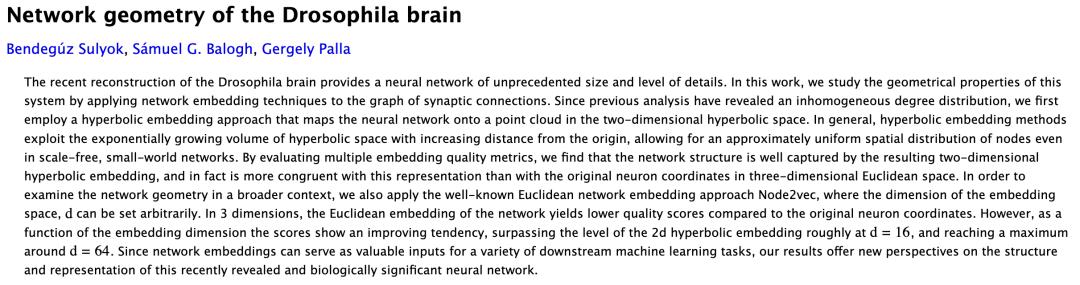
In a preprint paper published on arXiv in February 2026, researchers from Eötvös Loránd University in Budapest did something counterintuitive. Instead of focusing on the physical locations of fruit fly neurons in space, they studied how these neurons are connected to each other. Then, the research team projected the entire network into hyperbolic space - a curved geometric space with what mathematicians call "negative curvature."
https://arxiv.org/abs/2602.16417
The mainstream Euclidean geometry - the geometry that most people learn in school - describes the familiar world composed of rulers, grids, straight lines, and ordinary three-dimensional coordinates. Hyperbolic geometry, on the other hand, deviates from the straight lines and regular grids in Euclidean space. As you move away from the center, the space expands at a faster rate, creating space for large networks, hierarchical structures with multiple branches, and highly interconnected hub nodes. Since many real-world systems, from the brain and ecosystems to social networks and the Internet, have these characteristics, researchers are increasingly using hyperbolic geometry to reveal the "hidden geometry" in complex systems - the deep organizational blueprint that governs the behavior of the network, even if this blueprint is invisible in the physical structure.
"In the standard three-dimensional Euclidean representation, the physical layout would appear very crowded, masking how signals actually propagate in the system," said Bendegúz Sulyok, a network science researcher at Eötvös Loránd University and one of the authors of the study. By moving to a mathematical space with negative curvature - where space expands rapidly away from the center - his team observed striking patterns in the fruit fly connectome. They found that neurons that serve as major communication hubs cluster near the center of the space, while specialized cells responsible for specific functions are distributed in the peripheral areas, even though their physical distances in the real brain are far apart.
Sulyok said that the principle behind this is complex but essentially: neurons that perform similar functions ultimately point in roughly the same direction. For example, visual neurons - which help the fruit fly spot a piece of watermelon from across the room - and central neurons - which help integrate information from the entire brain to decide how to avoid a swatting hand - are mapped to different regions on the map.
However, even though the hyperbolic map reveals relationships, groups, and patterns hidden in traditional planar connectome diagrams, a bigger question remains: Does this hidden geometry reflect some fundamental law of how the brain organizes itself - or even the essence of consciousness itself - or is it just a clever mathematical visualization tool with little significance outside the laboratory?
"The answer is both," Sulyok said. "It is a highly complex mathematical lens, but it also tracks a fundamental biological reality." The neural circuits in the brain are naturally like a large banyan tree. Axons and dendrites - the cable-like extensions of neurons - continuously branch and expand, forming a vast neural matrix. Sulyok believes that hyperbolic geometry provides a particularly natural way to represent these hierarchical structures. To test this idea, the research team conducted a large number of mathematical tests to check whether this invisible structure really reflects the deep organizational way of the brain. The results showed again and again that the hyperbolic model outperforms traditional low-dimensional maps, indicating that this alternative geometric framework is not just a pretty visualization technique.
You might object that fruit flies are not humans after all. But you may have overlooked an important feature of nature: Everything, from intricate neural networks and ecosystems to the brains of insects, tends to be organized around clusters, hubs, and sub-networks, and these structures must communicate with each other. If these systems share some invisible code that supports their organizational way, then the clearest manifestation of this code may be hyperbolic geometry. And if such a large connectivity already exists in a nervous system the size of a pinhead, then it is imaginable how huge the organizational challenges the human brain faces will be.
Sulyok suspects that the fruit fly may just be the first place where we discovered this pattern. "We expect that these results also apply to the human brain," he said. This alone raises an intriguing possibility: In our attempt to understand consciousness, have we been too focused on the visible anatomical structures and overlooked something deeper - the invisible connection network that emerges when billions of neurons start to act in concert?
This question points to a broader trend in neuroscience. More and more researchers are going beyond the question of "what function a certain brain region is responsible for" and turning to a more elusive question: Do cognition, awareness, and even consciousness itself exist in the components of the brain or in the process of communication between them?
Theoretical neuroscientist and psychiatrist Karl Friston views the brain as a prediction machine that constantly constructs models of reality and updates these models in real-time. Olaf Sporns, a pioneer in network neuroscience, believes that the brain is not composed of a set of clearly labeled functional modules but is more like an entangled and intertwined connection network. And Giulio Tononi, a consciousness researcher, believes that consciousness does not only depend on neuron firing but on how countless signals converge to form a unified real-world experience.
This view is also shared by Ramses Alcaide, a neuroscientist and the CEO of the neurotechnology company Neurable. He said that for decades, the research method of dividing the brain into different regions and assigning functions to each region has indeed led to important discoveries, but this method may not reveal the whole truth. As Alcaide said, cognition exists in the flow, not in the location.
"Anatomy tells you where things are. Network geometry tells you how information actually flows... Connection lines can only tell you what can be connected. They cannot tell you why certain specific connection patterns give rise to thoughts, attention, or consciousness."
References
https://www.popularmechanics.com/science/a71483448/brain-hidden-dimensions-consciousness/
This article is from the WeChat official account "Neural Reality" (ID: neureality), written by Stav Dimitropoulos, and published by 36Kr with authorization.